

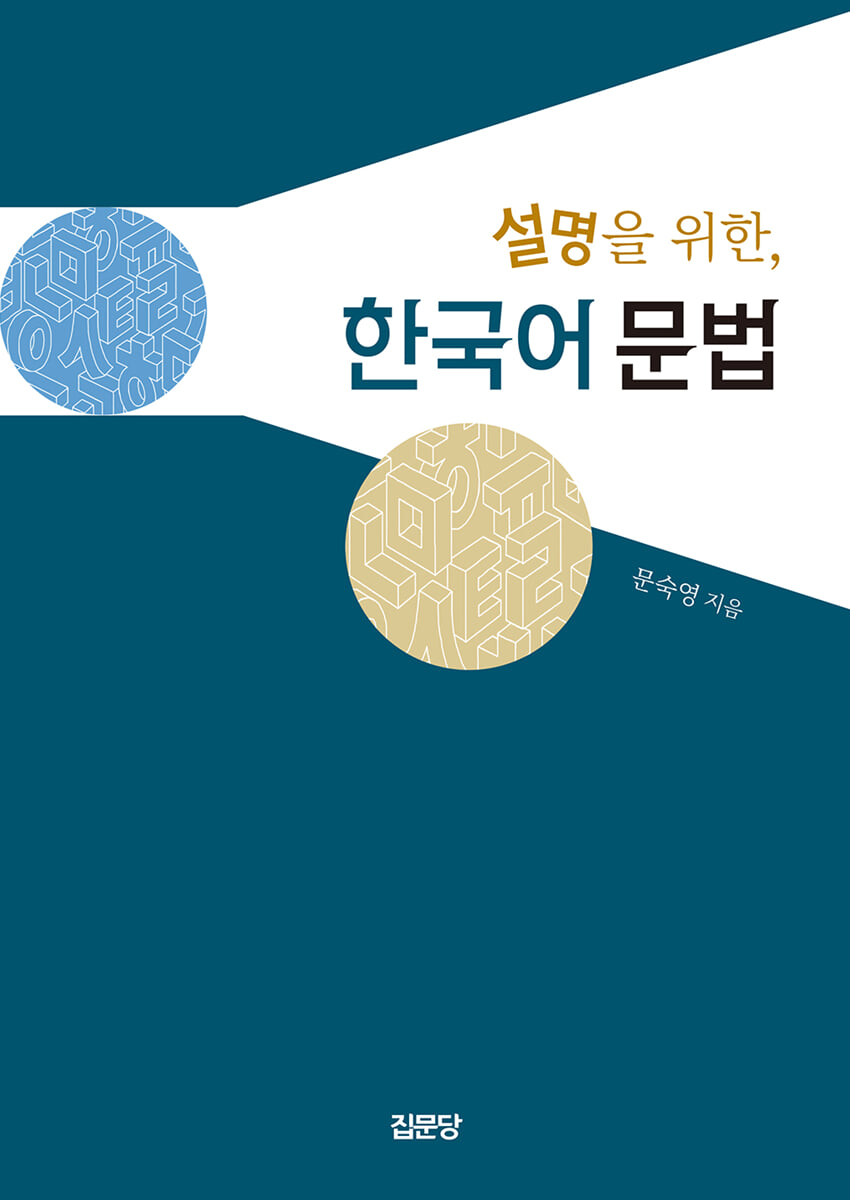
Korean grammar for explanation
 |
Description
Book Introduction
This book describes the hidden order and grammar of the Korean language, which we have been familiar with but not aware of.
It was written for the purpose of understanding the order of the Korean language and obtaining a language of explanation that would help others understand Korean.
This book is a little different from the books published under the name of ‘Grammar Theory’.
The book's structure is different, it contains little theoretical discussion, and it avoids technical jargon as much as possible.
Instead, the grammatical phenomenon itself was brought to the forefront and explained in as simple and everyday language as possible.
The goal was to focus on ‘grammar’ rather than ‘grammar theory’.
The content covered is mainly selected from grammar items directly related to Korean language proficiency, and includes many phenomena that are likely to be asked when learning Korean as a foreign language.
Therefore, if necessary, it also describes how to approach the grammar from a Korean language education perspective.
This book was written with the intention that it would be useful not only to those majoring in Korean language and literature, Korean language education, or Korean language education, but also to anyone curious about Korean grammar.
It was written for the purpose of understanding the order of the Korean language and obtaining a language of explanation that would help others understand Korean.
This book is a little different from the books published under the name of ‘Grammar Theory’.
The book's structure is different, it contains little theoretical discussion, and it avoids technical jargon as much as possible.
Instead, the grammatical phenomenon itself was brought to the forefront and explained in as simple and everyday language as possible.
The goal was to focus on ‘grammar’ rather than ‘grammar theory’.
The content covered is mainly selected from grammar items directly related to Korean language proficiency, and includes many phenomena that are likely to be asked when learning Korean as a foreign language.
Therefore, if necessary, it also describes how to approach the grammar from a Korean language education perspective.
This book was written with the intention that it would be useful not only to those majoring in Korean language and literature, Korean language education, or Korean language education, but also to anyone curious about Korean grammar.
index
preface
1.
Basic concepts and terminology
1.1.
Basic Terms
1.2.
Word order, the starting point of language understanding
1.3.
Korean, an agglutinative language
1.4.
Sentence elements and patterns
1.5.
Conjugation and irregular verbs
2.
inspection
2.1.
Types of investigation
2.2.
'This/that' and 'This/that'
2.3.
'to/to, in/from, to, (eu)ro, with/with'
2.4.
Meaning of auxiliary verbs
2.5.
Auxiliary usage of '이/가' and '을/를'
2.6.
Combination and order between investigations
3.
Final and final endings
3.1.
Sentence types
3.2.
Final endings and honorifics
3.3.
'-city-'
3.4.
Past and non-past
3.5.
'-eot-' and '-eot-eot-'
3.6.
'-more-'
3.7.
'-geu-'
4.
Verbs and adjectives
4.1.
Two characteristics of Korean adjectives
4.2.
Grammatical differences between verbs and adjectives
4.3.
'Hada' is a verb only in name
4.4.
'am'
4.5.
'no'
4.6.
'There is', 'There is not', 'There is'
5.
The ins and outs of words
5.1.
List of Korean parts of speech
5.2.
adverb
5.3.
adjective
5.4.
Pronouns and 'this, that, that'
5.5.
Nouns and plural expressions
5.6.
investigation, number adjective, dependent noun
6.
Negative sentences
6.1.
Types of negative sentences and negative expressions
6.2.
'Not', 'Not', '-not', '-not'
6.3.
Don't do it, don't let it happen
6.4.
An expression always used with negative sentences
6.5.
Negative sentence with positive meaning, positive sentence with negative meaning
6.6.
Negative questions and answers
7.
Passive and causative sentences
7.1.
Passive verbs and passive sentences
7.2.
Passive voice '-eojida', 'become', 'receive', 'be inflicted'
7.3.
Causative verbs and causative sentences
7.4.
Causative and passive verbs of the same form
7.5.
Use of passive sentences
8.
auxiliary verbs
8.1.
Grammar of auxiliary verb construction
8.2.
-어 보다, -고 보다, -어 주다
8.3.
-I want to, -I want to, -I wish I were, -I want to
8.4.
-There is, -There is
8.5.
-Come, come, -go
8.6.
-gon hada, -eo daeda, -eo tosseda, -eo tosseda, -eo tosseda, -eo tosseda, -eo tosseda, -eo tosseda
9.
Inner clause and ending
9.1.
Temple, inner temple
9.2.
Adjectival suffixes '-eun' and '-eul'
9.3.
The time of '-deon' and '-deon'
9.4.
Noun clauses '-eum', '-gi', '-eun/eul geot'
9.5.
Quotation clauses and '-냐뭐뭐다' type phrases
9.6.
Phrases in which adverbial clauses are essential
9.7.
'-다다' and '-는' must be used separately
10.
Conjunctive clauses and connective endings
10.1.
The world's languages are unusually rich in connective endings.
10.2.
Grammar of connective endings
10.3.
Meaning of connective endings
10.4.
Time expression in conjunction
10.5.
Change of order and omission of main clauses
10.6.
Development into a final ending
11.
Vocabulary and expressions
11.1.
Characteristics of Korean vocabulary
11.2.
Word composition and derivation
11.3.
salmon, idioms, and fixed structures
11.4.
Omission of sentence elements
11.5.
Octopus and spoken language
References
1.
Basic concepts and terminology
1.1.
Basic Terms
1.2.
Word order, the starting point of language understanding
1.3.
Korean, an agglutinative language
1.4.
Sentence elements and patterns
1.5.
Conjugation and irregular verbs
2.
inspection
2.1.
Types of investigation
2.2.
'This/that' and 'This/that'
2.3.
'to/to, in/from, to, (eu)ro, with/with'
2.4.
Meaning of auxiliary verbs
2.5.
Auxiliary usage of '이/가' and '을/를'
2.6.
Combination and order between investigations
3.
Final and final endings
3.1.
Sentence types
3.2.
Final endings and honorifics
3.3.
'-city-'
3.4.
Past and non-past
3.5.
'-eot-' and '-eot-eot-'
3.6.
'-more-'
3.7.
'-geu-'
4.
Verbs and adjectives
4.1.
Two characteristics of Korean adjectives
4.2.
Grammatical differences between verbs and adjectives
4.3.
'Hada' is a verb only in name
4.4.
'am'
4.5.
'no'
4.6.
'There is', 'There is not', 'There is'
5.
The ins and outs of words
5.1.
List of Korean parts of speech
5.2.
adverb
5.3.
adjective
5.4.
Pronouns and 'this, that, that'
5.5.
Nouns and plural expressions
5.6.
investigation, number adjective, dependent noun
6.
Negative sentences
6.1.
Types of negative sentences and negative expressions
6.2.
'Not', 'Not', '-not', '-not'
6.3.
Don't do it, don't let it happen
6.4.
An expression always used with negative sentences
6.5.
Negative sentence with positive meaning, positive sentence with negative meaning
6.6.
Negative questions and answers
7.
Passive and causative sentences
7.1.
Passive verbs and passive sentences
7.2.
Passive voice '-eojida', 'become', 'receive', 'be inflicted'
7.3.
Causative verbs and causative sentences
7.4.
Causative and passive verbs of the same form
7.5.
Use of passive sentences
8.
auxiliary verbs
8.1.
Grammar of auxiliary verb construction
8.2.
-어 보다, -고 보다, -어 주다
8.3.
-I want to, -I want to, -I wish I were, -I want to
8.4.
-There is, -There is
8.5.
-Come, come, -go
8.6.
-gon hada, -eo daeda, -eo tosseda, -eo tosseda, -eo tosseda, -eo tosseda, -eo tosseda, -eo tosseda
9.
Inner clause and ending
9.1.
Temple, inner temple
9.2.
Adjectival suffixes '-eun' and '-eul'
9.3.
The time of '-deon' and '-deon'
9.4.
Noun clauses '-eum', '-gi', '-eun/eul geot'
9.5.
Quotation clauses and '-냐뭐뭐다' type phrases
9.6.
Phrases in which adverbial clauses are essential
9.7.
'-다다' and '-는' must be used separately
10.
Conjunctive clauses and connective endings
10.1.
The world's languages are unusually rich in connective endings.
10.2.
Grammar of connective endings
10.3.
Meaning of connective endings
10.4.
Time expression in conjunction
10.5.
Change of order and omission of main clauses
10.6.
Development into a final ending
11.
Vocabulary and expressions
11.1.
Characteristics of Korean vocabulary
11.2.
Word composition and derivation
11.3.
salmon, idioms, and fixed structures
11.4.
Omission of sentence elements
11.5.
Octopus and spoken language
References
GOODS SPECIFICS
- Date of issue: December 30, 2023
- Page count, weight, size: 436 pages | 176*248*30mm
- ISBN13: 9788930319614
- ISBN10: 8930319610
You may also like
카테고리
korean


korean

![GQ KOREA Mark (Monthly): December [2025]](http://librairie.coreenne.fr/cdn/shop/files/8ef265dbbfbf186523ed75ba7319009d.jpg?v=1765340328&width=3840)


