

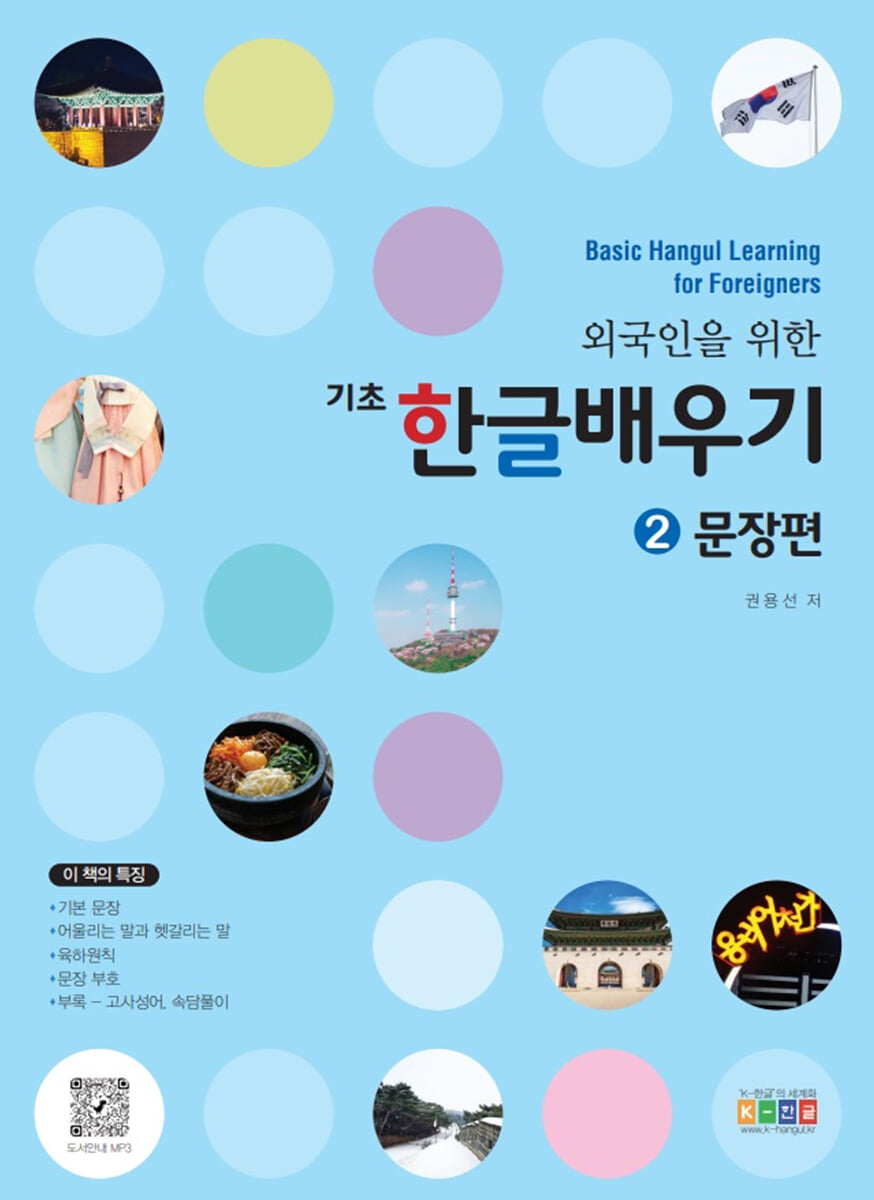
Basic Korean for Foreigners: Part 2
 |
Description
Book Introduction
Hangul is composed of 14 consonants, 10 vowels, and a combination of double consonants and double vowels to form letters and sounds.
The Korean alphabet consists of approximately 11,170 characters, of which about 30% are commonly used.
This book is based on Korean words frequently used in daily life and was developed with the following as its focus:
It consists of basic learning content based on the consonants and vowels of the Korean language.
By presenting the stroke order of Hangul, we aim to lay a solid foundation for the correct use of Hangul.
A lot of space was devoted to 'writing' so that Korean can be acquired naturally through repetitive writing practice.
We provide materials that can be studied in parallel with the textbook on our website (www.k-hangul.kr).
The content is organized around letters and words frequently used in daily life in Korea.
We have reduced the content on Korean characters that are not frequently used, and included only the essential content.
The Korean alphabet consists of approximately 11,170 characters, of which about 30% are commonly used.
This book is based on Korean words frequently used in daily life and was developed with the following as its focus:
It consists of basic learning content based on the consonants and vowels of the Korean language.
By presenting the stroke order of Hangul, we aim to lay a solid foundation for the correct use of Hangul.
A lot of space was devoted to 'writing' so that Korean can be acquired naturally through repetitive writing practice.
We provide materials that can be studied in parallel with the textbook on our website (www.k-hangul.kr).
The content is organized around letters and words frequently used in daily life in Korea.
We have reduced the content on Korean characters that are not frequently used, and included only the essential content.
- You can preview some of the book's contents.
Preview
index
Preface 3p
Chapter 1 Basic Sentences 5p
- What's the big deal 6p
- What to do 12p
- What is it like? 18p
- What is What 24p
- What does what 30p
Chapter 2: Matching Decorating Words 37pp
- Movement 38p
- Shape Words 38p
Chapter 3: Matching Movements, p. 51
- Movement 52p
Chapter 4: Matching Shapes, p. 65
- Shape Words 66p
Chapter 5: Confusing Words, p. 83
- Confusing Words 84p
Chapter 6, Six Harmonies, p. 103
- Who 104p
- When 108p
- Where 112p
- What 116p
- Why 120p
- How 124p
Chapter 7 Punctuation Marks, p. 129
- Period (.)
- Question mark (?)
- Exclamation mark (!)
- comma (,)
- Middle dot (·)
- Colon (:)
- Double quotation marks (" ")
- Single quotation marks (' '1)
- Ellipsis (··· ···)
Chapter 8 Appendix 142p
- Idioms 143p
- Proverb Interpretation 166p
Chapter 1 Basic Sentences 5p
- What's the big deal 6p
- What to do 12p
- What is it like? 18p
- What is What 24p
- What does what 30p
Chapter 2: Matching Decorating Words 37pp
- Movement 38p
- Shape Words 38p
Chapter 3: Matching Movements, p. 51
- Movement 52p
Chapter 4: Matching Shapes, p. 65
- Shape Words 66p
Chapter 5: Confusing Words, p. 83
- Confusing Words 84p
Chapter 6, Six Harmonies, p. 103
- Who 104p
- When 108p
- Where 112p
- What 116p
- Why 120p
- How 124p
Chapter 7 Punctuation Marks, p. 129
- Period (.)
- Question mark (?)
- Exclamation mark (!)
- comma (,)
- Middle dot (·)
- Colon (:)
- Double quotation marks (" ")
- Single quotation marks (' '1)
- Ellipsis (··· ···)
Chapter 8 Appendix 142p
- Idioms 143p
- Proverb Interpretation 166p
Publisher's Review
'Learning Basic Korean for Foreigners' is composed of ①Basics, ②Sentences, ③Conversation, and ④Life. The first edition was published in 2016 and is currently sold at Kyobo Bookstore, Yes24, Aladdin, Coupang, and large bookstores. Since 2017, it has been sold in Taiwan, Hong Kong, Macau, Singapore, and Malaysia under a copyright contract with a Taiwanese publisher.
It is also used as a textbook for learning Korean in schools in the United States and elsewhere.
Accordingly, in 2024, we are publishing 'Basic Korean Learning for Foreigners' in 16 languages as a textbook and e-book, as follows.
※ Textbooks and e-books published in 16 languages (① Basic Edition)
1.
Learning Korean in Vietnamese
2.
Learning Korean in Mongolian
3.
Learning Korean in Japanese
4.
Learning Korean in Spanish (EU)
5.
Learn Korean in French
6.
Learn Korean in Russian
7.
Learning Korean through Chinese
8.
Learn Korean in German
9.
Learn Korean in Hindi
10.
Learn Korean in Thai
11.
Learn Korean in Portuguese
12.
Learn Korean in Arabic
13.
Learning Korean in Persian
14.
Learning Korean in Turkic
15.
Learning Korean in Spanish (South America)
16.
Learning Korean in English (Revised 2nd Edition)
Hangul is composed of 14 consonants, 10 vowels, and a combination of double consonants and double vowels.
It will have a sound.
The Korean alphabet consists of approximately 11,170 characters, of which about 30% are mainly
It is being used.
This book is based on Korean words frequently used in real life.
It was developed around the following:
■ It consists of basic learning content based on the consonants and vowels of the Korean language.
■ The stroke order of Hangul has been presented to provide a solid foundation for correct Hangul use.
■ We devote a lot of space to ‘writing’ so that you can naturally acquire Korean through repetitive writing practice.
I have allocated it.
■ We provide materials that can be studied in parallel with the textbook on our website (www.k-hangul.kr).
■ The content is organized around letters and words frequently used in daily life in Korea.
■ We have reduced the content on Korean characters that are not frequently used, and included only the essential content.
Learning a language is learning a culture, and it broadens your thinking.
This book is in Korean
Since it is a basic textbook for learning, if you thoroughly understand the contents, you will be able to learn Korean language as well as Korean culture.
You will gain a broader understanding of the mind.
※ Note: This textbook is published and sold in the following sections: ② Sentence section, ① Basic section, ③ Conversation section, and ④ Life section.
It's in the middle.
thank you
Author: Kwon Yong-sun / K-hangul Publisher: Kwon, Yong-sun
It is also used as a textbook for learning Korean in schools in the United States and elsewhere.
Accordingly, in 2024, we are publishing 'Basic Korean Learning for Foreigners' in 16 languages as a textbook and e-book, as follows.
※ Textbooks and e-books published in 16 languages (① Basic Edition)
1.
Learning Korean in Vietnamese
2.
Learning Korean in Mongolian
3.
Learning Korean in Japanese
4.
Learning Korean in Spanish (EU)
5.
Learn Korean in French
6.
Learn Korean in Russian
7.
Learning Korean through Chinese
8.
Learn Korean in German
9.
Learn Korean in Hindi
10.
Learn Korean in Thai
11.
Learn Korean in Portuguese
12.
Learn Korean in Arabic
13.
Learning Korean in Persian
14.
Learning Korean in Turkic
15.
Learning Korean in Spanish (South America)
16.
Learning Korean in English (Revised 2nd Edition)
Hangul is composed of 14 consonants, 10 vowels, and a combination of double consonants and double vowels.
It will have a sound.
The Korean alphabet consists of approximately 11,170 characters, of which about 30% are mainly
It is being used.
This book is based on Korean words frequently used in real life.
It was developed around the following:
■ It consists of basic learning content based on the consonants and vowels of the Korean language.
■ The stroke order of Hangul has been presented to provide a solid foundation for correct Hangul use.
■ We devote a lot of space to ‘writing’ so that you can naturally acquire Korean through repetitive writing practice.
I have allocated it.
■ We provide materials that can be studied in parallel with the textbook on our website (www.k-hangul.kr).
■ The content is organized around letters and words frequently used in daily life in Korea.
■ We have reduced the content on Korean characters that are not frequently used, and included only the essential content.
Learning a language is learning a culture, and it broadens your thinking.
This book is in Korean
Since it is a basic textbook for learning, if you thoroughly understand the contents, you will be able to learn Korean language as well as Korean culture.
You will gain a broader understanding of the mind.
※ Note: This textbook is published and sold in the following sections: ② Sentence section, ① Basic section, ③ Conversation section, and ④ Life section.
It's in the middle.
thank you
Author: Kwon Yong-sun / K-hangul Publisher: Kwon, Yong-sun
GOODS SPECIFICS
- Date of issue: October 9, 2024
- Page count, weight, size: 184 pages | 190*260*20mm
- ISBN13: 9791188505814
- ISBN10: 1188505815
You may also like
카테고리
korean


korean

![GQ KOREA Mark (Monthly): December [2025]](http://librairie.coreenne.fr/cdn/shop/files/8ef265dbbfbf186523ed75ba7319009d.jpg?v=1765340328&width=3840)


