

Learn Korean Grammar, Chinese, Japanese, and English
 |
Description
Book Introduction
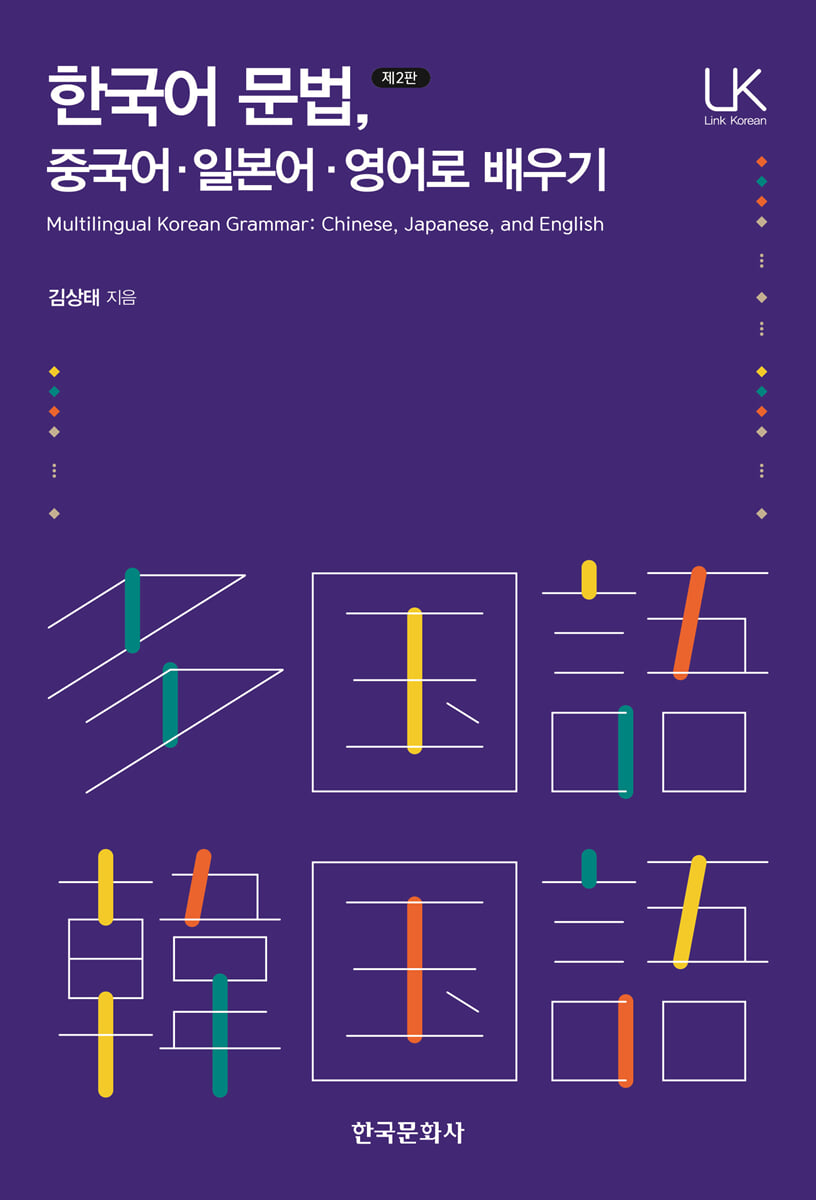
Today, we live in a multicultural and multilingual world.
This book is a guide for foreigners who wish to learn Korean in this environment, and at the same time, it aims to provide opportunities for Koreans to learn various foreign languages.
xianzai w?men sh?nghuo zai yige du? wenhua he du? y?yan xiang ronghe de shijie l?。 zhe b?nsh? shi wei zai zhezh?ng huanjing xia waiguoren xuexi hany? de ren zh?nbei de zh?nan, tongshi wei hanguoren tig?ng xuexi du?zh?ng waiy? de j?hui.
Nowadays, it's private, it's multicultural, it's multilingual, and it's living in the world.いる。この本はこのような環の中で外? People in Korea? 語をHow to follow? What to do in Korea at the same time? ?People, many?な外?speaking?
We are currently living in a world where multiculturalism and multilingualism coexist.
This book serves as a guide for foreigners who want to learn Korean in this environment, while also providing opportunities for Koreans to learn various foreign languages.
This book is a guide for foreigners who wish to learn Korean in this environment, and at the same time, it aims to provide opportunities for Koreans to learn various foreign languages.
xianzai w?men sh?nghuo zai yige du? wenhua he du? y?yan xiang ronghe de shijie l?。 zhe b?nsh? shi wei zai zhezh?ng huanjing xia waiguoren xuexi hany? de ren zh?nbei de zh?nan, tongshi wei hanguoren tig?ng xuexi du?zh?ng waiy? de j?hui.
Nowadays, it's private, it's multicultural, it's multilingual, and it's living in the world.いる。この本はこのような環の中で外? People in Korea? 語をHow to follow? What to do in Korea at the same time? ?People, many?な外?speaking?
We are currently living in a world where multiculturalism and multilingualism coexist.
This book serves as a guide for foreigners who want to learn Korean in this environment, while also providing opportunities for Koreans to learn various foreign languages.
- You can preview some of the book's contents.
Preview
index
introduction
1.
How to learn Korean
hany? xuexi f?ngf? How to learn Korean
2.
Language type
y?yan leixing 言語 タイプ Language type
2.1.
Isolated word g?liy? Isolating language
2.2.
Inflectional word q?zhey? Inflectional language
2.3.
Agglutinative word nianzhuoy? Agglutinative language
3.
Noun
t?ci ?言 Substantive
3.1.
Noun mingci 名詞 Noun
3.2.
Pronoun daici 代名詞 Pronoun
3.3.
Investigation shuci ?詞 Numeral
4.
Verb
weici Predicate
4.1.
Verb dongci 動詞 Verb
4.2.
Adjective xingrongci 形容詞 Adjective
4.3.
Main predicate and auxiliary verb zh?weici he f?zhuweici Main predicate and auxiliary predicate
4.4.
Conjugation and ending huoyong he ciw?i 活用と語尾 Inflection and ending
5.
Modifier
xi?shiy? 修飾語 Modifier
5.1.
guanxingci 冠形詞 Determiner
5.2.
Adverb fuci 副詞 Adverb
6.
Independence speech
duliyan ?立言 Independent word
7.
sentence elements
juz? chengfen Sentence component
7.1.
Subject zh?y? Subject
7.2.
Object b?ny? 目的語 Object
7.3.
Predicate weiy? 述語 Predicate
7.4.
Adjective dingy? Adnominal
7.5.
Adverb zhuangy? Adverbial
7.6.
Complement
7.7.
Independent word duliy? ?立語 Independent word
8.
Morphemes and words
cisu he d?nci 形態素と?語 Morpheme and word
8.1.
Morpheme cisu 形態素 Morpheme
8.2.
Word d?nci ?語 Word
8.3.
Morph analysis xingtai f?nxi 形態分析 Morph analysis
<supplement>
Classroom Korean
fluu: jiaoshi hany? 付?: ?室韓?語 Appendix: Classroom Korean
1.
How to learn Korean
hany? xuexi f?ngf? How to learn Korean
2.
Language type
y?yan leixing 言語 タイプ Language type
2.1.
Isolated word g?liy? Isolating language
2.2.
Inflectional word q?zhey? Inflectional language
2.3.
Agglutinative word nianzhuoy? Agglutinative language
3.
Noun
t?ci ?言 Substantive
3.1.
Noun mingci 名詞 Noun
3.2.
Pronoun daici 代名詞 Pronoun
3.3.
Investigation shuci ?詞 Numeral
4.
Verb
weici Predicate
4.1.
Verb dongci 動詞 Verb
4.2.
Adjective xingrongci 形容詞 Adjective
4.3.
Main predicate and auxiliary verb zh?weici he f?zhuweici Main predicate and auxiliary predicate
4.4.
Conjugation and ending huoyong he ciw?i 活用と語尾 Inflection and ending
5.
Modifier
xi?shiy? 修飾語 Modifier
5.1.
guanxingci 冠形詞 Determiner
5.2.
Adverb fuci 副詞 Adverb
6.
Independence speech
duliyan ?立言 Independent word
7.
sentence elements
juz? chengfen Sentence component
7.1.
Subject zh?y? Subject
7.2.
Object b?ny? 目的語 Object
7.3.
Predicate weiy? 述語 Predicate
7.4.
Adjective dingy? Adnominal
7.5.
Adverb zhuangy? Adverbial
7.6.
Complement
7.7.
Independent word duliy? ?立語 Independent word
8.
Morphemes and words
cisu he d?nci 形態素と?語 Morpheme and word
8.1.
Morpheme cisu 形態素 Morpheme
8.2.
Word d?nci ?語 Word
8.3.
Morph analysis xingtai f?nxi 形態分析 Morph analysis
<supplement>
Classroom Korean
fluu: jiaoshi hany? 付?: ?室韓?語 Appendix: Classroom Korean
Publisher's Review
Today, we live in a multicultural and multilingual world.
This book is a guide for foreigners who wish to learn Korean in this environment, and at the same time, it aims to provide opportunities for Koreans to learn various foreign languages.
This book is explained in Korean, Chinese, Japanese, and English.
In particular, Korean, Chinese, and Japanese are languages that use Chinese characters.
These languages have both linguistic similarities and differences.
Through this book, readers will be able to identify the common characteristics of each language and understand its unique aspects.
Additionally, these languages will be able to understand each other's language and culture more deeply through the Chinese characters they use in common.
Furthermore, by using English to explain these linguistic similarities and differences, we hope that this will provide an opportunity for all of us living in a multicultural era to better understand and communicate with one another.
I hope this book will provide readers with useful and entertaining information, and I ask for your continued support and interest.
I am grateful to many people for publishing this book.
First of all, I would like to thank Professor Park Gwang-sun for his great encouragement during the planning of this book.
I would also like to express my gratitude to my fellow teachers who helped me when I had difficulties while writing.
I would also like to express my gratitude to the staff of Hankuk Cultural Publishing Co., including President Kim Jin-su, Director Han Byeong-sun, and Manager Kang In-hye, who willingly took on the task of publishing my manuscript.
Lastly, I would like to express my gratitude to my mother, wife, and son who watched over me and encouraged me during the hot summer.
Written by the author at the foot of Mt. Uam, as cool autumn approaches.
This book is a guide for foreigners who wish to learn Korean in this environment, and at the same time, it aims to provide opportunities for Koreans to learn various foreign languages.
This book is explained in Korean, Chinese, Japanese, and English.
In particular, Korean, Chinese, and Japanese are languages that use Chinese characters.
These languages have both linguistic similarities and differences.
Through this book, readers will be able to identify the common characteristics of each language and understand its unique aspects.
Additionally, these languages will be able to understand each other's language and culture more deeply through the Chinese characters they use in common.
Furthermore, by using English to explain these linguistic similarities and differences, we hope that this will provide an opportunity for all of us living in a multicultural era to better understand and communicate with one another.
I hope this book will provide readers with useful and entertaining information, and I ask for your continued support and interest.
I am grateful to many people for publishing this book.
First of all, I would like to thank Professor Park Gwang-sun for his great encouragement during the planning of this book.
I would also like to express my gratitude to my fellow teachers who helped me when I had difficulties while writing.
I would also like to express my gratitude to the staff of Hankuk Cultural Publishing Co., including President Kim Jin-su, Director Han Byeong-sun, and Manager Kang In-hye, who willingly took on the task of publishing my manuscript.
Lastly, I would like to express my gratitude to my mother, wife, and son who watched over me and encouraged me during the hot summer.
Written by the author at the foot of Mt. Uam, as cool autumn approaches.
GOODS SPECIFICS
- Date of issue: August 28, 2025
- Page count, weight, size: 172 pages | 153*225*9mm
- ISBN13: 9791169193283
You may also like
카테고리
korean


korean

![ELLE 엘르 스페셜 에디션 A형 : 12월 [2025]](http://librairie.coreenne.fr/cdn/shop/files/b8e27a3de6c9538896439686c6b0e8fb.jpg?v=1766436872&width=3840)


