

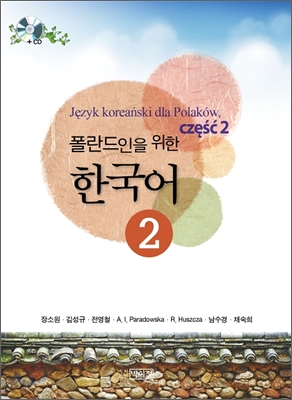
Korean for Polish People 2
 |
Description
Book Introduction
This is a conversation-focused learning material for Polish people learning Korean.
Following Volume 1, which is aimed at beginners, Volume 2 is for intermediate level learners.
You can learn vocabulary, expressions, and important grammar centered on various real-life conversations, and each chapter presents various detailed unit goals such as 'asking and answering about places', 'comparing', 'describe locations', 'guessing', 'asking and answering about studying abroad preparations', 'asking permission', 'asking and answering about transportation', 'ordering food', 'expressing conditions', and 'writing a diary'.
Following Volume 1, which is aimed at beginners, Volume 2 is for intermediate level learners.
You can learn vocabulary, expressions, and important grammar centered on various real-life conversations, and each chapter presents various detailed unit goals such as 'asking and answering about places', 'comparing', 'describe locations', 'guessing', 'asking and answering about studying abroad preparations', 'asking permission', 'asking and answering about transportation', 'ordering food', 'expressing conditions', and 'writing a diary'.
index
preface
Textbook composition table
1. Warsaw is the capital of Poland
Lesson 2 I think the children will be very excited for Christmas.
Lesson 3 I like listening to music
Lesson 4: What should I prepare for going to Korea?
Lesson 5 Instead of the number, I'll help Mr. Mihau.
Lesson 6 I'm not sure if the food will suit my taste.
Lesson 7 Have you ever lived in a dorm?
Lesson 8: We decided to go to Gyeongbokgung Palace together on the weekend.
Lesson 9 It would be nice to have a tracksuit to wear when playing soccer.
Lesson 10 I heard there are many different relics
Lesson 11 I couldn't sleep because I was coughing
I'm worried that I should be able to understand Lesson 12 well.
Lesson 13 I came here to open a bankbook
Lesson 14: Shall we go to the restaurant you see over there?
Lesson 15 I'm thinking of sending a gift now
Listening manuscript
Model answer
Word list
Textbook composition table
1. Warsaw is the capital of Poland
Lesson 2 I think the children will be very excited for Christmas.
Lesson 3 I like listening to music
Lesson 4: What should I prepare for going to Korea?
Lesson 5 Instead of the number, I'll help Mr. Mihau.
Lesson 6 I'm not sure if the food will suit my taste.
Lesson 7 Have you ever lived in a dorm?
Lesson 8: We decided to go to Gyeongbokgung Palace together on the weekend.
Lesson 9 It would be nice to have a tracksuit to wear when playing soccer.
Lesson 10 I heard there are many different relics
Lesson 11 I couldn't sleep because I was coughing
I'm worried that I should be able to understand Lesson 12 well.
Lesson 13 I came here to open a bankbook
Lesson 14: Shall we go to the restaurant you see over there?
Lesson 15 I'm thinking of sending a gift now
Listening manuscript
Model answer
Word list
Publisher's Review
Until the publication of the Korean language textbook for Polish people… …
As Korea's economy grows and its culture and arts develop, there is a growing interest in learning Korean around the world.
The history of Korean language education as a foreign language has undergone significant changes over the past 50 years, and textbooks are at the center of this change.
Beyond the limitations of general-purpose textbooks, language-specific textbooks, special-purpose textbooks, and localized textbooks are being compiled.
The Institute of Korean Language and Literature at Seoul National University was selected for the research project titled “Development of Curriculum and Teaching Materials for Undergraduate and Graduate Students Majoring in Korean Studies in Poland” in the Korean Studies Promotion Project, which was sponsored by the Academy of Korean Studies in 2009 with the aim of contributing to enhancing the image of “Cultural Korea” and securing the identity of Korean studies.
This is part of a project to develop a global Korean studies curriculum and teaching materials. The Institute of Korean Language and Literature at Seoul National University has signed an agreement with the Department of Korean Studies at the University of Warsaw in Poland to foster Korean studies education in Poland and contribute to the establishment of Korean studies that communicates with the world.
For this research project, which will be conducted over three years, the entire research team was divided into the ‘Korean Conversation Textbook for Polish People’ team and the ‘Korean Studies Textbook for Polish People’ team.
The goal is to develop and propose curricula for the undergraduate course “Practical Korean” and the master’s course “Korean Studies” at Polish universities, and to develop teacher’s guides for Volumes 1, 2, and 3 of “Korean Language for Poles” and Volume 1 of “Korean Studies for Poles” (tentative title) to be used as textbooks for each of these.
Since publishing the first volume of “Korean for Poles” last January, we have been working hard on the follow-up work and have now published the second volume of “Korean for Poles.”
During this period, there were changes, both large and small, such as the visit of Polish author Professor Anna Paradowska of the University of Warsaw to Korea and the close collaboration with domestic researchers, and the addition of Professor Romuald Huszcza to the writing team, but there is no doubt that everyone was striving to compile a more desirable Korean language textbook.
Now, the Korean language textbook for Polish people, originally planned to be a three-volume series, is reduced to just one volume, the third volume, which is an advanced conversational book.
We believe that if each volume is accompanied by a CD containing vivid standard Korean pronunciation and a separate teacher's guide is developed, convenient and efficient Korean language learning will be possible not only in Korean studies departments at Polish universities but also in Korean language courses at any institution.
Describe the features and advantages of this book
A special Korean language education textbook for Polish people, “Korean for Polish People 2,” has been published.
This book is unique in that it is structured so that Polish people can easily learn Korean and also experience the Korean culture that permeates it.
If the beginner's textbook, "Korean for Polish People 1," covers the basics of Korean notation, grammar, and sentence structures, this volume is for the intermediate level.
It teaches vocabulary, expressions, and important grammar point by point, focusing on various real-life conversations.
Additionally, various practice problems are included in each chapter to review the key contents.
Each chapter presents various detailed unit objectives, such as 'asking and answering about places', 'comparing', 'describe locations', 'guessing', 'asking and answering about studying abroad preparations', 'asking permission', 'asking and answering about transportation', 'ordering food', 'expressing conditions', and 'writing a diary'.
Additionally, all conversations in the book are recorded with vivid standard Korean pronunciation, providing practical assistance as a teaching material not only for Polish people who want to learn Korean but also for actual Korean language teachers.
If you make good use of this textbook, you will be able to learn Korean conveniently and efficiently not only in Korean language courses offered at various universities in Poland, but also in Korean language courses offered at other institutions.
As Korea's economy grows and its culture and arts develop, there is a growing interest in learning Korean around the world.
The history of Korean language education as a foreign language has undergone significant changes over the past 50 years, and textbooks are at the center of this change.
Beyond the limitations of general-purpose textbooks, language-specific textbooks, special-purpose textbooks, and localized textbooks are being compiled.
The Institute of Korean Language and Literature at Seoul National University was selected for the research project titled “Development of Curriculum and Teaching Materials for Undergraduate and Graduate Students Majoring in Korean Studies in Poland” in the Korean Studies Promotion Project, which was sponsored by the Academy of Korean Studies in 2009 with the aim of contributing to enhancing the image of “Cultural Korea” and securing the identity of Korean studies.
This is part of a project to develop a global Korean studies curriculum and teaching materials. The Institute of Korean Language and Literature at Seoul National University has signed an agreement with the Department of Korean Studies at the University of Warsaw in Poland to foster Korean studies education in Poland and contribute to the establishment of Korean studies that communicates with the world.
For this research project, which will be conducted over three years, the entire research team was divided into the ‘Korean Conversation Textbook for Polish People’ team and the ‘Korean Studies Textbook for Polish People’ team.
The goal is to develop and propose curricula for the undergraduate course “Practical Korean” and the master’s course “Korean Studies” at Polish universities, and to develop teacher’s guides for Volumes 1, 2, and 3 of “Korean Language for Poles” and Volume 1 of “Korean Studies for Poles” (tentative title) to be used as textbooks for each of these.
Since publishing the first volume of “Korean for Poles” last January, we have been working hard on the follow-up work and have now published the second volume of “Korean for Poles.”
During this period, there were changes, both large and small, such as the visit of Polish author Professor Anna Paradowska of the University of Warsaw to Korea and the close collaboration with domestic researchers, and the addition of Professor Romuald Huszcza to the writing team, but there is no doubt that everyone was striving to compile a more desirable Korean language textbook.
Now, the Korean language textbook for Polish people, originally planned to be a three-volume series, is reduced to just one volume, the third volume, which is an advanced conversational book.
We believe that if each volume is accompanied by a CD containing vivid standard Korean pronunciation and a separate teacher's guide is developed, convenient and efficient Korean language learning will be possible not only in Korean studies departments at Polish universities but also in Korean language courses at any institution.
Describe the features and advantages of this book
A special Korean language education textbook for Polish people, “Korean for Polish People 2,” has been published.
This book is unique in that it is structured so that Polish people can easily learn Korean and also experience the Korean culture that permeates it.
If the beginner's textbook, "Korean for Polish People 1," covers the basics of Korean notation, grammar, and sentence structures, this volume is for the intermediate level.
It teaches vocabulary, expressions, and important grammar point by point, focusing on various real-life conversations.
Additionally, various practice problems are included in each chapter to review the key contents.
Each chapter presents various detailed unit objectives, such as 'asking and answering about places', 'comparing', 'describe locations', 'guessing', 'asking and answering about studying abroad preparations', 'asking permission', 'asking and answering about transportation', 'ordering food', 'expressing conditions', and 'writing a diary'.
Additionally, all conversations in the book are recorded with vivid standard Korean pronunciation, providing practical assistance as a teaching material not only for Polish people who want to learn Korean but also for actual Korean language teachers.
If you make good use of this textbook, you will be able to learn Korean conveniently and efficiently not only in Korean language courses offered at various universities in Poland, but also in Korean language courses offered at other institutions.
GOODS SPECIFICS
- Date of publication: September 15, 2011
- Page count, weight, size: 260 pages | 576g | Checking size
- ISBN13: 9788962922783
- ISBN10: 8962922789
You may also like
카테고리
korean


korean

![ELLE 엘르 스페셜 에디션 A형 : 12월 [2025]](http://librairie.coreenne.fr/cdn/shop/files/b8e27a3de6c9538896439686c6b0e8fb.jpg?v=1766436872&width=3840)


