

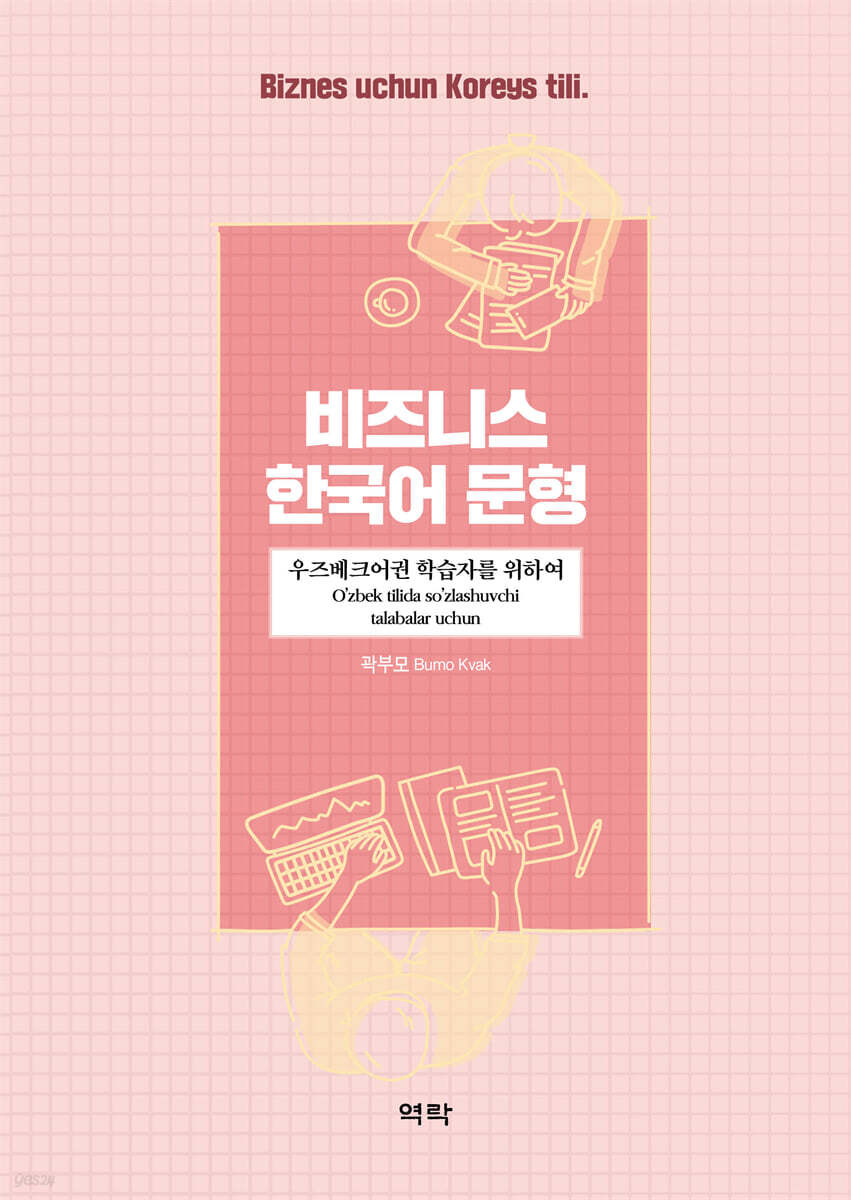
Business Korean Sentence Patterns: For Uzbek Learners
 |
Description
Book Introduction
Business Korean Sentence Patterns Biznes uchun Koreys tili.
-For Uzbek language learners Koreys tilini o'rganayotgan o'zbek tilida
so'zlashuvchi talabalar uchun
For foreigners who will be working for Korean companies and corporations for the first time
Birinchi marotaba Koreya firmalarida ishlamoqchi bo?ganlar uchun
This book is designed to study business Korean sentence patterns, and is designed to help students with basic Korean communication skills understand business tasks and the workplace culture of Korean companies based on the Korean language.
It is natural that the structure of conversation in business Korean should vary depending on the person and the purpose.
Therefore, it is necessary to practice words and expressions that are appropriate for the purpose and to approach it more practically.
Accordingly, we have presented various sentence patterns suitable for business situations and, going one step further, have organized them so that they can be used to create various sentences and apply them in new situations.
-For Uzbek language learners Koreys tilini o'rganayotgan o'zbek tilida
so'zlashuvchi talabalar uchun
For foreigners who will be working for Korean companies and corporations for the first time
Birinchi marotaba Koreya firmalarida ishlamoqchi bo?ganlar uchun
This book is designed to study business Korean sentence patterns, and is designed to help students with basic Korean communication skills understand business tasks and the workplace culture of Korean companies based on the Korean language.
It is natural that the structure of conversation in business Korean should vary depending on the person and the purpose.
Therefore, it is necessary to practice words and expressions that are appropriate for the purpose and to approach it more practically.
Accordingly, we have presented various sentence patterns suitable for business situations and, going one step further, have organized them so that they can be used to create various sentences and apply them in new situations.
index
preface
How to use the book
Bo?lim.
01
Ish izlash Find a job
1.
My name is ~.┃Mening ismim ~.
2.
I majored in ~ at ~.┃~ da ~ mutaxassisligini tugatganman.
3.
I have worked at ~.┃Men ~ da malaka oshirganman.
4.
I want to work at ~.┃Men ~ da ishlashni xohlayman.
5.
Can I ask you a question about ~┃~ haqida so'rasam bo'ladimi?
Bo?lim.
02
Ish uchun intervyu interview
1.
~ is the ~ that applied to ~.┃Men ~bo'sh ish o'rni uchun ariza topshirgan ~.
2.
I would like to talk about ~.┃Men sizga ~ haqida aytib bermoqchiman.
3.
I want to be ~.┃Men ~ bo'lishni xohlayman.
4.
The biggest advantage is ~.┃Mening eng kuchli nuqtam ~.
5.
My goal is ~.┃Mening maqsadim ~.
6.
If given the opportunity to work at ~, I will do my best.┃
Men ~ da ishlash imkoniyatiga ega bo'lishim bilan qo'limdan
kelganicha harakat qilaman.
Bo?lim.
03
Ish vaqti business hours
1.
Working hours are from ~ to ~.┃Ish vaqti ~ dan ~ gacha.
2.
Excuse me, but I will be leaving work early because of ~.┃
Kechirasiz.
~ sababli birinchi bo'lib ishni tugatishim kerak.
3.
~(으)니 Should I go to work a little early?┃
~ sababli ishga erta kelishim kerakmi
4.
~아/어/서/서 was absent from work.┃Men ~ sababli kela olmadim.
5.
I'm sorry for being ~아/어/서.┃
Uzur so'rayman / ~ ligi uchun uzur so'rayman
Bo?lim.
04
Ofis jihozlaridan foydalanish use of office equipment
1.
Can I print ~┃~ chop qilsam bo?larmikin?
2.
~(으)니까 ~(으)세요.┃Iltimos, ~ ni qiling, chunki ~.
3.
Where is ~┃~ qayerda?
4.
~ Please teach me how to use it.┃
Iltimos, ~ dan qanday foydalanishniko'rsating.
5.
Thank you for ~.┃~ uchun rahmat.
Bo?lim.
05
Telefonda biznes suhbat business phone
1.
I called to say ~.┃Men ~ ga qo'ng'iroq qilaman.
2.
Can I speak to ~┃~ bilan gaplashsam bo'ladimi?
3.
Would you like to leave a comment┃~ bilan yolg?iz qolsam bo?ladimi?
4.
Could you please say ~ again┃~ takrorlay olasizmi?
5.
I would like to check ~ again.┃Men aniqlik kiritmoqchiman ~
6.
Could you please tell me that~┃Buni o'tkazib yubora olasizmi ~?
Bo?lim.
06
Elektron pochta email
1.
I am writing this email to ~(으)로.┃Men bu xatni ~ ga yozyapman.
2.
I have a question about ~.┃Haqida so'ramoqchiman
3.
Please send ~.┃Iltimos, ~ yuboring.
4.
~I will also include it for reference.
┃Nusxaga ~ ni ham kiritaman.
5.
~ is attached.┃Men biriktiraman (biriktiraman) ~.
6.
~ is passed on to ~.┃Men ~ (kimga) ~ (nima)ni yuboraman.
7.
~ is/are as follows.┃~ quyidagicha.
8.
~I hope so.┃Sizga tilayman ~.
9.
If I am away, please contact ~.┃
Agar men yo'q bo'lsam, ~ bilan bog'laning.
Bo?lim.
07
Hisobot va avtorizatsiya work report and receive approval
1.
Is ~ going well?┃Jarayon ~ yaxshi ketyaptimi?
2.
I will finish ~ by ~.┃Men ~ni ~ dan oldin tugataman.
3.
I will submit it by ~ at the latest.┃Men ~ dan kechikmay topshiraman.
4.
Please approve the report on ~.┃
Iltimos, ~ haqidagi hisobotni tasdiqlang.
5.
Let me check ~ again.┃Men yana ~ tekshiraman.
Bo?lim.
08
Uchrashuvga tayyorgarlik meeting preparation
1.
We gathered today to ~.┃Bugun biz ~ uchun yig'ildik.
2.
There are ~ things to do.┃Kun tartibida ~ savollar.
3.
The meeting will be concluded by ~.┃Uchrashuvni ~dan oldin tugatamiz.
4.
What do you think about ~┃Siz ~ haqida nima deb o'ylaysiz ?
5.
Before ~, is there ~?┃~ dan oldin ~ bormi?
6.
~ will be in ~.┃~ da bo?adi.
Bo?lim.
09
Kompaniya xabarnomalari company notice
1.
Please check ~.┃
Iltimos, ~ ni tekshiringizni so?rayman / Iltimos, ~ ni tekshiring.
2.
Please share ~.┃Iltimos, baham ko'ring ~.
3.
~ to inform you.┃~ dan xabar.
4.
~ is/will be at ~.┃~ ichida sodir bo'ladi.
5.
Congratulations on ~.┃~ bilan tabriklaymiz.
6.
I'm sorry to hear that.┃~ ni eshitganimdan afsusdaman.
7.
May the deceased rest in peace.┃Men marhumning tinchligini tilayman.
Bo?lim.
10
kompaniya kechki ovqati company dinner
1.
~은/는 ~에서 ┃~ qayerda bo'ladi?
2.
It is difficult to do ~ because of ~.┃~ tufayli ~ qila olmayman.
3.
I will do ~.┃Men ~ tanlayman / tanlayman.
4.
I can't drink ~.┃Men ~ icholmayman.
5.
~ was really fun.┃Menga ~ juda yoqdi.
6.
Excuse me, but I'll ~ first.┃Uzr so'rayman.
Men ~ birinchi.
Bo?lim.
11
Ish safari business trip
1.
I'm going on a business trip to ~.┃Men ~ ga xizmat safariga ketyapman.
2.
Could you please come pick me up at ~? ┃
~ ga uchrashish/olish uchun mashinada bora olasizmi
3.
How do I get to ~┃~ ga qanday borishim mumkin?
4.
~ is our company's main product.┃
~ Kompaniyamizning asosiy mahsuloti.
5.
I can send you ~.┃Men sizga ~ yuborishim mumkin.
6.
I hope to cooperate with you on ~.┃
Men ~ da hamkorlik qilishimizni xohlayman.
Bo?lim.
12
Dam olish kuni vacation
1.
Can I ~을/를 ~아/어/이?┃Men ~ qila olamanmi?
2.
I took a vacation because of ~.┃~ tufayli ta'til oldim.
3.
~아/어/서~을/을 decided to bet.┃~ tufayli ~ olishga qaror qildim.
4.
I will submit it after doing/doing ~.┃
~ni tugatib/tugatganimdan keyin topshiraman
supplement
How to use the book
Bo?lim.
01
Ish izlash Find a job
1.
My name is ~.┃Mening ismim ~.
2.
I majored in ~ at ~.┃~ da ~ mutaxassisligini tugatganman.
3.
I have worked at ~.┃Men ~ da malaka oshirganman.
4.
I want to work at ~.┃Men ~ da ishlashni xohlayman.
5.
Can I ask you a question about ~┃~ haqida so'rasam bo'ladimi?
Bo?lim.
02
Ish uchun intervyu interview
1.
~ is the ~ that applied to ~.┃Men ~bo'sh ish o'rni uchun ariza topshirgan ~.
2.
I would like to talk about ~.┃Men sizga ~ haqida aytib bermoqchiman.
3.
I want to be ~.┃Men ~ bo'lishni xohlayman.
4.
The biggest advantage is ~.┃Mening eng kuchli nuqtam ~.
5.
My goal is ~.┃Mening maqsadim ~.
6.
If given the opportunity to work at ~, I will do my best.┃
Men ~ da ishlash imkoniyatiga ega bo'lishim bilan qo'limdan
kelganicha harakat qilaman.
Bo?lim.
03
Ish vaqti business hours
1.
Working hours are from ~ to ~.┃Ish vaqti ~ dan ~ gacha.
2.
Excuse me, but I will be leaving work early because of ~.┃
Kechirasiz.
~ sababli birinchi bo'lib ishni tugatishim kerak.
3.
~(으)니 Should I go to work a little early?┃
~ sababli ishga erta kelishim kerakmi
4.
~아/어/서/서 was absent from work.┃Men ~ sababli kela olmadim.
5.
I'm sorry for being ~아/어/서.┃
Uzur so'rayman / ~ ligi uchun uzur so'rayman
Bo?lim.
04
Ofis jihozlaridan foydalanish use of office equipment
1.
Can I print ~┃~ chop qilsam bo?larmikin?
2.
~(으)니까 ~(으)세요.┃Iltimos, ~ ni qiling, chunki ~.
3.
Where is ~┃~ qayerda?
4.
~ Please teach me how to use it.┃
Iltimos, ~ dan qanday foydalanishniko'rsating.
5.
Thank you for ~.┃~ uchun rahmat.
Bo?lim.
05
Telefonda biznes suhbat business phone
1.
I called to say ~.┃Men ~ ga qo'ng'iroq qilaman.
2.
Can I speak to ~┃~ bilan gaplashsam bo'ladimi?
3.
Would you like to leave a comment┃~ bilan yolg?iz qolsam bo?ladimi?
4.
Could you please say ~ again┃~ takrorlay olasizmi?
5.
I would like to check ~ again.┃Men aniqlik kiritmoqchiman ~
6.
Could you please tell me that~┃Buni o'tkazib yubora olasizmi ~?
Bo?lim.
06
Elektron pochta email
1.
I am writing this email to ~(으)로.┃Men bu xatni ~ ga yozyapman.
2.
I have a question about ~.┃Haqida so'ramoqchiman
3.
Please send ~.┃Iltimos, ~ yuboring.
4.
~I will also include it for reference.
┃Nusxaga ~ ni ham kiritaman.
5.
~ is attached.┃Men biriktiraman (biriktiraman) ~.
6.
~ is passed on to ~.┃Men ~ (kimga) ~ (nima)ni yuboraman.
7.
~ is/are as follows.┃~ quyidagicha.
8.
~I hope so.┃Sizga tilayman ~.
9.
If I am away, please contact ~.┃
Agar men yo'q bo'lsam, ~ bilan bog'laning.
Bo?lim.
07
Hisobot va avtorizatsiya work report and receive approval
1.
Is ~ going well?┃Jarayon ~ yaxshi ketyaptimi?
2.
I will finish ~ by ~.┃Men ~ni ~ dan oldin tugataman.
3.
I will submit it by ~ at the latest.┃Men ~ dan kechikmay topshiraman.
4.
Please approve the report on ~.┃
Iltimos, ~ haqidagi hisobotni tasdiqlang.
5.
Let me check ~ again.┃Men yana ~ tekshiraman.
Bo?lim.
08
Uchrashuvga tayyorgarlik meeting preparation
1.
We gathered today to ~.┃Bugun biz ~ uchun yig'ildik.
2.
There are ~ things to do.┃Kun tartibida ~ savollar.
3.
The meeting will be concluded by ~.┃Uchrashuvni ~dan oldin tugatamiz.
4.
What do you think about ~┃Siz ~ haqida nima deb o'ylaysiz ?
5.
Before ~, is there ~?┃~ dan oldin ~ bormi?
6.
~ will be in ~.┃~ da bo?adi.
Bo?lim.
09
Kompaniya xabarnomalari company notice
1.
Please check ~.┃
Iltimos, ~ ni tekshiringizni so?rayman / Iltimos, ~ ni tekshiring.
2.
Please share ~.┃Iltimos, baham ko'ring ~.
3.
~ to inform you.┃~ dan xabar.
4.
~ is/will be at ~.┃~ ichida sodir bo'ladi.
5.
Congratulations on ~.┃~ bilan tabriklaymiz.
6.
I'm sorry to hear that.┃~ ni eshitganimdan afsusdaman.
7.
May the deceased rest in peace.┃Men marhumning tinchligini tilayman.
Bo?lim.
10
kompaniya kechki ovqati company dinner
1.
~은/는 ~에서 ┃~ qayerda bo'ladi?
2.
It is difficult to do ~ because of ~.┃~ tufayli ~ qila olmayman.
3.
I will do ~.┃Men ~ tanlayman / tanlayman.
4.
I can't drink ~.┃Men ~ icholmayman.
5.
~ was really fun.┃Menga ~ juda yoqdi.
6.
Excuse me, but I'll ~ first.┃Uzr so'rayman.
Men ~ birinchi.
Bo?lim.
11
Ish safari business trip
1.
I'm going on a business trip to ~.┃Men ~ ga xizmat safariga ketyapman.
2.
Could you please come pick me up at ~? ┃
~ ga uchrashish/olish uchun mashinada bora olasizmi
3.
How do I get to ~┃~ ga qanday borishim mumkin?
4.
~ is our company's main product.┃
~ Kompaniyamizning asosiy mahsuloti.
5.
I can send you ~.┃Men sizga ~ yuborishim mumkin.
6.
I hope to cooperate with you on ~.┃
Men ~ da hamkorlik qilishimizni xohlayman.
Bo?lim.
12
Dam olish kuni vacation
1.
Can I ~을/를 ~아/어/이?┃Men ~ qila olamanmi?
2.
I took a vacation because of ~.┃~ tufayli ta'til oldim.
3.
~아/어/서~을/을 decided to bet.┃~ tufayli ~ olishga qaror qildim.
4.
I will submit it after doing/doing ~.┃
~ni tugatib/tugatganimdan keyin topshiraman
supplement
Publisher's Review
Many universities around the world teach business Korean as a foreign language as a major or liberal arts course.
As a Korean language teacher and researcher, I was inspired to conceive of this book because, aside from textbooks published domestically for students learning business Korean for special purposes, there are virtually no textbooks available for local students studying business Korean at overseas universities.
This book is designed to study business Korean sentence patterns, and is designed to help students with basic Korean communication skills understand business tasks and the workplace culture of Korean companies based on the Korean language.
It is natural that the structure of conversation in business Korean should vary depending on the person and the purpose.
Therefore, it is necessary to practice words and expressions that are appropriate for the purpose and to approach it more practically.
Accordingly, we have presented various sentence patterns suitable for business situations and, going one step further, have organized them so that they can be used to create various sentences and apply them in new situations.
How to use books How to Use Books How to Use Books
You can use the sentence patterns in this book when you need to use business Korean in a Korean company or when you need to use Korean as needed in a work situation.
It will be helpful to practice the useful sentence patterns presented in this book, check the sentence patterns emphasized in each unit, and practice with the vocabulary and conversations presented in the comprehensive exercises.
And since each dialogue presented in the sentence pattern practice contains important sentence pattern expressions, if you practice these sentence pattern expressions through conversation, you will be able to easily use the expressions needed in business Korean situations.
Additionally, we have provided additional information (Business Korean Tips) for each sentence structure to help you understand the workplace culture of Korean companies.
Lastly, we must not forget to self-review what we have learned through comprehensive practice.
Each chapter of the book covers:
Siz ushbu kitobning har bir bobidan quyidagi tartibda foydalanishingiz mumkin:
ㆍKey sentence pattern guide Nutq almashinuvini tushuntirish
ㆍSentence pattern practice Nutq almashtirish amaliyoti
ㆍDialog amaliyoti
Step Up (Koreya biznes maslahati)
ㆍCheck 1 (word) Topshiriq 1 (Leksika)
ㆍCheck 2 (Sentence) Topshiriq 2 (Gap)
ㆍComprehensive Practice (Dialogue) Murakkab amaliyot (dialog)
As a Korean language teacher and researcher, I was inspired to conceive of this book because, aside from textbooks published domestically for students learning business Korean for special purposes, there are virtually no textbooks available for local students studying business Korean at overseas universities.
This book is designed to study business Korean sentence patterns, and is designed to help students with basic Korean communication skills understand business tasks and the workplace culture of Korean companies based on the Korean language.
It is natural that the structure of conversation in business Korean should vary depending on the person and the purpose.
Therefore, it is necessary to practice words and expressions that are appropriate for the purpose and to approach it more practically.
Accordingly, we have presented various sentence patterns suitable for business situations and, going one step further, have organized them so that they can be used to create various sentences and apply them in new situations.
How to use books How to Use Books How to Use Books
You can use the sentence patterns in this book when you need to use business Korean in a Korean company or when you need to use Korean as needed in a work situation.
It will be helpful to practice the useful sentence patterns presented in this book, check the sentence patterns emphasized in each unit, and practice with the vocabulary and conversations presented in the comprehensive exercises.
And since each dialogue presented in the sentence pattern practice contains important sentence pattern expressions, if you practice these sentence pattern expressions through conversation, you will be able to easily use the expressions needed in business Korean situations.
Additionally, we have provided additional information (Business Korean Tips) for each sentence structure to help you understand the workplace culture of Korean companies.
Lastly, we must not forget to self-review what we have learned through comprehensive practice.
Each chapter of the book covers:
Siz ushbu kitobning har bir bobidan quyidagi tartibda foydalanishingiz mumkin:
ㆍKey sentence pattern guide Nutq almashinuvini tushuntirish
ㆍSentence pattern practice Nutq almashtirish amaliyoti
ㆍDialog amaliyoti
Step Up (Koreya biznes maslahati)
ㆍCheck 1 (word) Topshiriq 1 (Leksika)
ㆍCheck 2 (Sentence) Topshiriq 2 (Gap)
ㆍComprehensive Practice (Dialogue) Murakkab amaliyot (dialog)
GOODS SPECIFICS
- Date of issue: September 30, 2024
- Page count, weight, size: 256 pages | 176*248*14mm
- ISBN13: 9791167428622
You may also like
카테고리
korean


korean

![ELLE 엘르 스페셜 에디션 A형 : 12월 [2025]](http://librairie.coreenne.fr/cdn/shop/files/b8e27a3de6c9538896439686c6b0e8fb.jpg?v=1766436872&width=3840)


