

Vowels and consonants of Hangul
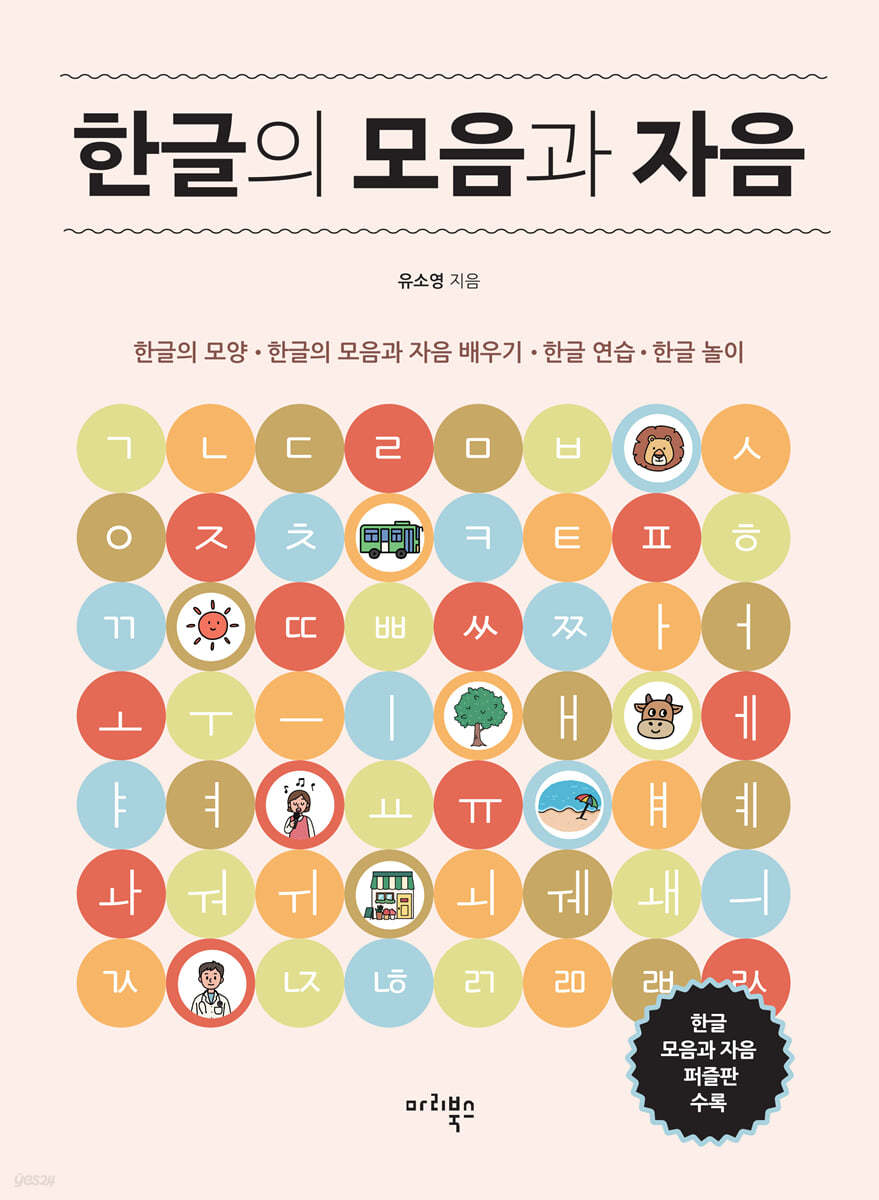 |
Description
Book Introduction
The beginning of studying Korean,
Learn the vowels and consonants of Korean!
The beginning of studying Korean is learning the vowels and consonants of the Korean alphabet.
There is a clear difference between a Korean learning Korean as their native language and a foreigner learning Korean as a foreign language.
Since native Korean speakers are born and raised in an environment where Korean is used, they can express themselves naturally just by learning the written language, Hangul.
On the other hand, learners of Korean as a foreign language have the burden of having to learn Korean pronunciation and writing at the same time.
Therefore, it should be a Korean language study book that can be learned more efficiently from a foreigner's perspective.
This book adopts a Korean language study method that is easier and more convenient to approach and learn from the perspective of a foreigner who is learning Korean for the first time.
What does Hangul look like? In 'The Shape of Hangul', you can visually confirm the letters of Hangul with vocabulary pictures, and above all, rather than the 'ㄱ, ㄴ, ㄷ, ㄹ' and 'ㅏ, ㅑ, ㅓ, ㅕ' that Koreans are familiar with, you can practice Hangul in the order of 'ㅂ, ㄷ, ㄱ, ㅅ, ㅈ, ㅎ … ' and 'ㅏ, ㅓ, ㅗ, ㅜ … ' that is easier for foreigners to pronounce.
The vocabulary learned in each unit is also structured in a variety of ways so that it can be learned by everyone from elementary school students to adult learners.
It contains vocabulary and sentences that are familiar to children, such as 'butterfly' and 'apple', as well as vocabulary and sentences that are frequently used by adult learners, such as 'company', 'vacation', 'shoes', and 'have a nice weekend'.
The titles and instructions for each unit are also provided in English to help foreign learners understand the material more quickly.
This book will help you learn Korean well enough to take your first steps.
Learn the vowels and consonants of Korean!
The beginning of studying Korean is learning the vowels and consonants of the Korean alphabet.
There is a clear difference between a Korean learning Korean as their native language and a foreigner learning Korean as a foreign language.
Since native Korean speakers are born and raised in an environment where Korean is used, they can express themselves naturally just by learning the written language, Hangul.
On the other hand, learners of Korean as a foreign language have the burden of having to learn Korean pronunciation and writing at the same time.
Therefore, it should be a Korean language study book that can be learned more efficiently from a foreigner's perspective.
This book adopts a Korean language study method that is easier and more convenient to approach and learn from the perspective of a foreigner who is learning Korean for the first time.
What does Hangul look like? In 'The Shape of Hangul', you can visually confirm the letters of Hangul with vocabulary pictures, and above all, rather than the 'ㄱ, ㄴ, ㄷ, ㄹ' and 'ㅏ, ㅑ, ㅓ, ㅕ' that Koreans are familiar with, you can practice Hangul in the order of 'ㅂ, ㄷ, ㄱ, ㅅ, ㅈ, ㅎ … ' and 'ㅏ, ㅓ, ㅗ, ㅜ … ' that is easier for foreigners to pronounce.
The vocabulary learned in each unit is also structured in a variety of ways so that it can be learned by everyone from elementary school students to adult learners.
It contains vocabulary and sentences that are familiar to children, such as 'butterfly' and 'apple', as well as vocabulary and sentences that are frequently used by adult learners, such as 'company', 'vacation', 'shoes', and 'have a nice weekend'.
The titles and instructions for each unit are also provided in English to help foreign learners understand the material more quickly.
This book will help you learn Korean well enough to take your first steps.
- You can preview some of the book's contents.
Preview
index
Author's Note
How to use the textbook
?The shape of Hangul
1.
consonant + vowel
2.
Consonant + vowel + consonant
?Learning vowels and consonants
1.
gather
2.
Learn more vowels
3.
consonant
4.
Learn more consonants
5.
Vowel table
6.
consonant chart
Korean Practice 1
1.
A, E, O, T
2.
B, D, G
3.
ㅡ, ㅣ, ㅔ, ㅐ
4.
ㅅ, ㅈ, ㅎ
5.
Practice
Korean Practice 2
1.
ㅑ, ㅕ, ㅛ, ㅠ
2.
P, T
3.
ㅖ, ㅒ
4.
Haha, okay
5.
Practice
Korean Practice 3
1.
ㅘ, ㅝ, ㅟ
2.
ㅃ, ㄸ, ㄲ
3.
Ss, ss
4.
Practice
Korean Practice 4
1.
ㅚ, ㅞ, ㅙ
2.
many
3.
ㅢ
4.
consolation
5.
Practice
Korean Practice 5
1.
B, D, G
2.
ㅁ, ㄴ, ㅇ, ㄹ
?Korean language play
Correct answer
How to use the textbook
?The shape of Hangul
1.
consonant + vowel
2.
Consonant + vowel + consonant
?Learning vowels and consonants
1.
gather
2.
Learn more vowels
3.
consonant
4.
Learn more consonants
5.
Vowel table
6.
consonant chart
Korean Practice 1
1.
A, E, O, T
2.
B, D, G
3.
ㅡ, ㅣ, ㅔ, ㅐ
4.
ㅅ, ㅈ, ㅎ
5.
Practice
Korean Practice 2
1.
ㅑ, ㅕ, ㅛ, ㅠ
2.
P, T
3.
ㅖ, ㅒ
4.
Haha, okay
5.
Practice
Korean Practice 3
1.
ㅘ, ㅝ, ㅟ
2.
ㅃ, ㄸ, ㄲ
3.
Ss, ss
4.
Practice
Korean Practice 4
1.
ㅚ, ㅞ, ㅙ
2.
many
3.
ㅢ
4.
consolation
5.
Practice
Korean Practice 5
1.
B, D, G
2.
ㅁ, ㄴ, ㅇ, ㄹ
?Korean language play
Correct answer
Detailed image
Publisher's Review
From the shape of Hangul step by step
Learn a variety of vocabulary through pictures and improve your Korean language skills through fun games!
This book is largely divided into four stages.
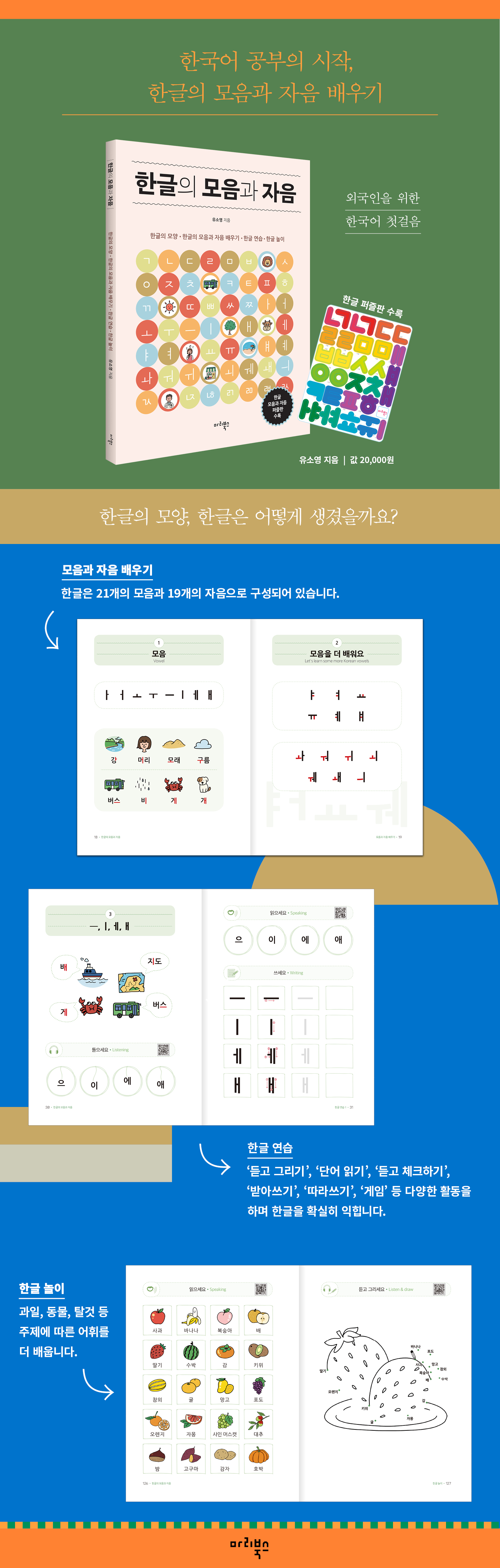
First, 'The Shape of Hangul' shows how consonants and vowels combine to form words.
In this unit, learners can learn the shapes and combinations of Hangul.
Next, in 'Learning Vowels and Consonants', we will look at vowels and consonants in their entirety.
It proceeds in the order of showing single vowels and words containing those vowels, followed by showing diphthongs.
At this time, the diphthongs have strokes of different colors, so you can see how the diphthongs are formed based on the single vowels.
Consonants also follow the same order.
After looking at both the vowels and consonants, I made a table so that you can see them at a glance.
‘Korean practice’ is the core of this book.
Learn how to pronounce and write each vowel and consonant, and thoroughly master Hangul through various activities such as ‘listen and draw,’ ‘read words,’ ‘listen and check,’ ‘dictation,’ ‘copy,’ and ‘games.’
The activities in this unit include a variety of activities, but care has been taken to develop listening, reading, and writing skills evenly.
In the final stage, 'Korean Language Play', you will learn more vocabulary based on themes such as fruits, animals, and vehicles.
This unit will help you build a solid foundation for learning Korean in earnest by learning vocabulary through activities.
Study Korean in three dimensions with the Korean puzzle board.
A book and puzzle board that can be used by anyone who wants to study Korean.
《Vowels and Consonants of Hangul》 consists of a book and a Hangul puzzle board as an appendix.
By making the Korean letters and vocabulary learned in the book into a puzzle board, I was able to study more enjoyably and remember them for a longer time.
By moving the vowels and consonants of the Korean alphabet in various ways on a puzzle board and creating vocabulary, you can study Korean in a three-dimensional way.
The puzzle board can be used by anyone who wants to learn Korean, including those studying Korean on their own, those studying with friends, and Korean language teachers who need teaching materials for their classes.
If you are studying Korean on your own, you can check your Korean language skills without looking at a book by mixing up the puzzle board, matching the names of vowels and consonants, and lining them up, or by making specific letters.
If you are studying Korean with someone else, you can have fun studying by playing games, such as competing to see who can put words together first or giving each other problems and having them create puzzles with the answers.
Korean language teachers are well-suited to using it as a teaching tool, including the various activities mentioned above.
In this way, with 《Korean Vowels and Consonants》, there is no need to purchase any additional auxiliary tools other than the book, and the effectiveness of the study can be further enhanced by utilizing the puzzle board.
GOODS SPECIFICS
- Date of issue: June 30, 2022
- Page count, weight, size: 148 pages | 508g | 188*257*20mm
- ISBN13: 9791189943813
- ISBN10: 1189943816
You may also like
카테고리
korean


korean

![GQ KOREA Mark (Monthly): December [2025]](http://librairie.coreenne.fr/cdn/shop/files/8ef265dbbfbf186523ed75ba7319009d.jpg?v=1765340328&width=3840)


