

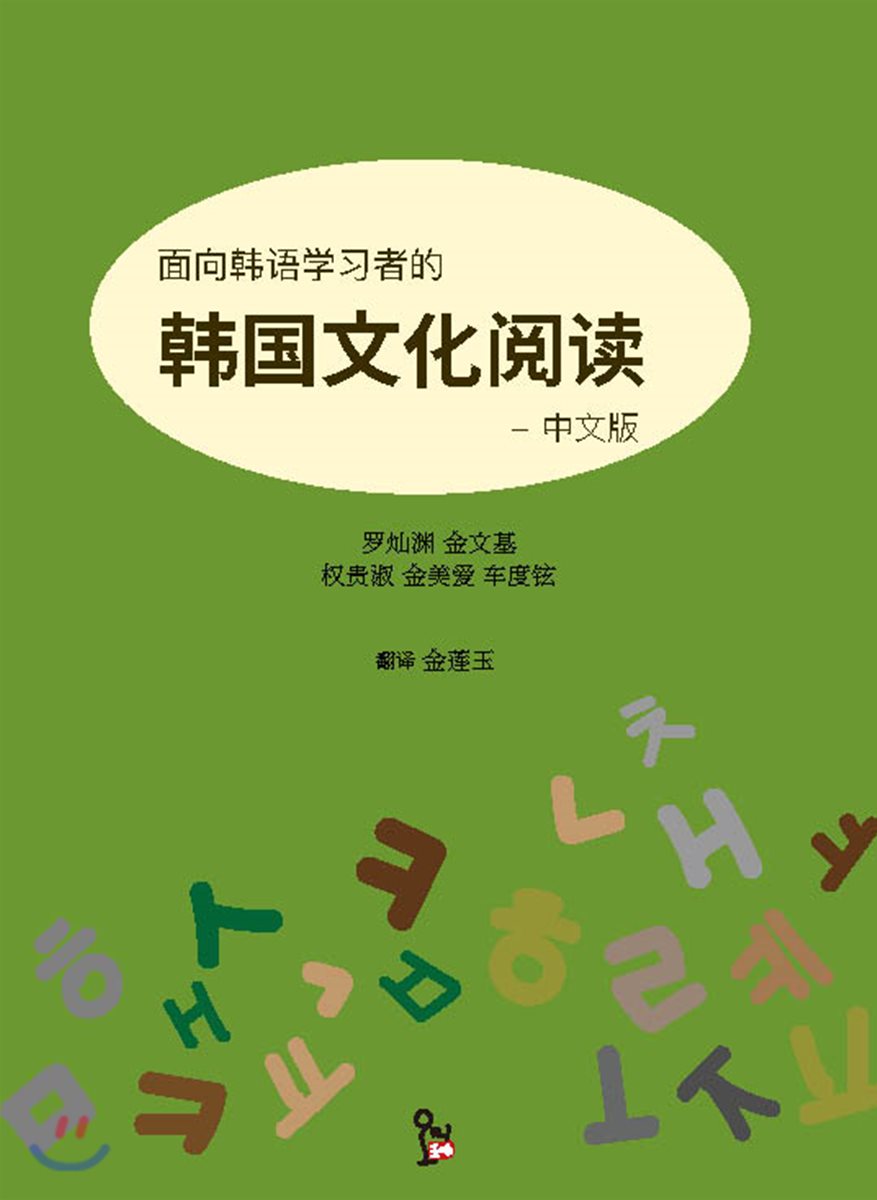
Korean Culture Reading for Korean Learners - Chinese
 |
Description
Book Introduction
The textbook, "Reading Korean Culture for Korean Language Learners," is organized into 12 chapters by topic.
Soon, 12 units were organized by topic: ① language culture, ② leisure culture, ③ food culture, ④ community culture, ⑤ regional culture, ⑥ culture of recent generations, ⑦ house culture, ⑧ play culture, ⑨ origin culture, ⑩ folk medical culture, ⑪ traditional music culture, and ⑫ printing culture.
This takes into account the fact that most universities conduct classes in 15-week units, but actual classes last about 12 weeks.
『Reading Korean Culture for Korean Language Learners』 is structured as follows for each sub-unit.
First, in the ‘Unit Introduction Activity’ section, ① the title of the sub-unit, ② learning objectives, and ③ a picture to stimulate motivation were presented.
Second, we presented learning text and set up a ‘thinking exercise’ to follow.
Third, in the ‘Unit Understanding Activities’ section, learning problems related to the content of the main text were presented so that learners could solve them themselves during the teaching-learning process.
Learning problems were presented in four types: ① problems measuring vocabulary, ② problems measuring text comprehension, ③ problems measuring writing ability, and ④ problems measuring speaking ability.
By working through these learning challenges with the teacher's assistance during class, learners can develop the ability to understand culturally relevant texts and solve the four types of learning challenges outlined above.
Soon, 12 units were organized by topic: ① language culture, ② leisure culture, ③ food culture, ④ community culture, ⑤ regional culture, ⑥ culture of recent generations, ⑦ house culture, ⑧ play culture, ⑨ origin culture, ⑩ folk medical culture, ⑪ traditional music culture, and ⑫ printing culture.
This takes into account the fact that most universities conduct classes in 15-week units, but actual classes last about 12 weeks.
『Reading Korean Culture for Korean Language Learners』 is structured as follows for each sub-unit.
First, in the ‘Unit Introduction Activity’ section, ① the title of the sub-unit, ② learning objectives, and ③ a picture to stimulate motivation were presented.
Second, we presented learning text and set up a ‘thinking exercise’ to follow.
Third, in the ‘Unit Understanding Activities’ section, learning problems related to the content of the main text were presented so that learners could solve them themselves during the teaching-learning process.
Learning problems were presented in four types: ① problems measuring vocabulary, ② problems measuring text comprehension, ③ problems measuring writing ability, and ④ problems measuring speaking ability.
By working through these learning challenges with the teacher's assistance during class, learners can develop the ability to understand culturally relevant texts and solve the four types of learning challenges outlined above.
- You can preview some of the book's contents.
Preview
index
Lesson 1 Language Life 9
Lesson 2 Leisure Culture 15
3 Food Compatibility 21
Life with 4 27
Lesson 5 Local Festivals 33
Lesson 6 Kangaroo Tribe and Tonk Tribe 39
Lesson 7: Traditional Houses 45
Lesson 8: Playing with Memories 51
Lesson 9 Origin Culture 57
Lesson 10: Folk Remedies 63
Lesson 11 Folk Music 69
Lesson 12 Print Culture 75
Appendix 82
Lesson 2 Leisure Culture 15
3 Food Compatibility 21
Life with 4 27
Lesson 5 Local Festivals 33
Lesson 6 Kangaroo Tribe and Tonk Tribe 39
Lesson 7: Traditional Houses 45
Lesson 8: Playing with Memories 51
Lesson 9 Origin Culture 57
Lesson 10: Folk Remedies 63
Lesson 11 Folk Music 69
Lesson 12 Print Culture 75
Appendix 82
Into the book
What is the main food eaten in your country? What ingredients are used to make it? ... ... Humans used to eat food to sustain life, but today, people eat food with health in mind.
Koreans also now consider food as a means of well-being.
Koreans believe that there is a 'compatibility' between the ingredients that go into food.
'Compatibility' is originally a method of fortune telling when two people get married to see if they can live well by making the best of each other's strengths and making up for each other's weaknesses.
The ingredients used in cooking are also beneficial to health when they are well-matched with each other.
On the other hand, if it is not, it may not be helpful to your health or may even harm your health. … …
Koreans also now consider food as a means of well-being.
Koreans believe that there is a 'compatibility' between the ingredients that go into food.
'Compatibility' is originally a method of fortune telling when two people get married to see if they can live well by making the best of each other's strengths and making up for each other's weaknesses.
The ingredients used in cooking are also beneficial to health when they are well-matched with each other.
On the other hand, if it is not, it may not be helpful to your health or may even harm your health. … …
--- From the text
GOODS SPECIFICS
- Date of publication: February 28, 2019
- Pages, weight, size: 143 pages | 410g | 190*260*10mm
- ISBN13: 9791196418977
- ISBN10: 1196418977
You may also like
카테고리
korean


korean

![GQ KOREA Mark (Monthly): December [2025]](http://librairie.coreenne.fr/cdn/shop/files/8ef265dbbfbf186523ed75ba7319009d.jpg?v=1765340328&width=3840)


