

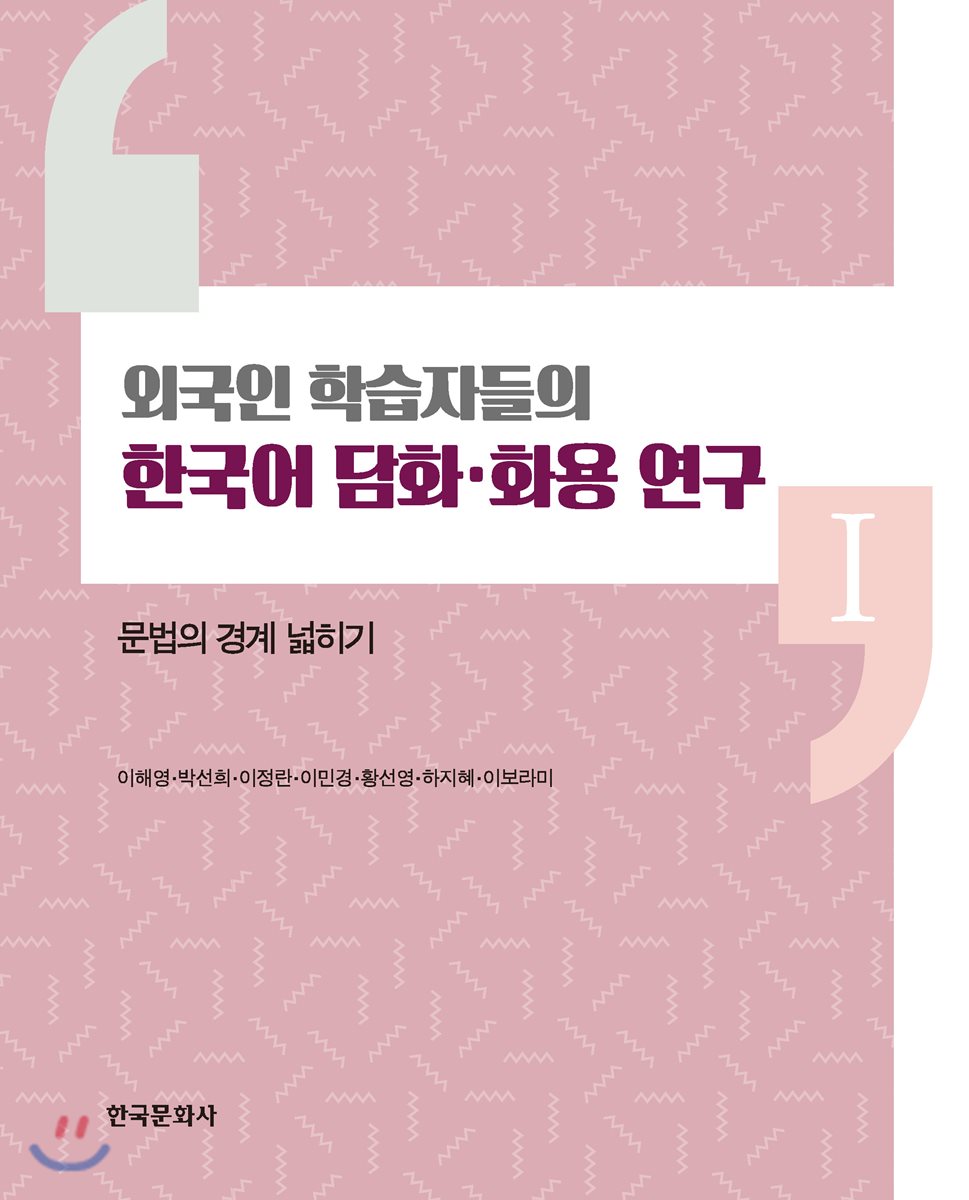
A Study on the Pragmatics of Korean Discourse by Foreign Learners 1
 |
Description
Book Introduction
In the past, both teachers and students of languages thought that learning vocabulary and grammar was sufficient.
But in today's world where face-to-face situations are on the rise, this alone is not enough.
Now, a splendid outing into discourse and pragmatics has begun in Korean language education.
This book contains the childish, ups and downs of researchers who are deeply immersed in these concerns.
Of course, the big dream of expanding the boundaries of grammar is contained in those trials and tribulations.
But in today's world where face-to-face situations are on the rise, this alone is not enough.
Now, a splendid outing into discourse and pragmatics has begun in Korean language education.
This book contains the childish, ups and downs of researchers who are deeply immersed in these concerns.
Of course, the big dream of expanding the boundaries of grammar is contained in those trials and tribulations.
- You can preview some of the book's contents.
Preview
index
prolog
Part 1: Expanding the Boundaries of Grammar
Pragmatic features of linguistic devices, politeness
1.
Discovering Mistakes and Problems of Korean Learners
2.
A shift in perspective from form to pragmatics
3.
Linguistic devices that convey politeness in Korean
4.
Meaning from form, conjugation endings, and politeness
5.
The Shift to Pragmatic Thinking and Subsequent Research
Acquisition of the semantic function of directives by English-speaking Korean learners
1.
Directives: The Long and Daunting Journey of Learning Korean
2.
Classification of Korean directives and semantic functions of directives
3.
The best method for research
4.
Korean native speakers and learners' use of directives
5.
Interpreting the Use of Directives by English-Speaking Learners of Korean
6.
Proposals and Prospects
Pragmatic Interpretation and Learner Understanding of Adverbial Position in Korean
1.
Difficulties Learners Face in Learning Adverbial Position
2.
Problems with the position of Korean adverbs
3.
The best method for research
4.
Korean learners' understanding of adverbial position
5.
Proposals and Prospects
Tense Acquisition by Chinese-Speaking Korean Learners from a Direct Perspective
1.
Time of concept, tense of expression
2.
The flow of research on tense acquisition
3.
The best method for research
4.
Tense recognition based on whether time and tense expressions match
5.
Use of tenses according to the topic of discourse
6.
Proposals and Prospects
The developmental relationship between grammatical and pragmatic abilities
1.
Grammar and pragmatics, inseparable
2.
Studies focusing on the relationship between grammatical and pragmatic abilities
3.
Characteristics of Korean modal expressions
4.
The best method for research
5.
The developmental relationship between grammatical and pragmatic abilities
6.
Suggestions and Outlook
Part 2: Looking at Discourse in Discourse
Substitute coagulation devices in the spoken and written texts of Chinese-speaking Korean learners.
1.
Condensers, their various expressions
2.
Footsteps of previous research on condensing devices
3.
Condensers and substitutes
4.
The best method for research
5.
A substitute coagulant in spoken and written texts
6.
Proposals and Prospects
Relational Cohesion in Korean Learner-Described Discourse
1.
Discourse as discourse, unexplained problem
2.
A New Perspective on Cohesion: Relational Cohesion
3.
The best method for research
4.
Using relational cohesion, the gap between learner and native speaker
5.
Learners' use of relational cohesion according to proficiency level
6.
Proposals and Prospects
?Epilogue
About the Author
?Source of the paper
Appendix 1: Key Terms
Appendix 2: Data Collection Methods in Discourse and Pragmatics Studies
Part 1: Expanding the Boundaries of Grammar
Pragmatic features of linguistic devices, politeness
1.
Discovering Mistakes and Problems of Korean Learners
2.
A shift in perspective from form to pragmatics
3.
Linguistic devices that convey politeness in Korean
4.
Meaning from form, conjugation endings, and politeness
5.
The Shift to Pragmatic Thinking and Subsequent Research
Acquisition of the semantic function of directives by English-speaking Korean learners
1.
Directives: The Long and Daunting Journey of Learning Korean
2.
Classification of Korean directives and semantic functions of directives
3.
The best method for research
4.
Korean native speakers and learners' use of directives
5.
Interpreting the Use of Directives by English-Speaking Learners of Korean
6.
Proposals and Prospects
Pragmatic Interpretation and Learner Understanding of Adverbial Position in Korean
1.
Difficulties Learners Face in Learning Adverbial Position
2.
Problems with the position of Korean adverbs
3.
The best method for research
4.
Korean learners' understanding of adverbial position
5.
Proposals and Prospects
Tense Acquisition by Chinese-Speaking Korean Learners from a Direct Perspective
1.
Time of concept, tense of expression
2.
The flow of research on tense acquisition
3.
The best method for research
4.
Tense recognition based on whether time and tense expressions match
5.
Use of tenses according to the topic of discourse
6.
Proposals and Prospects
The developmental relationship between grammatical and pragmatic abilities
1.
Grammar and pragmatics, inseparable
2.
Studies focusing on the relationship between grammatical and pragmatic abilities
3.
Characteristics of Korean modal expressions
4.
The best method for research
5.
The developmental relationship between grammatical and pragmatic abilities
6.
Suggestions and Outlook
Part 2: Looking at Discourse in Discourse
Substitute coagulation devices in the spoken and written texts of Chinese-speaking Korean learners.
1.
Condensers, their various expressions
2.
Footsteps of previous research on condensing devices
3.
Condensers and substitutes
4.
The best method for research
5.
A substitute coagulant in spoken and written texts
6.
Proposals and Prospects
Relational Cohesion in Korean Learner-Described Discourse
1.
Discourse as discourse, unexplained problem
2.
A New Perspective on Cohesion: Relational Cohesion
3.
The best method for research
4.
Using relational cohesion, the gap between learner and native speaker
5.
Learners' use of relational cohesion according to proficiency level
6.
Proposals and Prospects
?Epilogue
About the Author
?Source of the paper
Appendix 1: Key Terms
Appendix 2: Data Collection Methods in Discourse and Pragmatics Studies
Into the book
1. Discovering Mistakes and Problems of Korean Learners
Even intermediate to advanced learners who can communicate fluently in Korean often struggle to master the subtle language skills necessary for maintaining interpersonal relationships, making them prone to making numerous mistakes.
These mistakes can lead to misunderstandings and communication barriers, which can negatively impact your ability to maintain positive interpersonal relationships.
Let's look at the following examples of Korean language learners' speech and identify some of the more serious mistakes in Korean that could impact the maintenance and development of interpersonal relationships.
(1) Ciao: [Gonbu] Did you do a lot?
Woosung: No, I didn't do much.
(2) Elena: It's so hot, should we go get some ice cream?
Jeong-eun: Yes.
It's hot, so let's eat something cool.
(3) (In a situation where a teacher asks a student for a favor)
Teacher: Could you help me out for a bit after class today?
Hans: No.
I'm busy today.
(4) (In a situation where a student makes a suggestion to a teacher)
Peter: Teacher, let's have lunch.
Teacher: Oh, okay.
What seems to be the most serious mistake? In (1), Chao did not pronounce 'study' correctly but pronounced it as [gonbu], and in (2), Elena made a grammatical error by saying 'because it is hot' instead of 'because it is hot'.
(3) and (4) do not contain any specific phonetic, lexical, or grammatical errors.
However, in (3) and (4), a pragmatic failure occurred in which a foreign student used inappropriate expressions toward the teacher.
In (3), the student damaged the other person's face by using the socio-culturally inappropriate, assertive, and decisive expression "No," and in (4), the student damaged the other person's face by using the overly direct expression "-(으)ㅂし다" while suggesting a meal to a teacher of high social status and with a different age.
However, when actual Koreans encounter such pragmatic failures of learners, they may misunderstand them as a problem with the learner's personality or attitude rather than viewing them as a result of the learner's lack of Korean language knowledge (Lee Hae-young, 2009:226).
Neither the speaker nor the listener wants to damage their own face, nor do they want to damage the face of others.
In this way, conversations flow in a direction of maintaining face between each other, and to this end, speakers use various linguistic devices to show politeness in order to achieve the purpose of the conversation.
Lee Hae-young (1996:18) called the pragmatic function performed for the purpose of maintaining and promoting smooth interpersonal relationships between speakers and listeners burden reduction.
Politeness is so named because it focuses on the loss of face for the other person, but also on the speaker's face, which would be damaged if the statement were not true, rather than the other person's face.
However, this book focuses on the strategy of overcoming the threat to the other person's face, and discusses politeness in order to use universal terminology.
Brown & Levinson (1987:49) stated that politeness is a linguistic device of social relationships. Participants in a conversation display politeness to save face among themselves, and this is expressed as a linguistic device.
Linguistic devices at this time appear as phonological elements, vocabulary, and grammatical items that can be confirmed on the surface among the discourse segments that make up the discourse.
It also encompasses expressions used with pragmatic intent.
In uncovering what linguistic devices are used to express politeness, we focus on pragmatic intent that goes beyond the level of grammar or vocabulary.
Here, we need a shift in perspective, focusing on the functions that Korean grammar and lexical expressions, which have traditionally been dealt with from a morphological, syntactic, and semantic perspective, can play from a pragmatics perspective.
Korean language learners worry about using appropriate expressions when conversing with Koreans and want to know which linguistic devices are appropriate to use (Lee Hae-young, 2016:92).
However, if these linguistic devices are not properly learned, it is not easy to properly pronounce or understand them, because simply being exposed to the target language is not enough.
Bouton (1994:167) argues that educational intervention is important for learners to understand implicature.
Even after 17 months, non-native speakers still had difficulty understanding implicature types such as unmentioned criticism, chaining, POPE implicature, and relevance maxim.
Moreover, it was found that three of the four types of implicature were acquired only after four and a half years had passed (Lee Hae-young, 2015:250).
Ultimately, Korean language learners need to explicitly learn various linguistic devices to realize politeness.
These linguistic devices that learners need to learn explicitly are comprised of various levels within traditional grammar, ranging from phonological phenomena to morphemes, syntactic structures, discourse and pragmatic phenomena, and even the secondary linguistic features of spoken language that contribute to the transmission of emotions.
These seemingly diverse and heterogeneous expressions serve the same function in that they represent the speaker's attitude of politeness.
Examples of linguistic devices that express politeness in Korean include the endings of grammatical morphemes at the morphological level, and auxiliary verbs such as '주다', '보다', and '싶다', and discourse markers such as '거울', '좀', and '거기' at the lexical level.
At the syntactic level, passive sentences, indirect questions, and indirect quotations serve as devices to express politeness.
Meanwhile, at the discourse/pragmatic level, politeness can be expressed through omissions, indirect speech acts, implicatures, and rhetorical expressions.
This is presented in Chapter 3.
Based on the above argument, this paper examines the linguistic devices that express politeness as a learning item based on a doctoral dissertation published in 1996, focusing on the linguistic devices realized at the lexical and grammatical levels.
In other words, this paper will examine these linguistic devices from a perspective other than grammatical analysis, focusing on the fixed implicit meanings of grammatical forms and their pragmatic function of realizing politeness.
Even intermediate to advanced learners who can communicate fluently in Korean often struggle to master the subtle language skills necessary for maintaining interpersonal relationships, making them prone to making numerous mistakes.
These mistakes can lead to misunderstandings and communication barriers, which can negatively impact your ability to maintain positive interpersonal relationships.
Let's look at the following examples of Korean language learners' speech and identify some of the more serious mistakes in Korean that could impact the maintenance and development of interpersonal relationships.
(1) Ciao: [Gonbu] Did you do a lot?
Woosung: No, I didn't do much.
(2) Elena: It's so hot, should we go get some ice cream?
Jeong-eun: Yes.
It's hot, so let's eat something cool.
(3) (In a situation where a teacher asks a student for a favor)
Teacher: Could you help me out for a bit after class today?
Hans: No.
I'm busy today.
(4) (In a situation where a student makes a suggestion to a teacher)
Peter: Teacher, let's have lunch.
Teacher: Oh, okay.
What seems to be the most serious mistake? In (1), Chao did not pronounce 'study' correctly but pronounced it as [gonbu], and in (2), Elena made a grammatical error by saying 'because it is hot' instead of 'because it is hot'.
(3) and (4) do not contain any specific phonetic, lexical, or grammatical errors.
However, in (3) and (4), a pragmatic failure occurred in which a foreign student used inappropriate expressions toward the teacher.
In (3), the student damaged the other person's face by using the socio-culturally inappropriate, assertive, and decisive expression "No," and in (4), the student damaged the other person's face by using the overly direct expression "-(으)ㅂし다" while suggesting a meal to a teacher of high social status and with a different age.
However, when actual Koreans encounter such pragmatic failures of learners, they may misunderstand them as a problem with the learner's personality or attitude rather than viewing them as a result of the learner's lack of Korean language knowledge (Lee Hae-young, 2009:226).
Neither the speaker nor the listener wants to damage their own face, nor do they want to damage the face of others.
In this way, conversations flow in a direction of maintaining face between each other, and to this end, speakers use various linguistic devices to show politeness in order to achieve the purpose of the conversation.
Lee Hae-young (1996:18) called the pragmatic function performed for the purpose of maintaining and promoting smooth interpersonal relationships between speakers and listeners burden reduction.
Politeness is so named because it focuses on the loss of face for the other person, but also on the speaker's face, which would be damaged if the statement were not true, rather than the other person's face.
However, this book focuses on the strategy of overcoming the threat to the other person's face, and discusses politeness in order to use universal terminology.
Brown & Levinson (1987:49) stated that politeness is a linguistic device of social relationships. Participants in a conversation display politeness to save face among themselves, and this is expressed as a linguistic device.
Linguistic devices at this time appear as phonological elements, vocabulary, and grammatical items that can be confirmed on the surface among the discourse segments that make up the discourse.
It also encompasses expressions used with pragmatic intent.
In uncovering what linguistic devices are used to express politeness, we focus on pragmatic intent that goes beyond the level of grammar or vocabulary.
Here, we need a shift in perspective, focusing on the functions that Korean grammar and lexical expressions, which have traditionally been dealt with from a morphological, syntactic, and semantic perspective, can play from a pragmatics perspective.
Korean language learners worry about using appropriate expressions when conversing with Koreans and want to know which linguistic devices are appropriate to use (Lee Hae-young, 2016:92).
However, if these linguistic devices are not properly learned, it is not easy to properly pronounce or understand them, because simply being exposed to the target language is not enough.
Bouton (1994:167) argues that educational intervention is important for learners to understand implicature.
Even after 17 months, non-native speakers still had difficulty understanding implicature types such as unmentioned criticism, chaining, POPE implicature, and relevance maxim.
Moreover, it was found that three of the four types of implicature were acquired only after four and a half years had passed (Lee Hae-young, 2015:250).
Ultimately, Korean language learners need to explicitly learn various linguistic devices to realize politeness.
These linguistic devices that learners need to learn explicitly are comprised of various levels within traditional grammar, ranging from phonological phenomena to morphemes, syntactic structures, discourse and pragmatic phenomena, and even the secondary linguistic features of spoken language that contribute to the transmission of emotions.
These seemingly diverse and heterogeneous expressions serve the same function in that they represent the speaker's attitude of politeness.
Examples of linguistic devices that express politeness in Korean include the endings of grammatical morphemes at the morphological level, and auxiliary verbs such as '주다', '보다', and '싶다', and discourse markers such as '거울', '좀', and '거기' at the lexical level.
At the syntactic level, passive sentences, indirect questions, and indirect quotations serve as devices to express politeness.
Meanwhile, at the discourse/pragmatic level, politeness can be expressed through omissions, indirect speech acts, implicatures, and rhetorical expressions.
This is presented in Chapter 3.
Based on the above argument, this paper examines the linguistic devices that express politeness as a learning item based on a doctoral dissertation published in 1996, focusing on the linguistic devices realized at the lexical and grammatical levels.
In other words, this paper will examine these linguistic devices from a perspective other than grammatical analysis, focusing on the fixed implicit meanings of grammatical forms and their pragmatic function of realizing politeness.
--- From the text
Publisher's Review
In the facial expressions of foreign Korean learners conversing with Koreans, we see the struggle to choose the right words, as well as the traces of their struggle to choose the right words for the right situation.
Foreign learners of Korean often worry about how to speak without being rude, what expressions to use without offending the other person, and whether they are talking too much.
Moreover, Korean speech is so ambiguous, and full of instructions and omissions, it's truly difficult to understand.
In the past, both teachers and students of languages thought that learning vocabulary and grammar was sufficient.
But in today's world where face-to-face situations are on the rise, that alone is not enough.
Learners must quickly understand and respond to conversational techniques that reveal the speaker's intentions more through facial expressions or by beating around the bush.
What is most disturbing to learners and teachers alike is that individual vocabulary and grammar items are sometimes used as devices to reveal the speaker's intentions and to perform special functions in discourse.
We must now teach that neither grammatical forms, nor vocabulary, nor phonological phenomena are to be interpreted solely as they appear.
Now, a splendid outing into discourse and pragmatics has begun in Korean language education.
This book contains the childish, ups and downs of researchers who are deeply immersed in these concerns.
Of course, the big dream of expanding the boundaries of grammar is contained in those trials and tribulations.
The articles included in this book are a series of studies that the authors developed while teaching foreign students, ultimately leading to their doctoral dissertations.
Although these papers seem to focus on different topics, they share a commonality in that they attempt to break down the boundaries of the existing grammatical and lexical perspectives and shift the perspective to pragmatics.
This is in line with the change that occurred as language education shifted from a focus on form to improving communication skills.
A shift in perspective has occurred from analyzing the form of language to understanding the speaker's intentions, and as a result, researchers have become tasked with addressing various problems that cannot be resolved within sentences.
The key word in solving the problem was outside the sentence, in the context where the speaker exists.
The first paper in Part 1 is based on my doctoral dissertation written about 20 years ago.
As time passed, the writing style and format of the paper became worn out, like clothes that had fallen out of fashion, and there were many things that needed to be fixed, but I decided to include them in this collection of papers in order to share the starting point of recognizing the problem.
Although time has passed, I think the concerns of that time are still relevant today, as they started from the awareness that learning is difficult if you only deal with inflectional endings at a grammatical level, and the relationship between the form of a linguistic device and pragmatics is interpreted as the pragmatic meaning of fixed implications.
And the key to solving that problem was shared with other researchers in this book, who are my students.
Professor Park Seon-hee, who studied the acquisition of the semantic function of directives by Korean language learners, traces the layers of directives by expanding them to include not only the context but also the speaker's thoughts and speech patterns.
This paper can be said to be a pioneering study in the field of second language acquisition in that it attempts to elucidate the phenomenon of linguistic contextual variation in the language of Korean learners.
In addition, Professor Ha Ji-hye's thesis on Korean learners' understanding of adverbial position from the perspective of Korean language acquisition and Professor Hwang Seon-yeong's thesis on the acquisition of tenses by Chinese-speaking Korean learners from the perspective of deictic perspective also interpret adverbials and tense expressions from a discourse and pragmatic perspective beyond the grammatical perspective.
These attempts also began with the learners' need to learn about the context in which the speaker exists, a key keyword for solving the problem.
Discussing the close yet deviant relationship between grammar and pragmatics in this way raises the question of whether grammar or pragmatics comes first.
Professor Lee Jeong-ran's study on the developmental relationship between grammatical and pragmatic abilities through the acquisition of modal expressions by Korean language learners allows learners and teachers to dream of a balanced development of grammatical and pragmatic abilities.
If Part 1 discussed the deviation of grammatical expressions from discourse and pragmatics, Part 2 focused on discourse itself, and included papers by Professor Lee Min-kyung and Researcher Lee Bo-ra-mi that systematically analyzed the cohesion and coherence of discourse.
The two papers are interesting in that they interpret the common interest of discourse in different ways, demonstrating their connections as an academic community.
Above all, it has the significance of expanding the scope of research by focusing on the functions of language that were not resolved at the sentence level.
It is expected that this series of studies will continue to develop its links as it closely examines discourse, the linguistic resource of foreign learners of Korean.
Compared to a decade ago, the study of Korean language discourse and pragmatics by foreign learners has grown considerably.
But this tree still needs to establish its roots more firmly, and its trunk needs to grow and become more lush.
This book simply presents a group of studies that have expressed their interest in a simple way at the starting point.
I hope that research on the discourse and pragmatics of foreign learners of Korean will continue, expanding from a form-centered perspective that focused on sentences to a functional one.
Also, although this book is divided into two parts as a discourse, we look forward to seeing a series of splendid outings to Hwayong unfold in other pages in the future.
Foreign learners of Korean often worry about how to speak without being rude, what expressions to use without offending the other person, and whether they are talking too much.
Moreover, Korean speech is so ambiguous, and full of instructions and omissions, it's truly difficult to understand.
In the past, both teachers and students of languages thought that learning vocabulary and grammar was sufficient.
But in today's world where face-to-face situations are on the rise, that alone is not enough.
Learners must quickly understand and respond to conversational techniques that reveal the speaker's intentions more through facial expressions or by beating around the bush.
What is most disturbing to learners and teachers alike is that individual vocabulary and grammar items are sometimes used as devices to reveal the speaker's intentions and to perform special functions in discourse.
We must now teach that neither grammatical forms, nor vocabulary, nor phonological phenomena are to be interpreted solely as they appear.
Now, a splendid outing into discourse and pragmatics has begun in Korean language education.
This book contains the childish, ups and downs of researchers who are deeply immersed in these concerns.
Of course, the big dream of expanding the boundaries of grammar is contained in those trials and tribulations.
The articles included in this book are a series of studies that the authors developed while teaching foreign students, ultimately leading to their doctoral dissertations.
Although these papers seem to focus on different topics, they share a commonality in that they attempt to break down the boundaries of the existing grammatical and lexical perspectives and shift the perspective to pragmatics.
This is in line with the change that occurred as language education shifted from a focus on form to improving communication skills.
A shift in perspective has occurred from analyzing the form of language to understanding the speaker's intentions, and as a result, researchers have become tasked with addressing various problems that cannot be resolved within sentences.
The key word in solving the problem was outside the sentence, in the context where the speaker exists.
The first paper in Part 1 is based on my doctoral dissertation written about 20 years ago.
As time passed, the writing style and format of the paper became worn out, like clothes that had fallen out of fashion, and there were many things that needed to be fixed, but I decided to include them in this collection of papers in order to share the starting point of recognizing the problem.
Although time has passed, I think the concerns of that time are still relevant today, as they started from the awareness that learning is difficult if you only deal with inflectional endings at a grammatical level, and the relationship between the form of a linguistic device and pragmatics is interpreted as the pragmatic meaning of fixed implications.
And the key to solving that problem was shared with other researchers in this book, who are my students.
Professor Park Seon-hee, who studied the acquisition of the semantic function of directives by Korean language learners, traces the layers of directives by expanding them to include not only the context but also the speaker's thoughts and speech patterns.
This paper can be said to be a pioneering study in the field of second language acquisition in that it attempts to elucidate the phenomenon of linguistic contextual variation in the language of Korean learners.
In addition, Professor Ha Ji-hye's thesis on Korean learners' understanding of adverbial position from the perspective of Korean language acquisition and Professor Hwang Seon-yeong's thesis on the acquisition of tenses by Chinese-speaking Korean learners from the perspective of deictic perspective also interpret adverbials and tense expressions from a discourse and pragmatic perspective beyond the grammatical perspective.
These attempts also began with the learners' need to learn about the context in which the speaker exists, a key keyword for solving the problem.
Discussing the close yet deviant relationship between grammar and pragmatics in this way raises the question of whether grammar or pragmatics comes first.
Professor Lee Jeong-ran's study on the developmental relationship between grammatical and pragmatic abilities through the acquisition of modal expressions by Korean language learners allows learners and teachers to dream of a balanced development of grammatical and pragmatic abilities.
If Part 1 discussed the deviation of grammatical expressions from discourse and pragmatics, Part 2 focused on discourse itself, and included papers by Professor Lee Min-kyung and Researcher Lee Bo-ra-mi that systematically analyzed the cohesion and coherence of discourse.
The two papers are interesting in that they interpret the common interest of discourse in different ways, demonstrating their connections as an academic community.
Above all, it has the significance of expanding the scope of research by focusing on the functions of language that were not resolved at the sentence level.
It is expected that this series of studies will continue to develop its links as it closely examines discourse, the linguistic resource of foreign learners of Korean.
Compared to a decade ago, the study of Korean language discourse and pragmatics by foreign learners has grown considerably.
But this tree still needs to establish its roots more firmly, and its trunk needs to grow and become more lush.
This book simply presents a group of studies that have expressed their interest in a simple way at the starting point.
I hope that research on the discourse and pragmatics of foreign learners of Korean will continue, expanding from a form-centered perspective that focused on sentences to a functional one.
Also, although this book is divided into two parts as a discourse, we look forward to seeing a series of splendid outings to Hwayong unfold in other pages in the future.
GOODS SPECIFICS
- Date of issue: April 7, 2018
- Page count, weight, size: 424 pages | 830g | 190*235*21mm
- ISBN13: 9788968176210
- ISBN10: 8968176213
You may also like
카테고리
korean


korean

![GQ KOREA Mark (Monthly): December [2025]](http://librairie.coreenne.fr/cdn/shop/files/8ef265dbbfbf186523ed75ba7319009d.jpg?v=1765340328&width=3840)


