

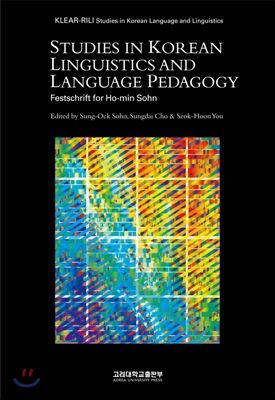
STUDIES IN KOREAN LINGUISTICS AND LANGUAGE PEDAGOGY
 |
Description
index
Preface
Contributors
Introduction
PART I KOREAN LINGUISTICS
1.
Korean Honorific Sentence Ending, -pnita:
Indexing of Knowledgeable Expert · Sumi Chang
2.
Semantic and Pragmatic Functions of Sentence Enders
-kwun and -ney in Korean · In Jung Cho and Young-A Cho
3. KULENIKKA as a Marker of Agreement and Disagreement · Jae-Eun Im
4.
The Classification of Compounds Revisited:
with Reference to Korean and English · Weon-Don Jeong
5.
Opacity: Back to Derivation? · Gyung-Ran Kim
6.
Common Grammatical Properties of World Englishes · Jeong-Ryeol Kim
7.
Double Evidential Marking in Korean Storytelling · Mary Shin Kim
8.
The Price of Politeness: Subject Honorification and Processing
· William O'Grady, On-Soon Lee, and Miho Choo
9.
The Grammaticalisation of -(u)l ke(s) in Korean · Duk-Soo Park
10.
Etymologies and Uncooperative Facts · S.
Robert Ramsey
11.
Dialogic Contexts for the Emergence of New Grammar:
The Case of Final -ketun in Korean · Sung-Ock Sohn
12.
The Mongolian Names for 'Korea' and 'Korean' and Their
Significance for the History of the Korean Language · Alexander Vovin
13.
Interactive Nature of the Korean Honorific Marker -yo · Sang-Seok Yoon
PART II KOREAN LANGUAGE PEDAGOGY
14.
Vocabulary Teaching and Learning in KFL Classroom Settings:
What To Know and How To Teach · Andrew Sangpil Byon
15.
Collaborative Writing with Concept Maps · Sungdai Cho and Yongjin Lee
16.
The Effect of Short Term Study Abroad Program on Proficiency Gains · Sahie Kang
17.
Globalization and Process of Transformation of Language of Korean Students in America · Hi-Sun H.
Kim
18.
Quest for Identity: Korea's Language and Culture on the World Stage · Young-Key Kim-Renaud
19.
Exploration of Applicability of Pilot 6.0 and Paradox 9.0 in KSL Research · Eun-Joo Lee
20.
Collocation Usage by Learners of Korean:
Analysis and Pedagogical Implications · Sang-suk Oh and Mi-Hyun Kim
21.
An Effective Way of Teaching Korean Obstruents to Beginning Learners · Mee-Jeong Park
22.
Cognitive Linguistics and Second Language Instruction
for Teaching Korean Postpositons -ey and -eyse · Ebru Tu?rker
23.
Trends and Issues in Korean Language and Culture Education
Research: A Comparative Study · Hye-Sook Wang
PART III KOREAN LANGUAGE PEDAGOGY AND GENERAL(WRITTEN IN KOREAN)
24.
A Study on Ways to Enhance Interaction in Online English Reading Classes
(The Acquisition of Korean Head-internal Relative Clauses by Korean Adults) · Sookeun Cho
25.
Conversation Analysis and Conversation Analytical Studies of the Korean Language
(Conversation Analysis and Conversation-Analytic Studies in Korean) · Haeyeon Kim
26.
Comments on Son Ho-min's The Korean Language (1999)
(A Review of The Korean Language) · Yong-Kun Ko
27.
The practice of detailed research and textbook development in Korean
(Research on Korean Text Elaboration and its Practice on Materials Development)
· Joint Pavilion (Dong-Kwan Kong)
28.
A Development of Korean Linguistics in North Korea · Jae-il Kwon
29.
Verb construction - Regarding the argument structure of '-하다'/do in Korean and English
(Light Verb '-hata'/do Constructions: In Relation to Argument Structure in Korean and English) · Chungmin Lee
30.
Proposal for Revision of the Indicator of the Standards for Korean Language Learning
━ Goal 4: Comparison, focusing on Standard 4.1
(Suggestions for the Revision of Indicators for Standards for Korean Language Learning) · Jeyseon Lee
31.
About the categories of Korean teacher grammar and learner grammar
(Categories of Teacher's and Learner's Grammar in Korean Language Pedagogy) · Pong-Ja Paik
32.
System and content of Korean language education grammar
━ Korean: Focusing on A Comprehensive Grammar (Yeon and Brown)
(Organization and Contents for Korean Pedagogical Grammar) · Jaehoon Yeon
33.
A Study on the Use of Team Protocol Methods to Activate Discussion Classes
(Team Protocol Method as an Effective Way of Enhancing Students' Participation
in the Discussion Session) · Seok-Hoon You Major Publications
Contributors
Introduction
PART I KOREAN LINGUISTICS
1.
Korean Honorific Sentence Ending, -pnita:
Indexing of Knowledgeable Expert · Sumi Chang
2.
Semantic and Pragmatic Functions of Sentence Enders
-kwun and -ney in Korean · In Jung Cho and Young-A Cho
3. KULENIKKA as a Marker of Agreement and Disagreement · Jae-Eun Im
4.
The Classification of Compounds Revisited:
with Reference to Korean and English · Weon-Don Jeong
5.
Opacity: Back to Derivation? · Gyung-Ran Kim
6.
Common Grammatical Properties of World Englishes · Jeong-Ryeol Kim
7.
Double Evidential Marking in Korean Storytelling · Mary Shin Kim
8.
The Price of Politeness: Subject Honorification and Processing
· William O'Grady, On-Soon Lee, and Miho Choo
9.
The Grammaticalisation of -(u)l ke(s) in Korean · Duk-Soo Park
10.
Etymologies and Uncooperative Facts · S.
Robert Ramsey
11.
Dialogic Contexts for the Emergence of New Grammar:
The Case of Final -ketun in Korean · Sung-Ock Sohn
12.
The Mongolian Names for 'Korea' and 'Korean' and Their
Significance for the History of the Korean Language · Alexander Vovin
13.
Interactive Nature of the Korean Honorific Marker -yo · Sang-Seok Yoon
PART II KOREAN LANGUAGE PEDAGOGY
14.
Vocabulary Teaching and Learning in KFL Classroom Settings:
What To Know and How To Teach · Andrew Sangpil Byon
15.
Collaborative Writing with Concept Maps · Sungdai Cho and Yongjin Lee
16.
The Effect of Short Term Study Abroad Program on Proficiency Gains · Sahie Kang
17.
Globalization and Process of Transformation of Language of Korean Students in America · Hi-Sun H.
Kim
18.
Quest for Identity: Korea's Language and Culture on the World Stage · Young-Key Kim-Renaud
19.
Exploration of Applicability of Pilot 6.0 and Paradox 9.0 in KSL Research · Eun-Joo Lee
20.
Collocation Usage by Learners of Korean:
Analysis and Pedagogical Implications · Sang-suk Oh and Mi-Hyun Kim
21.
An Effective Way of Teaching Korean Obstruents to Beginning Learners · Mee-Jeong Park
22.
Cognitive Linguistics and Second Language Instruction
for Teaching Korean Postpositons -ey and -eyse · Ebru Tu?rker
23.
Trends and Issues in Korean Language and Culture Education
Research: A Comparative Study · Hye-Sook Wang
PART III KOREAN LANGUAGE PEDAGOGY AND GENERAL(WRITTEN IN KOREAN)
24.
A Study on Ways to Enhance Interaction in Online English Reading Classes
(The Acquisition of Korean Head-internal Relative Clauses by Korean Adults) · Sookeun Cho
25.
Conversation Analysis and Conversation Analytical Studies of the Korean Language
(Conversation Analysis and Conversation-Analytic Studies in Korean) · Haeyeon Kim
26.
Comments on Son Ho-min's The Korean Language (1999)
(A Review of The Korean Language) · Yong-Kun Ko
27.
The practice of detailed research and textbook development in Korean
(Research on Korean Text Elaboration and its Practice on Materials Development)
· Joint Pavilion (Dong-Kwan Kong)
28.
A Development of Korean Linguistics in North Korea · Jae-il Kwon
29.
Verb construction - Regarding the argument structure of '-하다'/do in Korean and English
(Light Verb '-hata'/do Constructions: In Relation to Argument Structure in Korean and English) · Chungmin Lee
30.
Proposal for Revision of the Indicator of the Standards for Korean Language Learning
━ Goal 4: Comparison, focusing on Standard 4.1
(Suggestions for the Revision of Indicators for Standards for Korean Language Learning) · Jeyseon Lee
31.
About the categories of Korean teacher grammar and learner grammar
(Categories of Teacher's and Learner's Grammar in Korean Language Pedagogy) · Pong-Ja Paik
32.
System and content of Korean language education grammar
━ Korean: Focusing on A Comprehensive Grammar (Yeon and Brown)
(Organization and Contents for Korean Pedagogical Grammar) · Jaehoon Yeon
33.
A Study on the Use of Team Protocol Methods to Activate Discussion Classes
(Team Protocol Method as an Effective Way of Enhancing Students' Participation
in the Discussion Session) · Seok-Hoon You Major Publications
Publisher's Review
Studies in Korean Linguistics and Language Pedagogy is the festschrift commemorates Professor Sohn's achievement for his scholarship in Korean linguistics and language pedagogy for the past 42 years.
It is a collaborative product of Prof.
Sohn's close colleagues and former students in honor of his lifelong contribution to promoting Korean linguistics and Korean as a foreign language worldwide.
Composed of three parts: Korean Linguistics, Korean Language Pedagogy, Korean Language Pedagogy and General (written in Korean), it covers the essential aspects of Korean linguistics and Korean language pedagogy, such as phonetics, phonology, discourse analysis, socio-pragmatics, honorifics, grammaticalization, historical linguistics, vocabulary teaching and learning, collocation usage, linguistic research in North Korea, Korean pedagogical grammar.
It is a collaborative product of Prof.
Sohn's close colleagues and former students in honor of his lifelong contribution to promoting Korean linguistics and Korean as a foreign language worldwide.
Composed of three parts: Korean Linguistics, Korean Language Pedagogy, Korean Language Pedagogy and General (written in Korean), it covers the essential aspects of Korean linguistics and Korean language pedagogy, such as phonetics, phonology, discourse analysis, socio-pragmatics, honorifics, grammaticalization, historical linguistics, vocabulary teaching and learning, collocation usage, linguistic research in North Korea, Korean pedagogical grammar.
GOODS SPECIFICS
- Date of issue: October 31, 2013
- Format: Hardcover book binding method guide
- Page count, weight, size: 616 pages | 1,115g | 153*224*35mm
- ISBN13: 9788976418302
- ISBN10: 8976418301
You may also like
카테고리
korean


korean

![GQ KOREA Mark (Monthly): December [2025]](http://librairie.coreenne.fr/cdn/shop/files/8ef265dbbfbf186523ed75ba7319009d.jpg?v=1765340328&width=3840)


