

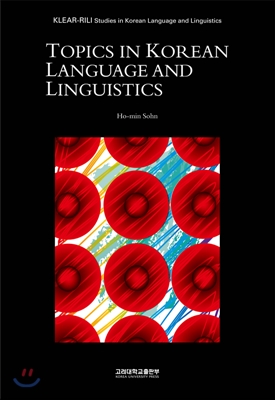
TOPICS IN KOREAN LANGUAGE AND LINGUISTICS
 |
Description
index
Preface
List of Abbreviations
Table of Romanization Systems
PART I LINGUISTIC AND PEDAGOGICAL OVERVIEW
1.
Salient Features of Korean
2.
Middle Korean
3.
Modern Korean
4.
The History and Future of Korean Language Education in the United States
5.
The Current State and Future of Korean Language Education for Overseas Koreans
6.
Current Issues in Korean Language Education and Korean Studies at Overseas Universities
PART II STRUCTURAL DYNAMISM
7.
Typological characteristics of the Korean language
8.
The Adjective Class in Korean
9.
Semantics of Clause Linking in Korean
10.
Grammaticalization and Semantic Shift
11.
Functional Shift in Case Stacking in Korean
12.
Reanalysis in Korean Complex Predicate Constructions: Causative Derivation
13.
A Grammar of Po- 'see' in Korean: A Pan-Chronic Approach
14.
An Emergent Category of Interpersonal Modal Endings in Korean
15.
Evolution of Addressee Honorifics in Korean
PART III SOCIOLINGUISTIC AND PRAGMATIC ISSUES
16.
Korean in Culture and Society: An Introduction
17.
Language Purification Movements in the Two Koreas
18.
Orthographic Divergence in South and North Korea: Toward a Unified Spelling System
19.
Korean in Contact with Chinese
20.
Politeness Strategies in Korean
21.
Honorific Patterns in Korean
22.
Honorific Agreement in Korean
23.
Politeness Formulas in L2 Acquisition: An Intercultural Perspective
24.
Politeness as a Cause of Linguistic Change in Korean
25.
Strategies of Indirection in Language
PART IV TEACHING KOREAN AS A FOREIGN LANGUAGE
26.
Sociolinguistic and Pragmatic Appropriateness in Proficiency-oriented Korean Language Instruction
27.
Korean Proficiency Guidelines: Needs, Procedures, Principles and Implications
28.
Performance-based Principles and Proficiency Criteria for KFL Textbook Development
29.
Curricular Goals and Content Standards for K-16 Korean Language Learning
30.
Korean Flagship: A New Frontier for Advanced Language Study
31.
Current Issues in Korean Language Education in the United States and Leading, Innovative Responses
32.
Analysis of the Status of Korean Community Schools in Hawaii · Son Ho-min, Heo So-rin, and Choi Yun-hwa
33.
Toward K-16 Articulation for Advanced Korean Language Learning
· Ho-Min Sohn, Hee-Jeong Jeong, and Miyung Park
34.
Evolution of the Korean Program at the University of Hawaii at Manoa: A Narrative History
Index
List of Abbreviations
Table of Romanization Systems
PART I LINGUISTIC AND PEDAGOGICAL OVERVIEW
1.
Salient Features of Korean
2.
Middle Korean
3.
Modern Korean
4.
The History and Future of Korean Language Education in the United States
5.
The Current State and Future of Korean Language Education for Overseas Koreans
6.
Current Issues in Korean Language Education and Korean Studies at Overseas Universities
PART II STRUCTURAL DYNAMISM
7.
Typological characteristics of the Korean language
8.
The Adjective Class in Korean
9.
Semantics of Clause Linking in Korean
10.
Grammaticalization and Semantic Shift
11.
Functional Shift in Case Stacking in Korean
12.
Reanalysis in Korean Complex Predicate Constructions: Causative Derivation
13.
A Grammar of Po- 'see' in Korean: A Pan-Chronic Approach
14.
An Emergent Category of Interpersonal Modal Endings in Korean
15.
Evolution of Addressee Honorifics in Korean
PART III SOCIOLINGUISTIC AND PRAGMATIC ISSUES
16.
Korean in Culture and Society: An Introduction
17.
Language Purification Movements in the Two Koreas
18.
Orthographic Divergence in South and North Korea: Toward a Unified Spelling System
19.
Korean in Contact with Chinese
20.
Politeness Strategies in Korean
21.
Honorific Patterns in Korean
22.
Honorific Agreement in Korean
23.
Politeness Formulas in L2 Acquisition: An Intercultural Perspective
24.
Politeness as a Cause of Linguistic Change in Korean
25.
Strategies of Indirection in Language
PART IV TEACHING KOREAN AS A FOREIGN LANGUAGE
26.
Sociolinguistic and Pragmatic Appropriateness in Proficiency-oriented Korean Language Instruction
27.
Korean Proficiency Guidelines: Needs, Procedures, Principles and Implications
28.
Performance-based Principles and Proficiency Criteria for KFL Textbook Development
29.
Curricular Goals and Content Standards for K-16 Korean Language Learning
30.
Korean Flagship: A New Frontier for Advanced Language Study
31.
Current Issues in Korean Language Education in the United States and Leading, Innovative Responses
32.
Analysis of the Status of Korean Community Schools in Hawaii · Son Ho-min, Heo So-rin, and Choi Yun-hwa
33.
Toward K-16 Articulation for Advanced Korean Language Learning
· Ho-Min Sohn, Hee-Jeong Jeong, and Miyung Park
34.
Evolution of the Korean Program at the University of Hawaii at Manoa: A Narrative History
Index
Publisher's Review
This book is an anthology of selected papers on Korean language and linguistics that Ho-min Sohn, Professor of Korean linguistics and Director of the Korean Language Flagship Center at the University of Hawaii at Manoa (UHM) and President of the Korean Language Education and Research Center, Inc., have written for academic conferences, journals, and/or chapters in edited books during the past twenty odd years.
A total of thirty-four papers were selected to encompass topics on diverse aspects of Korean language and linguistics.
These papers are topically classified into four major categories: (a) linguistic and pedagogical overview, (b) structural dynamism, (c) sociolinguistic and pragmatic issues, and (d) teaching Korean as a foreign language.
A total of thirty-four papers were selected to encompass topics on diverse aspects of Korean language and linguistics.
These papers are topically classified into four major categories: (a) linguistic and pedagogical overview, (b) structural dynamism, (c) sociolinguistic and pragmatic issues, and (d) teaching Korean as a foreign language.
GOODS SPECIFICS
- Date of issue: October 31, 2013
- Format: Hardcover book binding method guide
- Page count, weight, size: 791 pages | 1,384g | 153*224*40mm
- ISBN13: 9788976418326
- ISBN10: 8976418328
You may also like
카테고리
korean


korean

![GQ KOREA Mark (Monthly): December [2025]](http://librairie.coreenne.fr/cdn/shop/files/8ef265dbbfbf186523ed75ba7319009d.jpg?v=1765340328&width=3840)


