

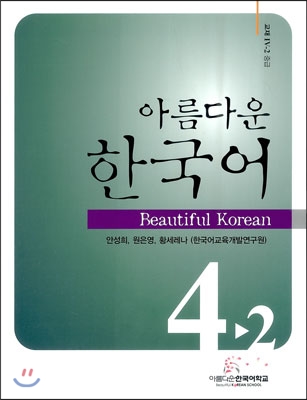
Beautiful Korean Intermediate 4-2 Textbook
 |
Description
Book Introduction
『Beautiful Korean 4-2』 consists of 8 lessons and is designed to fit 100 hours of Korean language classes.
This textbook includes a variety of task activities similar to real-life situations, targeting communication skills.
Additionally, the textbooks for each subject are divided into five sections, with each section subdivided into sub-sections under the same subject.
The four parts of the assignment, excluding writing, are designed to avoid overlapping subtopics, allowing teachers to teach as independent areas, which will increase learners' curiosity and enjoyment.
From stage 4, all assignment activities are divided into three stages: pre-activity, main activity, and post-activity, allowing for more diverse activities and allowing students to focus on activities such as speaking, listening, and reading.
By establishing key characters and developing a consistent story, we aim to keep learners engaged. New characters introduced in Beautiful Korean Level 3 continue to further develop the story.
The listening CD is organized in the order of ‘Speaking 1’ and ‘Listening 2’ in the textbook.
This textbook includes a variety of task activities similar to real-life situations, targeting communication skills.
Additionally, the textbooks for each subject are divided into five sections, with each section subdivided into sub-sections under the same subject.
The four parts of the assignment, excluding writing, are designed to avoid overlapping subtopics, allowing teachers to teach as independent areas, which will increase learners' curiosity and enjoyment.
From stage 4, all assignment activities are divided into three stages: pre-activity, main activity, and post-activity, allowing for more diverse activities and allowing students to focus on activities such as speaking, listening, and reading.
By establishing key characters and developing a consistent story, we aim to keep learners engaged. New characters introduced in Beautiful Korean Level 3 continue to further develop the story.
The listening CD is organized in the order of ‘Speaking 1’ and ‘Listening 2’ in the textbook.
index
Lesson 1 Education
Lesson 2: Work Life
Lesson 3 Differences
Lesson 4 Environment
Lesson 5 Religion
Lesson 6: Old Stories
Lesson 7: People
Lesson 8 Multicultural Society
Lesson 2: Work Life
Lesson 3 Differences
Lesson 4 Environment
Lesson 5 Religion
Lesson 6: Old Stories
Lesson 7: People
Lesson 8 Multicultural Society
Publisher's Review
The composition of a beautiful Korean language textbook
Beginner (Level 1-2)
Level 1 textbook
Can perform basic language functions necessary for survival, such as introducing oneself, buying things, and ordering food.
They can also understand and express simple content related to very personal and familiar topics such as themselves, their families, and the weather.
You can create simple sentences based on an understanding of about 800 basic vocabulary words and basic grammar.
Additionally, you can understand and compose simple everyday and practical texts.
You can read simple everyday texts such as diaries, letters, memos, and receipts, and understand the content and information.
Topics: learning consonants and vowels, greetings, introductions, weekends, locations, numbers, shopping, places, dates, daily routines, past vacations, transportation, using the subway, directions, appointments, restaurants, ordering, phone calls, weather, seasons, travel, honorifics, birthdays
Level 2 textbook
Able to perform basic language functions necessary for daily life, such as making phone calls, making requests, and making suggestions, as well as using public facilities such as post offices, banks, and hospitals.
Using approximately 1,500 to 2,000 words, you can understand and express content related to personal and familiar topics such as work, hobbies, and appointments.
You can use language differently in formal and informal situations.
You can write about everyday and familiar topics, and write practical texts such as simple notes, letters, and notices.
Topics: Hobbies, company dinners, shopping, exchanges, field trips, suggestions (requests), permission and prohibition, honorifics, plans, concerns and advice, wishes (hopes), finding a home, skills, reservations, banking, transportation (directions), visits, graduation ceremonies
Intermediate (Level 3-4)
Level 3 textbook
I don't have much difficulty conducting my daily life in Korean.
Able to perform basic language functions such as explaining, describing, and refusing, which are necessary for using public facilities such as immigration offices and travel agencies and maintaining social relationships.
You can express or understand familiar social topics such as occupations, events, countries, and lifestyle culture in paragraph units, as well as personal topics that are familiar to you.
You can understand and use the basic characteristics of written and spoken language.
You can listen to practical conversations such as advertisements, interviews, and weather forecasts and understand the general content.
Topics: Health, post office, cooking, appearance? personality, lifestyle information, interview? interview, pharmacy, news, old stories, festival dreams, repairs, hospital, anniversary, weather and life, marriage, public facilities, housewarming, newspaper, television
Level 4 textbook
Can perform most language functions necessary for using public facilities and maintaining social relationships, and can perform some of the functions necessary for performing general tasks, such as writing simple documents and reporting.
Also, you can understand relatively simple content from news and newspaper articles.
Able to understand and express familiar social and abstract material relatively accurately and fluently.
Based on frequently used idiomatic expressions and an understanding of representative Korean culture, you can understand and express socio-cultural content. You can read explanatory texts, editorials, and other texts on economics, society, and culture, and understand or infer the content.
You can read practical texts such as contracts, user manuals, advertisements, and guides and understand specific information.
Topics: food, clothing, shelter, street culture, fashion, holidays, communication, consumer life, transportation, performances, education, work life, differences, environment, religion, old stories, people, multiculturalism
Advanced (Level 5-6)
Level 5 textbook
Able to perform to some extent the language functions necessary for research or work in one's field of expertise, such as summarizing, arguing, inferring, and discussing.
Able to generally understand and express unfamiliar topics across politics, economics, society, and culture.
You can use language appropriately in formal and informal contexts and in spoken and written language, and understand and compose essays, reports, literary works, conversations, and discussions.
You can read and understand the content of essays, reports, editorials, and other writings on topics such as politics, economics, society, and science.
Can read relatively easy literary works such as poetry and novels and understand their contents.
You can listen to lectures and discussions that cover familiar social and abstract topics and get a general understanding of the content.
You can listen to a discourse dealing with social and abstract topics and understand the speaker's intention or infer the content.
You can listen to speeches given in special situations, such as wedding speeches and memorial speeches, and understand the general content.
Topics: Symbols, appearance, aging issues, future society, ethics and morals, leisure culture, marriage, science and technology, sharing society, literature, etc.
6th grade textbook
Able to perform language functions necessary for research or work in one's field of expertise with relative accuracy and fluency, and able to understand and express unfamiliar material across politics, economics, society, and culture.
Although they do not reach the level of native speakers, they do not have difficulty performing most functions or expressing meaning.
You can read texts such as explanatory notes or editorials and understand their contents.
You can read representative works of Korean literature such as essays, novels, and plays, understand the situations and characters' psychology, and listen to most news, broadcasts, lectures, conversations, and discussions, and understand or infer the content.
Topics: mass media, folklore, family, sports, science, culture and art, history, philosophy, economics, inter-Korean issues, culture, tradition, women and society, film, literature, etc.
Beautiful Korean Language Textbook and the Test of Proficiency in Korean (TOPIK)
The Beautiful Korean Language textbook is divided into 6 levels, which are the same as the levels of the Test of Proficiency in Korean (TOPIK).
Therefore, students taking the exam at each level can look at the same parts of the Beautiful Korean textbook.
The test is now divided into beginner, intermediate, and advanced levels, so students who have studied Beautiful Korean Level 2 will be able to take the beginner test.
Beginner (Level 1-2)
Level 1 textbook
Can perform basic language functions necessary for survival, such as introducing oneself, buying things, and ordering food.
They can also understand and express simple content related to very personal and familiar topics such as themselves, their families, and the weather.
You can create simple sentences based on an understanding of about 800 basic vocabulary words and basic grammar.
Additionally, you can understand and compose simple everyday and practical texts.
You can read simple everyday texts such as diaries, letters, memos, and receipts, and understand the content and information.
Topics: learning consonants and vowels, greetings, introductions, weekends, locations, numbers, shopping, places, dates, daily routines, past vacations, transportation, using the subway, directions, appointments, restaurants, ordering, phone calls, weather, seasons, travel, honorifics, birthdays
Level 2 textbook
Able to perform basic language functions necessary for daily life, such as making phone calls, making requests, and making suggestions, as well as using public facilities such as post offices, banks, and hospitals.
Using approximately 1,500 to 2,000 words, you can understand and express content related to personal and familiar topics such as work, hobbies, and appointments.
You can use language differently in formal and informal situations.
You can write about everyday and familiar topics, and write practical texts such as simple notes, letters, and notices.
Topics: Hobbies, company dinners, shopping, exchanges, field trips, suggestions (requests), permission and prohibition, honorifics, plans, concerns and advice, wishes (hopes), finding a home, skills, reservations, banking, transportation (directions), visits, graduation ceremonies
Intermediate (Level 3-4)
Level 3 textbook
I don't have much difficulty conducting my daily life in Korean.
Able to perform basic language functions such as explaining, describing, and refusing, which are necessary for using public facilities such as immigration offices and travel agencies and maintaining social relationships.
You can express or understand familiar social topics such as occupations, events, countries, and lifestyle culture in paragraph units, as well as personal topics that are familiar to you.
You can understand and use the basic characteristics of written and spoken language.
You can listen to practical conversations such as advertisements, interviews, and weather forecasts and understand the general content.
Topics: Health, post office, cooking, appearance? personality, lifestyle information, interview? interview, pharmacy, news, old stories, festival dreams, repairs, hospital, anniversary, weather and life, marriage, public facilities, housewarming, newspaper, television
Level 4 textbook
Can perform most language functions necessary for using public facilities and maintaining social relationships, and can perform some of the functions necessary for performing general tasks, such as writing simple documents and reporting.
Also, you can understand relatively simple content from news and newspaper articles.
Able to understand and express familiar social and abstract material relatively accurately and fluently.
Based on frequently used idiomatic expressions and an understanding of representative Korean culture, you can understand and express socio-cultural content. You can read explanatory texts, editorials, and other texts on economics, society, and culture, and understand or infer the content.
You can read practical texts such as contracts, user manuals, advertisements, and guides and understand specific information.
Topics: food, clothing, shelter, street culture, fashion, holidays, communication, consumer life, transportation, performances, education, work life, differences, environment, religion, old stories, people, multiculturalism
Advanced (Level 5-6)
Level 5 textbook
Able to perform to some extent the language functions necessary for research or work in one's field of expertise, such as summarizing, arguing, inferring, and discussing.
Able to generally understand and express unfamiliar topics across politics, economics, society, and culture.
You can use language appropriately in formal and informal contexts and in spoken and written language, and understand and compose essays, reports, literary works, conversations, and discussions.
You can read and understand the content of essays, reports, editorials, and other writings on topics such as politics, economics, society, and science.
Can read relatively easy literary works such as poetry and novels and understand their contents.
You can listen to lectures and discussions that cover familiar social and abstract topics and get a general understanding of the content.
You can listen to a discourse dealing with social and abstract topics and understand the speaker's intention or infer the content.
You can listen to speeches given in special situations, such as wedding speeches and memorial speeches, and understand the general content.
Topics: Symbols, appearance, aging issues, future society, ethics and morals, leisure culture, marriage, science and technology, sharing society, literature, etc.
6th grade textbook
Able to perform language functions necessary for research or work in one's field of expertise with relative accuracy and fluency, and able to understand and express unfamiliar material across politics, economics, society, and culture.
Although they do not reach the level of native speakers, they do not have difficulty performing most functions or expressing meaning.
You can read texts such as explanatory notes or editorials and understand their contents.
You can read representative works of Korean literature such as essays, novels, and plays, understand the situations and characters' psychology, and listen to most news, broadcasts, lectures, conversations, and discussions, and understand or infer the content.
Topics: mass media, folklore, family, sports, science, culture and art, history, philosophy, economics, inter-Korean issues, culture, tradition, women and society, film, literature, etc.
Beautiful Korean Language Textbook and the Test of Proficiency in Korean (TOPIK)
The Beautiful Korean Language textbook is divided into 6 levels, which are the same as the levels of the Test of Proficiency in Korean (TOPIK).
Therefore, students taking the exam at each level can look at the same parts of the Beautiful Korean textbook.
The test is now divided into beginner, intermediate, and advanced levels, so students who have studied Beautiful Korean Level 2 will be able to take the beginner test.
GOODS SPECIFICS
- Date of issue: July 12, 2012
- Page count, weight, size: 159 pages | 436g | 188*254*20mm
- ISBN13: 9788991869752
- ISBN10: 8991869750
You may also like
카테고리
korean


korean

![GQ KOREA Mark (Monthly): December [2025]](http://librairie.coreenne.fr/cdn/shop/files/8ef265dbbfbf186523ed75ba7319009d.jpg?v=1765340328&width=3840)


