

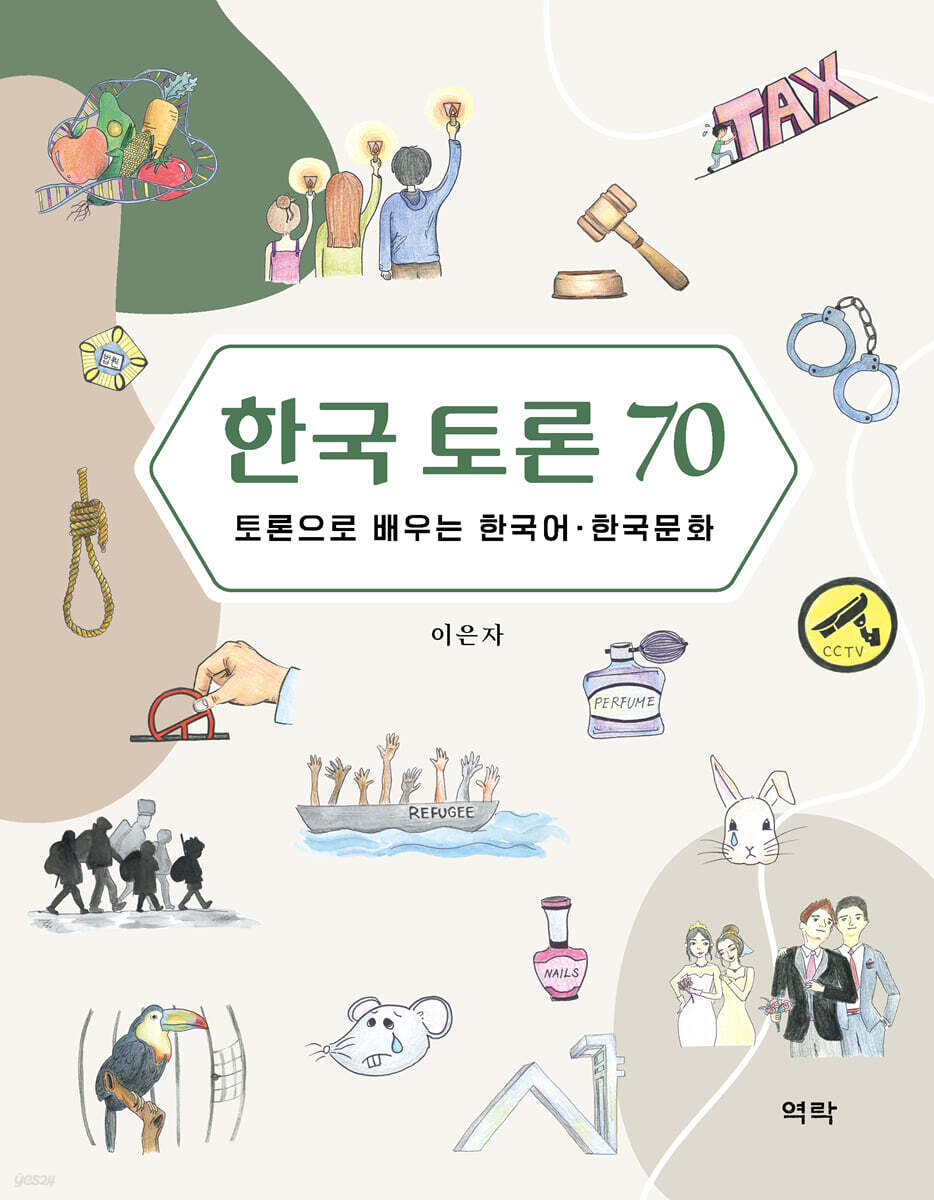
Korean Debate 70
 |
Description
Book Introduction
『Korean Debate 70 - Learning Korean and Culture through Debate』 was created for foreign learners of the Korean language.
The 70 discussions in this book are the most frequently discussed topics among Koreans in recent years, and by looking at the topics of discussion, you can get an idea of the problems Koreans are trying to solve.
Of course, many of these topics are of interest not only to Koreans but to people all over the world.
This book serves as a virtual meal planner for foreign learners of Korean.
However, it is not advisable to just hold a spoon and parrot the basis of the discussion.
Please find specific evidence, organize it, and put it into your own thoughts and words.
The 70 discussions in this book are the most frequently discussed topics among Koreans in recent years, and by looking at the topics of discussion, you can get an idea of the problems Koreans are trying to solve.
Of course, many of these topics are of interest not only to Koreans but to people all over the world.
This book serves as a virtual meal planner for foreign learners of Korean.
However, it is not advisable to just hold a spoon and parrot the basis of the discussion.
Please find specific evidence, organize it, and put it into your own thoughts and words.
index
04 At the beginning of the book
How to Use Books 07
Before discussing 13
Discussion Topic Selection Criteria 14
Type 16 of Debate Topics
17 Korean Expressions Commonly Used in Debates
Part 1: Ethics and Morality 21
01 Human nature is good.
22
02 A euthanasia system must be introduced.
26
03 Abortion should be legalized.
30
04 Animal testing in cosmetics development should be banned.
34
05 It is a good thing to give alms to beggars.
38
06 Good Samaritan laws must be introduced.
42
07 White lies are necessary.
46
Korean Religion and Religious Culture 50
Part 2 Politics and Society 53
08 The political participation of religious people must be regulated.
54
09 Korea must be unified with North and South Korea.
58
President of South Korea 62
10 The voting age should be reconsidered.
64
11 Freedom of assembly must be restricted.
68
Korean Rally and Protest Culture 72
12 English should be made the official language.
74
13 Refugee acceptance policy must be expanded.
78
Part 3: Economics 83
14 Religious people should be taxed.
84
15 Cryptocurrencies are objects of speculation.
It needs to be regulated.
88
16 Retirement age should be extended.
92
17 Indirect TV advertising should be banned.
96
18 The tax on the wealthy must be expanded and strengthened.
100
19 Non-regular workers in public institutions must be converted to regular workers.
104
20 The minimum wage must be raised.
108
Golden Spoon, Dirt Spoon, and Spoon Class Theory 112
Part 4 Education 115
21 The humanities and sciences must be integrated.
116
22 The university's academic excellence scholarships should be abolished.
120
23 School uniforms should be liberalized.
124
24. Corporal punishment in educational settings must be completely banned.
128
25 Universities should allow donation-based admissions.
132
26 Special admissions for celebrities should be allowed.
136
27 Early English education should be banned.
140
28 The mandatory volunteer service system must be abolished.
144
29. Relative evaluation of universities should be abolished.
148
30 Schools should implement a Sunday closing system.
152
Korea's Education System and Educational Fever 156
Part 5 Law and Crime 159
31 The death penalty must be abolished.
160
32 Prostitution should be legalized.
164
33 Chemical castration of sex offenders should be expanded across the board.
168
34 Adultery must be resurrected.
172
Korean Sexual Culture 176
35 The age of criminal punishment for juveniles should be lowered.
178
36. The statute of limitations for murder must be abolished.
182
37 CCTV installation in operating rooms should be expanded.
186
Part 6 Military Service 191
38 A conscription system must be introduced.
192
39 Conscientious objection to military service must be recognized.
196
The 40-year military service bonus point system should be introduced.
200
41 The special military service exemption for sports players should be abolished.
204
The Korean Military and Military Culture 208
Part 7 Marriage and Family 211
42 Premarital cohabitation is desirable.
212
Korean Family System and Culture 216
43 The institution of marriage is unnecessary.
218
Korean Marriage Culture 222
44 Same-sex marriage should be permitted.
224
45 Surrogacy should be allowed.
228
46 Baby boxes should be installed and expanded.
232
47 No kids zones should be banned.
236
48 The law to prevent unfilial children must be introduced.
240
Korean Filial Piety Culture 244
Part 8: Health Preferences 247
49 Smoking on the streets should be regulated.
248
50 Plastic Surgery, Appearance is also a competitive edge.
252
51 Free school meals must be stopped.
256
52 The sale of bosintang should be banned.
260
Korean Bosintang 264
Korean words with 'dog' 265
53 Medical care should be privatized.
266
54 Cigarette prices must be raised.
270
55 Marijuana should be legalized.
274
Korean Drinking Culture 278
Part 9 Science Information 281
56 Nuclear power plant expansion must be halted.
282
57 GMO (genetically modified) food development must be stopped.
286
58 Embryonic stem cell research must be promoted.
290
59 Gaming addiction is not a disease.
294
Korean Electronic Gaming Culture 298
60 The Internet real-name system must be strengthened.
300
61 The shutdown system must be implemented.
304
62 The right to be forgotten must be guaranteed.
308
63 SNS should be regulated.
312
64 Artificial intelligence is the disaster of the future.
316
Part 10 Culture and Arts 321
65 Freedom of artistic expression also requires regulation.
322
66 Zoos should be closed.
326
67 National Museum admission fees should be charged.
330
68 Copyleft, knowledge and information are public goods that should be shared.
334
69 Parody is a new way of creating art.
338
A 70-screen cap should be introduced.
342
Korean Leisure Culture 346
* Korean Culture in a Nutshell
Types of Deathㆍ29
Korean ageㆍ33
3R Lawㆍ37
Room and Room 37
Bangkokㆍ37
Angbaliㆍ40
Samaritansㆍ45
Types of Liesㆍ48
Refugee Quota Systemㆍ81
Korea's large corporations, chaebols (chaebol, 財閥)ㆍ103
Goose Dadㆍ143
Types of Executionsㆍ162
Types of Prisonsㆍ162
The Five Desires of Humanityㆍ171
Juvenile Actㆍ181
Eating Tofu After Releaseㆍ185
Six Major Duties of Korean Citizensㆍ195
Giving up on marriage, giving up on dating: the N-po generation ㆍ215
Same-sex marriage and same-surname marriage in Koreaㆍ226
Mamchungㆍ238
Korea's National Health Insurance Serviceㆍ269
Types of Addictionㆍ297
Zoo Animal Namesㆍ329
Koreans' Favorite Animals and Petsㆍ329
How to Use Books 07
Before discussing 13
Discussion Topic Selection Criteria 14
Type 16 of Debate Topics
17 Korean Expressions Commonly Used in Debates
Part 1: Ethics and Morality 21
01 Human nature is good.
22
02 A euthanasia system must be introduced.
26
03 Abortion should be legalized.
30
04 Animal testing in cosmetics development should be banned.
34
05 It is a good thing to give alms to beggars.
38
06 Good Samaritan laws must be introduced.
42
07 White lies are necessary.
46
Korean Religion and Religious Culture 50
Part 2 Politics and Society 53
08 The political participation of religious people must be regulated.
54
09 Korea must be unified with North and South Korea.
58
President of South Korea 62
10 The voting age should be reconsidered.
64
11 Freedom of assembly must be restricted.
68
Korean Rally and Protest Culture 72
12 English should be made the official language.
74
13 Refugee acceptance policy must be expanded.
78
Part 3: Economics 83
14 Religious people should be taxed.
84
15 Cryptocurrencies are objects of speculation.
It needs to be regulated.
88
16 Retirement age should be extended.
92
17 Indirect TV advertising should be banned.
96
18 The tax on the wealthy must be expanded and strengthened.
100
19 Non-regular workers in public institutions must be converted to regular workers.
104
20 The minimum wage must be raised.
108
Golden Spoon, Dirt Spoon, and Spoon Class Theory 112
Part 4 Education 115
21 The humanities and sciences must be integrated.
116
22 The university's academic excellence scholarships should be abolished.
120
23 School uniforms should be liberalized.
124
24. Corporal punishment in educational settings must be completely banned.
128
25 Universities should allow donation-based admissions.
132
26 Special admissions for celebrities should be allowed.
136
27 Early English education should be banned.
140
28 The mandatory volunteer service system must be abolished.
144
29. Relative evaluation of universities should be abolished.
148
30 Schools should implement a Sunday closing system.
152
Korea's Education System and Educational Fever 156
Part 5 Law and Crime 159
31 The death penalty must be abolished.
160
32 Prostitution should be legalized.
164
33 Chemical castration of sex offenders should be expanded across the board.
168
34 Adultery must be resurrected.
172
Korean Sexual Culture 176
35 The age of criminal punishment for juveniles should be lowered.
178
36. The statute of limitations for murder must be abolished.
182
37 CCTV installation in operating rooms should be expanded.
186
Part 6 Military Service 191
38 A conscription system must be introduced.
192
39 Conscientious objection to military service must be recognized.
196
The 40-year military service bonus point system should be introduced.
200
41 The special military service exemption for sports players should be abolished.
204
The Korean Military and Military Culture 208
Part 7 Marriage and Family 211
42 Premarital cohabitation is desirable.
212
Korean Family System and Culture 216
43 The institution of marriage is unnecessary.
218
Korean Marriage Culture 222
44 Same-sex marriage should be permitted.
224
45 Surrogacy should be allowed.
228
46 Baby boxes should be installed and expanded.
232
47 No kids zones should be banned.
236
48 The law to prevent unfilial children must be introduced.
240
Korean Filial Piety Culture 244
Part 8: Health Preferences 247
49 Smoking on the streets should be regulated.
248
50 Plastic Surgery, Appearance is also a competitive edge.
252
51 Free school meals must be stopped.
256
52 The sale of bosintang should be banned.
260
Korean Bosintang 264
Korean words with 'dog' 265
53 Medical care should be privatized.
266
54 Cigarette prices must be raised.
270
55 Marijuana should be legalized.
274
Korean Drinking Culture 278
Part 9 Science Information 281
56 Nuclear power plant expansion must be halted.
282
57 GMO (genetically modified) food development must be stopped.
286
58 Embryonic stem cell research must be promoted.
290
59 Gaming addiction is not a disease.
294
Korean Electronic Gaming Culture 298
60 The Internet real-name system must be strengthened.
300
61 The shutdown system must be implemented.
304
62 The right to be forgotten must be guaranteed.
308
63 SNS should be regulated.
312
64 Artificial intelligence is the disaster of the future.
316
Part 10 Culture and Arts 321
65 Freedom of artistic expression also requires regulation.
322
66 Zoos should be closed.
326
67 National Museum admission fees should be charged.
330
68 Copyleft, knowledge and information are public goods that should be shared.
334
69 Parody is a new way of creating art.
338
A 70-screen cap should be introduced.
342
Korean Leisure Culture 346
* Korean Culture in a Nutshell
Types of Deathㆍ29
Korean ageㆍ33
3R Lawㆍ37
Room and Room 37
Bangkokㆍ37
Angbaliㆍ40
Samaritansㆍ45
Types of Liesㆍ48
Refugee Quota Systemㆍ81
Korea's large corporations, chaebols (chaebol, 財閥)ㆍ103
Goose Dadㆍ143
Types of Executionsㆍ162
Types of Prisonsㆍ162
The Five Desires of Humanityㆍ171
Juvenile Actㆍ181
Eating Tofu After Releaseㆍ185
Six Major Duties of Korean Citizensㆍ195
Giving up on marriage, giving up on dating: the N-po generation ㆍ215
Same-sex marriage and same-surname marriage in Koreaㆍ226
Mamchungㆍ238
Korea's National Health Insurance Serviceㆍ269
Types of Addictionㆍ297
Zoo Animal Namesㆍ329
Koreans' Favorite Animals and Petsㆍ329
Into the book
This book is designed for foreign learners of Korean.
Debate is a speaking activity that involves persuading others by expressing one's thoughts and opinions on an issue.
Speaking is arguably the most difficult stage of learning Korean.
Even if you speak Korean fluently, you won't be able to have a good discussion.
To have a good discussion, you need to provide evidence to logically justify your position, and you need to listen carefully to what the other person has to say to figure out what's wrong with their logic.
So, even for people whose native language is Korean, discussions are not easy.
It hasn't been long since the debate became active in Korea.
Since ancient times, Koreans have considered actions more important than words.
This appears to be because it was influenced by Confucian culture for a long time in the past.
This is also because, during the Japanese colonial period and military dictatorship, a vertical culture that emphasized political and social order and hierarchy dominated.
Therefore, it was difficult to train in daily life the free discussion that allowed for the expression of opinions and arguments in a horizontal relationship.
However, interest in debates has grown since the early 2000s with the emergence of many TV debate programs.
In Korea, internet-based discussions have become a familiar part of everyday life, and are becoming an important part of the communication culture throughout society.
The 70 discussions in this book are the most frequently discussed topics among Koreans in recent years.
If you look at the topics of discussion, you can see what problems Koreans are trying to solve.
Of course, many of these topics are of interest not only to Koreans but to people all over the world.
The discussion begins with a call for change in the current situation.
In the midst of rapidly changing political and social changes, the topics of discussion and the positions for and against can change significantly.
Debate is an important measure of a country's democracy.
A society that allows for dialogue and discussion, rather than violence and power, can be called a healthy democratic society.
Debate can be a powerful force for changing the world only when citizens make efforts to rationally solve social problems.
When discussing, there are times when I wonder if it is necessary to talk like that without reaching a conclusion.
Nevertheless, we have discussions because we need to recognize that there are various views that differ from my own.
We must constantly practice dialogue and respecting the thoughts and words of others.
So first of all, you need to be better at listening than speaking.
Just listening carefully makes the discussion meaningful.
Discussion doesn't necessarily have to lead to a conclusion or solve a problem.
However, we must be able to find the best answer through the free exchange of different opinions.
The ultimate goal of debate is not just to convey information and exchange opinions, but to speak in a way that persuades the other party by justifying one's own argument.
This book serves as a virtual meal planner for foreign learners of Korean.
But don't think you can have a discussion just with a spoon in your hand.
It is not advisable to parrot the basis of the discussion.
Please find specific evidence, organize it, and put it into your own thoughts and words.
Above all, I hope you will take the time to understand the Korean language and culture.
Debate is a speaking activity that involves persuading others by expressing one's thoughts and opinions on an issue.
Speaking is arguably the most difficult stage of learning Korean.
Even if you speak Korean fluently, you won't be able to have a good discussion.
To have a good discussion, you need to provide evidence to logically justify your position, and you need to listen carefully to what the other person has to say to figure out what's wrong with their logic.
So, even for people whose native language is Korean, discussions are not easy.
It hasn't been long since the debate became active in Korea.
Since ancient times, Koreans have considered actions more important than words.
This appears to be because it was influenced by Confucian culture for a long time in the past.
This is also because, during the Japanese colonial period and military dictatorship, a vertical culture that emphasized political and social order and hierarchy dominated.
Therefore, it was difficult to train in daily life the free discussion that allowed for the expression of opinions and arguments in a horizontal relationship.
However, interest in debates has grown since the early 2000s with the emergence of many TV debate programs.
In Korea, internet-based discussions have become a familiar part of everyday life, and are becoming an important part of the communication culture throughout society.
The 70 discussions in this book are the most frequently discussed topics among Koreans in recent years.
If you look at the topics of discussion, you can see what problems Koreans are trying to solve.
Of course, many of these topics are of interest not only to Koreans but to people all over the world.
The discussion begins with a call for change in the current situation.
In the midst of rapidly changing political and social changes, the topics of discussion and the positions for and against can change significantly.
Debate is an important measure of a country's democracy.
A society that allows for dialogue and discussion, rather than violence and power, can be called a healthy democratic society.
Debate can be a powerful force for changing the world only when citizens make efforts to rationally solve social problems.
When discussing, there are times when I wonder if it is necessary to talk like that without reaching a conclusion.
Nevertheless, we have discussions because we need to recognize that there are various views that differ from my own.
We must constantly practice dialogue and respecting the thoughts and words of others.
So first of all, you need to be better at listening than speaking.
Just listening carefully makes the discussion meaningful.
Discussion doesn't necessarily have to lead to a conclusion or solve a problem.
However, we must be able to find the best answer through the free exchange of different opinions.
The ultimate goal of debate is not just to convey information and exchange opinions, but to speak in a way that persuades the other party by justifying one's own argument.
This book serves as a virtual meal planner for foreign learners of Korean.
But don't think you can have a discussion just with a spoon in your hand.
It is not advisable to parrot the basis of the discussion.
Please find specific evidence, organize it, and put it into your own thoughts and words.
Above all, I hope you will take the time to understand the Korean language and culture.
--- From "Introduction to the Book"
GOODS SPECIFICS
- Publication date: February 26, 2021
- Page count, weight, size: 348 pages | 774g | 183*235*30mm
- ISBN13: 9791162447048
- ISBN10: 1162447044
You may also like
카테고리
korean


korean

![GQ KOREA Mark (Monthly): December [2025]](http://librairie.coreenne.fr/cdn/shop/files/8ef265dbbfbf186523ed75ba7319009d.jpg?v=1765340328&width=3840)


