

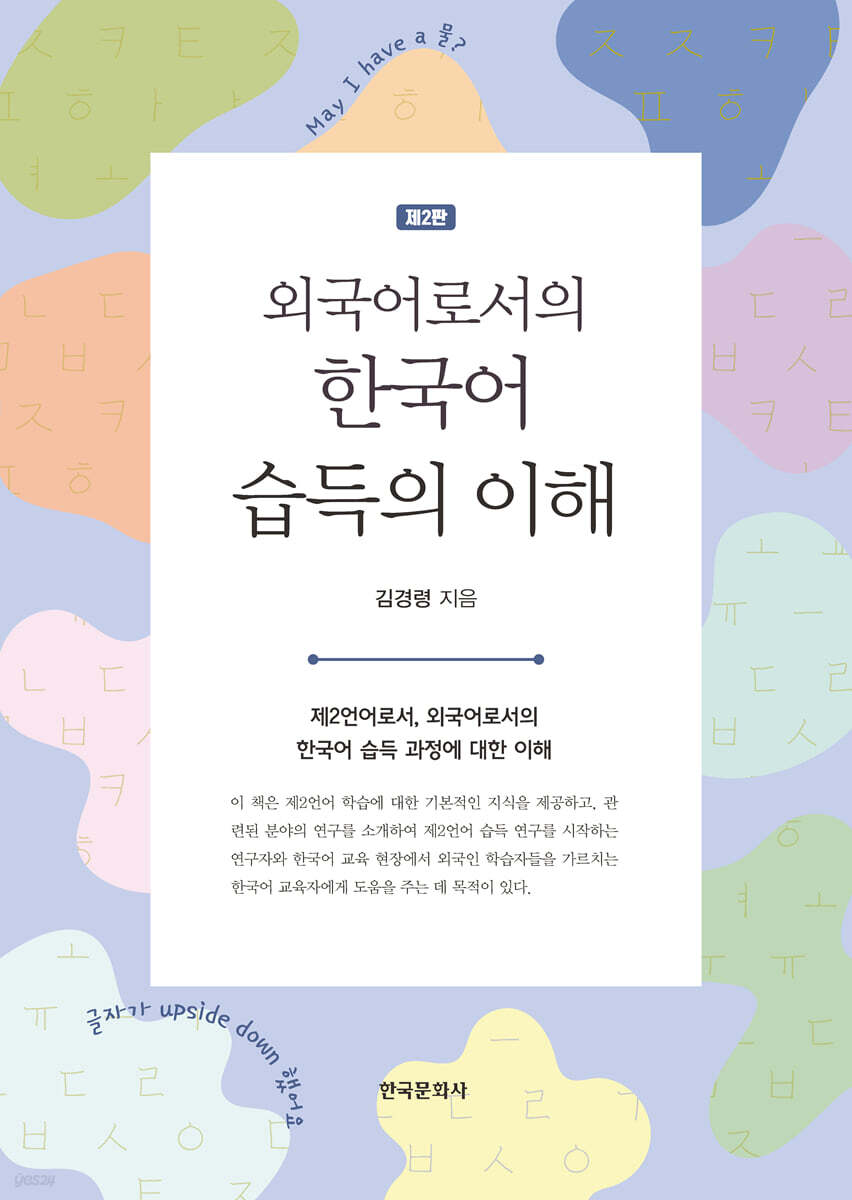
Understanding Korean as a Foreign Language
 |
Description
Book Introduction
Chapter 1 discusses first and second language acquisition, and language acquisition by adult and child learners.
This book introduces how second language acquisition research is being conducted based on various research methods and theoretical backgrounds in fields such as linguistics, psycholinguistics, and sociolinguistics, and organizes the content by presenting terminology, etc.
In Chapter 2, we analyzed related research focusing on the field of linguistics to find an answer to the question of what systematically determines the linguistic constraints that occur in the process of forming second language grammar.
In the field of linguistics, hypotheses and theories on second language acquisition were introduced based on theories such as contrastive analysis, error analysis, interlanguage, universal grammar and markedness, and functional typology.
Chapter 3 introduces how second language acquisition research is being conducted in the field of psycholinguistics.
In relation to cognitive domain and neurolinguistics research, the hemispheric polarization of the brain, critical periods, etc. were introduced, and further theories on the language learning process, language acquisition sequence, input and output processes, etc. were introduced.
We also describe and provide various examples of studies related to learning motivation, learning styles, and learning strategies that focus on learner variables rather than teacher variables.
Chapter 4 introduces how research on second language acquisition is being conducted in the field of sociolinguistics.
Chapter 5 summarizes the second language acquisition theories discussed previously.
We also discussed various research methods, including qualitative research, quantitative research, and observational research, in data analysis for second language acquisition research.
This book introduces how second language acquisition research is being conducted based on various research methods and theoretical backgrounds in fields such as linguistics, psycholinguistics, and sociolinguistics, and organizes the content by presenting terminology, etc.
In Chapter 2, we analyzed related research focusing on the field of linguistics to find an answer to the question of what systematically determines the linguistic constraints that occur in the process of forming second language grammar.
In the field of linguistics, hypotheses and theories on second language acquisition were introduced based on theories such as contrastive analysis, error analysis, interlanguage, universal grammar and markedness, and functional typology.
Chapter 3 introduces how second language acquisition research is being conducted in the field of psycholinguistics.
In relation to cognitive domain and neurolinguistics research, the hemispheric polarization of the brain, critical periods, etc. were introduced, and further theories on the language learning process, language acquisition sequence, input and output processes, etc. were introduced.
We also describe and provide various examples of studies related to learning motivation, learning styles, and learning strategies that focus on learner variables rather than teacher variables.
Chapter 4 introduces how research on second language acquisition is being conducted in the field of sociolinguistics.
Chapter 5 summarizes the second language acquisition theories discussed previously.
We also discussed various research methods, including qualitative research, quantitative research, and observational research, in data analysis for second language acquisition research.
- You can preview some of the book's contents.
Preview
index
Preface to the 2nd edition
Preface to the First Edition
Words of gratitude
Book structure
Chapter 1 First Language Acquisition & Second Language Acquisition
1.1.
Second Language Acquisition Research
1.2.
Second Language Acquisition Research and Korean Language Education
1.3.
First and second language acquisition
1.4.
Children's first language acquisition
.5.
Bilingualism in children
1.6.
Korean language acquisition by overseas Korean children
Chapter 2: Linguistics of Korean Language Acquisition
2.1.
Contrastive analysis
2.1.1.
Contrastive Analysis in Korean Language Education
2.2.
Error Analysis
2.2.1.
Error Analysis in Korean Language Education
2.3.
interlanguage
2.3.1.
interlanguage theory
2.3.2.
Native language influence
2.4.
Liu Biao and Universal Grammar
2.4.1.
universal grammar hypothesis
2.4.2.
Universality and distinctiveness in Korean language education
2.5.
Language Teaching Approaches
2.5.1.
Formal guidance in Korean language education
Chapter 3: The Psychology of Korean Language Acquisition
3.1.
Neurolinguistics
3.2.
Language learning process
3.3.
Language acquisition sequence
3.3.1.
Morpheme acquisition order in Korean language education
3.4.
Input and output
3.4.1.
Input, output, and input-output-based teaching in Korean language education
3.5.
Explicit and implicit learning
3.5.1.
Explicit and implicit feedback in Korean language education
3.6.
Learner variables
3.6.1.
Learning Motivation in Korean Language Education
3.6.2.
Learning styles in Korean language education
3.6.3.
Learning Strategies in Korean Language Education
Chapter 4: Sociolinguistics of Korean Language Acquisition
4.1.
communication skills
4.1.1.
Speech acts in Korean language education
4.2.
social interaction
4.2.1.
Classroom Conversation in Korean Language Education
4.3.
microsociological factors
4.4.
macrosocial factors
4.5.
Institutional power and constraints
4.5.1.
Korean language education policy
Chapter 5: Second Language Acquisition Theory and Research Methods
5.1.
Synthesis and Critique of Second Language Acquisition Theories
5.2.
Considerations on Research Methods
References
Glossary of Terms
Search
Preface to the First Edition
Words of gratitude
Book structure
Chapter 1 First Language Acquisition & Second Language Acquisition
1.1.
Second Language Acquisition Research
1.2.
Second Language Acquisition Research and Korean Language Education
1.3.
First and second language acquisition
1.4.
Children's first language acquisition
.5.
Bilingualism in children
1.6.
Korean language acquisition by overseas Korean children
Chapter 2: Linguistics of Korean Language Acquisition
2.1.
Contrastive analysis
2.1.1.
Contrastive Analysis in Korean Language Education
2.2.
Error Analysis
2.2.1.
Error Analysis in Korean Language Education
2.3.
interlanguage
2.3.1.
interlanguage theory
2.3.2.
Native language influence
2.4.
Liu Biao and Universal Grammar
2.4.1.
universal grammar hypothesis
2.4.2.
Universality and distinctiveness in Korean language education
2.5.
Language Teaching Approaches
2.5.1.
Formal guidance in Korean language education
Chapter 3: The Psychology of Korean Language Acquisition
3.1.
Neurolinguistics
3.2.
Language learning process
3.3.
Language acquisition sequence
3.3.1.
Morpheme acquisition order in Korean language education
3.4.
Input and output
3.4.1.
Input, output, and input-output-based teaching in Korean language education
3.5.
Explicit and implicit learning
3.5.1.
Explicit and implicit feedback in Korean language education
3.6.
Learner variables
3.6.1.
Learning Motivation in Korean Language Education
3.6.2.
Learning styles in Korean language education
3.6.3.
Learning Strategies in Korean Language Education
Chapter 4: Sociolinguistics of Korean Language Acquisition
4.1.
communication skills
4.1.1.
Speech acts in Korean language education
4.2.
social interaction
4.2.1.
Classroom Conversation in Korean Language Education
4.3.
microsociological factors
4.4.
macrosocial factors
4.5.
Institutional power and constraints
4.5.1.
Korean language education policy
Chapter 5: Second Language Acquisition Theory and Research Methods
5.1.
Synthesis and Critique of Second Language Acquisition Theories
5.2.
Considerations on Research Methods
References
Glossary of Terms
Search
Into the book
Chapter 1 provides a general introduction to how the theoretical foundations of research on second language acquisition have been developed organically and integratively in the fields of linguistics, psychology, and sociology.
The differences and similarities between first and second language acquisition are explained, and the language acquisition process of child and adult learners is described.
In addition, we introduced and presented directions for the development of educational materials for Korean language acquisition, cognitive ability, language and identity, and language education for overseas Korean children.
--- From "Enter"
Second Language AcquisitionThe fundamental questions researchers have in understanding the second language acquisition process are: What is second language acquisition? What process do second language learners go through to learn a language? How do second and first language acquisition differ?
Second language acquisition research began as an independent discipline in the 1970s, but has made remarkable progress in the short period since.
Second language acquisition research studies how and through what process a second language is learned.
It is a study of how learners learn a new language system in an artificial environment, what is learned and what is not, and why it is not acquired like a native language.
Second language acquisition research is an interdisciplinary field in which theories from various fields, including linguistics, psychology, sociology, sociolinguistics, and education, influence each other.
Second language acquisition research, in the field of linguistics, has examined linguistic constraints on second language pronunciation, vocabulary, and grammar formation.
In the field of language education, the results of language acquisition research are influencing curriculum design.
Cognitive Psychology In the field of cognitive psychology, discussions are taking place on language input and output, learners' affective factors, and the order of language acquisition.
In the field of sociolinguistics, research is being conducted on discourse, pragmatics, and linguistic etiquette between native and non-native speakers in terms of intercultural communication, and research is also being conducted on bilingual/multilingual language acquisition in relation to language policy.
Second language acquisition research is a complex field that involves abstract linguistic theories.
In each field, data on second language acquisition are collected and analyzed in various ways, and the research results are interpreted in various ways using different approaches.
--- 「1.1.
From “Research on Second Language Acquisition”
A major goal of second language acquisition research is to systematically explain the linguistic constraints that occur during the formation of second language grammar.
In the field of linguistics, the study of human language knowledge, including language creation and the limitations of language variation, is not limited to the first language but also includes the second language.
In the field of linguistics, research on second language acquisition has been conducted based on theories such as contrastive analysis, error analysis, interlanguage, universal grammar and markedness, and functional typology.
--- From "Linguistics"
In the field of psycholinguistics, the study of cognitive domains, neurolinguistics, and hemispheric lateralization of the brain, critical periods, etc. were discussed, and later theories were formed by analyzing data in the fields of language learning process, language acquisition sequence, input and output, etc.
As the focus shifts to learner variables rather than teacher variables, research is being conducted on learning motivation, learning styles, and learning strategies.
--- From "Psycholinguistics"
SociolinguisticsThe field of sociolinguistics examines the influence of social variables on interlanguage development.
Research is being conducted on sociolinguistic transfer phenomena that occur in the process of second language acquisition, communication skills, language input and interaction, sociocultural theory, bilingualism and identity, and how the institutional power and constraints of a country affect language use.
--- From "Sociolinguistics"
Language education is a field that requires methodological knowledge about language learning.
It is a field that studies how language learning occurs through language teaching methods.
Second language acquisition research has contributed to the recognition in language curriculum design that language learning involves more than just memorizing grammar rules.
It contributed to a new and broad concept of the nature of language learning.
For example, if a teacher has students learn a specific grammar structure by repeatedly practicing it during class, but then, after class, when speaking with the teacher, the students produce a different grammar structure from what they just learned, the cause of this can be examined from various angles.
The differences and similarities between first and second language acquisition are explained, and the language acquisition process of child and adult learners is described.
In addition, we introduced and presented directions for the development of educational materials for Korean language acquisition, cognitive ability, language and identity, and language education for overseas Korean children.
--- From "Enter"
Second Language AcquisitionThe fundamental questions researchers have in understanding the second language acquisition process are: What is second language acquisition? What process do second language learners go through to learn a language? How do second and first language acquisition differ?
Second language acquisition research began as an independent discipline in the 1970s, but has made remarkable progress in the short period since.
Second language acquisition research studies how and through what process a second language is learned.
It is a study of how learners learn a new language system in an artificial environment, what is learned and what is not, and why it is not acquired like a native language.
Second language acquisition research is an interdisciplinary field in which theories from various fields, including linguistics, psychology, sociology, sociolinguistics, and education, influence each other.
Second language acquisition research, in the field of linguistics, has examined linguistic constraints on second language pronunciation, vocabulary, and grammar formation.
In the field of language education, the results of language acquisition research are influencing curriculum design.
Cognitive Psychology In the field of cognitive psychology, discussions are taking place on language input and output, learners' affective factors, and the order of language acquisition.
In the field of sociolinguistics, research is being conducted on discourse, pragmatics, and linguistic etiquette between native and non-native speakers in terms of intercultural communication, and research is also being conducted on bilingual/multilingual language acquisition in relation to language policy.
Second language acquisition research is a complex field that involves abstract linguistic theories.
In each field, data on second language acquisition are collected and analyzed in various ways, and the research results are interpreted in various ways using different approaches.
--- 「1.1.
From “Research on Second Language Acquisition”
A major goal of second language acquisition research is to systematically explain the linguistic constraints that occur during the formation of second language grammar.
In the field of linguistics, the study of human language knowledge, including language creation and the limitations of language variation, is not limited to the first language but also includes the second language.
In the field of linguistics, research on second language acquisition has been conducted based on theories such as contrastive analysis, error analysis, interlanguage, universal grammar and markedness, and functional typology.
--- From "Linguistics"
In the field of psycholinguistics, the study of cognitive domains, neurolinguistics, and hemispheric lateralization of the brain, critical periods, etc. were discussed, and later theories were formed by analyzing data in the fields of language learning process, language acquisition sequence, input and output, etc.
As the focus shifts to learner variables rather than teacher variables, research is being conducted on learning motivation, learning styles, and learning strategies.
--- From "Psycholinguistics"
SociolinguisticsThe field of sociolinguistics examines the influence of social variables on interlanguage development.
Research is being conducted on sociolinguistic transfer phenomena that occur in the process of second language acquisition, communication skills, language input and interaction, sociocultural theory, bilingualism and identity, and how the institutional power and constraints of a country affect language use.
--- From "Sociolinguistics"
Language education is a field that requires methodological knowledge about language learning.
It is a field that studies how language learning occurs through language teaching methods.
Second language acquisition research has contributed to the recognition in language curriculum design that language learning involves more than just memorizing grammar rules.
It contributed to a new and broad concept of the nature of language learning.
For example, if a teacher has students learn a specific grammar structure by repeatedly practicing it during class, but then, after class, when speaking with the teacher, the students produce a different grammar structure from what they just learned, the cause of this can be examined from various angles.
--- From "Language Education"
Publisher's Review
This book comprehensively covers the major theories and methodologies related to the acquisition of Korean as a second or foreign language, focusing on systematically explaining the process of language acquisition.
The field of second language acquisition has long developed independently, based on the unique characteristics of each academic discipline. However, recently, close interdisciplinary collaborations have led to active, convergent research.
This book reflects this multidisciplinary approach, comprehensively covering research findings from various fields, including linguistics, psychology, and sociology.
This second edition supplements existing content and adds new research and cases.
The field of Korean language education has made remarkable progress in a relatively short period of time.
Now, Korean language acquisition research has gone beyond simply accepting foreign research and has reached a level where it can be discussed and developed on its own.
This book was made possible by the dedicated efforts of all those involved in Korean language education, both in research and education. It is my hope that this book will contribute, even if only in a small way, to the advancement of Korean language education and research.
I hope this book will be a useful resource for domestic and international master's and doctoral students studying Korean language education, as well as for researchers beginning second language acquisition research.
We hope that this will provide a basic understanding of language acquisition theory and serve as a foundation for discussing various research methods.
It would be a great reward for me if this book could serve as a guide for you on your learning journey.
I would like to express my deepest gratitude and support to those who are dedicated to their work as researchers and educators in the Korean language education field.
The field of second language acquisition has long developed independently, based on the unique characteristics of each academic discipline. However, recently, close interdisciplinary collaborations have led to active, convergent research.
This book reflects this multidisciplinary approach, comprehensively covering research findings from various fields, including linguistics, psychology, and sociology.
This second edition supplements existing content and adds new research and cases.
The field of Korean language education has made remarkable progress in a relatively short period of time.
Now, Korean language acquisition research has gone beyond simply accepting foreign research and has reached a level where it can be discussed and developed on its own.
This book was made possible by the dedicated efforts of all those involved in Korean language education, both in research and education. It is my hope that this book will contribute, even if only in a small way, to the advancement of Korean language education and research.
I hope this book will be a useful resource for domestic and international master's and doctoral students studying Korean language education, as well as for researchers beginning second language acquisition research.
We hope that this will provide a basic understanding of language acquisition theory and serve as a foundation for discussing various research methods.
It would be a great reward for me if this book could serve as a guide for you on your learning journey.
I would like to express my deepest gratitude and support to those who are dedicated to their work as researchers and educators in the Korean language education field.
GOODS SPECIFICS
- Date of issue: September 1, 2024
- Page count, weight, size: 426 pages | 174*245*30mm
- ISBN13: 9791169192385
- ISBN10: 1169192386
You may also like
카테고리
korean


korean

![GQ KOREA Mark (Monthly): December [2025]](http://librairie.coreenne.fr/cdn/shop/files/8ef265dbbfbf186523ed75ba7319009d.jpg?v=1765340328&width=3840)


