

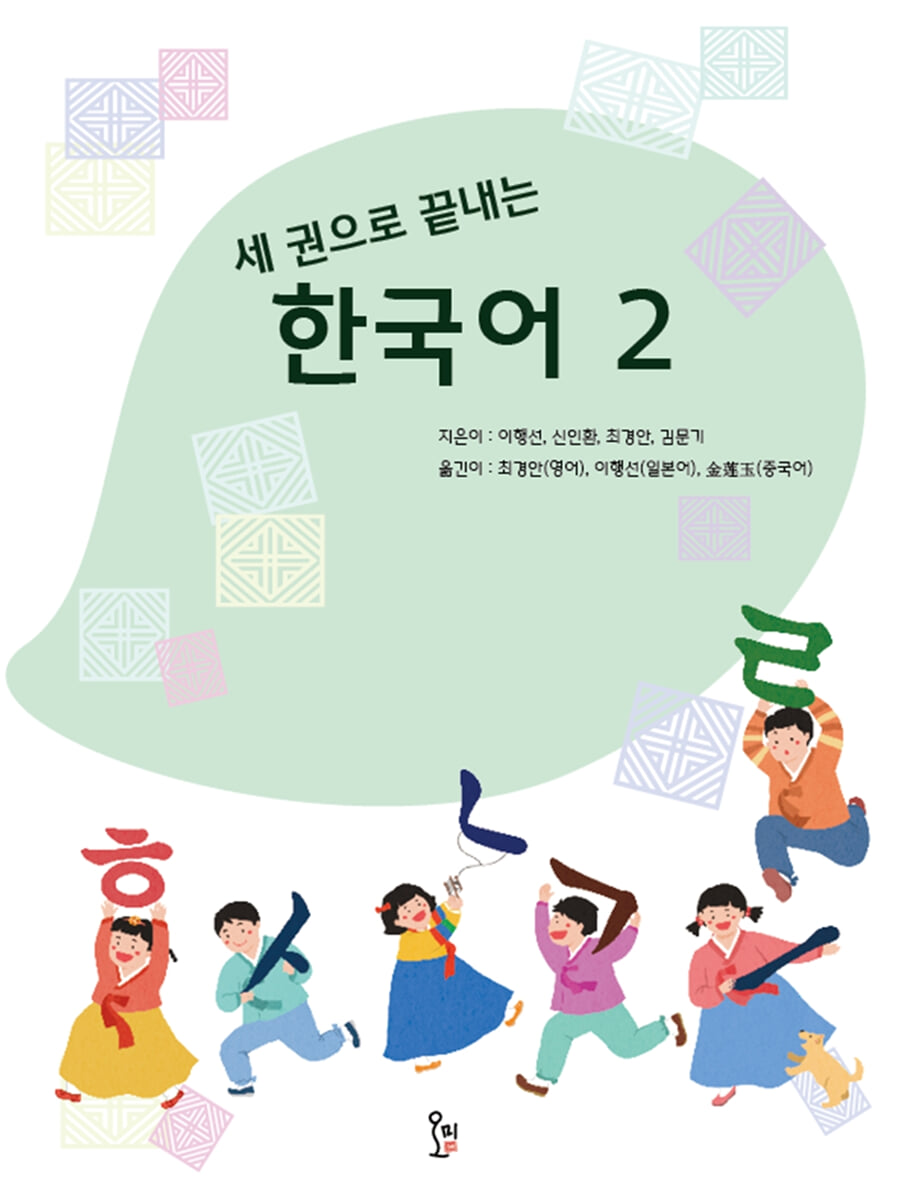
Korean in Three Volumes 2
 |
Description
Book Introduction
『Korean in Three Volumes』 was planned to be a three-volume series. Volume 1 is a beginner's textbook, covering the existing level 1 to the first half of level 2, Volume 2 is an intermediate textbook, covering the latter half of level 2 to level 3, and Volume 3 is an advanced textbook, covering levels 4 and 5.
And each textbook is composed of 12 units.
At this time, the vocabulary, grammar, and expressions of each unit were presented with consideration to the learner's level, focusing on those that are most frequently used in real-life situations.
And each textbook is composed of 12 units.
At this time, the vocabulary, grammar, and expressions of each unit were presented with consideration to the learner's level, focusing on those that are most frequently used in real-life situations.
index
preface
Unit composition
1. I prepared the documents to apply for a scholarship.
Lesson 2: Do you want to have lunch together?
Lesson 3 How about going next weekend?
You can exchange or refund Lesson 4.
I came here to look into one-room apartments.
Lesson 6 I would like to meet someone who is honest and proactive.
Lesson 7: Why don't you take a few days off and rest?
Lesson 8 I didn't know I could make this mistake.
Lesson 9 I don't know what gift to buy.
Lesson 10 I overslept and ended up being late.
Lesson 11: How did the accident happen?
There was an announcement that they were hiring 12 employees.
Appendix 1 Answer
Appendix 2 Listening Script
Appendix 3 Translation (English, Japanese, Chinese)
Appendix 4 Vocabulary List
Unit composition
1. I prepared the documents to apply for a scholarship.
Lesson 2: Do you want to have lunch together?
Lesson 3 How about going next weekend?
You can exchange or refund Lesson 4.
I came here to look into one-room apartments.
Lesson 6 I would like to meet someone who is honest and proactive.
Lesson 7: Why don't you take a few days off and rest?
Lesson 8 I didn't know I could make this mistake.
Lesson 9 I don't know what gift to buy.
Lesson 10 I overslept and ended up being late.
Lesson 11: How did the accident happen?
There was an announcement that they were hiring 12 employees.
Appendix 1 Answer
Appendix 2 Listening Script
Appendix 3 Translation (English, Japanese, Chinese)
Appendix 4 Vocabulary List
Into the book
Lesson 9 I don't know what gift to buy.
<text>
James: Anna, do you know what gifts people usually give when they visit a Korean home?
Anna: Why? Were you invited by a Korean friend?
James: Yes, this Saturday.
But my friend lives with his parents, so I don't know what gift to buy him.
Anna: Hmm… Last time, when my Korean friends went to see the professor, it seemed like they bought drinks and fruit and things like that.
James: Oh, I've seen my friends buy juice too.
But isn't there a better gift to give to adults?
Anna: Or how about health supplements like red ginseng or vitamins? I think those would be better than drinks or fruit.
James: Yeah, that would be better for adults.
I should go to the department store this weekend and pick one out.
Anna: If you have trouble choosing on your own, would you like me to go with you?
James: Really? I'd appreciate it if you could do that.
1.
Please answer.
(1) What is Mr. James worried about?
(2) What gift did Mr. James decide to buy for his friend's house?
Listening and Speaking
1.
Listen to the following and answer the questions.
(1) If it is correct to be careful about what you do in front of adults, mark ○. If it is incorrect, mark ×.
① Use a spoon when eating soup.
( )
② When eating with adults, you must hold the bowl and eat.
( )
③ You must use chopsticks when eating rice and side dishes.
( )
④ A subordinate person should not start eating before a superior person.
( )
2.
Listen to the following and choose the correct answer.
(1) What gift did Mr. James give to his friend's parents?
① Alcohol ② Red ginseng ③ Makgeolli ④ Korean food
(2) Choose something similar to the conversation.
① James visited a Korean home for the first time.
② James helped his friend learn Korean.
③ James's friend's parents took him to a Korean restaurant.
④ My friend's mother didn't prepare much food and alcohol.
<text>
James: Anna, do you know what gifts people usually give when they visit a Korean home?
Anna: Why? Were you invited by a Korean friend?
James: Yes, this Saturday.
But my friend lives with his parents, so I don't know what gift to buy him.
Anna: Hmm… Last time, when my Korean friends went to see the professor, it seemed like they bought drinks and fruit and things like that.
James: Oh, I've seen my friends buy juice too.
But isn't there a better gift to give to adults?
Anna: Or how about health supplements like red ginseng or vitamins? I think those would be better than drinks or fruit.
James: Yeah, that would be better for adults.
I should go to the department store this weekend and pick one out.
Anna: If you have trouble choosing on your own, would you like me to go with you?
James: Really? I'd appreciate it if you could do that.
1.
Please answer.
(1) What is Mr. James worried about?
(2) What gift did Mr. James decide to buy for his friend's house?
Listening and Speaking
1.
Listen to the following and answer the questions.
(1) If it is correct to be careful about what you do in front of adults, mark ○. If it is incorrect, mark ×.
① Use a spoon when eating soup.
( )
② When eating with adults, you must hold the bowl and eat.
( )
③ You must use chopsticks when eating rice and side dishes.
( )
④ A subordinate person should not start eating before a superior person.
( )
2.
Listen to the following and choose the correct answer.
(1) What gift did Mr. James give to his friend's parents?
① Alcohol ② Red ginseng ③ Makgeolli ④ Korean food
(2) Choose something similar to the conversation.
① James visited a Korean home for the first time.
② James helped his friend learn Korean.
③ James's friend's parents took him to a Korean restaurant.
④ My friend's mother didn't prepare much food and alcohol.
---From the text
Publisher's Review
『Korean in Three Volumes』 was planned to be a three-volume series. Volume 1 is a beginner's textbook, covering the existing level 1 to the first half of level 2, Volume 2 is an intermediate textbook, covering the latter half of level 2 to level 3, and Volume 3 is an advanced textbook, covering levels 4 and 5.
And each textbook is composed of 12 units.
At this time, the vocabulary, grammar, and expressions of each unit were presented with consideration to the learner's level, focusing on those that are most frequently used in real-life situations.
"Korean in Three Volumes 2" is an integrated textbook for intermediate Korean language learners, and is comprised of 12 units, from Lesson 1 to Lesson 12.
And in each unit, it is presented in the order of ‘vocabulary-grammar and expressions-text-listening and speaking-reading and writing-Korean culture.’
In the 'Vocabulary' section, vocabulary and expressions related to the topic and function of each unit are presented.
And we presented various questions to help you recall and use the vocabulary and expressions.
In the 'Grammar and Expression' section, grammar and expression items related to the topic of each unit are arranged.
At this time, the learner's level and the aspects of actual use were taken into consideration as much as possible.
And we provide practice problems so that you can practice the grammar and expressions you have learned.
In the 'Main Text' section, situations corresponding to the topic and function of each unit are presented in the form of dialogue.
This has enabled it to be fully utilized in real-world situations.
And a problem was presented to check whether the learners accurately understood the content of the text.
At this time, the learners were allowed to understand the content and write or answer directly, which helped to more directly improve the learners' understanding and expression skills.
In the 'Listening and Speaking' section, you can practice listening and speaking that matches the topic or function of each unit.
First, in ‘Listening’, situations related to the ‘text’ were presented so that learners could practice listening without difficulty.
Next, in ‘Speaking’, situations related to the content in ‘Listening’ were presented to ensure sufficient practice.
At this time, we attempted to reduce the learner's burden by providing relevant information such as situations, vocabulary, and expressions, thereby encouraging active participation.
In the 'Reading and Writing' section, reading and writing corresponding to the topic and function of each unit are provided.
First, in ‘Reading’, text related to the topic was presented.
And to check whether the learners understood the content accurately, we presented descriptive problems by applying it to speaking or writing.
And in 'Writing', topics or content related to the 'Reading' text were covered so that learners could write and speak about their experiences or thoughts.
To this end, specific conditions necessary for this were presented so that practical language functions could be improved.
In the 'Korean Culture' section, Korean culture related to the topic of each unit is presented.
At this time, not only the reading text but also related vocabulary, expressions, pictures, etc. were presented in various ways according to the level of the unit.
In addition, the following contents are included as an appendix at the end of this book.
First, model answers to practice problems and activities for each unit were provided.
Second, a listening script for each unit was provided.
Third, the presentation text and listening script for each unit were translated into English, Japanese, and Chinese.
Fourth, new words in each unit were translated into English, Japanese, and Chinese.
And each textbook is composed of 12 units.
At this time, the vocabulary, grammar, and expressions of each unit were presented with consideration to the learner's level, focusing on those that are most frequently used in real-life situations.
"Korean in Three Volumes 2" is an integrated textbook for intermediate Korean language learners, and is comprised of 12 units, from Lesson 1 to Lesson 12.
And in each unit, it is presented in the order of ‘vocabulary-grammar and expressions-text-listening and speaking-reading and writing-Korean culture.’
In the 'Vocabulary' section, vocabulary and expressions related to the topic and function of each unit are presented.
And we presented various questions to help you recall and use the vocabulary and expressions.
In the 'Grammar and Expression' section, grammar and expression items related to the topic of each unit are arranged.
At this time, the learner's level and the aspects of actual use were taken into consideration as much as possible.
And we provide practice problems so that you can practice the grammar and expressions you have learned.
In the 'Main Text' section, situations corresponding to the topic and function of each unit are presented in the form of dialogue.
This has enabled it to be fully utilized in real-world situations.
And a problem was presented to check whether the learners accurately understood the content of the text.
At this time, the learners were allowed to understand the content and write or answer directly, which helped to more directly improve the learners' understanding and expression skills.
In the 'Listening and Speaking' section, you can practice listening and speaking that matches the topic or function of each unit.
First, in ‘Listening’, situations related to the ‘text’ were presented so that learners could practice listening without difficulty.
Next, in ‘Speaking’, situations related to the content in ‘Listening’ were presented to ensure sufficient practice.
At this time, we attempted to reduce the learner's burden by providing relevant information such as situations, vocabulary, and expressions, thereby encouraging active participation.
In the 'Reading and Writing' section, reading and writing corresponding to the topic and function of each unit are provided.
First, in ‘Reading’, text related to the topic was presented.
And to check whether the learners understood the content accurately, we presented descriptive problems by applying it to speaking or writing.
And in 'Writing', topics or content related to the 'Reading' text were covered so that learners could write and speak about their experiences or thoughts.
To this end, specific conditions necessary for this were presented so that practical language functions could be improved.
In the 'Korean Culture' section, Korean culture related to the topic of each unit is presented.
At this time, not only the reading text but also related vocabulary, expressions, pictures, etc. were presented in various ways according to the level of the unit.
In addition, the following contents are included as an appendix at the end of this book.
First, model answers to practice problems and activities for each unit were provided.
Second, a listening script for each unit was provided.
Third, the presentation text and listening script for each unit were translated into English, Japanese, and Chinese.
Fourth, new words in each unit were translated into English, Japanese, and Chinese.
GOODS SPECIFICS
- Date of issue: September 20, 2023
- Page count, weight, size: 251 pages | 210*280*20mm
- ISBN13: 9791197720529
- ISBN10: 1197720529
You may also like
카테고리
korean


korean

![GQ KOREA Mark (Monthly): December [2025]](http://librairie.coreenne.fr/cdn/shop/files/8ef265dbbfbf186523ed75ba7319009d.jpg?v=1765340328&width=3840)


