

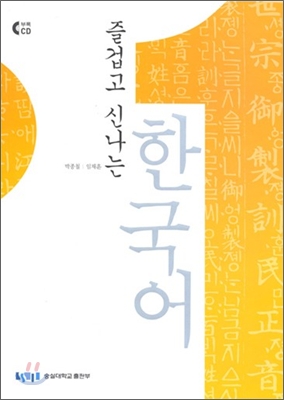
Fun and Exciting Korean 1
 |
Description
Book Introduction
This is a Korean language textbook designed to help you become familiar with the Korean language by composing natural conversational situations in Korean.
It presents many examples and vocabulary focusing on school life, work life, and home life, and contains as many diverse aspects of Korean language life as possible.
You can learn expressions frequently used by Koreans centered on the topic of the unit through the composition of pictures, dialogue, words, and grammar that show the conversation scenes in the text.
It presents many examples and vocabulary focusing on school life, work life, and home life, and contains as many diverse aspects of Korean language life as possible.
You can learn expressions frequently used by Koreans centered on the topic of the unit through the composition of pictures, dialogue, words, and grammar that show the conversation scenes in the text.
index
Note
Textbook composition
time
Basic 1 Korean Language Practice
Basic 2 Vocabulary Practice
People coming out
Lesson 1 Hello?
Lesson 2 This person is a Korean teacher
Lesson 3 Where are you going now?
Lesson 4 Where did you buy this?
Lesson 5 The weather will be clear tomorrow
Lesson 6 Please Help Me
Lesson 7: What is your phone number?
Lesson 8 How much are ten of these?
Lesson 9 What month and day is it today?
Lesson 10 I'm not going home
Lesson 11 I want to eat kimchi stew today.
Lesson 12 I'm thinking of buying a gift for my parents.
Lesson 13 I couldn't come because I had a cold.
Lesson 14 We drank tea and chatted
Lesson 15 How long does it take from home to work?
Lesson 16 I'll get into it a little later
Model answer
Listening passage
Word index
Textbook composition
time
Basic 1 Korean Language Practice
Basic 2 Vocabulary Practice
People coming out
Lesson 1 Hello?
Lesson 2 This person is a Korean teacher
Lesson 3 Where are you going now?
Lesson 4 Where did you buy this?
Lesson 5 The weather will be clear tomorrow
Lesson 6 Please Help Me
Lesson 7: What is your phone number?
Lesson 8 How much are ten of these?
Lesson 9 What month and day is it today?
Lesson 10 I'm not going home
Lesson 11 I want to eat kimchi stew today.
Lesson 12 I'm thinking of buying a gift for my parents.
Lesson 13 I couldn't come because I had a cold.
Lesson 14 We drank tea and chatted
Lesson 15 How long does it take from home to work?
Lesson 16 I'll get into it a little later
Model answer
Listening passage
Word index
Into the book
Lesson 1 Hello?
〈Listen and Write〉Listen carefully and fill in the blanks.
Mika: ( )? Nice to meet you.
My name is Mika.
Kim Byung-ho: Hello. Nice to meet you ( ).
My name is Kim Byeong-ho.
Mika: Well ( ).
Kim Byung-ho: Thank you for your consideration.
〈Grammar Practice〉 Try expressing yourself using the following grammar.
[Verb/Adjective]ㅂ니다/습니다.
1.
[Noun] is/is [Verb/Adjective]
The flowers are pretty.
Mika smiles.
Write in the blank and tell the story.
1) Tall, big ⇒ Tall.
2) Train, fast ⇒ The train is fast.
3) Pencil, you need ⇒ _______________
4) Bulgogi, delicious ⇒ _______________
5) Korean food, good ⇒ _______________
〈Listen and Write〉Listen carefully and fill in the blanks.
Mika: ( )? Nice to meet you.
My name is Mika.
Kim Byung-ho: Hello. Nice to meet you ( ).
My name is Kim Byeong-ho.
Mika: Well ( ).
Kim Byung-ho: Thank you for your consideration.
〈Grammar Practice〉 Try expressing yourself using the following grammar.
[Verb/Adjective]ㅂ니다/습니다.
1.
[Noun] is/is [Verb/Adjective]
The flowers are pretty.
Mika smiles.
Write in the blank and tell the story.
1) Tall, big ⇒ Tall.
2) Train, fast ⇒ The train is fast.
3) Pencil, you need ⇒ _______________
4) Bulgogi, delicious ⇒ _______________
5) Korean food, good ⇒ _______________
--- From the 'Main Text'
Publisher's Review
1.
This textbook is structured as follows:
1) Look at the picture and talk about it
The picture presented at the beginning of the unit shows a conversation scene.
Since the meaning of every utterance is important in the context of the conversation, I wanted to provide a framework for understanding the conversation.
2) Listening and speaking
This is a conversation containing the main expressions of the unit.
By presenting the conversation situation in a picture, learners were able to naturally understand the content of the conversation through the conversation situation.
3) Study vocabulary in advance
We have provided vocabulary words that learners should study in advance before studying the unit.
Many learners are confused during class or have trouble looking up words because they do not know the words well.
4) Grammar practice
This section is for practicing grammar items that appear in the dialogue text.
We have provided as many examples as possible to ensure that learners can practice sufficiently.
5) Expressing
This is the part where learners practice speaking.
It contains expressions frequently used by Koreans, centered around the topic.
If grammar practice is about practicing specific grammatical items, then “expressing” is about practicing speaking with the expression itself as a complete item rather than practicing grammatical analysis and usage.
6) Reading
In 〈Beginner 1〉, there are limitations in vocabulary and grammar, so the difficulty of 〈Reading〉 should be lowered in terms of subject matter and length.
Rather than having learners understand new reading material, we built on what they had heard in the conversation to increase their comprehension.
We helped students become familiar with reading and writing in an eloquent manner by organizing the content of actual conversations into stories.
7) Writing
〈Reading〉 Ask learners questions about the content after fully understanding it.
I tried to structure my writing naturally while answering this question.
2.
This textbook takes into account the following points:
1) Korean that fits reality
I tried to show natural conversational situations in Korean, even if abbreviations or somewhat difficult expressions were exposed.
The goal is to help you become familiar with Korean through repeated, natural conversations and to naturally advance to higher levels while developing your grammar skills.
2) Many examples and words
By providing as many examples and vocabulary as possible, we have ensured that both learners and instructors can engage in sufficient learning activities centered around the textbook.
3) Korean in various aspects of daily life
Since most beginner learners live in language schools, many textbooks have tended to focus on school life.
This textbook strives to include as many diverse Korean language experiences as possible, including work and home life, to ensure learners can experience them in a variety of ways.
This textbook is structured as follows:
1) Look at the picture and talk about it
The picture presented at the beginning of the unit shows a conversation scene.
Since the meaning of every utterance is important in the context of the conversation, I wanted to provide a framework for understanding the conversation.
2) Listening and speaking
This is a conversation containing the main expressions of the unit.
By presenting the conversation situation in a picture, learners were able to naturally understand the content of the conversation through the conversation situation.
3) Study vocabulary in advance
We have provided vocabulary words that learners should study in advance before studying the unit.
Many learners are confused during class or have trouble looking up words because they do not know the words well.
4) Grammar practice
This section is for practicing grammar items that appear in the dialogue text.
We have provided as many examples as possible to ensure that learners can practice sufficiently.
5) Expressing
This is the part where learners practice speaking.
It contains expressions frequently used by Koreans, centered around the topic.
If grammar practice is about practicing specific grammatical items, then “expressing” is about practicing speaking with the expression itself as a complete item rather than practicing grammatical analysis and usage.
6) Reading
In 〈Beginner 1〉, there are limitations in vocabulary and grammar, so the difficulty of 〈Reading〉 should be lowered in terms of subject matter and length.
Rather than having learners understand new reading material, we built on what they had heard in the conversation to increase their comprehension.
We helped students become familiar with reading and writing in an eloquent manner by organizing the content of actual conversations into stories.
7) Writing
〈Reading〉 Ask learners questions about the content after fully understanding it.
I tried to structure my writing naturally while answering this question.
2.
This textbook takes into account the following points:
1) Korean that fits reality
I tried to show natural conversational situations in Korean, even if abbreviations or somewhat difficult expressions were exposed.
The goal is to help you become familiar with Korean through repeated, natural conversations and to naturally advance to higher levels while developing your grammar skills.
2) Many examples and words
By providing as many examples and vocabulary as possible, we have ensured that both learners and instructors can engage in sufficient learning activities centered around the textbook.
3) Korean in various aspects of daily life
Since most beginner learners live in language schools, many textbooks have tended to focus on school life.
This textbook strives to include as many diverse Korean language experiences as possible, including work and home life, to ensure learners can experience them in a variety of ways.
GOODS SPECIFICS
- Date of publication: September 26, 2009
- Page count, weight, size: 193 pages | 698g | Checking size
- ISBN13: 9788974502461
- ISBN10: 8974502461
You may also like
카테고리
korean


korean

![GQ KOREA Mark (Monthly): December [2025]](http://librairie.coreenne.fr/cdn/shop/files/8ef265dbbfbf186523ed75ba7319009d.jpg?v=1765340328&width=3840)


