

Korean Verb Education Theory
 |
Description
Book Introduction
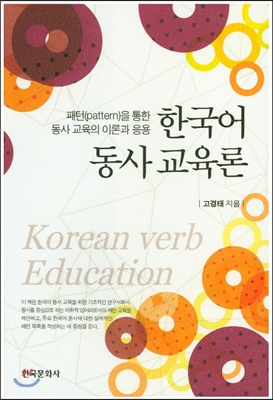
This book was published in 2008 based on the author's doctoral dissertation titled [A Study on Korean Verb Education: Focusing on the Selection of Patterns for Verb Syntax and Semantic Education].
As a Korean language teacher, the author has had many opportunities to observe the speaking and writing of intermediate and advanced Korean language learners. He addresses various errors made by Korean language learners from the perspective of a Korean language teacher.
As a Korean language teacher, the author has had many opportunities to observe the speaking and writing of intermediate and advanced Korean language learners. He addresses various errors made by Korean language learners from the perspective of a Korean language teacher.
- You can preview some of the book's contents.
Preview
index
introduction
Introduction / The Importance of 'Korean Verbs' and the Need for 'Pattern Learning'
Part 1
Discussion and Theory: Pattern-Centered Verb Teaching
1.
Review: Existing Discussions on Verb Education
1.1.
Grammar Item Teaching Theory
1.2.
Particle teaching theory
1.3.
Sentence pattern education theory
1.4.
Polysemy Education Theory
2.
Why 'Pattern'?: The Concept and Usefulness of Patterns
2.1.
The concept and history of patterns
2.2.
Scope of patterns and similar concepts
2.3.
The educational utility of patterns
3.
Exploration: Verb Patterns: What to Extract and How?
3.1.
Discussion on selection of main verbs
3.2.
Observations of corpora and types of Korean verb patterns
3.3.
Processing and utilization of corpora
4.
Establishment: How to Select Verb Patterns for Education?
4.1.
Criteria for pattern selection
4.2.
Principles for selecting patterns for syntactic education
4.3.
Principles for selecting patterns for semantic education
5.
conclusion
5.1.
Summary and Organization
5.2.
Remaining issues
Part 2
Application: List of patterns for teaching verbs
index
1.
'go'
2.
'Have', 'Have'
3.
'Walk' (move with alternate feet)
4.
'hang' (hang)
5.
'wait'
6.
'draw'
7.
'end'
8.
'go out'
9.
'divide'
10.
'Nada' (to rise from the ground)
11.
'come out'
12.
'appear'
13.
'remain'
14.
'spawn'
15.
'get off'
16.
'exceed'
17.
'enclose'
18.
'put'
19.
'feel'
20.
'go'
21.
'encounter'
22.
'subtend'
23.
'turn' (causative verb of 'turn')
24.
'return'
25.
Return
26.
'lay'
27.
'listen'
28.
'Hold 1' (inside~), 'Hold 2' (thing~)
29.
'hear' (passive verb of 'listen')
30.
'enter'
31.
Come in
32.
'Follow' (to chase after)
33.
'leave'
34.
'get off'
35.
'drink'
36.
'meet'
37.
'make'
38.
'say'
39.
'Correct 1' (not wrong), 'Correct 2' (harmed by external impact)
40.
'take charge' (take responsibility and be in charge of)
41.
'eat'
42.
'don't know'
43.
'collect'
44.
'ask' (ask for an answer or explanation)
45.
'To go crazy' (to reach or arrive)
46.
'trust'
47.
'change'
48.
Look at
49.
'Receive' (take something given by someone else)
50.
'define'
51.
'learn'
52.
'let go'
53.
'see'
54.
'See' (passive verb of 'see')
55.
'call' (to call someone)
56.
'Ppajida1' (come out), 'Ppajida2' (fall)
57.
'buy'
58.
'live'
59.
Think
60.
'befall'
61.
'stand'
62.
'erect'
63.
'start'
64.
'Write 1' (write), 'Write 2' (wear a hat), 'Write 3' (use)
65.
'sit'
66.
'know'
67.
'get'
68.
'open'
69.
'open' (passive verb of 'open')
70.
'come'
71.
'rise'
72.
'raise'
73.
'Cry', 'Laugh'
74.
'For'
75.
'make'
76.
'Irda' (reach the destination)
77.
'wake up'
78.
'cause'
79.
'read'
80.
'put on'
81.
'piece'
82.
'grapple'
83.
'give'
84.
'die'
85.
'pass by'
86.
'do'
87.
'protect'
88.
'compose'
89.
'find'
90.
'Chi-da' (hit)
91.
'Tada' (to get on and take a seat)
92.
'pass'
93.
'sell'
94.
'lean towards'
95.
'flow'
References
Introduction / The Importance of 'Korean Verbs' and the Need for 'Pattern Learning'
Part 1
Discussion and Theory: Pattern-Centered Verb Teaching
1.
Review: Existing Discussions on Verb Education
1.1.
Grammar Item Teaching Theory
1.2.
Particle teaching theory
1.3.
Sentence pattern education theory
1.4.
Polysemy Education Theory
2.
Why 'Pattern'?: The Concept and Usefulness of Patterns
2.1.
The concept and history of patterns
2.2.
Scope of patterns and similar concepts
2.3.
The educational utility of patterns
3.
Exploration: Verb Patterns: What to Extract and How?
3.1.
Discussion on selection of main verbs
3.2.
Observations of corpora and types of Korean verb patterns
3.3.
Processing and utilization of corpora
4.
Establishment: How to Select Verb Patterns for Education?
4.1.
Criteria for pattern selection
4.2.
Principles for selecting patterns for syntactic education
4.3.
Principles for selecting patterns for semantic education
5.
conclusion
5.1.
Summary and Organization
5.2.
Remaining issues
Part 2
Application: List of patterns for teaching verbs
index
1.
'go'
2.
'Have', 'Have'
3.
'Walk' (move with alternate feet)
4.
'hang' (hang)
5.
'wait'
6.
'draw'
7.
'end'
8.
'go out'
9.
'divide'
10.
'Nada' (to rise from the ground)
11.
'come out'
12.
'appear'
13.
'remain'
14.
'spawn'
15.
'get off'
16.
'exceed'
17.
'enclose'
18.
'put'
19.
'feel'
20.
'go'
21.
'encounter'
22.
'subtend'
23.
'turn' (causative verb of 'turn')
24.
'return'
25.
Return
26.
'lay'
27.
'listen'
28.
'Hold 1' (inside~), 'Hold 2' (thing~)
29.
'hear' (passive verb of 'listen')
30.
'enter'
31.
Come in
32.
'Follow' (to chase after)
33.
'leave'
34.
'get off'
35.
'drink'
36.
'meet'
37.
'make'
38.
'say'
39.
'Correct 1' (not wrong), 'Correct 2' (harmed by external impact)
40.
'take charge' (take responsibility and be in charge of)
41.
'eat'
42.
'don't know'
43.
'collect'
44.
'ask' (ask for an answer or explanation)
45.
'To go crazy' (to reach or arrive)
46.
'trust'
47.
'change'
48.
Look at
49.
'Receive' (take something given by someone else)
50.
'define'
51.
'learn'
52.
'let go'
53.
'see'
54.
'See' (passive verb of 'see')
55.
'call' (to call someone)
56.
'Ppajida1' (come out), 'Ppajida2' (fall)
57.
'buy'
58.
'live'
59.
Think
60.
'befall'
61.
'stand'
62.
'erect'
63.
'start'
64.
'Write 1' (write), 'Write 2' (wear a hat), 'Write 3' (use)
65.
'sit'
66.
'know'
67.
'get'
68.
'open'
69.
'open' (passive verb of 'open')
70.
'come'
71.
'rise'
72.
'raise'
73.
'Cry', 'Laugh'
74.
'For'
75.
'make'
76.
'Irda' (reach the destination)
77.
'wake up'
78.
'cause'
79.
'read'
80.
'put on'
81.
'piece'
82.
'grapple'
83.
'give'
84.
'die'
85.
'pass by'
86.
'do'
87.
'protect'
88.
'compose'
89.
'find'
90.
'Chi-da' (hit)
91.
'Tada' (to get on and take a seat)
92.
'pass'
93.
'sell'
94.
'lean towards'
95.
'flow'
References
Into the book
The Importance of Korean Verbs and the Need for Pattern Learning
This book is a fundamental study for teaching Korean verbs. It proposes pattern education as a lexical chunk centered around verbs, and focuses on creating a list of practical patterns for major Korean verbs.
To this end, this book establishes a methodology for extracting patterns from a large-scale corpus, and focuses on selecting and discovering verb education patterns necessary for Korean language learners, targeting 102 Korean verbs.
Verbs are the fundamental components of sentences, and they contain important syntactic information about the realization of other sentence components such as subjects and objects. They are also used in various ways in sentences and discourses, making them a very important part of speech both syntactically and semantically.
Therefore, if Korean language learners know how to understand and use verbs correctly, they can expect to be able to create and understand numerous legitimate sentences and discourses.
However, despite the educational importance of verbs, interest in verbs in Korean language education does not seem to be very prominent.
Compared to other grammatical forms, including nouns and other substantial forms, verbs do not seem to be treated particularly differently.
This point is also confirmed in discussions related to grammar and vocabulary education in current Korean language education.
If we discuss verbs from a grammar educational perspective, the discussion related to teaching their conjugations and syntactic frames will be important topics, and if we approach it from a vocabulary educational perspective, the main research subjects will be theoretical discussions about the basic and extended meanings of certain verbs and contents related to teaching methods.
However, in reality, grammar education research focuses on issues of conjugation such as phonological replacement of verb forms, or teaching grammatical forms of meaning and function units, while in vocabulary education research, relatively few studies are found on the derived meanings or multiple meanings of verbs.
In this light, it can be said that research on verb syntax education and polysemy education is relatively inadequate.
Perhaps because of this influence, Korean language learners sometimes make errors related to case frames because they do not know the syntactic knowledge that should be emphasized in the grammar of verbs, and sometimes they make errors by using less basic and more difficult verbs in sentences or discourses that can be solved by using the polysemous usage of basic verbs.
These facts have been pointed out in previous error studies, and many prescriptive discussions have been presented regarding them.
However, there is still no fundamental solution or plan, and even then, it is difficult to find educational discussions centered on verbs, with only brief discussions in relation to particle cases, basic sentence patterns, or collocations.
In this respect, the educational exploration and illumination of Korean verbs is an urgent and critical issue.
This book begins with these questions and focuses its discussion on exploring Korean language education methods centered on verbs.
However, since research on verbs has been minimal in previous studies, it would be desirable to prioritize discussions on the content of verb education over discussions on teaching methods for verbs.
What should be considered here is that recent foreign language teaching theories emphasize procedural knowledge that can contribute to communication, rather than simple linguistic knowledge.
To achieve this, the development of sophisticated teaching methods may be considered, but first, it is necessary to have verb education content with an appropriate educational form.
This means that it should not simply remain a dictionary description of individual verbs, but should be in a form that can effectively contribute to improving communication skills.
Accordingly, this book considers that focusing on the characteristics of verbs, that is, the characteristics of 'patterns', which are frequently realized with other forms or words, is useful in organizing the educational content of verbs, and establishes this as two concepts: syntactic education pattern and semantic education pattern.
To this end, we focused on the process of selecting and discovering educational patterns for verbs through a corpus survey of 102 basic Korean verbs and on presenting the results of that selection.
I believe that this discussion will be significant and meaningful in that it actively elevates the status of verbs, which have traditionally been considered central to sentences in Korean language education.
This book is a fundamental study for teaching Korean verbs. It proposes pattern education as a lexical chunk centered around verbs, and focuses on creating a list of practical patterns for major Korean verbs.
To this end, this book establishes a methodology for extracting patterns from a large-scale corpus, and focuses on selecting and discovering verb education patterns necessary for Korean language learners, targeting 102 Korean verbs.
Verbs are the fundamental components of sentences, and they contain important syntactic information about the realization of other sentence components such as subjects and objects. They are also used in various ways in sentences and discourses, making them a very important part of speech both syntactically and semantically.
Therefore, if Korean language learners know how to understand and use verbs correctly, they can expect to be able to create and understand numerous legitimate sentences and discourses.
However, despite the educational importance of verbs, interest in verbs in Korean language education does not seem to be very prominent.
Compared to other grammatical forms, including nouns and other substantial forms, verbs do not seem to be treated particularly differently.
This point is also confirmed in discussions related to grammar and vocabulary education in current Korean language education.
If we discuss verbs from a grammar educational perspective, the discussion related to teaching their conjugations and syntactic frames will be important topics, and if we approach it from a vocabulary educational perspective, the main research subjects will be theoretical discussions about the basic and extended meanings of certain verbs and contents related to teaching methods.
However, in reality, grammar education research focuses on issues of conjugation such as phonological replacement of verb forms, or teaching grammatical forms of meaning and function units, while in vocabulary education research, relatively few studies are found on the derived meanings or multiple meanings of verbs.
In this light, it can be said that research on verb syntax education and polysemy education is relatively inadequate.
Perhaps because of this influence, Korean language learners sometimes make errors related to case frames because they do not know the syntactic knowledge that should be emphasized in the grammar of verbs, and sometimes they make errors by using less basic and more difficult verbs in sentences or discourses that can be solved by using the polysemous usage of basic verbs.
These facts have been pointed out in previous error studies, and many prescriptive discussions have been presented regarding them.
However, there is still no fundamental solution or plan, and even then, it is difficult to find educational discussions centered on verbs, with only brief discussions in relation to particle cases, basic sentence patterns, or collocations.
In this respect, the educational exploration and illumination of Korean verbs is an urgent and critical issue.
This book begins with these questions and focuses its discussion on exploring Korean language education methods centered on verbs.
However, since research on verbs has been minimal in previous studies, it would be desirable to prioritize discussions on the content of verb education over discussions on teaching methods for verbs.
What should be considered here is that recent foreign language teaching theories emphasize procedural knowledge that can contribute to communication, rather than simple linguistic knowledge.
To achieve this, the development of sophisticated teaching methods may be considered, but first, it is necessary to have verb education content with an appropriate educational form.
This means that it should not simply remain a dictionary description of individual verbs, but should be in a form that can effectively contribute to improving communication skills.
Accordingly, this book considers that focusing on the characteristics of verbs, that is, the characteristics of 'patterns', which are frequently realized with other forms or words, is useful in organizing the educational content of verbs, and establishes this as two concepts: syntactic education pattern and semantic education pattern.
To this end, we focused on the process of selecting and discovering educational patterns for verbs through a corpus survey of 102 basic Korean verbs and on presenting the results of that selection.
I believe that this discussion will be significant and meaningful in that it actively elevates the status of verbs, which have traditionally been considered central to sentences in Korean language education.
--- From the text
Publisher's Review
This book was published in 2008 based on the author's doctoral dissertation titled [A Study on Korean Verb Education: Focusing on the Selection of Patterns for Verb Syntax and Semantic Education].
As a Korean language teacher, I had many opportunities to observe the speaking and writing of intermediate and advanced Korean language learners while writing my dissertation.
From this experience, I was pondering what to focus on when dealing with various errors made by Korean language learners from the perspective of a Korean teacher, and I came to believe that one alternative was to focus on teaching the case frames or sentence structures of individual verbs.
It cannot be said that this book contains groundbreaking ideas or pioneering results in the field of Korean language education.
Nevertheless, the reason I am publishing this book is because I hope that research related to educational content theory will be promoted in the Korean language education field, and because I wanted to show that research like the one presented in this book is possible if educational content is organized based on the contents raised in various existing language teaching theories.
introduction
This book was published in 2008 based on the author's doctoral dissertation titled [A Study on Korean Verb Education: Focusing on the Selection of Patterns for Verb Syntax and Semantic Education].
As a Korean language teacher, I had many opportunities to observe the speaking and writing of intermediate and advanced Korean language learners while writing my dissertation.
From this experience, I was pondering what to focus on when dealing with various errors made by Korean language learners from the perspective of a Korean teacher, and I came to believe that one alternative was to focus on teaching the case frames or sentence structures of individual verbs.
Even after writing my dissertation based on these thoughts, I, who continued my life as a Korean language teacher, still found it difficult to shake the feeling that research on educational content in the Korean language education field seemed to be lacking.
While errors made by Korean language learners were a central theme of early Korean language education research, later on, research on teaching methods became popular, and research on the target audience of Korean language education also became popular, depending on whether the target audience was multicultural immigrant women or foreigners studying for academic purposes.
On the other hand, there were also occasional notable interests in teaching methods utilizing media, Korean culture education, or literature education.
Unfortunately, among such research materials, research on the ‘educational content’ that should be taught in Korean language education was rare.
Due to my limited academic background, I have not been able to verify all the research that may have been published domestically or internationally, but I believe that at least within the broader framework of the Korean language education community, the content theory of Korean language education has not been prominent.
This is precisely what prompted me to compile my thesis, which I had written quite some time ago, into a book.
My mentor, Hyedang Park Young-sun, used to emphasize that education must be harmonious among three elements: content, method, and evaluation.
If my observation is not wrong, it would not be an exaggeration to say that although there may have been subtle progress in the methodological aspect of Korean language education, research on educational content is relatively lacking.
In fact, it is true that I felt embarrassed after deciding to publish this book.
It cannot be said that this book contains groundbreaking ideas or pioneering results in the field of Korean language education.
Nevertheless, the reason I am publishing this book is because I hope that research related to educational content theory will be promoted in the Korean language education field, and because I wanted to show that research like the one presented in this book is possible if educational content is organized based on the contents raised in various existing language teaching theories.
Perhaps readers who discovered this book in a bookstore were a little surprised by its size.
This is because I have collected both the theory and application parts together to my heart's content.
In the theory section, I tried to include the process of selecting various Korean verb teaching patterns that will be introduced in the application section without any additions or subtractions.
If you look at this book with a little more focus, I think you will be able to read traces of the author's efforts to select patterns as educational content.
Meanwhile, the application section is presented as a result of that consideration.
This section also considered its value as practical material that would be useful to current Korean language teachers.
So, I tried to edit the application section in advance.
I hope that my hope is that this will be of some help to many teachers who are teaching or wish to teach Korean both domestically and internationally.
When I was a sophomore in college, I saw the preface to Professor Lee Gwan-gyu's book, "A Study on the Equivalent Structure of the Korean Language," which was on a shelf in the library. I thought to myself that I, too, would like to write such a wonderful preface someday.
Because I was deeply moved by the preface that contained his religious faith and gratitude.
As I write the preface to this book, I am filled with fear about who I will reveal to others.
But I would like to at least express my gratitude to you four.
First, I would like to express my sincere gratitude to President Kim Jin-su of Hankookmunhwasa for making the important decision to publish a book of this scale despite the worsening publishing environment.
And I would also like to express my gratitude to Professor Kim Jeong-sook of Korea University, who emphasized the need for research related to educational content when I was studying Korean language education.
I would also like to thank Professor Choi Woon-ho of Mokpo National University, who has a more extraordinary mind and talent than any Korean linguist I have ever met.
If I hadn't attended the graduate seminar he taught at Kyung Hee University, it might have taken me a long time to apply the main computational linguistic methodologies used in this book.
And finally, I would like to express my inexpressible gratitude to Professor Hyedang Park Young-sun, my mentor and second mother, who has had a great influence on my academic thinking and practice.
These days, I'm likely to get criticized for talking about religion rashly, but I still want to say this, relying on my faith.
In Christianity, there is a very famous gospel song called 'God's Grace' sung by vocalist Jong-ho Park.
In that song, there is a lyric that says, “Everything I am is by the grace of God.”
Even for those who pursue their studies as a calling, life is difficult and overwhelming.
I cannot help but confess that it is all by God's grace that I, a timid and low-spirited writer, have been able to publish this book.
As a Korean language teacher, I had many opportunities to observe the speaking and writing of intermediate and advanced Korean language learners while writing my dissertation.
From this experience, I was pondering what to focus on when dealing with various errors made by Korean language learners from the perspective of a Korean teacher, and I came to believe that one alternative was to focus on teaching the case frames or sentence structures of individual verbs.
It cannot be said that this book contains groundbreaking ideas or pioneering results in the field of Korean language education.
Nevertheless, the reason I am publishing this book is because I hope that research related to educational content theory will be promoted in the Korean language education field, and because I wanted to show that research like the one presented in this book is possible if educational content is organized based on the contents raised in various existing language teaching theories.
introduction
This book was published in 2008 based on the author's doctoral dissertation titled [A Study on Korean Verb Education: Focusing on the Selection of Patterns for Verb Syntax and Semantic Education].
As a Korean language teacher, I had many opportunities to observe the speaking and writing of intermediate and advanced Korean language learners while writing my dissertation.
From this experience, I was pondering what to focus on when dealing with various errors made by Korean language learners from the perspective of a Korean teacher, and I came to believe that one alternative was to focus on teaching the case frames or sentence structures of individual verbs.
Even after writing my dissertation based on these thoughts, I, who continued my life as a Korean language teacher, still found it difficult to shake the feeling that research on educational content in the Korean language education field seemed to be lacking.
While errors made by Korean language learners were a central theme of early Korean language education research, later on, research on teaching methods became popular, and research on the target audience of Korean language education also became popular, depending on whether the target audience was multicultural immigrant women or foreigners studying for academic purposes.
On the other hand, there were also occasional notable interests in teaching methods utilizing media, Korean culture education, or literature education.
Unfortunately, among such research materials, research on the ‘educational content’ that should be taught in Korean language education was rare.
Due to my limited academic background, I have not been able to verify all the research that may have been published domestically or internationally, but I believe that at least within the broader framework of the Korean language education community, the content theory of Korean language education has not been prominent.
This is precisely what prompted me to compile my thesis, which I had written quite some time ago, into a book.
My mentor, Hyedang Park Young-sun, used to emphasize that education must be harmonious among three elements: content, method, and evaluation.
If my observation is not wrong, it would not be an exaggeration to say that although there may have been subtle progress in the methodological aspect of Korean language education, research on educational content is relatively lacking.
In fact, it is true that I felt embarrassed after deciding to publish this book.
It cannot be said that this book contains groundbreaking ideas or pioneering results in the field of Korean language education.
Nevertheless, the reason I am publishing this book is because I hope that research related to educational content theory will be promoted in the Korean language education field, and because I wanted to show that research like the one presented in this book is possible if educational content is organized based on the contents raised in various existing language teaching theories.
Perhaps readers who discovered this book in a bookstore were a little surprised by its size.
This is because I have collected both the theory and application parts together to my heart's content.
In the theory section, I tried to include the process of selecting various Korean verb teaching patterns that will be introduced in the application section without any additions or subtractions.
If you look at this book with a little more focus, I think you will be able to read traces of the author's efforts to select patterns as educational content.
Meanwhile, the application section is presented as a result of that consideration.
This section also considered its value as practical material that would be useful to current Korean language teachers.
So, I tried to edit the application section in advance.
I hope that my hope is that this will be of some help to many teachers who are teaching or wish to teach Korean both domestically and internationally.
When I was a sophomore in college, I saw the preface to Professor Lee Gwan-gyu's book, "A Study on the Equivalent Structure of the Korean Language," which was on a shelf in the library. I thought to myself that I, too, would like to write such a wonderful preface someday.
Because I was deeply moved by the preface that contained his religious faith and gratitude.
As I write the preface to this book, I am filled with fear about who I will reveal to others.
But I would like to at least express my gratitude to you four.
First, I would like to express my sincere gratitude to President Kim Jin-su of Hankookmunhwasa for making the important decision to publish a book of this scale despite the worsening publishing environment.
And I would also like to express my gratitude to Professor Kim Jeong-sook of Korea University, who emphasized the need for research related to educational content when I was studying Korean language education.
I would also like to thank Professor Choi Woon-ho of Mokpo National University, who has a more extraordinary mind and talent than any Korean linguist I have ever met.
If I hadn't attended the graduate seminar he taught at Kyung Hee University, it might have taken me a long time to apply the main computational linguistic methodologies used in this book.
And finally, I would like to express my inexpressible gratitude to Professor Hyedang Park Young-sun, my mentor and second mother, who has had a great influence on my academic thinking and practice.
These days, I'm likely to get criticized for talking about religion rashly, but I still want to say this, relying on my faith.
In Christianity, there is a very famous gospel song called 'God's Grace' sung by vocalist Jong-ho Park.
In that song, there is a lyric that says, “Everything I am is by the grace of God.”
Even for those who pursue their studies as a calling, life is difficult and overwhelming.
I cannot help but confess that it is all by God's grace that I, a timid and low-spirited writer, have been able to publish this book.
GOODS SPECIFICS
- Date of issue: February 10, 2015
- Page count, weight, size: 476 pages | 698g | 153*225*30mm
- ISBN13: 9788968171970
- ISBN10: 8968171971
You may also like
카테고리
korean


korean

![GQ KOREA Mark (Monthly): December [2025]](http://librairie.coreenne.fr/cdn/shop/files/8ef265dbbfbf186523ed75ba7319009d.jpg?v=1765340328&width=3840)


