

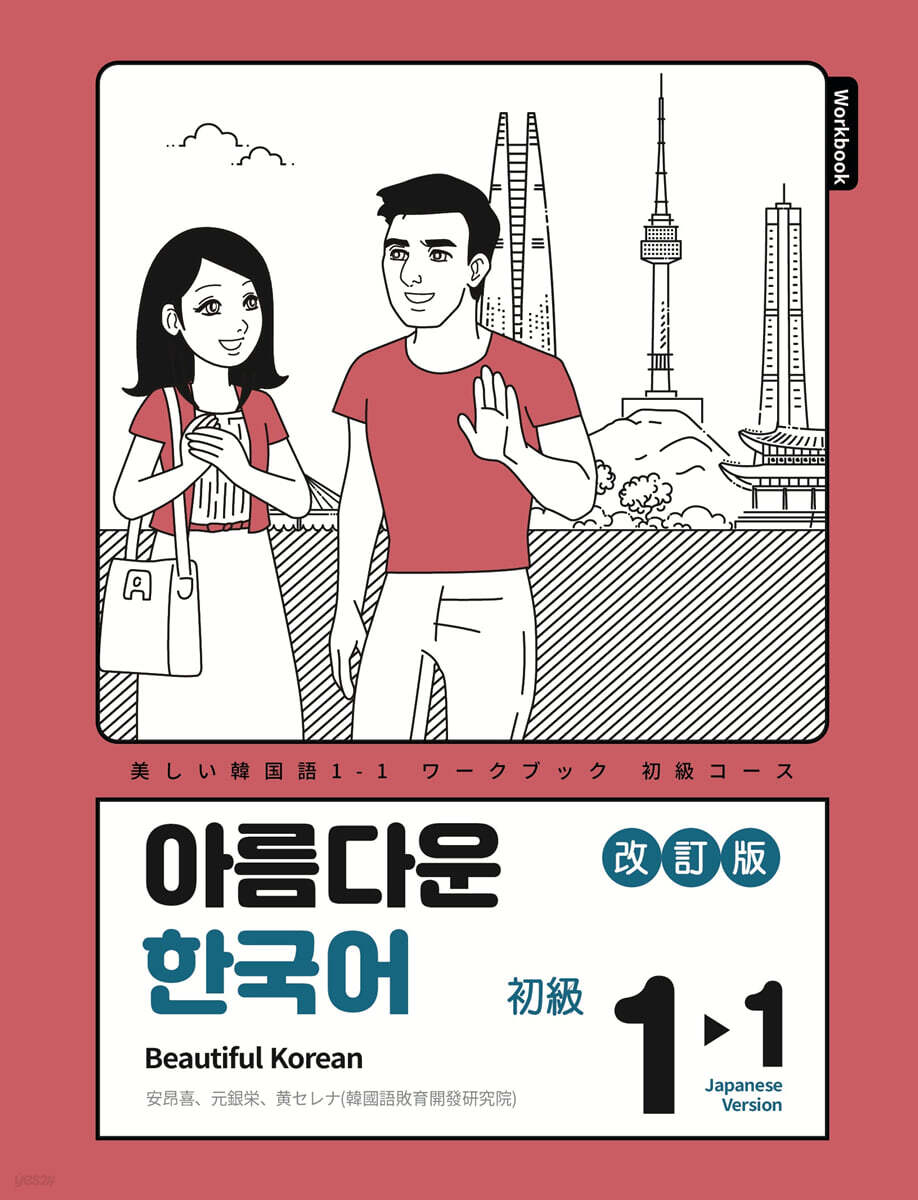
Beautiful Korean Homework Book 1-1 Japanese Edition
 |
Description
Book Introduction
◆ For beginners, it is translated into English, Japanese, and Chinese, so that students can study on their own as well as in class.
◆ The homework book is highly effective when studied together with this textbook, ‘Beautiful Korean.’
◆ It is structured so that learners can study the pre-learned content on their own and then have it checked by the teacher.
◆ The types of problems were varied to stimulate learners' interest.
◆ An integrated teaching method that includes listening, speaking, writing, and reading.
◆ All the photos and illustrations in [Beautiful Korean] were newly created by professional artists to match the time period and reality.
You can see a dynamic and living image of Korea today.
◆ You can solve similar problem types to the Test of Proficiency in Korean (TOPIK) through the text.
Therefore, you can prepare for the actual situation more systematically.
◆ [Beautiful Korean] is a textbook created with consideration for the situations of teachers and students, and will be updated as follows in the future.
We plan to research and publish the same textbook.
〉 [Beautiful Korean] Teacher's Guide
〉 [Beautiful Korean] Grammar Book (Beginner to Advanced)
〉 [Beautiful Korean] Various review materials (game board, flashcards, illustrations for posting on the blackboard, etc.)
〉 [Beautiful Korean] vocabulary, idioms, and grammar assessment workbook
◆ You can learn and speak accurate Korean pronunciation and Korean used in real-life situations at the same time.
〉 Listening CD recorded by KBS voice actors, MBC announcers, and Yonhap News announcers
◆ Continuous, direct communication is possible through events such as Korean language teacher training courses and seminars hosted by the 'Korean Language Education Development Research Institute', the research and development team behind [Beautiful Korean].
◆ You can start at the level that suits you through detailed step-by-step division.
◆ The homework book is highly effective when studied together with this textbook, ‘Beautiful Korean.’
◆ It is structured so that learners can study the pre-learned content on their own and then have it checked by the teacher.
◆ The types of problems were varied to stimulate learners' interest.
◆ An integrated teaching method that includes listening, speaking, writing, and reading.
◆ All the photos and illustrations in [Beautiful Korean] were newly created by professional artists to match the time period and reality.
You can see a dynamic and living image of Korea today.
◆ You can solve similar problem types to the Test of Proficiency in Korean (TOPIK) through the text.
Therefore, you can prepare for the actual situation more systematically.
◆ [Beautiful Korean] is a textbook created with consideration for the situations of teachers and students, and will be updated as follows in the future.
We plan to research and publish the same textbook.
〉 [Beautiful Korean] Teacher's Guide
〉 [Beautiful Korean] Grammar Book (Beginner to Advanced)
〉 [Beautiful Korean] Various review materials (game board, flashcards, illustrations for posting on the blackboard, etc.)
〉 [Beautiful Korean] vocabulary, idioms, and grammar assessment workbook
◆ You can learn and speak accurate Korean pronunciation and Korean used in real-life situations at the same time.
〉 Listening CD recorded by KBS voice actors, MBC announcers, and Yonhap News announcers
◆ Continuous, direct communication is possible through events such as Korean language teacher training courses and seminars hosted by the 'Korean Language Education Development Research Institute', the research and development team behind [Beautiful Korean].
◆ You can start at the level that suits you through detailed step-by-step division.
- You can preview some of the book's contents.
Preview
index
◆ When publishing a book
◆ Note
◆ Characters
◆ Textbook composition
◆ Table of Contents
◆ Lesson 1 Korean alphabet
◆ Lesson 2 Korean alphabet
◆ Lesson 3 Korean alphabet
◆ Lesson 4 Korean alphabet
◆ Lesson 5 Korean alphabet
◆ Lesson 6 Hello?
◆ Lesson 7 Nice to meet you.
◆ Lesson 8 What is this?
◆ Lesson 9 What do you do on the weekend?
◆ Lesson 10 Mr. Pierre's office is on the third floor.
◆ Lesson 11 What is your phone number?
◆ Appendix 1: Model Answer
◆ Note
◆ Characters
◆ Textbook composition
◆ Table of Contents
◆ Lesson 1 Korean alphabet
◆ Lesson 2 Korean alphabet
◆ Lesson 3 Korean alphabet
◆ Lesson 4 Korean alphabet
◆ Lesson 5 Korean alphabet
◆ Lesson 6 Hello?
◆ Lesson 7 Nice to meet you.
◆ Lesson 8 What is this?
◆ Lesson 9 What do you do on the weekend?
◆ Lesson 10 Mr. Pierre's office is on the third floor.
◆ Lesson 11 What is your phone number?
◆ Appendix 1: Model Answer
Publisher's Review
As the status of the Korean language gradually rises, new Korean language textbooks are being developed and published in many places.
In line with this, I have published “Beautiful Korean” based on my extensive experience in the Korean language education field for many years.
『Beautiful Korean』 means both ‘beautiful Korean’ and ‘beautiful Korean.’
It contains the meaning of Korean being a language that represents the spirit and culture of Korea and a Korean who strives to spread such Korean language to the world.
The textbook also tried to convey this meaning well.
『Beautiful Korean』Beginner Level 1 aims to help students learning Korean for the first time learn basic Korean sentence structures and vocabulary and use them to have simple conversations in everyday life.
And, to enable learners to practice and check on their own, we have made it 'learner activity-centered' to stimulate learners' interest, and we have reflected 'task-centered' and 'communication-centered' to enable them to apply the topics covered in the textbook to their daily lives.
We also pursued an 'integrated curriculum' that allowed students to learn the four areas of reading, writing, speaking, and listening evenly.
And we included cultural content to make it easier for learners to access not only the Korean language but also Korean culture.
I hope that the publication of "Beautiful Korean" will provide practical help to many learners who want to learn Korean more easily and approachably.
Of course, we believe this is not the end, but the beginning, and we will continue to work hard to develop new textbooks and supplementary materials that meet the needs of learners and contribute to the development of the Korean language.
Korean Language Education Development Institute
Director Ahn Seong-hee
1) Vocabulary and expressions
This textbook is composed of exercises to help you understand and use the words and expressions presented in each lesson.
This textbook also covers new vocabulary from the 'Let's Learn More' section.
A variety of practice types were used to stimulate learners' interest.
2) Grammar
It is designed so that students can check the grammar they have learned through 'Let's Learn' in each lesson by practicing it themselves.
For each sentence pattern practice, an example is provided so that students can see how to practice on their own.
Additionally, by presenting pictures together, we presented various situations so that students could practice naturally in situations similar to real life.
3) Listening
Through 'Listen and Write', students can write down simple vocabulary and sentences from each lesson, helping them learn correct spelling and pronunciation.
4) Writing
Writing related to the topic was made easier by presenting various writing processes through ‘Let’s Write.’
5) Appendix
Model answers are included so that learners can check for themselves.
go.
Basic Principles of Writing
1) It must be a learner-centered textbook.
Even though classes at school have teachers who guide and lead students through everything, students should be given consideration at least at the beginner level.
Many textbooks insist on using only Korean, which often leads to students having difficulty understanding.
Instructions should be translated into various languages to make it easier for beginners to participate in class and learn on their own.
2) Learning activities must be diverse.
The teaching materials should stimulate the intellectual curiosity of learners and be interesting.
3) Cultural aspects must be taken into consideration.
Many social and cultural elements of Korea should be reflected so that learners can naturally acquire Korean culture along with language acquisition.
This does not mean only the cultural corner, but if culture is to be learned throughout the textbook, it should be presented from the beginning.
4) The data must be factual.
Since language is a tool for everyday life, language education materials should be composed of content directly related to life.
It should also include a variety of genres and appropriately balance written and spoken language.
5) It must be possible to link with real-world situations.
Textbooks should include speaking tasks relevant to real-life situations and be flexible in setting the situations so that they can be applied to real-life situations.
6) All four areas of language (speaking, listening, reading, and writing) must be covered equally.
Each area should be presented evenly.
7) The connection between grammatical form and function must be natural and appropriate.
It should be focused on practical tasks and linked to the four language areas, rather than being a controlled grammar exercise.
8) There should be items for teaching the Korean phonological system and pronunciation.
9) To ensure comprehensive understanding, various media other than text, such as pictures and illustrations, should be used.
10) Teacher's guides must be produced and a variety of supplementary teaching materials must be developed.
What kind of people appear in “Beautiful Korean”?
Throughout 『Beautiful Korean』, foreigners learning Korean and Koreans who interact with them appear regularly.
These are characters who are consistent in personality, taste, voice, appearance, etc.
This setup not only increases learning interest, but also allows learners to naturally recognize how linguistic expressions change as relationships become more intimate.
The following are characters that appear in 『Beautiful Korean』.
1.
Emiko Watanabe: 33 years old, Japanese, reporter for the Tokyo Daily Newspaper
2.
Kevin Stuart: 29, American, English teacher
3.
Wang Xin: 23 years old, China, exchange student at the Department of Korean Studies at Korea University, majoring in Korean culture
4.
Mishchenko Natasha: 27 years old, Russian, housewife
5.
Pierre Jean: 34 years old, France, employee of Mirae Trading
6.
Sureng: 33 years old, Indian, Indian restaurant chef
7.
Yusuke Tanigawa: 31 years old, Japanese, reporter for the Tokyo Daily Newspaper
8.
Jo Yang: 22 years old, China, exchange student in the Department of Korean Studies at Korea University
9.
Jinwoo Ahn: 28 years old, South Korea, employee at Mirae Trading
10.
Lee Su-yeon: 27 years old, nurse at Seoul Hospital, South Korea
11.
Han Ji-young: 31 years old, South Korea, Korean language teacher
12.
Kim Young-min: 36 years old, Korean, office worker, Natasha's husband
In line with this, I have published “Beautiful Korean” based on my extensive experience in the Korean language education field for many years.
『Beautiful Korean』 means both ‘beautiful Korean’ and ‘beautiful Korean.’
It contains the meaning of Korean being a language that represents the spirit and culture of Korea and a Korean who strives to spread such Korean language to the world.
The textbook also tried to convey this meaning well.
『Beautiful Korean』Beginner Level 1 aims to help students learning Korean for the first time learn basic Korean sentence structures and vocabulary and use them to have simple conversations in everyday life.
And, to enable learners to practice and check on their own, we have made it 'learner activity-centered' to stimulate learners' interest, and we have reflected 'task-centered' and 'communication-centered' to enable them to apply the topics covered in the textbook to their daily lives.
We also pursued an 'integrated curriculum' that allowed students to learn the four areas of reading, writing, speaking, and listening evenly.
And we included cultural content to make it easier for learners to access not only the Korean language but also Korean culture.
I hope that the publication of "Beautiful Korean" will provide practical help to many learners who want to learn Korean more easily and approachably.
Of course, we believe this is not the end, but the beginning, and we will continue to work hard to develop new textbooks and supplementary materials that meet the needs of learners and contribute to the development of the Korean language.
Korean Language Education Development Institute
Director Ahn Seong-hee
1) Vocabulary and expressions
This textbook is composed of exercises to help you understand and use the words and expressions presented in each lesson.
This textbook also covers new vocabulary from the 'Let's Learn More' section.
A variety of practice types were used to stimulate learners' interest.
2) Grammar
It is designed so that students can check the grammar they have learned through 'Let's Learn' in each lesson by practicing it themselves.
For each sentence pattern practice, an example is provided so that students can see how to practice on their own.
Additionally, by presenting pictures together, we presented various situations so that students could practice naturally in situations similar to real life.
3) Listening
Through 'Listen and Write', students can write down simple vocabulary and sentences from each lesson, helping them learn correct spelling and pronunciation.
4) Writing
Writing related to the topic was made easier by presenting various writing processes through ‘Let’s Write.’
5) Appendix
Model answers are included so that learners can check for themselves.
go.
Basic Principles of Writing
1) It must be a learner-centered textbook.
Even though classes at school have teachers who guide and lead students through everything, students should be given consideration at least at the beginner level.
Many textbooks insist on using only Korean, which often leads to students having difficulty understanding.
Instructions should be translated into various languages to make it easier for beginners to participate in class and learn on their own.
2) Learning activities must be diverse.
The teaching materials should stimulate the intellectual curiosity of learners and be interesting.
3) Cultural aspects must be taken into consideration.
Many social and cultural elements of Korea should be reflected so that learners can naturally acquire Korean culture along with language acquisition.
This does not mean only the cultural corner, but if culture is to be learned throughout the textbook, it should be presented from the beginning.
4) The data must be factual.
Since language is a tool for everyday life, language education materials should be composed of content directly related to life.
It should also include a variety of genres and appropriately balance written and spoken language.
5) It must be possible to link with real-world situations.
Textbooks should include speaking tasks relevant to real-life situations and be flexible in setting the situations so that they can be applied to real-life situations.
6) All four areas of language (speaking, listening, reading, and writing) must be covered equally.
Each area should be presented evenly.
7) The connection between grammatical form and function must be natural and appropriate.
It should be focused on practical tasks and linked to the four language areas, rather than being a controlled grammar exercise.
8) There should be items for teaching the Korean phonological system and pronunciation.
9) To ensure comprehensive understanding, various media other than text, such as pictures and illustrations, should be used.
10) Teacher's guides must be produced and a variety of supplementary teaching materials must be developed.
What kind of people appear in “Beautiful Korean”?
Throughout 『Beautiful Korean』, foreigners learning Korean and Koreans who interact with them appear regularly.
These are characters who are consistent in personality, taste, voice, appearance, etc.
This setup not only increases learning interest, but also allows learners to naturally recognize how linguistic expressions change as relationships become more intimate.
The following are characters that appear in 『Beautiful Korean』.
1.
Emiko Watanabe: 33 years old, Japanese, reporter for the Tokyo Daily Newspaper
2.
Kevin Stuart: 29, American, English teacher
3.
Wang Xin: 23 years old, China, exchange student at the Department of Korean Studies at Korea University, majoring in Korean culture
4.
Mishchenko Natasha: 27 years old, Russian, housewife
5.
Pierre Jean: 34 years old, France, employee of Mirae Trading
6.
Sureng: 33 years old, Indian, Indian restaurant chef
7.
Yusuke Tanigawa: 31 years old, Japanese, reporter for the Tokyo Daily Newspaper
8.
Jo Yang: 22 years old, China, exchange student in the Department of Korean Studies at Korea University
9.
Jinwoo Ahn: 28 years old, South Korea, employee at Mirae Trading
10.
Lee Su-yeon: 27 years old, nurse at Seoul Hospital, South Korea
11.
Han Ji-young: 31 years old, South Korea, Korean language teacher
12.
Kim Young-min: 36 years old, Korean, office worker, Natasha's husband
GOODS SPECIFICS
- Date of issue: April 1, 2025
- Page count, weight, size: 94 pages | 550g | 210*297*15mm
- ISBN13: 9788991869929
- ISBN10: 8991869920
You may also like
카테고리
korean


korean

![GQ KOREA Mark (Monthly): December [2025]](http://librairie.coreenne.fr/cdn/shop/files/8ef265dbbfbf186523ed75ba7319009d.jpg?v=1765340328&width=3840)


