

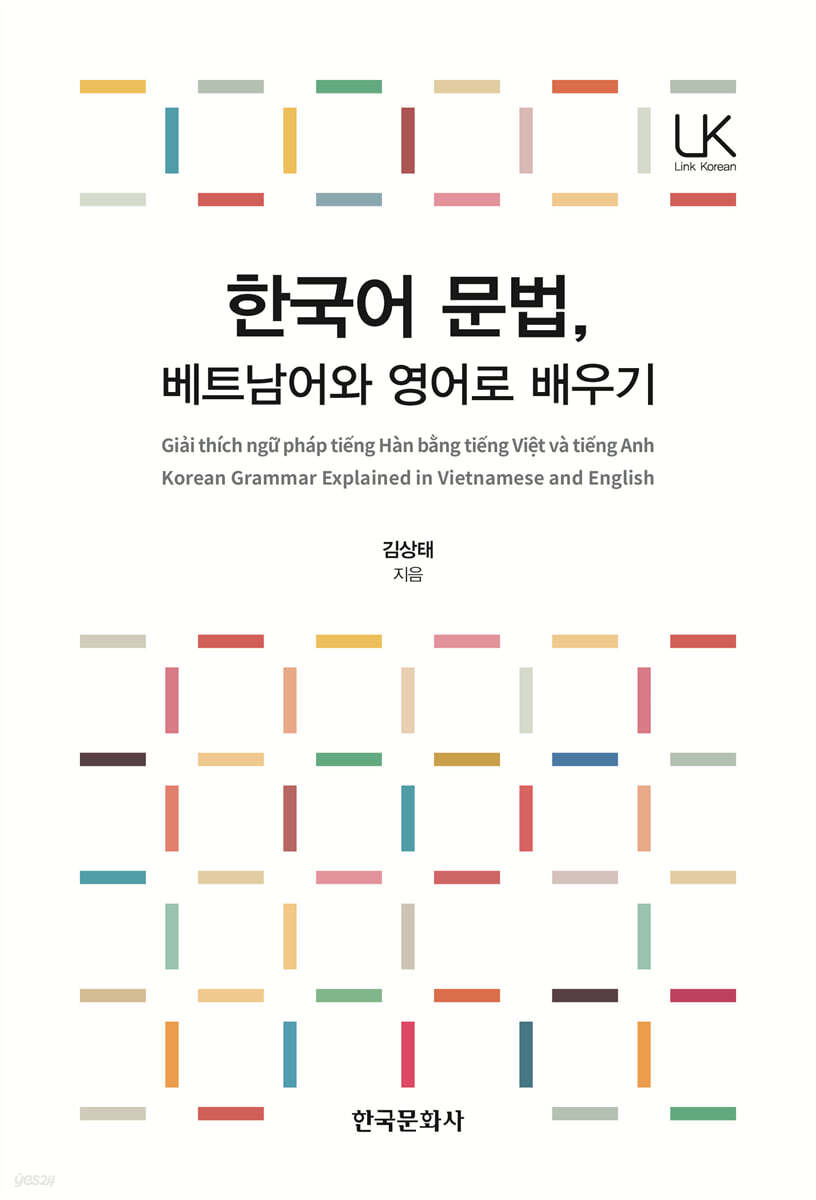
Learn Korean Grammar in Vietnamese and English
 |
Description
Book Introduction
Although Korean, Vietnamese, and English have many differences in structure and vocabulary, we have tried to help learners understand the explanations from the perspective of a common language learner.
This will enable learners to go beyond simple grammar knowledge to understand similarities and differences between languages, and even consider cultural backgrounds.
It is structured to allow learners to compare Korean grammar with other languages.
Although Korean, Vietnamese, and English differ greatly in structure and vocabulary, this book aims to make explanations accessible from the perspective of language learners.
Through this, learners can not only acquire grammatical knowledge but also understand linguistic similarities and differences and explore cultural contexts.
This will enable learners to go beyond simple grammar knowledge to understand similarities and differences between languages, and even consider cultural backgrounds.
It is structured to allow learners to compare Korean grammar with other languages.
Although Korean, Vietnamese, and English differ greatly in structure and vocabulary, this book aims to make explanations accessible from the perspective of language learners.
Through this, learners can not only acquire grammatical knowledge but also understand linguistic similarities and differences and explore cultural contexts.
- You can preview some of the book's contents.
Preview
index
introduction
1.
How to learn Korean, Cach h?c ti?ng Han How to learn Korean
2.
Language type, Lo?i hinh ngon ng? Language type
2.1.
Isolated word Ngon ng? đ?nl?p Isolating language
2.2.
Inflectional word Ngon ng? bi?n hinh Inflectional language
2.3.
Agglutinative word Ngon ng? ch?p dinh Agglutinative language
3.
Cheon, Nhom t? danh t? Nominal
3.1.
Noun Danh t? Noun
3.2.
Pronoun đ?it? Pronoun
3.3.
Investigation S? t? Numeral
4.
Verb, V? ng? Predicate
4.1.
Verb đ?ng t? Verb
4.2.
Tinh t? Adjective
4.3.
Main predicate and auxiliary predicate đ?ng t? chinh va đ?ng t? b? tr?
4.4.
Conjugation and ending S? chia đ?ng t? va tinh t? Conjugation and ending
5.
Modifier, T? b? ngh?a Modifier
5.1.
Adnominal word đ?nh t?
5.2.
Adverb Tr?ng t? Adverb
6.
Independent word, T? đ?cl?p Independent word
7.
Sentence component, Thanh ph?n cau Syntactic unit
7.1.
Ch? ng? Subject
7.2.
Tan ng? Object
7.3.
Predicate V? ng? Predicate
7.4.
Adnominal đ?nh ng? Adnominal
7.5.
Adverbial Tr?ng ng? Adverbial
7.6.
Bore B? ng? Complement
7.7.
Independent word T? đ?cl?p Independent word
8.
Morpheme and word, Hinh v? va t? Morpheme and word
8.1.
Morpheme Hinh v? Morpheme
8.2.
Word T? Word
8.3.
Morphological analysis Phan tich hinh thai Morphological analysis
supplement
Classroom Korean
Ti?ng Han trong l?ph?cAppendix: Classroom Korean
1.
How to learn Korean, Cach h?c ti?ng Han How to learn Korean
2.
Language type, Lo?i hinh ngon ng? Language type
2.1.
Isolated word Ngon ng? đ?nl?p Isolating language
2.2.
Inflectional word Ngon ng? bi?n hinh Inflectional language
2.3.
Agglutinative word Ngon ng? ch?p dinh Agglutinative language
3.
Cheon, Nhom t? danh t? Nominal
3.1.
Noun Danh t? Noun
3.2.
Pronoun đ?it? Pronoun
3.3.
Investigation S? t? Numeral
4.
Verb, V? ng? Predicate
4.1.
Verb đ?ng t? Verb
4.2.
Tinh t? Adjective
4.3.
Main predicate and auxiliary predicate đ?ng t? chinh va đ?ng t? b? tr?
4.4.
Conjugation and ending S? chia đ?ng t? va tinh t? Conjugation and ending
5.
Modifier, T? b? ngh?a Modifier
5.1.
Adnominal word đ?nh t?
5.2.
Adverb Tr?ng t? Adverb
6.
Independent word, T? đ?cl?p Independent word
7.
Sentence component, Thanh ph?n cau Syntactic unit
7.1.
Ch? ng? Subject
7.2.
Tan ng? Object
7.3.
Predicate V? ng? Predicate
7.4.
Adnominal đ?nh ng? Adnominal
7.5.
Adverbial Tr?ng ng? Adverbial
7.6.
Bore B? ng? Complement
7.7.
Independent word T? đ?cl?p Independent word
8.
Morpheme and word, Hinh v? va t? Morpheme and word
8.1.
Morpheme Hinh v? Morpheme
8.2.
Word T? Word
8.3.
Morphological analysis Phan tich hinh thai Morphological analysis
supplement
Classroom Korean
Ti?ng Han trong l?ph?cAppendix: Classroom Korean
Publisher's Review
We now live in an age where multiculturalism and multilingualism coexist.
This book is a Korean grammar guide for foreign learners who wish to learn Korean in this historical context.
Additionally, it was designed to be used as comparative language education material in multicultural language environments for Korean language teachers and those interested in Korean language education.
This textbook is written in Korean, Vietnamese, and English, and is designed specifically to allow students to learn Korean grammar by comparing it with other languages.
Although Korean, Vietnamese, and English have many differences in structure and vocabulary, I tried to help the explanations be understood from the perspective of a learner learning a common language.
This will enable learners to go beyond simple grammar knowledge to understand similarities and differences between languages, and even consider cultural backgrounds.
I hope this book will be accessible and enjoyable for Korean language learners and contribute, however small, to language education in this multicultural era.
I would like to express my sincere gratitude to everyone who supported the publication of this book, especially to my fellow teachers who helped me write the manuscript, to the staff at Korean Cultural History who handled the publishing, and to my family who has always been by my side and provided support.
Summer 2025, under Mt. Uam
Written by the author
This book is a Korean grammar guide for foreign learners who wish to learn Korean in this historical context.
Additionally, it was designed to be used as comparative language education material in multicultural language environments for Korean language teachers and those interested in Korean language education.
This textbook is written in Korean, Vietnamese, and English, and is designed specifically to allow students to learn Korean grammar by comparing it with other languages.
Although Korean, Vietnamese, and English have many differences in structure and vocabulary, I tried to help the explanations be understood from the perspective of a learner learning a common language.
This will enable learners to go beyond simple grammar knowledge to understand similarities and differences between languages, and even consider cultural backgrounds.
I hope this book will be accessible and enjoyable for Korean language learners and contribute, however small, to language education in this multicultural era.
I would like to express my sincere gratitude to everyone who supported the publication of this book, especially to my fellow teachers who helped me write the manuscript, to the staff at Korean Cultural History who handled the publishing, and to my family who has always been by my side and provided support.
Summer 2025, under Mt. Uam
Written by the author
GOODS SPECIFICS
- Date of issue: August 25, 2025
- Page count, weight, size: 166 pages | 153*225*8mm
- ISBN13: 9791169193290
You may also like
카테고리
korean


korean

![GQ KOREA Mark (Monthly): December [2025]](http://librairie.coreenne.fr/cdn/shop/files/8ef265dbbfbf186523ed75ba7319009d.jpg?v=1765340328&width=3840)


