

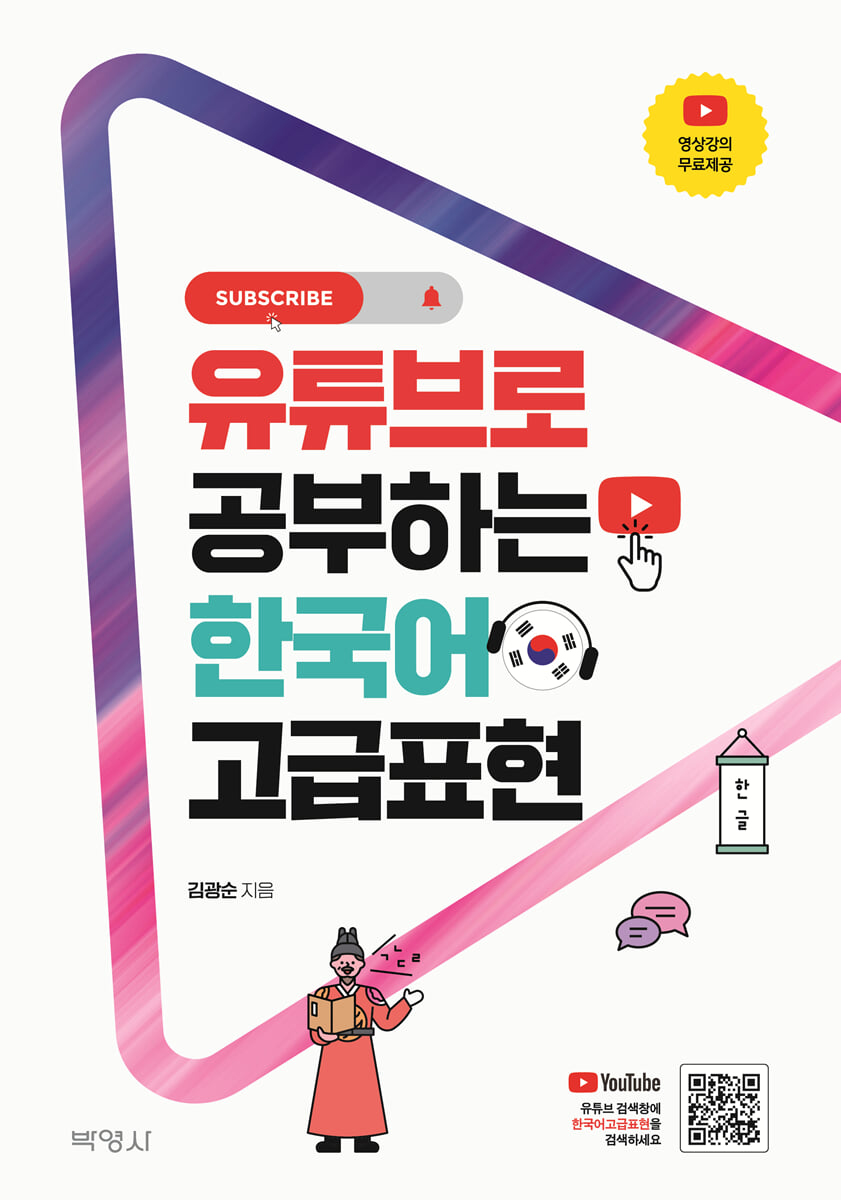
Advanced Korean Expressions for Learning on YouTube
 |
Description
Book Introduction
Unlike beginner grammar, advanced grammar is not actively used in daily life.
That is why Korean language learners often get criticized for using advanced sentence structures in conversations with Koreans.
However, this criticism should not be mistaken as an awkward expression that does not require advanced grammar.
This is because the vocabulary and sentence patterns learned in the advanced level are the most appropriate expressions in situations where you need to express your opinion, write formally, or use professional Korean.
For this reason, accurate use is of utmost importance, as errors in advanced grammar can directly affect the professionalism of one's Korean language skills.
This textbook was composed with these contents in mind as the most important.
In other words, even if it is not used with high frequency in daily life, it is considered to be qualified as target grammar if it is used with meaningful frequency in special situations.
Additionally, examples were organized based on the most accurate and appropriate usage.
Accordingly, we expect that learning this textbook will be most effective if you focus on the following contents.
That is why Korean language learners often get criticized for using advanced sentence structures in conversations with Koreans.
However, this criticism should not be mistaken as an awkward expression that does not require advanced grammar.
This is because the vocabulary and sentence patterns learned in the advanced level are the most appropriate expressions in situations where you need to express your opinion, write formally, or use professional Korean.
For this reason, accurate use is of utmost importance, as errors in advanced grammar can directly affect the professionalism of one's Korean language skills.
This textbook was composed with these contents in mind as the most important.
In other words, even if it is not used with high frequency in daily life, it is considered to be qualified as target grammar if it is used with meaningful frequency in special situations.
Additionally, examples were organized based on the most accurate and appropriate usage.
Accordingly, we expect that learning this textbook will be most effective if you focus on the following contents.
index
01 Geoniwa 9
02 Konkuk University 11
03 Sometimes 14
04 I think so 16
05 I guess 18
06 Let alone 20
07 It's no exaggeration 22
08 Just - I guess so 24
09 Because of that 26
10th generation is so bad 28
11 It depends 31
12 gigs is scary 33
35, let alone 13
14th generation Hani 37
15th anniversary 39th anniversary
16 Deceive! 41
43 according to 17th period
If it's 18, it's 45
19 long, - let's go 47
20 Why wouldn't I - 49
51 on the 21st
22 Because you are like that 53
23 Too much 55
24 Noramen 57
25 Not as good as Nuni 58
26 60
27 is 62
28 I can't do it all 1 64
29 I can't do it all 2 66
30 Dagado 67
31 and 69
32 can be said to be 71
73 in terms of 33
34 is the same as 75
Even if you hit 35, it's 77
36 As you can see, 79
37 As I said before, 81
38 Answer 83
39 then 85
Even if it's 40, it's 87
41 Dundle 1 89
42 Dundle 2 92
43 degrees is 94 degrees
44 Do 96
45 I think 98
100 rather than 46
47 Marjoram 102
48 Same as 104
49 is not even 106
108 as good as 50
51 On the other hand, 110
52 Starting with 112
53 Samut 114
54 I didn't think about it 115
55 I want to be 117
56 counts and 118
57 Ah/uh/yeo look out 120
58 Ah/uh/yeobtae1 122
59 Ah/uh/yeobbaecha2 123
60 Ah/eo/yeo Chiu-da 124
61 not possible 126
62 nights 128
63 Anyway 130
64 How - Ji 133
135 in light of 65
66 to be stuck in 137
67 and up to 139
68 Yeogan - Not much 141
69 There is room for 143
70 No room 144
71 How could it be 148?
72 If possible, 151
73 is 153
74 Euni/ni whatever you do 155
75 Trying to get 157
76 ryeoya/ryeoya 160
77 Euryeonman/Yeonman 162
164 by/because of 78
79 If it's 166, that's it
If it's 80, I don't know, but if it's 168
81 Eun/n remaining 170
82 Silver 172
83 silver/n bar 174
84 more than 176
85 silver 179
86 or 181
87 Should I or Should I not 183
There was a time when I was 88 185
89 Eulak Malak 187
188 at the risk of 90
91 to 190
92 to 193
Not only 93 but also 195
94 or 197
I'll give you 95 but 200
203 based on 96
97 'Eum' and 'Gi' (Pre-vowel Suffix) 204
98 sleeps 207
99 enemies 209
211 in 100
Correct answer 213
02 Konkuk University 11
03 Sometimes 14
04 I think so 16
05 I guess 18
06 Let alone 20
07 It's no exaggeration 22
08 Just - I guess so 24
09 Because of that 26
10th generation is so bad 28
11 It depends 31
12 gigs is scary 33
35, let alone 13
14th generation Hani 37
15th anniversary 39th anniversary
16 Deceive! 41
43 according to 17th period
If it's 18, it's 45
19 long, - let's go 47
20 Why wouldn't I - 49
51 on the 21st
22 Because you are like that 53
23 Too much 55
24 Noramen 57
25 Not as good as Nuni 58
26 60
27 is 62
28 I can't do it all 1 64
29 I can't do it all 2 66
30 Dagado 67
31 and 69
32 can be said to be 71
73 in terms of 33
34 is the same as 75
Even if you hit 35, it's 77
36 As you can see, 79
37 As I said before, 81
38 Answer 83
39 then 85
Even if it's 40, it's 87
41 Dundle 1 89
42 Dundle 2 92
43 degrees is 94 degrees
44 Do 96
45 I think 98
100 rather than 46
47 Marjoram 102
48 Same as 104
49 is not even 106
108 as good as 50
51 On the other hand, 110
52 Starting with 112
53 Samut 114
54 I didn't think about it 115
55 I want to be 117
56 counts and 118
57 Ah/uh/yeo look out 120
58 Ah/uh/yeobtae1 122
59 Ah/uh/yeobbaecha2 123
60 Ah/eo/yeo Chiu-da 124
61 not possible 126
62 nights 128
63 Anyway 130
64 How - Ji 133
135 in light of 65
66 to be stuck in 137
67 and up to 139
68 Yeogan - Not much 141
69 There is room for 143
70 No room 144
71 How could it be 148?
72 If possible, 151
73 is 153
74 Euni/ni whatever you do 155
75 Trying to get 157
76 ryeoya/ryeoya 160
77 Euryeonman/Yeonman 162
164 by/because of 78
79 If it's 166, that's it
If it's 80, I don't know, but if it's 168
81 Eun/n remaining 170
82 Silver 172
83 silver/n bar 174
84 more than 176
85 silver 179
86 or 181
87 Should I or Should I not 183
There was a time when I was 88 185
89 Eulak Malak 187
188 at the risk of 90
91 to 190
92 to 193
Not only 93 but also 195
94 or 197
I'll give you 95 but 200
203 based on 96
97 'Eum' and 'Gi' (Pre-vowel Suffix) 204
98 sleeps 207
99 enemies 209
211 in 100
Correct answer 213
Detailed image
.jpg)
Publisher's Review
preface
Unlike beginner grammar, advanced grammar is not actively used in daily life.
That is why Korean language learners often get criticized for using advanced sentence structures in conversations with Koreans.
However, this criticism should not be mistaken as an awkward expression that does not require advanced grammar.
This is because the vocabulary and sentence patterns learned in the advanced level are the most appropriate expressions in situations where you need to express your opinion, write formally, or use professional Korean.
For this reason, accurate use is of utmost importance, as errors in advanced grammar can directly affect the professionalism of one's Korean language skills.
This textbook was composed with these contents in mind as the most important.
In other words, even if it is not used with high frequency in daily life, it is considered to be qualified as target grammar if it is used with meaningful frequency in special situations.
Additionally, examples were organized based on the most accurate and appropriate usage.
Accordingly, we expect that learning this textbook will be most effective if you focus on the following contents.
First, advanced grammar can convey the most appropriate meaning when used with advanced vocabulary.
Some learners do not consider it important to learn advanced vocabulary that is less frequently used in everyday life when it is similar to what they learned in the beginner level.
However, keep in mind that advanced grammar and advanced vocabulary are not separate entities, and you should make a continuous effort to learn a variety of advanced vocabulary.
Second, advanced grammar is an expression that is appropriate for use in various situations where conversations are taking place or in writing in units of discourse, so there are many awkward contents when viewed at the sentence level.
This is also reflected in this textbook.
We have tried to help students understand and utilize sentence structures through dialogue as much as possible, but the awkwardness that arises from the limited volume and the inability to include the sounds used in conversation is considered an unavoidable limitation of the textbook. Taking this into account, we should strive to enable learning sentence structures within a broader context.
Third, the expressions that all Koreans use most naturally are the sentence patterns and vocabulary learned in the beginner level.
On the other hand, some Koreans may not be familiar with or find advanced sentence structures awkward.
This is not a question of grammatical correctness, but rather an awkwardness felt in an uncommonly used sentence structure.
We should not exclude certain sentence patterns from learning by misunderstanding them as unnecessary.
Fourth, this textbook consists of problems that focus on the use of target grammar and problems that derive various correct answers centered on target questions.
In this case, there is no significant difference from the correct answer presented in the textbook.
However, since the latter can have a wide variety of answers, any questions about it should be directed to the QR code of the relevant grammar and asked through the comments.
Fifth, the examples in this textbook are organized around the content in which the relevant grammar can be used most naturally and appropriately.
If you find it difficult to understand grammar, you can choose to memorize the provided examples as your primary learning method.
It should be kept in mind that memorizing sentence patterns can be an effective learning method, as various sentence patterns well stored in long-term memory can serve as materials necessary for producing new sentence patterns.
Finally, it is important to keep in mind that if you learn advanced grammar on your own without the assistance of an instructor, you may encounter numerous errors.
Especially in advanced grammar, a mistake in a particle or ending can result in a sentence being misspelled and the meaning completely changing.
However, learners who are not aware of this should keep in mind that they can accumulate infinitely meaningless Korean skills by studying Korean alone and diligently in the wrong way, and they should not stop actively asking questions and communicating through YouTube.
Having spent a long time teaching Korean to foreign learners, I often find myself questioning whether the Korean I use truly possesses universality.
For this reason, I try to create situations where I can be exposed to the Korean language through various media and listen to the stories of people working in various fields.
Nevertheless, I always bothered my family while writing this textbook, worried that I might pass on incorrect information due to my subjective language habits.
I would like to express my gratitude here for the help I received from my wife, Kim Joo-young, who listened to my explanations and judged right from wrong; my eldest son, Kim On-ju, who made an effort to answer my questions and fill in the blanks to the best of his knowledge; and my second son, Kim On-seo, who waited for me to miss his turn to speak because of my explanations and questions. Thanks to his help, I was able to create another book.
Unlike beginner grammar, advanced grammar is not actively used in daily life.
That is why Korean language learners often get criticized for using advanced sentence structures in conversations with Koreans.
However, this criticism should not be mistaken as an awkward expression that does not require advanced grammar.
This is because the vocabulary and sentence patterns learned in the advanced level are the most appropriate expressions in situations where you need to express your opinion, write formally, or use professional Korean.
For this reason, accurate use is of utmost importance, as errors in advanced grammar can directly affect the professionalism of one's Korean language skills.
This textbook was composed with these contents in mind as the most important.
In other words, even if it is not used with high frequency in daily life, it is considered to be qualified as target grammar if it is used with meaningful frequency in special situations.
Additionally, examples were organized based on the most accurate and appropriate usage.
Accordingly, we expect that learning this textbook will be most effective if you focus on the following contents.
First, advanced grammar can convey the most appropriate meaning when used with advanced vocabulary.
Some learners do not consider it important to learn advanced vocabulary that is less frequently used in everyday life when it is similar to what they learned in the beginner level.
However, keep in mind that advanced grammar and advanced vocabulary are not separate entities, and you should make a continuous effort to learn a variety of advanced vocabulary.
Second, advanced grammar is an expression that is appropriate for use in various situations where conversations are taking place or in writing in units of discourse, so there are many awkward contents when viewed at the sentence level.
This is also reflected in this textbook.
We have tried to help students understand and utilize sentence structures through dialogue as much as possible, but the awkwardness that arises from the limited volume and the inability to include the sounds used in conversation is considered an unavoidable limitation of the textbook. Taking this into account, we should strive to enable learning sentence structures within a broader context.
Third, the expressions that all Koreans use most naturally are the sentence patterns and vocabulary learned in the beginner level.
On the other hand, some Koreans may not be familiar with or find advanced sentence structures awkward.
This is not a question of grammatical correctness, but rather an awkwardness felt in an uncommonly used sentence structure.
We should not exclude certain sentence patterns from learning by misunderstanding them as unnecessary.
Fourth, this textbook consists of problems that focus on the use of target grammar and problems that derive various correct answers centered on target questions.
In this case, there is no significant difference from the correct answer presented in the textbook.
However, since the latter can have a wide variety of answers, any questions about it should be directed to the QR code of the relevant grammar and asked through the comments.
Fifth, the examples in this textbook are organized around the content in which the relevant grammar can be used most naturally and appropriately.
If you find it difficult to understand grammar, you can choose to memorize the provided examples as your primary learning method.
It should be kept in mind that memorizing sentence patterns can be an effective learning method, as various sentence patterns well stored in long-term memory can serve as materials necessary for producing new sentence patterns.
Finally, it is important to keep in mind that if you learn advanced grammar on your own without the assistance of an instructor, you may encounter numerous errors.
Especially in advanced grammar, a mistake in a particle or ending can result in a sentence being misspelled and the meaning completely changing.
However, learners who are not aware of this should keep in mind that they can accumulate infinitely meaningless Korean skills by studying Korean alone and diligently in the wrong way, and they should not stop actively asking questions and communicating through YouTube.
Having spent a long time teaching Korean to foreign learners, I often find myself questioning whether the Korean I use truly possesses universality.
For this reason, I try to create situations where I can be exposed to the Korean language through various media and listen to the stories of people working in various fields.
Nevertheless, I always bothered my family while writing this textbook, worried that I might pass on incorrect information due to my subjective language habits.
I would like to express my gratitude here for the help I received from my wife, Kim Joo-young, who listened to my explanations and judged right from wrong; my eldest son, Kim On-ju, who made an effort to answer my questions and fill in the blanks to the best of his knowledge; and my second son, Kim On-seo, who waited for me to miss his turn to speak because of my explanations and questions. Thanks to his help, I was able to create another book.
GOODS SPECIFICS
- Date of issue: May 20, 2023
- Page count, weight, size: 256 pages | 176*248*20mm
- ISBN13: 9791130317717
- ISBN10: 1130317714
You may also like
카테고리
korean


korean

![GQ KOREA Mark (Monthly): December [2025]](http://librairie.coreenne.fr/cdn/shop/files/8ef265dbbfbf186523ed75ba7319009d.jpg?v=1765340328&width=3840)


