

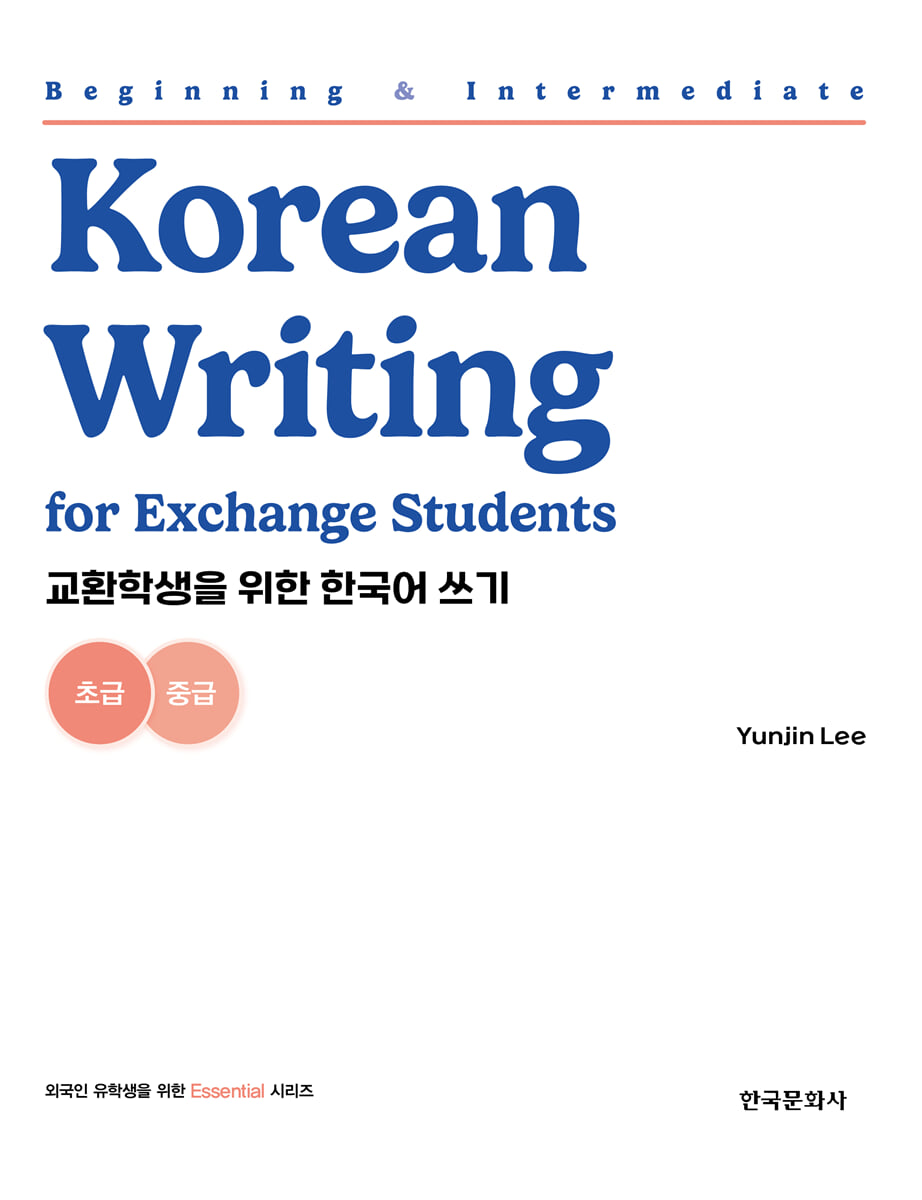
Korean Writing for Exchange Students - Beginner and Intermediate
 |
Description
Book Introduction
This is a textbook for exchange students at domestic universities.
This is a writing textbook covering beginner to intermediate level content, taking into account the characteristics and circumstances of short-term international students staying in Korea for one semester to one year.
English translations of the unit outline and instructions are provided.
This is a writing textbook covering beginner to intermediate level content, taking into account the characteristics and circumstances of short-term international students staying in Korea for one semester to one year.
English translations of the unit outline and instructions are provided.
- You can preview some of the book's contents.
Preview
index
Chapter 1 Getting to Know Each Other
01.
Self-Introduction 1
02.
Self-Introduction 2
03.
Introducing my classmates
04.
Looking for friends
05.
Introducing my school
06.
Things I like
Chapter 2 Taking Notes in a Diary
07.
Self-imposed rules and rituals
08.
My plans and wishes
09.
Facts and information
10.
Memo of past events
11.
Special experiences
Chapter 3 Grammar and Writing
12.
Effective approaches
13.
Making comparisons
14.
Completing sentences
15.
Spelling and grammar
16.
Spacing rules
Chapter 4 Vocabulary and Writing
17.
Synonyms
18.
Homophones: Vocabulary with the same pronunciation but different meaning
19.
Writing a short story
20.
Defining words
21.
Words with similar pronunciations and spellings
22.
Text messages with close friends
23.
Loanwords in everyday life
24.
Writing a diary
Chapter 5: Writing for Communication
25.
Writing e-mails
26.
Contact Us Making inquiries
27.
Making suggestions
28.
Descriptive writing
Chapter 6: Record Your Experiences and Personal Growth
29.
Reminiscing photos
30.
My unforgettable experiences
31.
My abilities and strengths
32.
My study abroad life
Appendix
① Writing a resume (CV)
② Writing on manuscript paper
③ Hangeul calligraphy
01.
Self-Introduction 1
02.
Self-Introduction 2
03.
Introducing my classmates
04.
Looking for friends
05.
Introducing my school
06.
Things I like
Chapter 2 Taking Notes in a Diary
07.
Self-imposed rules and rituals
08.
My plans and wishes
09.
Facts and information
10.
Memo of past events
11.
Special experiences
Chapter 3 Grammar and Writing
12.
Effective approaches
13.
Making comparisons
14.
Completing sentences
15.
Spelling and grammar
16.
Spacing rules
Chapter 4 Vocabulary and Writing
17.
Synonyms
18.
Homophones: Vocabulary with the same pronunciation but different meaning
19.
Writing a short story
20.
Defining words
21.
Words with similar pronunciations and spellings
22.
Text messages with close friends
23.
Loanwords in everyday life
24.
Writing a diary
Chapter 5: Writing for Communication
25.
Writing e-mails
26.
Contact Us Making inquiries
27.
Making suggestions
28.
Descriptive writing
Chapter 6: Record Your Experiences and Personal Growth
29.
Reminiscing photos
30.
My unforgettable experiences
31.
My abilities and strengths
32.
My study abroad life
Appendix
① Writing a resume (CV)
② Writing on manuscript paper
③ Hangeul calligraphy
Publisher's Review
preface
This book was written with a focus on exchange students at domestic universities.
Although the situation may vary slightly from educational institution to educational institution, the proportion of exchange students among domestic students is generally high.
However, unlike international students who advance to undergraduate or graduate school, there is a big difference in that exchange students are 'short-term international students' who stay in Korea for a few months at the shortest and up to a year at the longest.
In Korean language classes for exchange students, it is necessary to take their circumstances and backgrounds into account based on the above-mentioned understanding of diversity.
To efficiently conduct Korean writing classes over the course of a semester, this textbook incorporates the following features:
First, the key words of this textbook are ‘experience and growth.’
We covered situations and topics that are highly realistic for exchange students, such as their daily lives, school life, making and interacting with friends, and taking on challenges in areas of interest.
By challenging and experiencing various genres of Korean writing, you will feel a sense of accomplishment in communicating in written Korean and improve your Korean language skills.
Second, considering the Korean language learning experiences and differences in Korean language proficiency of exchange students from around the world, this book includes content from beginner to intermediate levels.
Instructors can select and order the units in the textbook based on students' level and interests.
Depending on the individual characteristics of each student, the textbook's presentation and practice questions can be modified to increase or decrease in length and difficulty.
Third, we took into account that the number of hours and method of operation of Korean language courses may differ depending on the educational institution.
Even for the same 3-credit course, classes may be held once a week, or there may be classes held twice a week, divided into 1-hour and 2-hour sessions.
This textbook includes both long and short chapters to allow for flexible use depending on the number of class hours and operating methods of each institution.
Fourth, considering the academic operation, we have designed a variety of writing activities suitable for the beginning and end of the semester.
Chapter 1: Getting to Know Each Other is a fun way for students who are meeting for the first time in the same class to get to know each other.
Especially at the beginning of the semester, partial changes in student enrollment are inevitable due to changes in course registration, but Chapter 1 has the advantage of not having a significant impact on the overall class operation and learning progress.
Next, Chapter 6, Recording Experiences and Growth, contains a writing activity where exchange students look back on their study abroad experience in Korea and reflect on its meaning before returning to their home countries.
Fifth, this textbook includes [Appendix] materials that can be used flexibly and selectively without disrupting the flow of the class.
When running classes for a semester, there are times when absences increase or overall class concentration decreases around holidays, school events or festivals, and exam periods.
As the scheduled return date approaches, many students are asking for forgiveness for their absence due to personal reasons such as travel.
During these times, you can utilize the [Appendix] materials, such as Korean calligraphy, resume writing, and manuscript writing, appropriately in class.
This book was written with a focus on exchange students at domestic universities.
Although the situation may vary slightly from educational institution to educational institution, the proportion of exchange students among domestic students is generally high.
However, unlike international students who advance to undergraduate or graduate school, there is a big difference in that exchange students are 'short-term international students' who stay in Korea for a few months at the shortest and up to a year at the longest.
In Korean language classes for exchange students, it is necessary to take their circumstances and backgrounds into account based on the above-mentioned understanding of diversity.
To efficiently conduct Korean writing classes over the course of a semester, this textbook incorporates the following features:
First, the key words of this textbook are ‘experience and growth.’
We covered situations and topics that are highly realistic for exchange students, such as their daily lives, school life, making and interacting with friends, and taking on challenges in areas of interest.
By challenging and experiencing various genres of Korean writing, you will feel a sense of accomplishment in communicating in written Korean and improve your Korean language skills.
Second, considering the Korean language learning experiences and differences in Korean language proficiency of exchange students from around the world, this book includes content from beginner to intermediate levels.
Instructors can select and order the units in the textbook based on students' level and interests.
Depending on the individual characteristics of each student, the textbook's presentation and practice questions can be modified to increase or decrease in length and difficulty.
Third, we took into account that the number of hours and method of operation of Korean language courses may differ depending on the educational institution.
Even for the same 3-credit course, classes may be held once a week, or there may be classes held twice a week, divided into 1-hour and 2-hour sessions.
This textbook includes both long and short chapters to allow for flexible use depending on the number of class hours and operating methods of each institution.
Fourth, considering the academic operation, we have designed a variety of writing activities suitable for the beginning and end of the semester.
Chapter 1: Getting to Know Each Other is a fun way for students who are meeting for the first time in the same class to get to know each other.
Especially at the beginning of the semester, partial changes in student enrollment are inevitable due to changes in course registration, but Chapter 1 has the advantage of not having a significant impact on the overall class operation and learning progress.
Next, Chapter 6, Recording Experiences and Growth, contains a writing activity where exchange students look back on their study abroad experience in Korea and reflect on its meaning before returning to their home countries.
Fifth, this textbook includes [Appendix] materials that can be used flexibly and selectively without disrupting the flow of the class.
When running classes for a semester, there are times when absences increase or overall class concentration decreases around holidays, school events or festivals, and exam periods.
As the scheduled return date approaches, many students are asking for forgiveness for their absence due to personal reasons such as travel.
During these times, you can utilize the [Appendix] materials, such as Korean calligraphy, resume writing, and manuscript writing, appropriately in class.
GOODS SPECIFICS
- Date of issue: August 25, 2023
- Page count, weight, size: 230 pages | 200*260*20mm
- ISBN13: 9791169191401
- ISBN10: 1169191401
You may also like
카테고리
korean


korean

![GQ KOREA Mark (Monthly): December [2025]](http://librairie.coreenne.fr/cdn/shop/files/8ef265dbbfbf186523ed75ba7319009d.jpg?v=1765340328&width=3840)


