

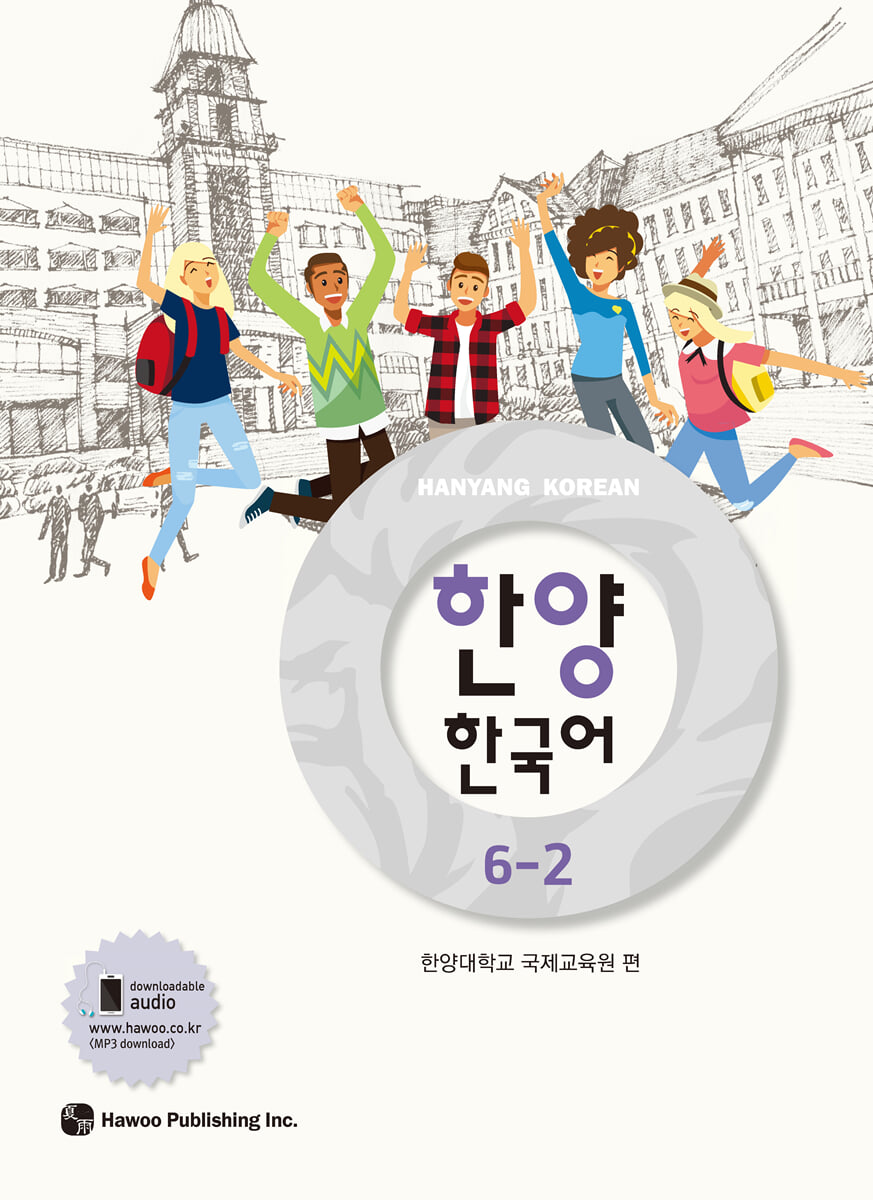
Hanyang Korean 6-2
 |
Description
Book Introduction
『Hanyang Korean 6』 is an integrated textbook for foreigners and overseas Koreans. It contains the educational content required for level 6 learners based on the international standard Korean language curriculum.
The unit was designed with the goal of enabling students to express their opinions fluently and accurately on universal human topics such as history, culture, environment, folklore, society, economy, and politics, and to communicate appropriately in formal settings.
As a follow-up course to 『Hanyang Korean 5』, it allows for systematic learning of academic speaking and writing. In particular, it helps students understand Korean society and culture, Korean values and way of thinking from an intercultural perspective and compare them with their own country's situation, thereby fostering the capabilities required of global citizens.
The unit was designed with the goal of enabling students to express their opinions fluently and accurately on universal human topics such as history, culture, environment, folklore, society, economy, and politics, and to communicate appropriately in formal settings.
As a follow-up course to 『Hanyang Korean 5』, it allows for systematic learning of academic speaking and writing. In particular, it helps students understand Korean society and culture, Korean values and way of thinking from an intercultural perspective and compare them with their own country's situation, thereby fostering the capabilities required of global citizens.
index
Preface
Note
Textbook composition table
Character introduction
05.
Changes in values and society
06.
A society where we live together
07.
World Economy and Trade
08.
The situation on the Korean Peninsula
List of appearing vocabulary
Listening passage
Listening Answers
Vocabulary Index
Grammar Index
Note
Textbook composition table
Character introduction
05.
Changes in values and society
06.
A society where we live together
07.
World Economy and Trade
08.
The situation on the Korean Peninsula
List of appearing vocabulary
Listening passage
Listening Answers
Vocabulary Index
Grammar Index
Publisher's Review
Textbook composition and study time
〈Hanyang Korean 6〉 is structured to operate a total of 200 hours of curriculum (5 times a week, total of 10 weeks).
It is divided into 8 units by topic, and each unit can be taught for 4 hours a day over 4 days, and one day can be flexibly organized into special activities or review depending on the characteristics of the operating organization.
The learning content for each day is structured in a modular manner, allowing for independent class operation while still being linked by topic.
Meanwhile, each unit is composed of “Introduction,” “Vocabulary and Expressions,” “Dialogue,” “Advanced Expressions,” “Grammar and Expressions,” “Advanced Expressions,” “Listening and Speaking,” “Reading and Writing,” “Topic Discussion,” “Academic Speaking,” and “Academic Writing.”
The appendix, “Vocabulary List,” provides a list of vocabulary covered in the textbook, and includes “Listening Text,” “Listening Answer Key,” “Vocabulary Index,” and “Grammar Index” to help learners easily find the information they need and to enable supplementary self-study as needed.
Detailed structure of the unit
ºIntroduction
We reviewed the background knowledge needed to know in advance about the unit topic and discussed the topic from an intercultural perspective.
ºVocabulary and expressions
1.
Vocabulary and expressions related to the unit topic are presented with pictures and illustrations, and example discourses are provided to allow learners to directly use the vocabulary and expressions they have learned.
2.
Useful expressions used in the dialogue are presented along with real conversation situations so that learners can use them appropriately.
ºDialogue
It is structured so that after listening to a conversation related to the topic, you can solve problems to understand the content, practice pronunciation and intonation, and check sociocultural information in that order.
After completing the conversation study, the content of the conversation was expanded and topics were presented that could be discussed from an intercultural perspective.
ºIntensive expression
Among the Chinese characters included in the dialogue, the most frequently used Chinese characters were selected and their meanings were presented with illustrations.
By providing additional vocabulary that includes the relevant Chinese characters, we have made it possible to efficiently learn the vocabulary required at an advanced level, and by providing examples in the form of newspaper articles, we have taken into consideration the interest of learners and the practicality of the material.
In addition, the principles of Korean vocabulary formation were presented to improve learners' vocabulary.
ºGrammar and Expressions
Grammar and expressions appropriate for implementing communication functions related to the topic of the unit were selected and presented.
It provides detailed information necessary for use, including examples and illustrations of discourse, meaning and usage, sentence structure information, and examples, and is structured to allow for meaningful practice following controlled practice.
ºIntensive expression
Chinese character idioms related to the topic of the unit were selected and their meanings were presented with illustrations.
We have provided examples to help students understand sentence structure, and have added examples in the form of newspaper articles to ensure learners' interest and the practicality of the material.
ºListening and speaking
In listening activities, oral discourses such as conversations, news, interviews, dialogues, and documentaries related to the unit's topic were presented, allowing for process-centered learning.
Expressions included in the fingerprint
It is presented in ‘Reference’ so that it can be used appropriately according to the learner’s level.
In speaking activities, students were able to acquire various information related to the content of the text and, based on this, were able to discuss related content from an intercultural perspective.
ºReading and writing
In reading activities, texts of various types, such as explanatory texts, essays, travel writings, literature (sijo, novels), articles, and columns related to the topic of the unit, were presented to enable process-centered learning.
Expressions included in the text are presented in 'Reference' so that learners can use them appropriately according to their level.
In writing activities, useful expressions are provided along with various types of text structures to help students build the basic knowledge necessary for writing.
Additionally, the writing process is presented to enable process-oriented writing classes or self-study.
ºTopic discussion
We have selected controversial issues related to the topic of the unit and made it possible to discuss them.
By presenting specific news materials, we considered learners' interests and practicality, and by sequentially organizing activities to select opposing claims and then find their basis, and by presenting expressions necessary for discussion, we enabled systematic discussion.
ºAcademic speaking
We have built the basic knowledge necessary to organize presentation content, create PPT materials needed for the presentation, and present according to a certain procedure, and based on this, we have enabled presentation activities on various topics.
For each unit, example presentations and expressions related to the unit's topic are provided to facilitate the use of the knowledge learned.
ºAcademic writing
It consists of activities to build the basic knowledge required to write a research report and then write a research report on a specific topic over the course of one semester based on this knowledge.
Through this, I learned how to write systematically and logically, enabling me to write formal academic papers.
〈Hanyang Korean 6〉 is structured to operate a total of 200 hours of curriculum (5 times a week, total of 10 weeks).
It is divided into 8 units by topic, and each unit can be taught for 4 hours a day over 4 days, and one day can be flexibly organized into special activities or review depending on the characteristics of the operating organization.
The learning content for each day is structured in a modular manner, allowing for independent class operation while still being linked by topic.
Meanwhile, each unit is composed of “Introduction,” “Vocabulary and Expressions,” “Dialogue,” “Advanced Expressions,” “Grammar and Expressions,” “Advanced Expressions,” “Listening and Speaking,” “Reading and Writing,” “Topic Discussion,” “Academic Speaking,” and “Academic Writing.”
The appendix, “Vocabulary List,” provides a list of vocabulary covered in the textbook, and includes “Listening Text,” “Listening Answer Key,” “Vocabulary Index,” and “Grammar Index” to help learners easily find the information they need and to enable supplementary self-study as needed.
Detailed structure of the unit
ºIntroduction
We reviewed the background knowledge needed to know in advance about the unit topic and discussed the topic from an intercultural perspective.
ºVocabulary and expressions
1.
Vocabulary and expressions related to the unit topic are presented with pictures and illustrations, and example discourses are provided to allow learners to directly use the vocabulary and expressions they have learned.
2.
Useful expressions used in the dialogue are presented along with real conversation situations so that learners can use them appropriately.
ºDialogue
It is structured so that after listening to a conversation related to the topic, you can solve problems to understand the content, practice pronunciation and intonation, and check sociocultural information in that order.
After completing the conversation study, the content of the conversation was expanded and topics were presented that could be discussed from an intercultural perspective.
ºIntensive expression
Among the Chinese characters included in the dialogue, the most frequently used Chinese characters were selected and their meanings were presented with illustrations.
By providing additional vocabulary that includes the relevant Chinese characters, we have made it possible to efficiently learn the vocabulary required at an advanced level, and by providing examples in the form of newspaper articles, we have taken into consideration the interest of learners and the practicality of the material.
In addition, the principles of Korean vocabulary formation were presented to improve learners' vocabulary.
ºGrammar and Expressions
Grammar and expressions appropriate for implementing communication functions related to the topic of the unit were selected and presented.
It provides detailed information necessary for use, including examples and illustrations of discourse, meaning and usage, sentence structure information, and examples, and is structured to allow for meaningful practice following controlled practice.
ºIntensive expression
Chinese character idioms related to the topic of the unit were selected and their meanings were presented with illustrations.
We have provided examples to help students understand sentence structure, and have added examples in the form of newspaper articles to ensure learners' interest and the practicality of the material.
ºListening and speaking
In listening activities, oral discourses such as conversations, news, interviews, dialogues, and documentaries related to the unit's topic were presented, allowing for process-centered learning.
Expressions included in the fingerprint
It is presented in ‘Reference’ so that it can be used appropriately according to the learner’s level.
In speaking activities, students were able to acquire various information related to the content of the text and, based on this, were able to discuss related content from an intercultural perspective.
ºReading and writing
In reading activities, texts of various types, such as explanatory texts, essays, travel writings, literature (sijo, novels), articles, and columns related to the topic of the unit, were presented to enable process-centered learning.
Expressions included in the text are presented in 'Reference' so that learners can use them appropriately according to their level.
In writing activities, useful expressions are provided along with various types of text structures to help students build the basic knowledge necessary for writing.
Additionally, the writing process is presented to enable process-oriented writing classes or self-study.
ºTopic discussion
We have selected controversial issues related to the topic of the unit and made it possible to discuss them.
By presenting specific news materials, we considered learners' interests and practicality, and by sequentially organizing activities to select opposing claims and then find their basis, and by presenting expressions necessary for discussion, we enabled systematic discussion.
ºAcademic speaking
We have built the basic knowledge necessary to organize presentation content, create PPT materials needed for the presentation, and present according to a certain procedure, and based on this, we have enabled presentation activities on various topics.
For each unit, example presentations and expressions related to the unit's topic are provided to facilitate the use of the knowledge learned.
ºAcademic writing
It consists of activities to build the basic knowledge required to write a research report and then write a research report on a specific topic over the course of one semester based on this knowledge.
Through this, I learned how to write systematically and logically, enabling me to write formal academic papers.
GOODS SPECIFICS
- Publication date: November 30, 2021
- Page count, weight, size: 144 pages | 378g | 188*257*20mm
- ISBN13: 9791167480248
- ISBN10: 1167480244
You may also like
카테고리
korean


korean

![GQ KOREA Mark (Monthly): December [2025]](http://librairie.coreenne.fr/cdn/shop/files/8ef265dbbfbf186523ed75ba7319009d.jpg?v=1765340328&width=3840)


