

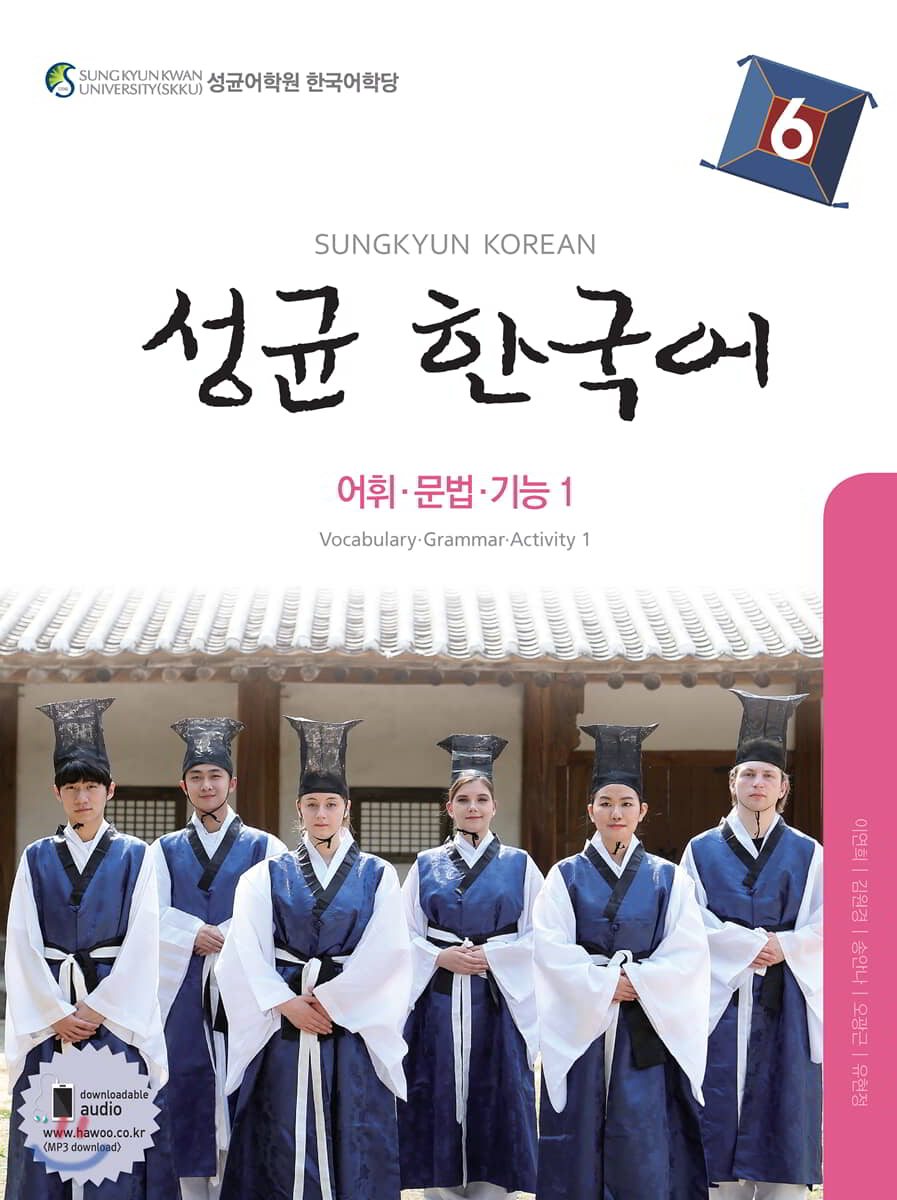
Sungkyunkwan Korean 6 Vocabulary, Grammar, and Functions 1
 |
Description
Book Introduction
[Sungkyun Korean 6] is the sixth book in a series of Korean language textbooks for adult Korean language learners.
This book was developed for use in a 200-hour regular course and aims to improve communication skills in Korean.
This book has the following features:
First, this book is structured to integrate ‘vocabulary/grammar’ and ‘listening/speaking/reading/writing.’
'Vocabulary and Grammar' corresponds to knowledge of the Korean language, and is structured so that students learn the relevant topic twice in each lesson and then learn language functions, namely listening, speaking, reading, and writing, based on this.
Therefore, it is structured so that you can communicate through extended activities of 'listening, speaking, reading, and writing' after going through the process of understanding and practicing related vocabulary and grammar centered on the main topic.
Second, although ‘vocabulary and grammar’ are considered language knowledge, they were developed with a focus on how they are connected to ‘Korean language use’ rather than being learned as knowledge.
Therefore, the usage practice for vocabulary and grammar is structured in stages so that you can practice from easy to difficult.
Third, this book is composed of a total of 16 lessons, and among them, 'Vocabulary and Grammar' consists of about 30 vocabulary and expressions and 4 grammar items per lesson, so that practice can be done within 120 or 130 minutes.
Fourth, all subjects are organized by topic.
The title of each unit will soon become the topic.
Therefore, 'Vocabulary and Grammar' were selected to best represent the subject matter, and were designed to enable appropriate functions, such as listening, speaking, reading, and writing.
Fifth, ‘Listening, Speaking, Reading, and Writing’ allows for a variety of exercises and problem-solving on the topic.
In particular, the course is designed to provide learners with meaningful practice tailored to their interests and concerns, including speaking, reading, and writing, and to enable in-depth communication activities through presentations, discussions, and debates on social and professional topics encountered by advanced learners.
Sixth, each lesson includes a 'Learn More' section to help students understand and practice figurative and symbolic Korean expressions by learning Korean idioms and Chinese character idioms.
Seventh, at the end of each lesson, a ‘self-assessment’ was included so that students could check for themselves whether they had achieved the learning objectives of the lesson, including vocabulary and grammar.
This book was developed for use in a 200-hour regular course and aims to improve communication skills in Korean.
This book has the following features:
First, this book is structured to integrate ‘vocabulary/grammar’ and ‘listening/speaking/reading/writing.’
'Vocabulary and Grammar' corresponds to knowledge of the Korean language, and is structured so that students learn the relevant topic twice in each lesson and then learn language functions, namely listening, speaking, reading, and writing, based on this.
Therefore, it is structured so that you can communicate through extended activities of 'listening, speaking, reading, and writing' after going through the process of understanding and practicing related vocabulary and grammar centered on the main topic.
Second, although ‘vocabulary and grammar’ are considered language knowledge, they were developed with a focus on how they are connected to ‘Korean language use’ rather than being learned as knowledge.
Therefore, the usage practice for vocabulary and grammar is structured in stages so that you can practice from easy to difficult.
Third, this book is composed of a total of 16 lessons, and among them, 'Vocabulary and Grammar' consists of about 30 vocabulary and expressions and 4 grammar items per lesson, so that practice can be done within 120 or 130 minutes.
Fourth, all subjects are organized by topic.
The title of each unit will soon become the topic.
Therefore, 'Vocabulary and Grammar' were selected to best represent the subject matter, and were designed to enable appropriate functions, such as listening, speaking, reading, and writing.
Fifth, ‘Listening, Speaking, Reading, and Writing’ allows for a variety of exercises and problem-solving on the topic.
In particular, the course is designed to provide learners with meaningful practice tailored to their interests and concerns, including speaking, reading, and writing, and to enable in-depth communication activities through presentations, discussions, and debates on social and professional topics encountered by advanced learners.
Sixth, each lesson includes a 'Learn More' section to help students understand and practice figurative and symbolic Korean expressions by learning Korean idioms and Chinese character idioms.
Seventh, at the end of each lesson, a ‘self-assessment’ was included so that students could check for themselves whether they had achieved the learning objectives of the lesson, including vocabulary and grammar.
index
preface
Note
Textbook composition table
Lesson 1: Culture of Communication
Lesson 2 Home and Life
Lesson 3: Consumers and Marketing
Lesson 4: Thought and Culture
Lesson 5: Korean History
Lesson 6: Precious Cultural Heritage
Lesson 7: The Changing Future Society
Lesson 8: A Change of Thinking
Review 1
Model answer
Listening passage
Vocabulary index
Grammar Index
Note
Textbook composition table
Lesson 1: Culture of Communication
Lesson 2 Home and Life
Lesson 3: Consumers and Marketing
Lesson 4: Thought and Culture
Lesson 5: Korean History
Lesson 6: Precious Cultural Heritage
Lesson 7: The Changing Future Society
Lesson 8: A Change of Thinking
Review 1
Model answer
Listening passage
Vocabulary index
Grammar Index
GOODS SPECIFICS
- Date of publication: June 26, 2019
- Page count, weight, size: 308 pages | 985g | 210*280*30mm
- ISBN13: 9791190154260
- ISBN10: 1190154269
You may also like
카테고리
korean


korean

![GQ KOREA Mark (Monthly): December [2025]](http://librairie.coreenne.fr/cdn/shop/files/8ef265dbbfbf186523ed75ba7319009d.jpg?v=1765340328&width=3840)


