

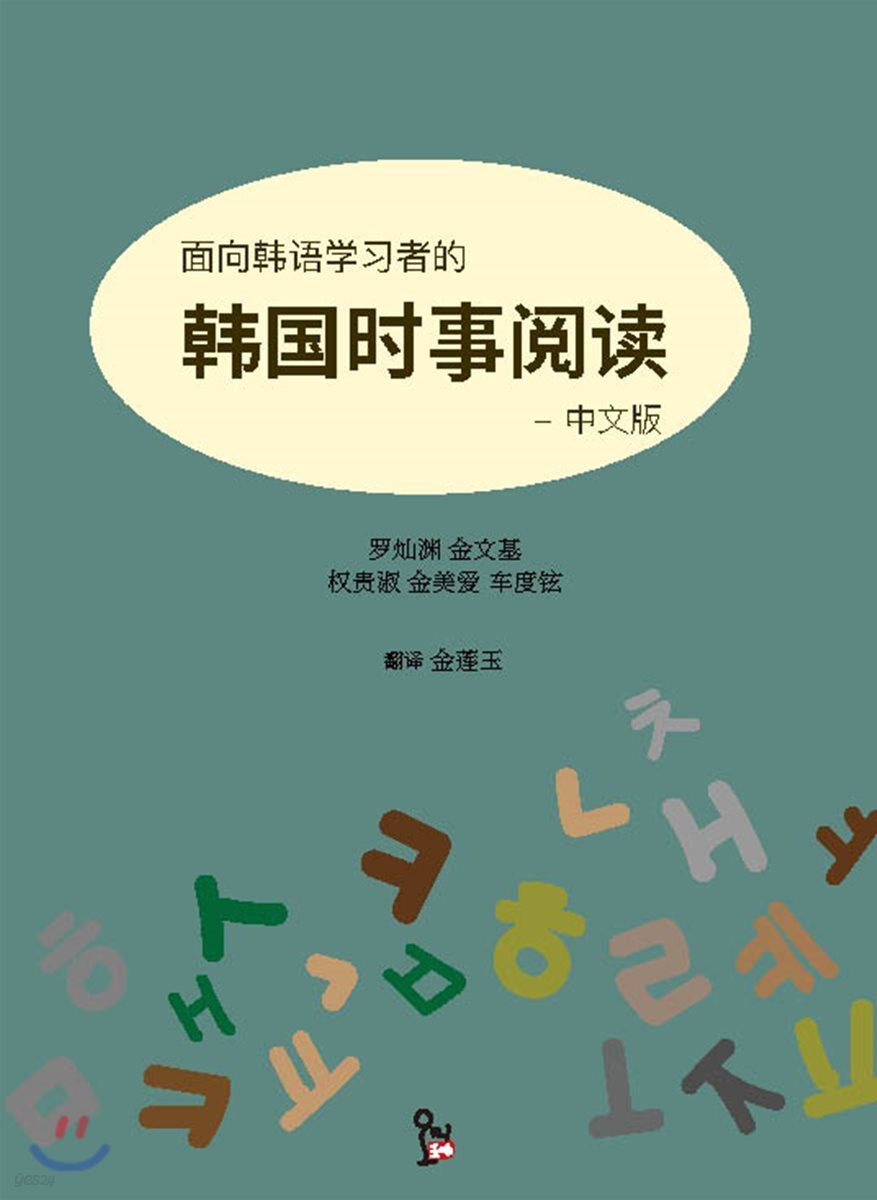
Korean Current Affairs Reading for Korean Learners - Chinese
 |
Description
Book Introduction
The textbook 'Reading Korean Current Affairs' is organized into 15 chapters by topic.
Soon, 15 units were organized by topic: ① Humans and the Environment, ② Capitals and Cities, ③ People, ④ Popular Culture, ⑤ Food Culture, ⑥ Sports, ⑦ Science and Technology, ⑧ International Relations, ⑨ Disease and Health, ⑩ Occupation, ⑪ Society, ⑫ Incidents and Accidents, ⑬ Press and Media, ⑭ Politics, ⑮ Religion and Belief.
This book is structured into 15 units, taking into account the fact that most universities conduct classes in 15- or 16-week units.
Soon, 15 units were organized by topic: ① Humans and the Environment, ② Capitals and Cities, ③ People, ④ Popular Culture, ⑤ Food Culture, ⑥ Sports, ⑦ Science and Technology, ⑧ International Relations, ⑨ Disease and Health, ⑩ Occupation, ⑪ Society, ⑫ Incidents and Accidents, ⑬ Press and Media, ⑭ Politics, ⑮ Religion and Belief.
This book is structured into 15 units, taking into account the fact that most universities conduct classes in 15- or 16-week units.
- You can preview some of the book's contents.
Preview
index
Lesson 1: What can we do for our sick planet? 9
2. Seoul Metropolitan City and Sejong Special Self-Governing City 17
Do you know this person? 25
Lesson 4: What is Korean popular culture like? 33
Lesson 5 Korean Food Culture 41
6. Sports to Enjoy Together 49
Lesson 7: How has the Internet changed our lives? 57
Lesson 8: What role does Korea play in the international community? 65
Lesson 9: Where do Koreans get sick the most? 73
Lesson 10: What kind of work would you like to do? 81
Lesson 11: The Korean way of life is changing! 89
Lesson 12: Let me tell you about today's news.
97
Lesson 13: What are the characteristics of the media? 105
Lesson 14 Korean Politics 113
Lesson 15: Korean Religious Life 121
Appendix 132
2. Seoul Metropolitan City and Sejong Special Self-Governing City 17
Do you know this person? 25
Lesson 4: What is Korean popular culture like? 33
Lesson 5 Korean Food Culture 41
6. Sports to Enjoy Together 49
Lesson 7: How has the Internet changed our lives? 57
Lesson 8: What role does Korea play in the international community? 65
Lesson 9: Where do Koreans get sick the most? 73
Lesson 10: What kind of work would you like to do? 81
Lesson 11: The Korean way of life is changing! 89
Lesson 12: Let me tell you about today's news.
97
Lesson 13: What are the characteristics of the media? 105
Lesson 14 Korean Politics 113
Lesson 15: Korean Religious Life 121
Appendix 132
Into the book
In Korea, April 5th is Arbor Day.
Why was Tree Planting Day established? Does your country have a similar day?
… … They say that as the Earth gets hotter, the ice in the North and South Poles will melt.
Then, just like in the movies, the place we live in could become the sea.
And when the ice melts, the temperature of the ocean changes, so the weather becomes very cold or hot, making it uninhabitable.
Why was Tree Planting Day established? Does your country have a similar day?
… … They say that as the Earth gets hotter, the ice in the North and South Poles will melt.
Then, just like in the movies, the place we live in could become the sea.
And when the ice melts, the temperature of the ocean changes, so the weather becomes very cold or hot, making it uninhabitable.
--- From the text
Publisher's Review
The educational content in each sub-unit is structured as follows.
First, in the ‘Unit Introduction Activity’ section, ① the title of the sub-unit, ② learning objectives, and ③ a picture to stimulate motivation were presented.
Second, the learning text was presented, but the same topic was divided into two parts, and the texts ‘Text 1’ and ‘Text 2’ were presented, and the corresponding ‘Thinking’ was set up.
Here, ‘Text 1’ is a text for basic learning, and ‘Text 2’ is a text for advanced learning.
Second, in the ‘Unit Understanding Activities’ section, learning problems related to the content of the main text were presented so that learners could solve them themselves during the teaching-learning process.
Learning problems were presented in four types: ① problems measuring vocabulary, ② problems measuring text comprehension, ③ problems measuring writing ability, and ④ problems measuring speaking ability.
By solving these learning problems with the teacher's assistance during class, learners can develop the ability to understand topical texts and solve the four types of learning problems mentioned above.
Third, in the ‘Unit Wrap-up Activity’ section, Korean proverbs directly related to the topic of the text were presented.
Through this, students can first understand and internalize the content of the text.
Furthermore, it aims to help students develop the ability to understand the meaning of Korean proverbs and use them in real-life situations.
Fourth, by presenting comprehensive problems for each unit in the form of an ‘appendix’ at the end of the book, it helps learners prepare for the advanced level ‘Test of Proficiency in Korean (TOPIK)’.
And by providing worksheets for vocabulary and writing activities, we enabled students to complete assignments after the class activities.
First, in the ‘Unit Introduction Activity’ section, ① the title of the sub-unit, ② learning objectives, and ③ a picture to stimulate motivation were presented.
Second, the learning text was presented, but the same topic was divided into two parts, and the texts ‘Text 1’ and ‘Text 2’ were presented, and the corresponding ‘Thinking’ was set up.
Here, ‘Text 1’ is a text for basic learning, and ‘Text 2’ is a text for advanced learning.
Second, in the ‘Unit Understanding Activities’ section, learning problems related to the content of the main text were presented so that learners could solve them themselves during the teaching-learning process.
Learning problems were presented in four types: ① problems measuring vocabulary, ② problems measuring text comprehension, ③ problems measuring writing ability, and ④ problems measuring speaking ability.
By solving these learning problems with the teacher's assistance during class, learners can develop the ability to understand topical texts and solve the four types of learning problems mentioned above.
Third, in the ‘Unit Wrap-up Activity’ section, Korean proverbs directly related to the topic of the text were presented.
Through this, students can first understand and internalize the content of the text.
Furthermore, it aims to help students develop the ability to understand the meaning of Korean proverbs and use them in real-life situations.
Fourth, by presenting comprehensive problems for each unit in the form of an ‘appendix’ at the end of the book, it helps learners prepare for the advanced level ‘Test of Proficiency in Korean (TOPIK)’.
And by providing worksheets for vocabulary and writing activities, we enabled students to complete assignments after the class activities.
GOODS SPECIFICS
- Date of publication: February 28, 2019
- Page count, weight, size: 227 pages | 616g | 190*260*15mm
- ISBN13: 9791196418984
- ISBN10: 1196418985
You may also like
카테고리
korean


korean

![GQ KOREA Mark (Monthly): December [2025]](http://librairie.coreenne.fr/cdn/shop/files/8ef265dbbfbf186523ed75ba7319009d.jpg?v=1765340328&width=3840)


