

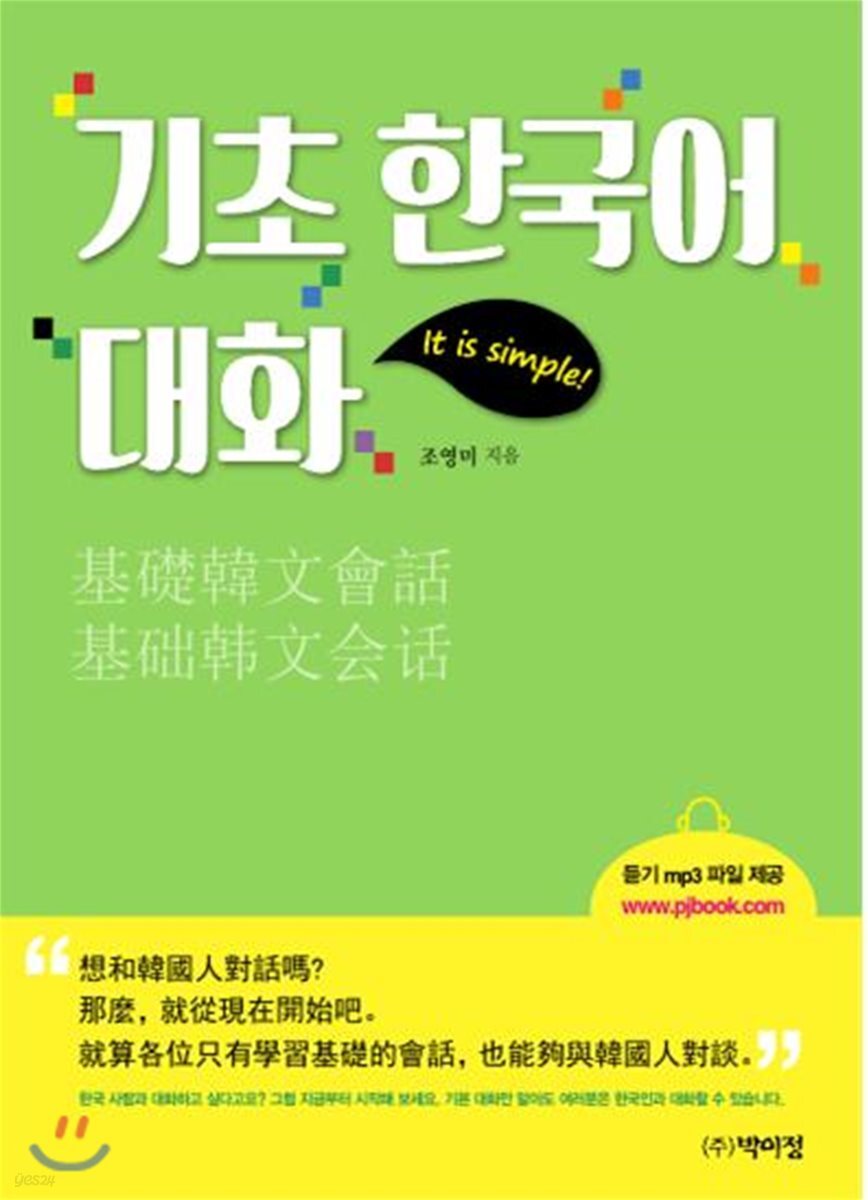
Basic Korean Conversation
 |
Description
Book Introduction
This book aims to enable beginner-level Korean learners to converse with Koreans.
The features of this book are as follows:
1.
By using both Korean and Chinese, Chinese speakers can easily understand the content of the textbook.
2.
Even learners who only know the basic consonants and vowels of Korean can easily attempt to have a conversation in Korean.
3.
The words and dialogue portions are also saved as recording files so that learners can practice their pronunciation on their own.
4.
Learners can build basic Korean language skills through the process of understanding, practicing, and applying grammar.
5.
By understanding Korean everyday culture, you can establish a foundation for appropriate conversation with Koreans.
The features of this book are as follows:
1.
By using both Korean and Chinese, Chinese speakers can easily understand the content of the textbook.
2.
Even learners who only know the basic consonants and vowels of Korean can easily attempt to have a conversation in Korean.
3.
The words and dialogue portions are also saved as recording files so that learners can practice their pronunciation on their own.
4.
Learners can build basic Korean language skills through the process of understanding, practicing, and applying grammar.
5.
By understanding Korean everyday culture, you can establish a foundation for appropriate conversation with Koreans.
index
Author's Note
Translator's Note
Composition of the textbook
ingress
Lesson 1: I am Korean.
I am a Korean citizen.
Lesson 2: What is this? (這)是什??
Lesson 3: There is an eraser.
(我)有橡皮擦.
Lesson 4 There is an electric fan in the classroom.
Where is the electric wind?
Lesson 5 There is a restaurant next to the bank.
The place to go is to go to the bank.
Lesson 6 I buy juice.
I am sorry.
Lesson 7 I don't eat kimbap at restaurants.
(我)在餐廳不吃紫菜飯捲。
Lesson 8 Tteokbokki is very delicious.
It's a good year? It's a good year.
Lesson 9 What did you do yesterday? (?) What did you do yesterday???
Lesson 10 What day is it today?
Lesson 11 Please wait a moment.
Let's talk about it.
Lesson 12 What are you going to do this weekend?
solution
Conversation Summary
Translator's Note
Composition of the textbook
ingress
Lesson 1: I am Korean.
I am a Korean citizen.
Lesson 2: What is this? (這)是什??
Lesson 3: There is an eraser.
(我)有橡皮擦.
Lesson 4 There is an electric fan in the classroom.
Where is the electric wind?
Lesson 5 There is a restaurant next to the bank.
The place to go is to go to the bank.
Lesson 6 I buy juice.
I am sorry.
Lesson 7 I don't eat kimbap at restaurants.
(我)在餐廳不吃紫菜飯捲。
Lesson 8 Tteokbokki is very delicious.
It's a good year? It's a good year.
Lesson 9 What did you do yesterday? (?) What did you do yesterday???
Lesson 10 What day is it today?
Lesson 11 Please wait a moment.
Let's talk about it.
Lesson 12 What are you going to do this weekend?
solution
Conversation Summary
Publisher's Review
Structure of this book
Goal
Check the grammar that serves as the learning objective for each lesson.
Grammar & Practice
After reviewing the grammar of each lesson one by one, learners understand the grammar through practice problems.
conversation
This is a conversation between two people, including the target grammar for each lesson.
Conversation practice
Learners practice new conversations by converting their own words based on what they practiced in the [Conversation] section.
Write a sentence
Learners practice writing sentences according to Korean spacing principles.
Try it out (try it out)
Learners practice the target grammar they learned in each lesson again.
In Korea, we do it like this.
(在Korea,這樣做。)
By understanding Korean daily culture, you will establish a foundation for communicating with Koreans appropriately.
Goal
Check the grammar that serves as the learning objective for each lesson.
Grammar & Practice
After reviewing the grammar of each lesson one by one, learners understand the grammar through practice problems.
conversation
This is a conversation between two people, including the target grammar for each lesson.
Conversation practice
Learners practice new conversations by converting their own words based on what they practiced in the [Conversation] section.
Write a sentence
Learners practice writing sentences according to Korean spacing principles.
Try it out (try it out)
Learners practice the target grammar they learned in each lesson again.
In Korea, we do it like this.
(在Korea,這樣做。)
By understanding Korean daily culture, you will establish a foundation for communicating with Koreans appropriately.
GOODS SPECIFICS
- Date of issue: August 30, 2018
- Page count, weight, size: 132 pages | 382g | 188*254*20mm
- ISBN13: 9791158483906
- ISBN10: 1158483902
You may also like
카테고리
korean


korean

![GQ KOREA Mark (Monthly): December [2025]](http://librairie.coreenne.fr/cdn/shop/files/8ef265dbbfbf186523ed75ba7319009d.jpg?v=1765340328&width=3840)


