

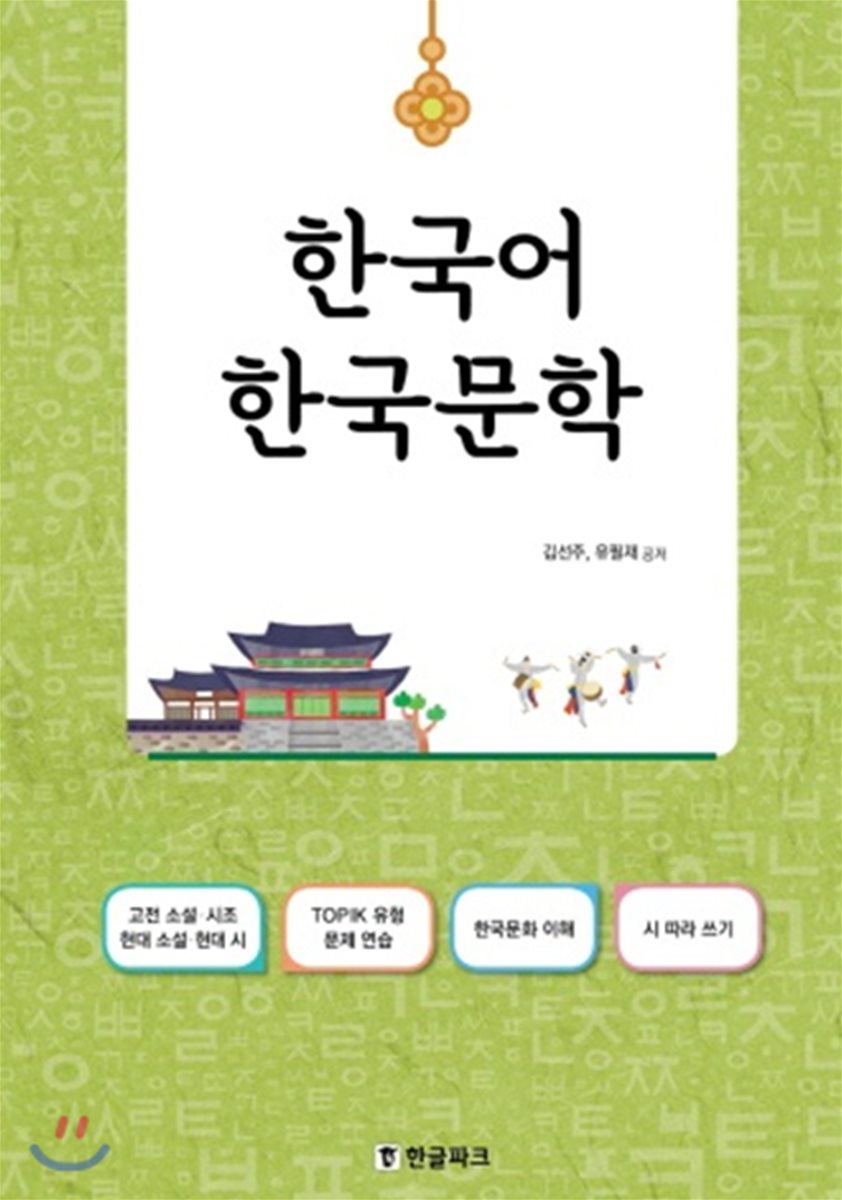
Korean language Korean literature
 |
Description
Book Introduction
As the number of intermediate and advanced Korean language learners increases, the demand for textbooks on Korean literature and culture, as well as Korean language, is also increasing.
Therefore, we planned this book to create a textbook that will make studying Korean literature more enjoyable.
This book is designed to help readers naturally immerse themselves in the charm of Korean literature through various activities such as reading, thinking, and discussing literary works.
You can also improve your Korean language skills through vocabulary, grammar, and content comprehension questions.
Through carefully selected Korean literature, including classics and modern works, poetry and novels, you can not only learn Korean but also understand Korean culture.
Therefore, we planned this book to create a textbook that will make studying Korean literature more enjoyable.
This book is designed to help readers naturally immerse themselves in the charm of Korean literature through various activities such as reading, thinking, and discussing literary works.
You can also improve your Korean language skills through vocabulary, grammar, and content comprehension questions.
Through carefully selected Korean literature, including classics and modern works, poetry and novels, you can not only learn Korean but also understand Korean culture.
- You can preview some of the book's contents.
Preview
index
preface
Note
Syllabus
[Modern Novel]
01.
camellia
02.
Dear Guest and Mother
03.
When buckwheat flowers bloom
04.
lucky day
[Modern Poetry]
05.
azalea
06.
Prologue
07.
Your silence
08.
flower
[Classic Novel]
09.
The Tale of Heungbu and Nolbu
10.
The Tale of Hong Gildong
11.
Simcheongjeon
12.
Chunhyangjeon
[father]
13.
Haeyoga/Dansimga
14.
The long night of winter solstice
15.
When my parents were alive
Appendix (answers to help you understand the content, vocabulary index, and grammar index)
Write a poem
Note
Syllabus
[Modern Novel]
01.
camellia
02.
Dear Guest and Mother
03.
When buckwheat flowers bloom
04.
lucky day
[Modern Poetry]
05.
azalea
06.
Prologue
07.
Your silence
08.
flower
[Classic Novel]
09.
The Tale of Heungbu and Nolbu
10.
The Tale of Hong Gildong
11.
Simcheongjeon
12.
Chunhyangjeon
[father]
13.
Haeyoga/Dansimga
14.
The long night of winter solstice
15.
When my parents were alive
Appendix (answers to help you understand the content, vocabulary index, and grammar index)
Write a poem
Publisher's Review
This book is a Korean literature textbook for intermediate-level Korean language learners, equivalent to Level 3 or 4 of the Korean Language Proficiency Test.
By appreciating various Korean literary works including sijo, poetry, classics, novels, and modern novels, you can gain a deeper understanding of Korean culture and the Korean language.
There are a total of 15 units, and each unit is composed of 8 steps as follows.
- Enter
This is the stage where you think in advance about what you will learn.
It is designed to stimulate interest in literary works through pictures and questions about them.
- Reading Korean literature
This is the stage of reading the work.
Modern poetry is presented in its original form, while modern novels, classic novels, and sijo are refined to the level of intermediate learners.
- Korean vocabulary
Difficult vocabulary is translated into three languages: English, Japanese, and Chinese.
By quickly grasping vocabulary, you can focus on your work.
- Description of literary works
This is the step where you read the description of the work you have appreciated.
You can understand the work more deeply by learning about the background of the work and the author's life.
- Understanding the content of literary works
This stage involves solving various problems related to the content, theme, and expression of the work. This test is similar in style to the TOPIK (Test of Proficiency in Korean), allowing you to prepare for the exam.
- Korean grammar
This is the stage where you learn the grammar in the work.
Based on the Standard Korean Dictionary, it is explained in an easy-to-understand way suitable for intermediate learners.
You can further improve your Korean language skills by checking the use of grammar in the work.
- Korean grammar and vocabulary learning activities
This is the stage where activities related to the theme and grammar of the work are performed.
You can check how much you understood the grammar and works you learned.
- Take a break
We provide a variety of things to see related to literary works, making it easier to become more interested in Korean literature.
You can read local tour information, interesting stories, etc. related to the work.
By appreciating various Korean literary works including sijo, poetry, classics, novels, and modern novels, you can gain a deeper understanding of Korean culture and the Korean language.
There are a total of 15 units, and each unit is composed of 8 steps as follows.
- Enter
This is the stage where you think in advance about what you will learn.
It is designed to stimulate interest in literary works through pictures and questions about them.
- Reading Korean literature
This is the stage of reading the work.
Modern poetry is presented in its original form, while modern novels, classic novels, and sijo are refined to the level of intermediate learners.
- Korean vocabulary
Difficult vocabulary is translated into three languages: English, Japanese, and Chinese.
By quickly grasping vocabulary, you can focus on your work.
- Description of literary works
This is the step where you read the description of the work you have appreciated.
You can understand the work more deeply by learning about the background of the work and the author's life.
- Understanding the content of literary works
This stage involves solving various problems related to the content, theme, and expression of the work. This test is similar in style to the TOPIK (Test of Proficiency in Korean), allowing you to prepare for the exam.
- Korean grammar
This is the stage where you learn the grammar in the work.
Based on the Standard Korean Dictionary, it is explained in an easy-to-understand way suitable for intermediate learners.
You can further improve your Korean language skills by checking the use of grammar in the work.
- Korean grammar and vocabulary learning activities
This is the stage where activities related to the theme and grammar of the work are performed.
You can check how much you understood the grammar and works you learned.
- Take a break
We provide a variety of things to see related to literary works, making it easier to become more interested in Korean literature.
You can read local tour information, interesting stories, etc. related to the work.
GOODS SPECIFICS
- Date of issue: September 4, 2017
- Page count, weight, size: 180 pages | 492g | 188*257mm
- ISBN13: 9788955188158
- ISBN10: 8955188153
You may also like
카테고리
korean


korean

![GQ KOREA Mark (Monthly): December [2025]](http://librairie.coreenne.fr/cdn/shop/files/8ef265dbbfbf186523ed75ba7319009d.jpg?v=1765340328&width=3840)


