

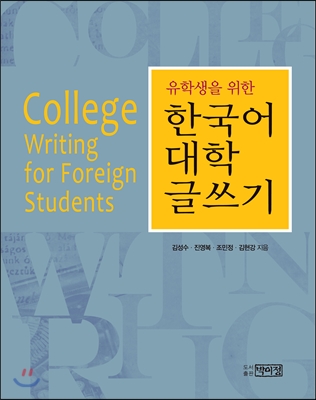
Korean University Writing for International Students
 |
Description
Book Introduction
A Guide to University Writing for International Students.
It is designed to systematically cover the entire process of college writing in Korean, from the basics of college writing in Korean to advanced Korean courses and graduate-level academic writing.
Key vocabulary and expressions in the examples are presented in both English and Chinese characters to help you learn more efficiently.
It is designed to systematically cover the entire process of college writing in Korean, from the basics of college writing in Korean to advanced Korean courses and graduate-level academic writing.
Key vocabulary and expressions in the examples are presented in both English and Chinese characters to help you learn more efficiently.
index
At the beginning of the book
Part I: Basics of Korean Writing
Chapter 1: Writing Sentences Correctly
1.
Understanding the language used in writing
2.
Writing Korean sentences correctly
Chapter 2: Connecting Sentences
1.
Sentence types in Korean
2.
Connecting sentences
Chapter 3: Creating Paragraphs
1.
What is a paragraph?
2.
Complete the paragraph
Chapter 4: Finding the topic and theme of the text
1.
Find a topic
2.
Choosing a topic
Chapter 5: Planning
1.
Creating content and capturing the flow of the text
2.
Find evidence or data to support your thoughts
Chapter 6 Short Writing
1.
Write an article
2.
Connectivity and consistency of the text
Writing Using Part II Topics
Chapter 7: Modern Society and 'I'
1.
Understanding Narrative Writing
2.
Modern society and self-story
3.
Writing Your Story: The Practice of Narrative Writing
Chapter 8: Digital Revolution and Media Change
1.
How to write a descriptive essay
2.
Digital Media and Cultural Change
3.
The Digital Revolution and Reason: The Practice of Expository Writing
Chapter 9 Globalization and Capitalism
1.
Understanding Book Review Writing
2.
Globalization and the Disintegration of Community
3.
Neoliberal Culture and the Search for True Freedom: The Practice of Book Review Writing
Chapter 10: Overcoming Western-Centrism and the Role of East Asia
1.
Topic and theme of the article
2.
Paragraph structure of a piece of writing: introduction, body, conclusion
Chapter 11: Korean Wave and Multicultural Society in the Glocal Era
1.
How to write a critique
2.
Korean Culture in the Glocal Era: Writing Introductions and Conclusions to Criticism
3.
The Practice of Criticism: The Korean Wave and Multicultural Society
Chapter 12 Science, Technology, and Bioethics
1.
Finding the point
2.
Establishing a point
3.
Arguing
Part III: The Practice of Academic Writing
Chapter 13: The Ethics of Writing
1.
Writing honestly and avoiding plagiarism
2.
How to cite correctly
Chapter 14: Writing a Report
1.
Report writing
2.
To summarize
Chapter 15: Writing Academic Papers
1.
Understanding academic papers
2.
How to Write an Academic Paper
3.
The Internet and Consumer Culture: A Case Study of Academic Writing
Search
Part I: Basics of Korean Writing
Chapter 1: Writing Sentences Correctly
1.
Understanding the language used in writing
2.
Writing Korean sentences correctly
Chapter 2: Connecting Sentences
1.
Sentence types in Korean
2.
Connecting sentences
Chapter 3: Creating Paragraphs
1.
What is a paragraph?
2.
Complete the paragraph
Chapter 4: Finding the topic and theme of the text
1.
Find a topic
2.
Choosing a topic
Chapter 5: Planning
1.
Creating content and capturing the flow of the text
2.
Find evidence or data to support your thoughts
Chapter 6 Short Writing
1.
Write an article
2.
Connectivity and consistency of the text
Writing Using Part II Topics
Chapter 7: Modern Society and 'I'
1.
Understanding Narrative Writing
2.
Modern society and self-story
3.
Writing Your Story: The Practice of Narrative Writing
Chapter 8: Digital Revolution and Media Change
1.
How to write a descriptive essay
2.
Digital Media and Cultural Change
3.
The Digital Revolution and Reason: The Practice of Expository Writing
Chapter 9 Globalization and Capitalism
1.
Understanding Book Review Writing
2.
Globalization and the Disintegration of Community
3.
Neoliberal Culture and the Search for True Freedom: The Practice of Book Review Writing
Chapter 10: Overcoming Western-Centrism and the Role of East Asia
1.
Topic and theme of the article
2.
Paragraph structure of a piece of writing: introduction, body, conclusion
Chapter 11: Korean Wave and Multicultural Society in the Glocal Era
1.
How to write a critique
2.
Korean Culture in the Glocal Era: Writing Introductions and Conclusions to Criticism
3.
The Practice of Criticism: The Korean Wave and Multicultural Society
Chapter 12 Science, Technology, and Bioethics
1.
Finding the point
2.
Establishing a point
3.
Arguing
Part III: The Practice of Academic Writing
Chapter 13: The Ethics of Writing
1.
Writing honestly and avoiding plagiarism
2.
How to cite correctly
Chapter 14: Writing a Report
1.
Report writing
2.
To summarize
Chapter 15: Writing Academic Papers
1.
Understanding academic papers
2.
How to Write an Academic Paper
3.
The Internet and Consumer Culture: A Case Study of Academic Writing
Search
Publisher's Review
Since the 2000s, the number of foreign students coming to study in Korea has been rapidly increasing.
As a result of the "Study Korea Project," a government-sponsored policy to attract international students since 2004, the number of international students enrolled in courses at junior colleges and higher has reached approximately 83,000.
These foreign students are entering university without proper Korean language skills or after completing only basic Korean language courses at university-affiliated Korean language education institutions.
Therefore, there are growing concerns about international students' Korean writing skills and academic abilities at university.
In reality, international students who have completed general Korean language courses and are now enrolled in universities face many difficulties in following academic writing courses such as reports and academic essays.
"Korean University Writing for International Students" is a book published with consideration to the Korean language level and learning ability of international students who must complete academic writing courses to improve their Korean writing skills.
This book is largely divided into three parts: Part 1, ‘Basics of Korean Writing,’ Part 2, ‘Writing Using Topics,’ and Part 3, ‘Practice of Academic Writing.’
In Part 1, you will learn about the characteristics of Korean 'writing' and 'sentences' and how to write short texts of three paragraphs or more.
Part 2 provides examples of various types of writing, including narratives, explanatory texts, book reviews, and academic essays. Part 3 is structured to enable students to write academically based on the content learned in Parts 1 and 2.
Part 1 is suitable for Korean language proficiency levels 4 and below, Part 2 is suitable for Korean language proficiency levels 5 and above, and Part 3 is suitable for advanced writing courses or graduate school thesis writing classes.
In each chapter, considering that the learners are mainly foreigners or overseas Korean students, key vocabulary and expressions in the examples are presented in English and Chinese characters together to enable efficient learning.
This book can function as both a 'textbook' and a 'workbook' as a textbook for Korean language college writing classes for international students.
The textbook content was designed to enable students to not only read and become familiar with academic texts, but also easily approach the topics of the given texts and proceed with writing.
In addition, the content and structure were designed to systematically study the entire process of college writing in Korean, from studying the basics of college writing in Korean to advanced Korean courses or graduate-level academic writing.
As a result of the "Study Korea Project," a government-sponsored policy to attract international students since 2004, the number of international students enrolled in courses at junior colleges and higher has reached approximately 83,000.
These foreign students are entering university without proper Korean language skills or after completing only basic Korean language courses at university-affiliated Korean language education institutions.
Therefore, there are growing concerns about international students' Korean writing skills and academic abilities at university.
In reality, international students who have completed general Korean language courses and are now enrolled in universities face many difficulties in following academic writing courses such as reports and academic essays.
"Korean University Writing for International Students" is a book published with consideration to the Korean language level and learning ability of international students who must complete academic writing courses to improve their Korean writing skills.
This book is largely divided into three parts: Part 1, ‘Basics of Korean Writing,’ Part 2, ‘Writing Using Topics,’ and Part 3, ‘Practice of Academic Writing.’
In Part 1, you will learn about the characteristics of Korean 'writing' and 'sentences' and how to write short texts of three paragraphs or more.
Part 2 provides examples of various types of writing, including narratives, explanatory texts, book reviews, and academic essays. Part 3 is structured to enable students to write academically based on the content learned in Parts 1 and 2.
Part 1 is suitable for Korean language proficiency levels 4 and below, Part 2 is suitable for Korean language proficiency levels 5 and above, and Part 3 is suitable for advanced writing courses or graduate school thesis writing classes.
In each chapter, considering that the learners are mainly foreigners or overseas Korean students, key vocabulary and expressions in the examples are presented in English and Chinese characters together to enable efficient learning.
This book can function as both a 'textbook' and a 'workbook' as a textbook for Korean language college writing classes for international students.
The textbook content was designed to enable students to not only read and become familiar with academic texts, but also easily approach the topics of the given texts and proceed with writing.
In addition, the content and structure were designed to systematically study the entire process of college writing in Korean, from studying the basics of college writing in Korean to advanced Korean courses or graduate-level academic writing.
GOODS SPECIFICS
- Date of issue: September 30, 2013
- Page count, weight, size: 293 pages | 585g | 185*235mm
- ISBN13: 9788962924428
- ISBN10: 8962924420
You may also like
카테고리
korean


korean

![GQ KOREA Mark (Monthly): December [2025]](http://librairie.coreenne.fr/cdn/shop/files/8ef265dbbfbf186523ed75ba7319009d.jpg?v=1765340328&width=3840)


