

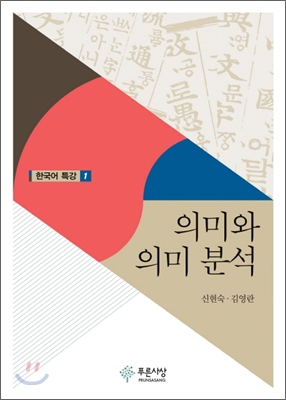
Meaning and semantic analysis
 |
Description
Book Introduction
『Meaning and Meaning Analysis』 by Shin Hyeon-suk, professor of Korean language education at Sangmyung University's College of Education, and Kim Young-ran, visiting professor at Sangmyung University's Graduate School.
This book is a special lecture-style book that contains various issues discussed while studying and teaching Korean.
Among the interests in Korean, the focus is on presenting problems that will enhance understanding of meaning and semantic analysis, and on revealing the methods and processes for solving them.
Its characteristic feature is that it presents topics and issues that Korean language learners and educators can think about together.
This book is a special lecture-style book that contains various issues discussed while studying and teaching Korean.
Among the interests in Korean, the focus is on presenting problems that will enhance understanding of meaning and semantic analysis, and on revealing the methods and processes for solving them.
Its characteristic feature is that it presents topics and issues that Korean language learners and educators can think about together.
index
Chapter 1: Study of Meaning
01.
What is the status of semantic studies in language studies?
02.
How can we explain the necessity and importance of semantic research?
03.
How does meaning come into play when studying speech?
04.
How is meaning involved in the study of phonology?
05.
How is meaning involved when studying morphemes?
06.
How does meaning come into play when studying words?
07.
How does meaning come into play when studying syntactic structure?
08.
How does meaning come into play when studying the structure of speech?
09.
How does meaning come into play when studying discourse structure?
10.
If you were to organize the subfields of semantics, what would they be?
Chapter 2 Meaning and Meaning Types
01.
What is the relationship between the form and meaning of language?
02.
How is meaning defined in language studies?
03.
How can we explain the difference between common meaning and individual meaning?
04.
How can we explain the difference between abstract and concrete meaning?
05.
How can we explain dictionary meaning, contextual meaning, situational meaning, and inferential meaning?
06.
How can semantic types be organized?
07.
What is conceptual meaning?
08.
What is implicit meaning?
09.
What is social meaning?
10.
What is emotional meaning?
11.
What is reflexive meaning?
12.
What is the salmon meaning?
13.
What is thematic meaning?
14.
What is the difference between central meaning and peripheral meaning?
15.
What is the difference between extension and intension?
Chapter 3 Semantic Attributes and Semantic Relationships
01.
How can we explain the semantic relationships between lexical elements?
02.
How can we explain the difference between a synonymous relationship and a consensual relationship?
03.
Why do language users choose one lexeme from a list of synonyms?
04.
What happens when two or more synonyms are used together?
05.
What principles can we discover in the process of competing synonyms?
06.
Is there a good way to clarify the difference in meaning between synonyms?
07.
What common and individual meanings do the synonyms {face} and {nature} indicate?
08.
How can we explain vocabulary that indicates a relationship of opposition?
09.
How will the opposition between antonyms manifest itself?
10.
Does one lexical word or word have one antonym?
11.
How can we explain the antonym of the verb {rise}?
12.
What phenomenon manifests itself as the cognitive distance between synonyms and antonyms?
13.
How can we explain the vocabulary or words that indicate a hierarchical relationship?
14.
What are the criteria for classifying types of hierarchical relationships?
15.
What kind of implication relationship can be used to explain the superior and inferior terms that form a hierarchical relationship?
16.
What phenomena exist between lexical elements or words that indicate a superior-subordinate relationship?
17.
How do form and meaning change when language forms combine?
18.
By what principles or methods do associative relations create new linguistic forms and meanings?
19.
How can we explain tolerance?
20.
How can we explain the process of creating idioms?
21.
How can we explain the salmon relationship?
22.
What restrictions are there between the words that form a salmon relationship?
23.
What is the difference between polysemy and homonym?
24.
How are polysemy created?
25.
How and why are homonyms created?
26.
What is ambiguity?
27.
What is the difference between ambiguity and ambiguity?
28.
What is selection restriction?
29.
How can we explain the surplus qualities?
30.
What redundant expressions do Korean society and its users use?
31.
What is conceptualization?
32.
How and why do semantic changes occur?
Chapter 4: Lexical Analysis Theory
01.
What is field theory, which is actively used in the study of Korean meaning?
02.
What are the achievements and limitations of field theory?
03.
How can we explain Trier's theory of succession?
04.
How can we explain Forzig's coupled field theory?
05.
What are the limitations of coupled field theory?
06.
How can we explain Weissgerba's conceptual field or semantic field?
07.
How can we explain Koseriu's vocabulary?
08.
How can we explain the theoretical differences between Saussure's field theory and the neo-Humboldtian school?
09.
How can we explain Bali's association with the city?
10.
How can we explain Matorre's field theory?
11.
How can we explain Giraud's field theory?
12.
What are the characteristics of component analysis theory used in semantic analysis?
13.
What are the theoretical limitations of semantic component analysis?
14.
How can field theory and component analysis theory be applied to semantic analysis?
15.
What semantic qualities are needed when analyzing the Korean color vocabulary?
Chapter 5: Lexical Analysis
01.
How can we analyze the meaning of the verb {go/come}?
02.
What forms and meanings do the verbs {go} and {come} produce?
03.
What are some movement verbs that can be associated with direction?
04.
What are some verbs of movement that can be associated with the process of moving?
05.
How can we analyze the meaning of {stand/sit/lie down}?
06.
What form and meaning does {stand} create?
07.
What form and meaning does {sit} create?
08.
What form and meaning does {lie down} create?
09.
How can we analyze the meaning of {laugh/cry}?
10.
How can we analyze the meaning of {to exist/to live}?
11.
How can we analyze the meaning of {rest/sleep/die}?
12.
What would be the result if we analyzed the meaning of {grow up/get old}?
13.
What is the vocabulary of movement verbs that move objects?
14.
What is the relationship between the categories of conjugative and separative verbs?
15.
What are the common and individual meanings of {connect/tie/bind/weave}?
16.
What are the common and individual meanings of {cut off/untie}?
17.
How can we explain the common and individual meanings of {receive} and {get}?
18.
How can we explain the common and individual meanings of {throw away} and {lose}?
19.
The meaning of {-geori}, {-daeda}, {-hada}, {-ida} that create imitative expressions is
How can we analyze it?
20.
Why do language users choose {-geori} to create imitative expressions?
21.
What is the difference in the selection restrictions of {-geori} and {-daeda} that generate mimic expressions?
22.
What are the selection restrictions for {-하다} that generates mimic expressions?
23.
What are the selection restrictions for {-이다} that generate mimic expressions?
24.
How can we utilize the semantic attributes [color/degree/feeling] when analyzing color words?
25.
How can we utilize the semantic attributes [state/positive/negative] when analyzing color words?
Chapter 6 Vocabulary
01.
How can we construct a vocabulary that expresses family or kinship relationships in Korean?
02.
How can we construct a vocabulary list that can be associated with a year in Korean?
03.
How can we construct a vocabulary list that can be related to {month [月]} or {day [日]} in Korean?
04.
What vocabulary can be associated with {日[日]}?
05.
What is the vocabulary that gives directions?
06.
What is the vocabulary that indicates direction?
07.
What is the vocabulary to express human?
08.
What vocabulary can be associated with marriage?
09.
What is the body organ vocabulary?
10.
What vocabulary can be associated with human personality or attitude?
11.
What vocabulary can be related to medical life?
12.
What is the vocabulary to describe the taste of food?
13.
What vocabulary can be associated with Korean food?
14.
What is the vocabulary for houses or buildings in Korean?
15.
What kind of vocabulary can we build based on {house}?
16.
How might we construct a vocabulary that describes the internal structure of a house?
17.
How can we construct a vocabulary that expresses the language life of Koreans?
18.
How can I build a career-related vocabulary list?
19.
How can we build a vocabulary of animal sounds expressed in Korean?
20.
What vocabulary can be associated with natural phenomena?
21.
How can we construct a vocabulary that indicates means of transportation?
22.
How can we construct a vocabulary that indicates the shape of objects?
23.
How can we construct a vocabulary list for counting the quantity of people, animals, and plants?
24.
How can we construct a vocabulary list for counting the quantity of things?
25.
How can we construct a vocabulary that indicates color and light in Korean?
Chapter 7 Meaning and Grammar
01.
Do grammar markers even make sense?
02.
What semantic properties can be used to analyze {-eun}, {-deon}, {-neun}, and {-eul}, which belong to the time expressions?
03.
What qualities are needed to analyze the meaning of the attributive ending {-eun}?
04.
How can the adjectival endings {-던} and {-는} be analyzed in terms of semantic properties?
05.
What semantic qualities can be analyzed for the attributive ending {-eul}?
06.
How can we explain the usage and meaning of the dependent nouns {척} and {체}?
07.
Is language created by the subjectivity of the language user, or is it an objective expression?
08.
What would be the result if we explained Korean treatment expressions using the concept of [distance]?
09.
What would be the result if we explained the Korean treatment expression using the concept of [fluidity]?
10.
How can we explain the meaning of negative expressions in Korean?
Chapter 8 Sentence and Discourse Analysis
01.
Can sentences with different formats convey the same meaning?
02.
When does ambiguity arise due to sentence structure, and how can it be resolved?
03.
How can we explain the prerequisites for recognizing the semantic information of a sentence?
04.
How can we explain the implications that allow us to perceive the semantic information of a sentence?
05.
What is the difference between interpreting utterance meaning and sentence meaning?
06.
In speech act theory, where should we focus our interpretation of meaning?
07.
How can we explain the intended meaning of language users?
08.
What characteristics can we recognize in the expression of time used in literary works?
09.
What characteristics can we recognize in characters written in literary works?
10.
Literary works? What can we perceive through the various written expressions?
11.
What characteristics can we recognize in quotations used in literary works?
12.
What meaning do Korean discourse markers indicate?
13.
What meaning can we perceive from nonverbal expressions?
■ References
■ Search
01.
What is the status of semantic studies in language studies?
02.
How can we explain the necessity and importance of semantic research?
03.
How does meaning come into play when studying speech?
04.
How is meaning involved in the study of phonology?
05.
How is meaning involved when studying morphemes?
06.
How does meaning come into play when studying words?
07.
How does meaning come into play when studying syntactic structure?
08.
How does meaning come into play when studying the structure of speech?
09.
How does meaning come into play when studying discourse structure?
10.
If you were to organize the subfields of semantics, what would they be?
Chapter 2 Meaning and Meaning Types
01.
What is the relationship between the form and meaning of language?
02.
How is meaning defined in language studies?
03.
How can we explain the difference between common meaning and individual meaning?
04.
How can we explain the difference between abstract and concrete meaning?
05.
How can we explain dictionary meaning, contextual meaning, situational meaning, and inferential meaning?
06.
How can semantic types be organized?
07.
What is conceptual meaning?
08.
What is implicit meaning?
09.
What is social meaning?
10.
What is emotional meaning?
11.
What is reflexive meaning?
12.
What is the salmon meaning?
13.
What is thematic meaning?
14.
What is the difference between central meaning and peripheral meaning?
15.
What is the difference between extension and intension?
Chapter 3 Semantic Attributes and Semantic Relationships
01.
How can we explain the semantic relationships between lexical elements?
02.
How can we explain the difference between a synonymous relationship and a consensual relationship?
03.
Why do language users choose one lexeme from a list of synonyms?
04.
What happens when two or more synonyms are used together?
05.
What principles can we discover in the process of competing synonyms?
06.
Is there a good way to clarify the difference in meaning between synonyms?
07.
What common and individual meanings do the synonyms {face} and {nature} indicate?
08.
How can we explain vocabulary that indicates a relationship of opposition?
09.
How will the opposition between antonyms manifest itself?
10.
Does one lexical word or word have one antonym?
11.
How can we explain the antonym of the verb {rise}?
12.
What phenomenon manifests itself as the cognitive distance between synonyms and antonyms?
13.
How can we explain the vocabulary or words that indicate a hierarchical relationship?
14.
What are the criteria for classifying types of hierarchical relationships?
15.
What kind of implication relationship can be used to explain the superior and inferior terms that form a hierarchical relationship?
16.
What phenomena exist between lexical elements or words that indicate a superior-subordinate relationship?
17.
How do form and meaning change when language forms combine?
18.
By what principles or methods do associative relations create new linguistic forms and meanings?
19.
How can we explain tolerance?
20.
How can we explain the process of creating idioms?
21.
How can we explain the salmon relationship?
22.
What restrictions are there between the words that form a salmon relationship?
23.
What is the difference between polysemy and homonym?
24.
How are polysemy created?
25.
How and why are homonyms created?
26.
What is ambiguity?
27.
What is the difference between ambiguity and ambiguity?
28.
What is selection restriction?
29.
How can we explain the surplus qualities?
30.
What redundant expressions do Korean society and its users use?
31.
What is conceptualization?
32.
How and why do semantic changes occur?
Chapter 4: Lexical Analysis Theory
01.
What is field theory, which is actively used in the study of Korean meaning?
02.
What are the achievements and limitations of field theory?
03.
How can we explain Trier's theory of succession?
04.
How can we explain Forzig's coupled field theory?
05.
What are the limitations of coupled field theory?
06.
How can we explain Weissgerba's conceptual field or semantic field?
07.
How can we explain Koseriu's vocabulary?
08.
How can we explain the theoretical differences between Saussure's field theory and the neo-Humboldtian school?
09.
How can we explain Bali's association with the city?
10.
How can we explain Matorre's field theory?
11.
How can we explain Giraud's field theory?
12.
What are the characteristics of component analysis theory used in semantic analysis?
13.
What are the theoretical limitations of semantic component analysis?
14.
How can field theory and component analysis theory be applied to semantic analysis?
15.
What semantic qualities are needed when analyzing the Korean color vocabulary?
Chapter 5: Lexical Analysis
01.
How can we analyze the meaning of the verb {go/come}?
02.
What forms and meanings do the verbs {go} and {come} produce?
03.
What are some movement verbs that can be associated with direction?
04.
What are some verbs of movement that can be associated with the process of moving?
05.
How can we analyze the meaning of {stand/sit/lie down}?
06.
What form and meaning does {stand} create?
07.
What form and meaning does {sit} create?
08.
What form and meaning does {lie down} create?
09.
How can we analyze the meaning of {laugh/cry}?
10.
How can we analyze the meaning of {to exist/to live}?
11.
How can we analyze the meaning of {rest/sleep/die}?
12.
What would be the result if we analyzed the meaning of {grow up/get old}?
13.
What is the vocabulary of movement verbs that move objects?
14.
What is the relationship between the categories of conjugative and separative verbs?
15.
What are the common and individual meanings of {connect/tie/bind/weave}?
16.
What are the common and individual meanings of {cut off/untie}?
17.
How can we explain the common and individual meanings of {receive} and {get}?
18.
How can we explain the common and individual meanings of {throw away} and {lose}?
19.
The meaning of {-geori}, {-daeda}, {-hada}, {-ida} that create imitative expressions is
How can we analyze it?
20.
Why do language users choose {-geori} to create imitative expressions?
21.
What is the difference in the selection restrictions of {-geori} and {-daeda} that generate mimic expressions?
22.
What are the selection restrictions for {-하다} that generates mimic expressions?
23.
What are the selection restrictions for {-이다} that generate mimic expressions?
24.
How can we utilize the semantic attributes [color/degree/feeling] when analyzing color words?
25.
How can we utilize the semantic attributes [state/positive/negative] when analyzing color words?
Chapter 6 Vocabulary
01.
How can we construct a vocabulary that expresses family or kinship relationships in Korean?
02.
How can we construct a vocabulary list that can be associated with a year in Korean?
03.
How can we construct a vocabulary list that can be related to {month [月]} or {day [日]} in Korean?
04.
What vocabulary can be associated with {日[日]}?
05.
What is the vocabulary that gives directions?
06.
What is the vocabulary that indicates direction?
07.
What is the vocabulary to express human?
08.
What vocabulary can be associated with marriage?
09.
What is the body organ vocabulary?
10.
What vocabulary can be associated with human personality or attitude?
11.
What vocabulary can be related to medical life?
12.
What is the vocabulary to describe the taste of food?
13.
What vocabulary can be associated with Korean food?
14.
What is the vocabulary for houses or buildings in Korean?
15.
What kind of vocabulary can we build based on {house}?
16.
How might we construct a vocabulary that describes the internal structure of a house?
17.
How can we construct a vocabulary that expresses the language life of Koreans?
18.
How can I build a career-related vocabulary list?
19.
How can we build a vocabulary of animal sounds expressed in Korean?
20.
What vocabulary can be associated with natural phenomena?
21.
How can we construct a vocabulary that indicates means of transportation?
22.
How can we construct a vocabulary that indicates the shape of objects?
23.
How can we construct a vocabulary list for counting the quantity of people, animals, and plants?
24.
How can we construct a vocabulary list for counting the quantity of things?
25.
How can we construct a vocabulary that indicates color and light in Korean?
Chapter 7 Meaning and Grammar
01.
Do grammar markers even make sense?
02.
What semantic properties can be used to analyze {-eun}, {-deon}, {-neun}, and {-eul}, which belong to the time expressions?
03.
What qualities are needed to analyze the meaning of the attributive ending {-eun}?
04.
How can the adjectival endings {-던} and {-는} be analyzed in terms of semantic properties?
05.
What semantic qualities can be analyzed for the attributive ending {-eul}?
06.
How can we explain the usage and meaning of the dependent nouns {척} and {체}?
07.
Is language created by the subjectivity of the language user, or is it an objective expression?
08.
What would be the result if we explained Korean treatment expressions using the concept of [distance]?
09.
What would be the result if we explained the Korean treatment expression using the concept of [fluidity]?
10.
How can we explain the meaning of negative expressions in Korean?
Chapter 8 Sentence and Discourse Analysis
01.
Can sentences with different formats convey the same meaning?
02.
When does ambiguity arise due to sentence structure, and how can it be resolved?
03.
How can we explain the prerequisites for recognizing the semantic information of a sentence?
04.
How can we explain the implications that allow us to perceive the semantic information of a sentence?
05.
What is the difference between interpreting utterance meaning and sentence meaning?
06.
In speech act theory, where should we focus our interpretation of meaning?
07.
How can we explain the intended meaning of language users?
08.
What characteristics can we recognize in the expression of time used in literary works?
09.
What characteristics can we recognize in characters written in literary works?
10.
Literary works? What can we perceive through the various written expressions?
11.
What characteristics can we recognize in quotations used in literary works?
12.
What meaning do Korean discourse markers indicate?
13.
What meaning can we perceive from nonverbal expressions?
■ References
■ Search
Publisher's Review
Blue Thought's new book, "Korean Special Lecture 1: Meaning and Meaning Analysis," has been published.
This book, co-authored by Professor Shin Hyun-sook (Professor of Korean Language Education, Sangmyung University) and Professor Kim Young-ran (Visiting Professor, Graduate School, Sangmyung University), focuses on teaching and learning Korean meaning and semantic analysis, as well as suggesting methods for constructing semantic information about the Korean language and methods for semantic analysis.
It is particularly significant in that it is based on the actual language life and language data of Korean society and Korean users.
I hope that this book will reach many readers through your introduction.
thank you
Contents of the book
As interest in the Korean language grows worldwide, research on the language is also being conducted on a very broad scale.
A variety of Korean language education materials and textbooks are being developed both domestically and internationally, and various projects are being undertaken at the national and government levels to elevate the status of the Korean language.
"Korean Special Lecture 1: Meaning and Semantic Analysis" is a special lecture format that covers various issues that have been discussed while studying and teaching Korean.
It focuses on presenting problems that can increase interest in Korean, especially understanding of meaning and semantic analysis, and on revealing methods and processes for solving those problems.
Through the process of thinking, analyzing, and discussing together, I hope to increase interest in the Korean language and develop our thoughts on the meaning of language and its analysis.
Meanwhile, this book presents topics and issues that Korean language learners and educators can think about together.
In the process of discussing and resolving topics and issues, I hope to gain an accurate understanding of the characteristics of the Korean language, as well as the cognitive processes and cognitive methods of Korean society and Korean speakers.
The terms and concepts discussed in this book are organized based on those widely used in Korean language research or Korean language education, and the materials and examples are organized based on those that can be easily found in actual language use.
The motivation is that Korean language research and education are now on a global stage.
Finally, I hope that this book will be actively utilized in Korean language research and education, especially in semantic research and semantic education.
Recommendation
The need and importance of studying meaning can be easily recognized by examining why we speak.
The primary function of language is to communicate in order to convey meaning.
Therefore, studying the meaning of linguistic forms is also very important in studying language.
Linguistic form and meaning are like two sides of the same coin.
Therefore, to study the linguistic forms that make up language, we need to study meaning, and to create and interpret meaning, we need to study linguistic forms.
The study of linguistic form and meaning can be divided into units ranging from sound units to literary works in series, but the ultimate goal of linguistic research is to elucidate the relationship between linguistic form and meaning, which can be used to understand language society and language users.
- From the text
This book, co-authored by Professor Shin Hyun-sook (Professor of Korean Language Education, Sangmyung University) and Professor Kim Young-ran (Visiting Professor, Graduate School, Sangmyung University), focuses on teaching and learning Korean meaning and semantic analysis, as well as suggesting methods for constructing semantic information about the Korean language and methods for semantic analysis.
It is particularly significant in that it is based on the actual language life and language data of Korean society and Korean users.
I hope that this book will reach many readers through your introduction.
thank you
Contents of the book
As interest in the Korean language grows worldwide, research on the language is also being conducted on a very broad scale.
A variety of Korean language education materials and textbooks are being developed both domestically and internationally, and various projects are being undertaken at the national and government levels to elevate the status of the Korean language.
"Korean Special Lecture 1: Meaning and Semantic Analysis" is a special lecture format that covers various issues that have been discussed while studying and teaching Korean.
It focuses on presenting problems that can increase interest in Korean, especially understanding of meaning and semantic analysis, and on revealing methods and processes for solving those problems.
Through the process of thinking, analyzing, and discussing together, I hope to increase interest in the Korean language and develop our thoughts on the meaning of language and its analysis.
Meanwhile, this book presents topics and issues that Korean language learners and educators can think about together.
In the process of discussing and resolving topics and issues, I hope to gain an accurate understanding of the characteristics of the Korean language, as well as the cognitive processes and cognitive methods of Korean society and Korean speakers.
The terms and concepts discussed in this book are organized based on those widely used in Korean language research or Korean language education, and the materials and examples are organized based on those that can be easily found in actual language use.
The motivation is that Korean language research and education are now on a global stage.
Finally, I hope that this book will be actively utilized in Korean language research and education, especially in semantic research and semantic education.
Recommendation
The need and importance of studying meaning can be easily recognized by examining why we speak.
The primary function of language is to communicate in order to convey meaning.
Therefore, studying the meaning of linguistic forms is also very important in studying language.
Linguistic form and meaning are like two sides of the same coin.
Therefore, to study the linguistic forms that make up language, we need to study meaning, and to create and interpret meaning, we need to study linguistic forms.
The study of linguistic form and meaning can be divided into units ranging from sound units to literary works in series, but the ultimate goal of linguistic research is to elucidate the relationship between linguistic form and meaning, which can be used to understand language society and language users.
- From the text
GOODS SPECIFICS
- Date of issue: March 3, 2012
- Page count, weight, size: 301 pages | 428g | 154*214*30mm
- ISBN13: 9788956409030
- ISBN10: 895640903X
You may also like
카테고리
korean


korean

![GQ KOREA Mark (Monthly): December [2025]](http://librairie.coreenne.fr/cdn/shop/files/8ef265dbbfbf186523ed75ba7319009d.jpg?v=1765340328&width=3840)


