

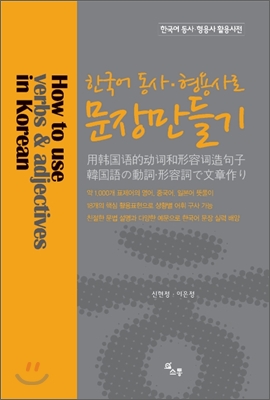
Making Sentences with Korean Verbs and Adjectives
 |
Description
Book Introduction
A dictionary of Korean verbs and adjectives for beginner and intermediate Korean learners.
All verbs and adjectives that appear in Korean language textbooks from Level 1 to Level 3 used by major universities in Korea have been collected and organized into headwords of approximately 1,000 words according to frequency.
Additionally, most of the verbs in the example sentences in this dictionary can be found in these entries.
It helps you use vocabulary in various situations with 18 key expressions, and it includes friendly grammar explanations and various examples to help you improve your Korean sentence skills.
All verbs and adjectives that appear in Korean language textbooks from Level 1 to Level 3 used by major universities in Korea have been collected and organized into headwords of approximately 1,000 words according to frequency.
Additionally, most of the verbs in the example sentences in this dictionary can be found in these entries.
It helps you use vocabulary in various situations with 18 key expressions, and it includes friendly grammar explanations and various examples to help you improve your Korean sentence skills.
- You can preview some of the book's contents.
Preview
index
go
you
do
L
grave
hundred
cow
blanket
trillion
congrat
lol
frame
blood
he
you
do
L
grave
hundred
cow
blanket
trillion
congrat
lol
frame
blood
he
Publisher's Review
entry
1) All verbs and adjectives that appear in Korean language textbooks from Level 1 to Level 3 used in major domestic universities were collected and organized into 1,000 words as headwords according to frequency.
Additionally, most of the verbs in the example sentences in this dictionary can be found in these entries.
2) Words are written in bold, and words with roots in Chinese characters, English, or other foreign languages are written in parentheses.
yes.
Input (input)
Part-time job (arbeit)
3) When the subject is separated, if the particle 'eul/reul' is included, '-' is indicated, and if 'i/ga' is included, '·' is indicated.
yes.
Tourism (gwangwanghada) [tourism/gwangwanghada] AV
Related/become [gwallyeondoeda/gwallyeondoeda] AV
pronunciation
The pronunciation of the word is indicated in [ ].
yes.
No [No] DV
Types of verbs
To make it easier to conjugate verbs, verbs are written as AV and adjectives are written as DV.
yes.
It's a shame [Agatta] DV ('ㅂ' irregular)
Save [Save] AV
irregular verbs
Irregular verbs are indicated in ( ).
yes.
It's a shame [Akwatta] DV ('ㅂ' irregular)
Verb conjugation table
Each verb is divided into verbs and adjectives, and the conjugations are presented in a table.
Since the table presents practical uses for learners based on the various usage forms of final and connective endings, it may be somewhat different from the Korean morphological and syntactic usage targeting native speakers.
Example 1.
Examples of verb conjugation
Save [Save] AV
-seumnida/bnida -waseo/waseo/waseo -seumnida/waseo/waseo -eul/rul will be
I saved it, I saved it, I will save it, I saved it, I will save it
-Do you want/are you okay? -Do you want/are you okay? -Please/please -Please/please -Let's go/let's go -Let's go/let's go
Do you care? Do you care? Do you care? Do you care? Do you care? Do you care? Do you care?
-go -jiman -eoseo/aseo/yeoseo -ikana/ika -neunde -eun/n,neun,eul/r
I save and save, but I save because I save, save, save
Example 2.
Examples of adjective conjugation
It's a shame [Agatta] DV ('ㅂ' irregular)
-seumnida/bnida -waseo/waseo/waseo -seumnida/waseo/waseo -eul/rul will be
It's a shame, it was a shame, it will be a shame, it's a shame, it will be a shame
-Do you want/are you okay? -Do you want/are you okay? -Please/please -Let's go/let's go -Let's go/let's go -Please/please -Please/please
Is it a pity? Is it a pity? - - - Is it a pity?
-go -jiman -eoseo/aseo/yeoseo -ikana/ika -eunde/nde -eun/n
It's a pity, it's a pity, but it's a pity, it's a pity, it's a pity
In the case of adjectives, they cannot be used in the imperative and imperative forms, such as 'please/please', 'please/please', and 'please/please'. In some cases, when an object is the subject, the honorific 'please/please' cannot be used.
The form of '서세요/서세요' can be either imperative or polite.
Additionally, those that are used extremely rarely and rarely appear in real life are not shown in the table.
Romanization and foreign language translation of titles
In addition to Romanization, translations were made into English, Japanese, and Chinese.
yes.
Dry [dry] DV
geonjohadaThe weather is dry.
↔Humidity: In winter, the skin becomes dry.
The room was so dry that I turned on the humidifier.
A: How is the winter weather in Seoul?
Me: It's cold and a bit dry.
♣ N is dry
- to be dry / dry / dry
Various examples
We have provided a variety of examples that are faithful to the basic sentence structure so that even beginners can use it.
Additionally, there are more colloquial expressions than written language, and some words are presented in conversational form, so learners can see how native speakers actually use the words through examples.
yes.
Close [Close] DV
The gakkapda store is nearby.
↔I like it because the school is close.
Where is the nearest subway station from here?
A: Is your house far?
Me: No, it's close.
It only takes 10 minutes from here.
Foreign word notation
Considering the difficulties in notating Korean loanwords, loanwords frequently used by Koreans in the example sentences are indicated in parentheses ( ) next to them for easy understanding.
yes.
Join [Gaipada] AV
I'm joining the gaipada club.
=Listen Which country is not a member of the United Nations (UN)?
↔Can foreigners join that group?
A: How do I join that club?
Me: You can go to the internet homepage and enter your information directly.
Morphological and syntactic information
Various particles used together with the title are presented.
yes.
Guide (案內) - [Guide] AV
♣ Guide N, guide to N
Synonyms and antonyms provided
Synonyms and antonyms of the title are presented.
It is organized according to beginner and intermediate levels, and when a single heading can be interpreted in multiple ways, a representative one is presented.
yes.
Join [Gaipada] AV
I'm joining the gaipada club.
=Listen Which country is not a member of the United Nations (UN)?
↔Can foreigners join that group?
A: How do I join that club?
Me: You can go to the internet homepage and enter your information directly.
Presenting grammatical information
In relation to the title, grammatical information such as causative verbs, passive verbs, honorifics, and idioms were presented separately and simply to help learners understand.
yes.
Set down [place] AV
♣ N makes N sit down
☞It is a causative verb of ‘to sit’.
1) All verbs and adjectives that appear in Korean language textbooks from Level 1 to Level 3 used in major domestic universities were collected and organized into 1,000 words as headwords according to frequency.
Additionally, most of the verbs in the example sentences in this dictionary can be found in these entries.
2) Words are written in bold, and words with roots in Chinese characters, English, or other foreign languages are written in parentheses.
yes.
Input (input)
Part-time job (arbeit)
3) When the subject is separated, if the particle 'eul/reul' is included, '-' is indicated, and if 'i/ga' is included, '·' is indicated.
yes.
Tourism (gwangwanghada) [tourism/gwangwanghada] AV
Related/become [gwallyeondoeda/gwallyeondoeda] AV
pronunciation
The pronunciation of the word is indicated in [ ].
yes.
No [No] DV
Types of verbs
To make it easier to conjugate verbs, verbs are written as AV and adjectives are written as DV.
yes.
It's a shame [Agatta] DV ('ㅂ' irregular)
Save [Save] AV
irregular verbs
Irregular verbs are indicated in ( ).
yes.
It's a shame [Akwatta] DV ('ㅂ' irregular)
Verb conjugation table
Each verb is divided into verbs and adjectives, and the conjugations are presented in a table.
Since the table presents practical uses for learners based on the various usage forms of final and connective endings, it may be somewhat different from the Korean morphological and syntactic usage targeting native speakers.
Example 1.
Examples of verb conjugation
Save [Save] AV
-seumnida/bnida -waseo/waseo/waseo -seumnida/waseo/waseo -eul/rul will be
I saved it, I saved it, I will save it, I saved it, I will save it
-Do you want/are you okay? -Do you want/are you okay? -Please/please -Please/please -Let's go/let's go -Let's go/let's go
Do you care? Do you care? Do you care? Do you care? Do you care? Do you care? Do you care?
-go -jiman -eoseo/aseo/yeoseo -ikana/ika -neunde -eun/n,neun,eul/r
I save and save, but I save because I save, save, save
Example 2.
Examples of adjective conjugation
It's a shame [Agatta] DV ('ㅂ' irregular)
-seumnida/bnida -waseo/waseo/waseo -seumnida/waseo/waseo -eul/rul will be
It's a shame, it was a shame, it will be a shame, it's a shame, it will be a shame
-Do you want/are you okay? -Do you want/are you okay? -Please/please -Let's go/let's go -Let's go/let's go -Please/please -Please/please
Is it a pity? Is it a pity? - - - Is it a pity?
-go -jiman -eoseo/aseo/yeoseo -ikana/ika -eunde/nde -eun/n
It's a pity, it's a pity, but it's a pity, it's a pity, it's a pity
In the case of adjectives, they cannot be used in the imperative and imperative forms, such as 'please/please', 'please/please', and 'please/please'. In some cases, when an object is the subject, the honorific 'please/please' cannot be used.
The form of '서세요/서세요' can be either imperative or polite.
Additionally, those that are used extremely rarely and rarely appear in real life are not shown in the table.
Romanization and foreign language translation of titles
In addition to Romanization, translations were made into English, Japanese, and Chinese.
yes.
Dry [dry] DV
geonjohadaThe weather is dry.
↔Humidity: In winter, the skin becomes dry.
The room was so dry that I turned on the humidifier.
A: How is the winter weather in Seoul?
Me: It's cold and a bit dry.
♣ N is dry
- to be dry / dry / dry
Various examples
We have provided a variety of examples that are faithful to the basic sentence structure so that even beginners can use it.
Additionally, there are more colloquial expressions than written language, and some words are presented in conversational form, so learners can see how native speakers actually use the words through examples.
yes.
Close [Close] DV
The gakkapda store is nearby.
↔I like it because the school is close.
Where is the nearest subway station from here?
A: Is your house far?
Me: No, it's close.
It only takes 10 minutes from here.
Foreign word notation
Considering the difficulties in notating Korean loanwords, loanwords frequently used by Koreans in the example sentences are indicated in parentheses ( ) next to them for easy understanding.
yes.
Join [Gaipada] AV
I'm joining the gaipada club.
=Listen Which country is not a member of the United Nations (UN)?
↔Can foreigners join that group?
A: How do I join that club?
Me: You can go to the internet homepage and enter your information directly.
Morphological and syntactic information
Various particles used together with the title are presented.
yes.
Guide (案內) - [Guide] AV
♣ Guide N, guide to N
Synonyms and antonyms provided
Synonyms and antonyms of the title are presented.
It is organized according to beginner and intermediate levels, and when a single heading can be interpreted in multiple ways, a representative one is presented.
yes.
Join [Gaipada] AV
I'm joining the gaipada club.
=Listen Which country is not a member of the United Nations (UN)?
↔Can foreigners join that group?
A: How do I join that club?
Me: You can go to the internet homepage and enter your information directly.
Presenting grammatical information
In relation to the title, grammatical information such as causative verbs, passive verbs, honorifics, and idioms were presented separately and simply to help learners understand.
yes.
Set down [place] AV
♣ N makes N sit down
☞It is a causative verb of ‘to sit’.
GOODS SPECIFICS
- Date of issue: March 1, 2012
- Page count, weight, size: 560 pages | 772g | 154*224*35mm
- ISBN13: 9788993454550
- ISBN10: 8993454558
You may also like
카테고리
korean


korean

![GQ KOREA Mark (Monthly): December [2025]](http://librairie.coreenne.fr/cdn/shop/files/8ef265dbbfbf186523ed75ba7319009d.jpg?v=1765340328&width=3840)


