

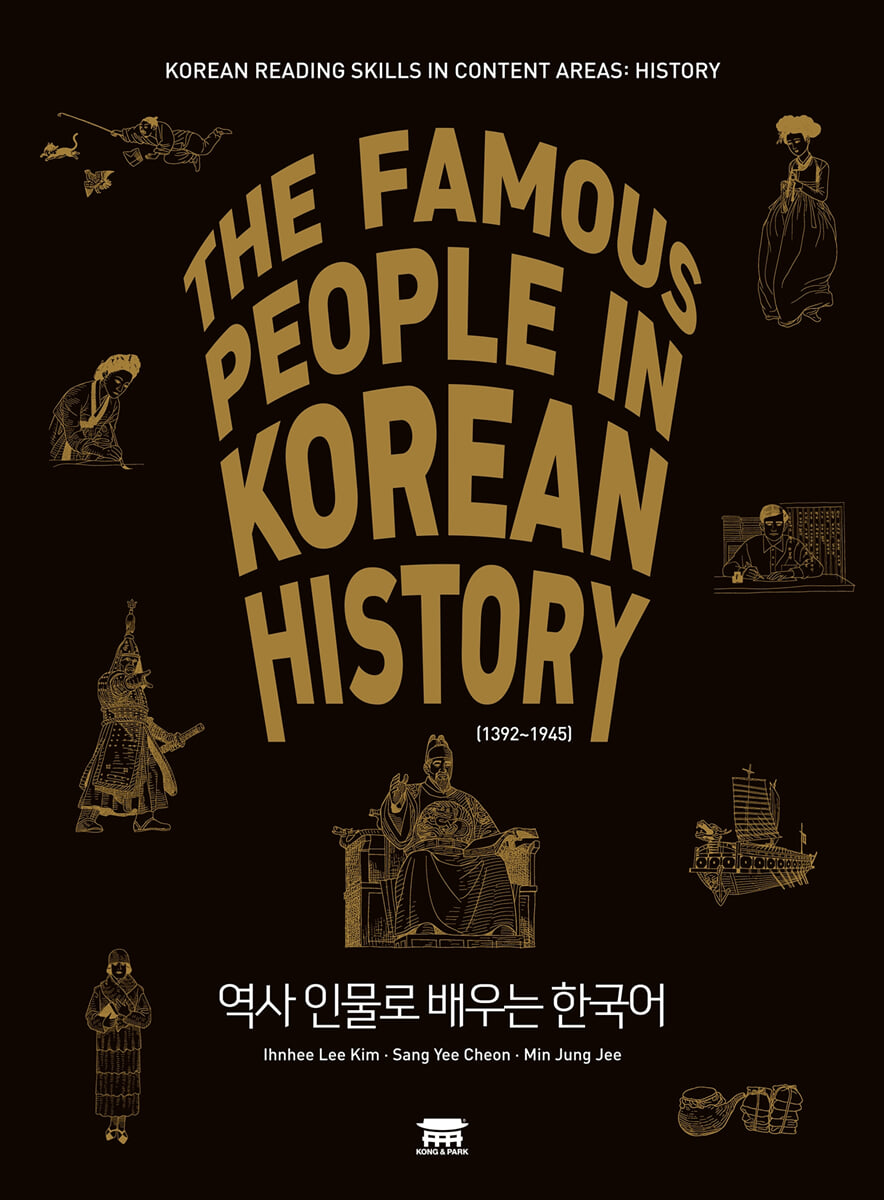
Learning Korean through historical figures
 |
Description
Book Introduction
A complete Korean history and culture textbook with six themes!
A textbook of Korean history and culture covering six themes!
"Learning Korean through Historical Figures" is a book planned according to a foreign language teaching method centered on cultural competence. It introduces figures who are significant to understanding the Korean language and culture, selected based on themes that students are currently interested in both in the classroom and outside the classroom.
Furthermore, by critically examining their lives and achievements, we move beyond a mere intellectual understanding of the Korean language and culture to a balanced perspective both regionally and globally.
This book pairs two people with each theme, explaining significant figures in understanding the Korean language and culture.
At this time, the themes were selected based on topics that students are interested in not only in Korean language classes but also in their daily lives outside the classroom, while being in line with the National Standards of the American Council on the Teaching of Foreign Languages (ACTFL).
We offer a variety of activities, from activities that check students' understanding of the content to multi-literacy learning activities that incorporate media materials such as movies, dramas, and records to encourage students to share diverse thoughts, to writing and presentation activities that can be used as research assignments in various fields such as history, art, science, and politics.
In this way, the four language areas of speaking, listening, reading, and writing can be organically developed, and specific teaching and learning methods are suggested in ‘Use of Textbooks.’
To help users better understand the content of the textbook as a historical reading material, we have selected and explained intermediate and advanced vocabulary groups and provided them in both Korean and English, thereby providing convenience to textbook users.
At this time, the selection of Korean vocabulary and idiomatic expressions followed the international standard Korean language curriculum.
This is an integrated textbook on Korean history and the Korean language, designed for Korean language learners around the world, with consideration for “diversity, equality, and inclusiveness,” through thorough review of the textbook’s historical statements by domestic history experts.
A textbook of Korean history and culture covering six themes!
"Learning Korean through Historical Figures" is a book planned according to a foreign language teaching method centered on cultural competence. It introduces figures who are significant to understanding the Korean language and culture, selected based on themes that students are currently interested in both in the classroom and outside the classroom.
Furthermore, by critically examining their lives and achievements, we move beyond a mere intellectual understanding of the Korean language and culture to a balanced perspective both regionally and globally.
This book pairs two people with each theme, explaining significant figures in understanding the Korean language and culture.
At this time, the themes were selected based on topics that students are interested in not only in Korean language classes but also in their daily lives outside the classroom, while being in line with the National Standards of the American Council on the Teaching of Foreign Languages (ACTFL).
We offer a variety of activities, from activities that check students' understanding of the content to multi-literacy learning activities that incorporate media materials such as movies, dramas, and records to encourage students to share diverse thoughts, to writing and presentation activities that can be used as research assignments in various fields such as history, art, science, and politics.
In this way, the four language areas of speaking, listening, reading, and writing can be organically developed, and specific teaching and learning methods are suggested in ‘Use of Textbooks.’
To help users better understand the content of the textbook as a historical reading material, we have selected and explained intermediate and advanced vocabulary groups and provided them in both Korean and English, thereby providing convenience to textbook users.
At this time, the selection of Korean vocabulary and idiomatic expressions followed the international standard Korean language curriculum.
This is an integrated textbook on Korean history and the Korean language, designed for Korean language learners around the world, with consideration for “diversity, equality, and inclusiveness,” through thorough review of the textbook’s historical statements by domestic history experts.
- You can preview some of the book's contents.
Preview
index
Preface
Scope and Sequence of the Textbook
How to Use This Book
Chapter 1 Language and Culture: King Sejong and Ju Si-gyeong
Language and Culture: King Sejong and Ju Si-gyeong
Chapter 2 Customs and Women: Shin Saimdang and Hwang Jini
Customs and Women: Sin Saimdang and Hwang Jin-i
Chapter 3 Politics and Leadership: Yi Sun-sin and Ryu Seong-ryong
Politics and Leadership: Yi Sun-sin and Yu Seong-ryong
Chapter 4: Medicine and Society: Heo Jun and Heo Im
Medicine and Society: Heo Jun and Heo Im
Chapter 5: Customs and Aesthetics: Kim Hong-do and Shin Yun-bok
Lifestyles and Aesthetics: Kim Hong-do and Sin Yun-bok
Chapter 6: Era and Art: Na Hye-seok and Yun Dong-ju
Times and Art: Na Hye-seok and Yun Dong-ju
Timeline
Search Index (in Korean alphabetical order)
See More For More Information
Scope and Sequence of the Textbook
How to Use This Book
Chapter 1 Language and Culture: King Sejong and Ju Si-gyeong
Language and Culture: King Sejong and Ju Si-gyeong
Chapter 2 Customs and Women: Shin Saimdang and Hwang Jini
Customs and Women: Sin Saimdang and Hwang Jin-i
Chapter 3 Politics and Leadership: Yi Sun-sin and Ryu Seong-ryong
Politics and Leadership: Yi Sun-sin and Yu Seong-ryong
Chapter 4: Medicine and Society: Heo Jun and Heo Im
Medicine and Society: Heo Jun and Heo Im
Chapter 5: Customs and Aesthetics: Kim Hong-do and Shin Yun-bok
Lifestyles and Aesthetics: Kim Hong-do and Sin Yun-bok
Chapter 6: Era and Art: Na Hye-seok and Yun Dong-ju
Times and Art: Na Hye-seok and Yun Dong-ju
Timeline
Search Index (in Korean alphabetical order)
See More For More Information
Detailed image
Publisher's Review
1.
A complete Korean history and culture textbook with six themes!
This book pairs two people with each theme, each of whom is significant in understanding the Korean language and culture.
At this time, the themes were selected based on topics that students are interested in not only in Korean language classes but also in their daily lives outside the classroom, while being in line with the National Standards of the American Council on the Teaching of Foreign Languages (ACTFL).
First, we examine the correlation between language and culture, starting with King Sejong and Ju Si-gyeong, the figures who created and protected the Korean alphabet. Then, we shed light on customs and women, examining Shin Saimdang and Hwang Jini, who walked their own paths in an era when gender roles were strongly prejudiced.
Also, in order to examine the attitudes of people who contributed to maintaining the common peace of mankind, we looked at 'Yi Sun-sin and Ryu Seong-ryong' who showed leadership in saving a country in crisis while also being wary of war; 'Heo Jun and Heo Im' who had a positive influence on society with their outstanding medical skills while thinking about the importance of a public medical system; 'Kim Hong-do and Shin Yun-bok' who depicted a world of satire and humor as a unique Korean aesthetic while examining the relationship between society and art; and 'Na Hye-seok and Yun Dong-ju' who did not suppress the voice of artists even in harsh times while looking back on the world of art that does not yield to the times.
This can be clearly seen through the 'textbook structure' in the book, and it can be confirmed that it is possible to reach a three-dimensional understanding of Korean culture through the lives and achievements of figures who have permeated Korean history, as well as an understanding of the Korean language.
A textbook of Korean history and culture covering six themes!
Each of the six themes pairs two key figures who are important in understanding the Korean language and culture.
Chosen in alignment with the National Standards for Foreign Language Learning of the American Council on the Teaching of Foreign Languages (ACTFL), the themes are centered around topics of students' current interests, both in their Korean classes and their everyday lives.
The book begins with “King Sejong and Ju Si-gyeong,” the one who created and the other who protected Hangeul, to examine the correlation between language and culture.
Following them are “Sin Saimdang and Hwang Jin-i,” women who forged their own paths in an era when gender roles and stereotypes were pervasive, in a dialogue about traditional customs and historical experiences as women of the Joseon dynasty.
The book also explores the mindsets of people who contributed to the consolidation of peace through “Yi Sun-sin and Yu Seong-ryong,” leaders who saved the country during times of crisis and saw war as a last resort; and “Heo Jun and Heo Im,” who made a positive impact on society with their exceptional medical skills and advocacy of a public healthcare system.
In studying the relationship between society and art, the book shares the stories of “Kim Hong-do and Sin Yun-bok,” artists who employed a unique Korean aesthetic to paint a world full of satire and humor.
Lastly, it reflects on how the art world resisted social pressures through “Na Hye-seok and Yun Dong-ju,” poets who refused to stay silent during the oppressive regime of Japanese imperialism.
In short, the book offers a three-dimensional understanding of Korean culture and enhances readers' understanding of the Korean language through the lives and achievements of influential figures who have left their mark on in Korean history.
The themes and the figures are laid out in the “Composition of the Textbook” section.
2.
A Korean history and culture textbook designed with actual class time in mind!
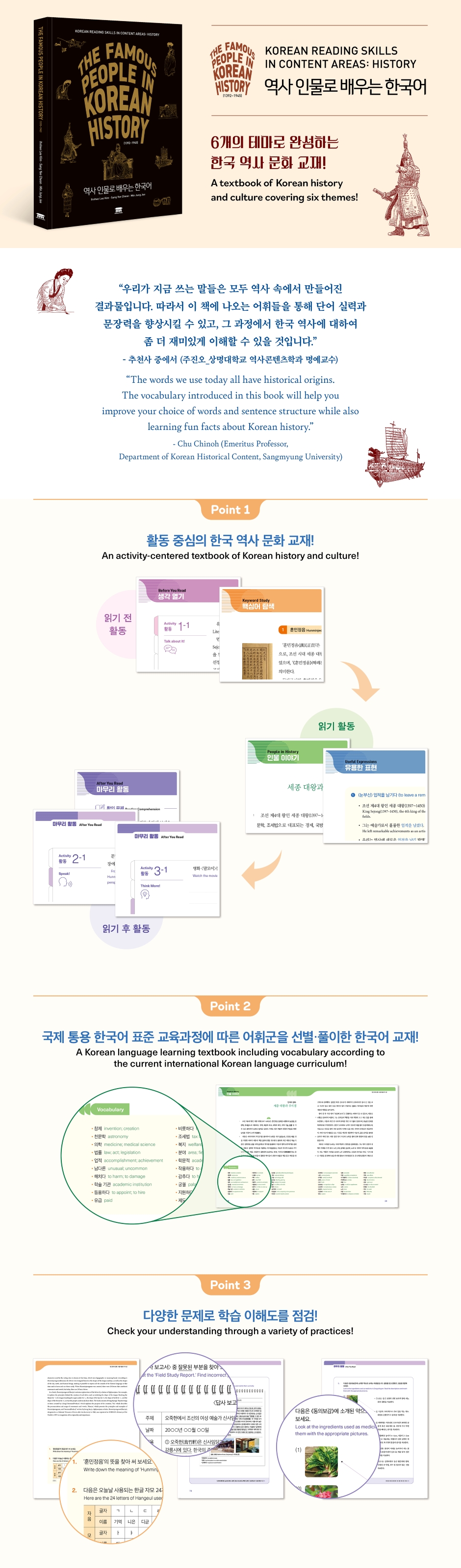
This book is structured into three stages: 'Pre-reading activities - Reading activities - Post-reading activities' for each chapter, taking into account actual class times.
The pre-reading activities in this book consist of 'Opening the Mind: Activity 1' and 'Exploring Key Words', and are designed to help students understand the content they need to acquire as background knowledge before engaging in full-scale reading activities and to keep in mind what they need to think about together.
Additionally, reading activities consist of ‘character stories’ and ‘useful expressions,’ and are designed to encourage learning intermediate and advanced Korean through historical figures.
Finally, the post-reading (conclusion) activities consist of 'confirmation questions' and 'Activities 2-3', which are designed to not only check understanding of the content but also have students write and present their own opinions on each theme.
A textbook of Korean history and culture designed with actual classes in mind!
In consideration of the class agenda, each chapter is divided into three stages: pre-reading activity, reading activity, and post-reading activity.
The pre-reading activity consists of “Before You Read: Activity One” and “Keyword Study,” which are designed to help students gain important background knowledge before the main reading activity.
The reading activity comprises “People in History” and “Useful Expressions” to guide students to an intermediate to advanced learning of Korean expressions through the stories of historical figures.
Finally, the post-reading(After You Read) activity includes “Reading Comprehension” and “Activities Two and Three” which not only help students double-check the lesson learned but also allow them to express their opinions on each corresponding theme.
3.
An activity-oriented Korean history and culture textbook!
We offer a variety of activities, from activities that check students' understanding of the content to multi-literacy learning activities that incorporate media materials such as movies, dramas, and records to encourage students to share diverse thoughts, to writing and presentation activities that can be used as research assignments in various fields such as history, art, science, and politics.
This allows the four language areas of speaking, listening, reading, and writing to be organically developed, and specific teaching and learning methods are suggested in 'Use of Textbooks.'
An activity-centered textbook of Korean history and culture!
The book ultimately encourages students to share their thoughts on the learned lessons.
This is achieved through a wide range of activities, including multiliteracies that incorporate media materials such as movies, dramas, and recordings.
Also included are writing and presentation activities that can be used as research projects within various academic disciplines such as history, art, science, and politics.
These activities naturally integrate the four areas of language: speaking, listening, reading, and writing.
Specific methods of teaching and learning that follow this approach are suggested in the “How to Use This Book” section.
4.
A Korean language textbook that selects and explains vocabulary groups according to the international standard Korean language curriculum!
To help readers better understand the content of the textbook as a historical reading resource, we have selected and explained intermediate and advanced vocabulary and provided both Korean and English versions to enhance the convenience of textbook users.
At this time, the selection of Korean vocabulary and idiomatic expressions followed the international standard Korean language curriculum.
A Korean language learning textbook including vocabulary selected and explained according to the current international Korean language curriculum!
This historical reading material is easy to understand as intermediate and high-level vocabulary are selected and explained in both Korean and English.
The selection of Korean vocabulary and idiomatic expressions also follows the current international Korean language curriculum.
5.
An integrated textbook on Korean history and Korean language, reviewed and recommended by history experts!
This integrated Korean history and Korean language textbook was produced with consideration for "diversity, equality, and inclusiveness" for Korean language learners around the world, with domestic history experts thoroughly reviewing the textbook's historical statements.
The perfect mix of Korean language and history, reviewed and recommended by Korean history experts!
This textbook provides in-depth insight into Korean history and language, and has been thoroughly reviewed by both domestic and overseas expert historians with regard to diversity, equality, and tolerance for Korean learners around the world.
A complete Korean history and culture textbook with six themes!
This book pairs two people with each theme, each of whom is significant in understanding the Korean language and culture.
At this time, the themes were selected based on topics that students are interested in not only in Korean language classes but also in their daily lives outside the classroom, while being in line with the National Standards of the American Council on the Teaching of Foreign Languages (ACTFL).
First, we examine the correlation between language and culture, starting with King Sejong and Ju Si-gyeong, the figures who created and protected the Korean alphabet. Then, we shed light on customs and women, examining Shin Saimdang and Hwang Jini, who walked their own paths in an era when gender roles were strongly prejudiced.
Also, in order to examine the attitudes of people who contributed to maintaining the common peace of mankind, we looked at 'Yi Sun-sin and Ryu Seong-ryong' who showed leadership in saving a country in crisis while also being wary of war; 'Heo Jun and Heo Im' who had a positive influence on society with their outstanding medical skills while thinking about the importance of a public medical system; 'Kim Hong-do and Shin Yun-bok' who depicted a world of satire and humor as a unique Korean aesthetic while examining the relationship between society and art; and 'Na Hye-seok and Yun Dong-ju' who did not suppress the voice of artists even in harsh times while looking back on the world of art that does not yield to the times.
This can be clearly seen through the 'textbook structure' in the book, and it can be confirmed that it is possible to reach a three-dimensional understanding of Korean culture through the lives and achievements of figures who have permeated Korean history, as well as an understanding of the Korean language.
A textbook of Korean history and culture covering six themes!
Each of the six themes pairs two key figures who are important in understanding the Korean language and culture.
Chosen in alignment with the National Standards for Foreign Language Learning of the American Council on the Teaching of Foreign Languages (ACTFL), the themes are centered around topics of students' current interests, both in their Korean classes and their everyday lives.
The book begins with “King Sejong and Ju Si-gyeong,” the one who created and the other who protected Hangeul, to examine the correlation between language and culture.
Following them are “Sin Saimdang and Hwang Jin-i,” women who forged their own paths in an era when gender roles and stereotypes were pervasive, in a dialogue about traditional customs and historical experiences as women of the Joseon dynasty.
The book also explores the mindsets of people who contributed to the consolidation of peace through “Yi Sun-sin and Yu Seong-ryong,” leaders who saved the country during times of crisis and saw war as a last resort; and “Heo Jun and Heo Im,” who made a positive impact on society with their exceptional medical skills and advocacy of a public healthcare system.
In studying the relationship between society and art, the book shares the stories of “Kim Hong-do and Sin Yun-bok,” artists who employed a unique Korean aesthetic to paint a world full of satire and humor.
Lastly, it reflects on how the art world resisted social pressures through “Na Hye-seok and Yun Dong-ju,” poets who refused to stay silent during the oppressive regime of Japanese imperialism.
In short, the book offers a three-dimensional understanding of Korean culture and enhances readers' understanding of the Korean language through the lives and achievements of influential figures who have left their mark on in Korean history.
The themes and the figures are laid out in the “Composition of the Textbook” section.
2.
A Korean history and culture textbook designed with actual class time in mind!
This book is structured into three stages: 'Pre-reading activities - Reading activities - Post-reading activities' for each chapter, taking into account actual class times.
The pre-reading activities in this book consist of 'Opening the Mind: Activity 1' and 'Exploring Key Words', and are designed to help students understand the content they need to acquire as background knowledge before engaging in full-scale reading activities and to keep in mind what they need to think about together.
Additionally, reading activities consist of ‘character stories’ and ‘useful expressions,’ and are designed to encourage learning intermediate and advanced Korean through historical figures.
Finally, the post-reading (conclusion) activities consist of 'confirmation questions' and 'Activities 2-3', which are designed to not only check understanding of the content but also have students write and present their own opinions on each theme.
A textbook of Korean history and culture designed with actual classes in mind!
In consideration of the class agenda, each chapter is divided into three stages: pre-reading activity, reading activity, and post-reading activity.
The pre-reading activity consists of “Before You Read: Activity One” and “Keyword Study,” which are designed to help students gain important background knowledge before the main reading activity.
The reading activity comprises “People in History” and “Useful Expressions” to guide students to an intermediate to advanced learning of Korean expressions through the stories of historical figures.
Finally, the post-reading(After You Read) activity includes “Reading Comprehension” and “Activities Two and Three” which not only help students double-check the lesson learned but also allow them to express their opinions on each corresponding theme.
3.
An activity-oriented Korean history and culture textbook!
We offer a variety of activities, from activities that check students' understanding of the content to multi-literacy learning activities that incorporate media materials such as movies, dramas, and records to encourage students to share diverse thoughts, to writing and presentation activities that can be used as research assignments in various fields such as history, art, science, and politics.
This allows the four language areas of speaking, listening, reading, and writing to be organically developed, and specific teaching and learning methods are suggested in 'Use of Textbooks.'
An activity-centered textbook of Korean history and culture!
The book ultimately encourages students to share their thoughts on the learned lessons.
This is achieved through a wide range of activities, including multiliteracies that incorporate media materials such as movies, dramas, and recordings.
Also included are writing and presentation activities that can be used as research projects within various academic disciplines such as history, art, science, and politics.
These activities naturally integrate the four areas of language: speaking, listening, reading, and writing.
Specific methods of teaching and learning that follow this approach are suggested in the “How to Use This Book” section.
4.
A Korean language textbook that selects and explains vocabulary groups according to the international standard Korean language curriculum!
To help readers better understand the content of the textbook as a historical reading resource, we have selected and explained intermediate and advanced vocabulary and provided both Korean and English versions to enhance the convenience of textbook users.
At this time, the selection of Korean vocabulary and idiomatic expressions followed the international standard Korean language curriculum.
A Korean language learning textbook including vocabulary selected and explained according to the current international Korean language curriculum!
This historical reading material is easy to understand as intermediate and high-level vocabulary are selected and explained in both Korean and English.
The selection of Korean vocabulary and idiomatic expressions also follows the current international Korean language curriculum.
5.
An integrated textbook on Korean history and Korean language, reviewed and recommended by history experts!
This integrated Korean history and Korean language textbook was produced with consideration for "diversity, equality, and inclusiveness" for Korean language learners around the world, with domestic history experts thoroughly reviewing the textbook's historical statements.
The perfect mix of Korean language and history, reviewed and recommended by Korean history experts!
This textbook provides in-depth insight into Korean history and language, and has been thoroughly reviewed by both domestic and overseas expert historians with regard to diversity, equality, and tolerance for Korean learners around the world.
GOODS SPECIFICS
- Date of issue: July 10, 2024
- Page count, weight, size: 228 pages | 188*255*20mm
- ISBN13: 9781635190861
- ISBN10: 163519086X
You may also like
카테고리
korean


korean

![ELLE 엘르 스페셜 에디션 A형 : 12월 [2025]](http://librairie.coreenne.fr/cdn/shop/files/b8e27a3de6c9538896439686c6b0e8fb.jpg?v=1766436872&width=3840)


