

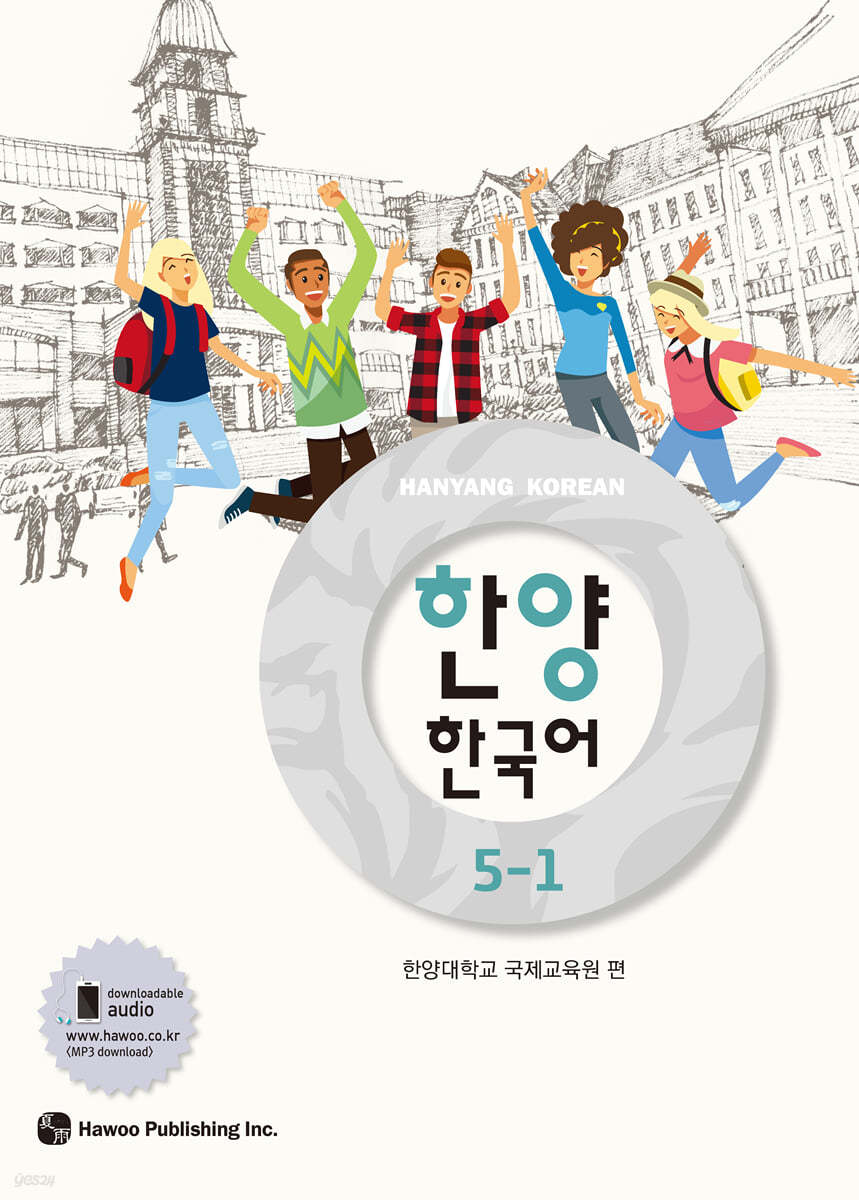
Hanyang Korean 5-1
 |
Description
Book Introduction
[Hanyang Korean 5] is an integrated Korean language textbook for foreigners and overseas Koreans.
Each unit covers unfamiliar topics such as society, culture, and economy that are essential for level 5 learners, and is designed to systematically acquire communication skills necessary for professional work or academic performance.
[Hanyang Korean 5] focuses on systematically learning academic writing through reading and developing presentation and logical thinking skills through expressing opinions. It is structured so that learners can evenly improve their oral and written communication skills through various interactions utilizing the grammar and vocabulary they have learned.
Each unit covers unfamiliar topics such as society, culture, and economy that are essential for level 5 learners, and is designed to systematically acquire communication skills necessary for professional work or academic performance.
[Hanyang Korean 5] focuses on systematically learning academic writing through reading and developing presentation and logical thinking skills through expressing opinions. It is structured so that learners can evenly improve their oral and written communication skills through various interactions utilizing the grammar and vocabulary they have learned.
index
Preface
Note
Textbook composition table
Character introduction
01. Korean lifestyle and culture
02.
Emotions and expressions
03.
Education and Society
04.
News and Reports
List of Appearance Vocabulary
Explanation of appearance grammar
Listening passage
Listening Answers
Vocabulary Index
Grammar Index
Note
Textbook composition table
Character introduction
01. Korean lifestyle and culture
02.
Emotions and expressions
03.
Education and Society
04.
News and Reports
List of Appearance Vocabulary
Explanation of appearance grammar
Listening passage
Listening Answers
Vocabulary Index
Grammar Index
Publisher's Review
Textbook composition and study time
The curriculum was designed to cover a total of 200 hours (5 times a week, 10 weeks) based on the 5th level of the Korean standard curriculum, and each unit can be taught over 4 days.
Each unit is divided into topic-related learning such as [Vocabulary], [Grammar], [Dialogue], and [Advanced Expression], and tasks and activities such as [Listening], [Expressing Opinion], [Reading], and [Writing] that utilize what has been learned. These tasks are marked as pre-stage, main stage, and post-stage to ensure that they are performed process-oriented.
The appendix includes a [List of Vocabulary Appearances], which organizes the vocabulary appearing in the textbook by subject, and a [Explanation of Grammar Appearances] section, which organizes grammar items that appear in the textbook in addition to the target grammar, and briefly explains their meaning and function with examples, so they can be used for confirmation learning.
In addition, [Listening passages and listening answers] and [Vocabulary and grammar index] were included to help learners conduct in-depth self-study.
Detailed structure of the unit
-Learning objectives
The topic of each unit is presented with pictures and detailed learning objectives are presented by date.
-QR code
By providing access to audio recordings using QR codes, you can learn the pronunciation and intonation of native Korean speakers.
- Vocabulary learning
We categorized topic-related vocabulary into semantic fields and presented them with pictures and illustrations to help learners understand, and provided a list of speaking questions to help them practice using the words and expressions they learned.
- Grammar learning
Grammar learning was designed to foster communication skills by selecting grammar that is more appropriate for the topic and function of each unit.
A pair of dialogues were presented with illustrations to aid understanding, and students were encouraged to use the grammar they learned, starting with sentence construction practice and progressing to meaningful speaking practice.
-Dialogue learning
The conversation learning was divided into pre-stage, main stage, and post-stage.
In the previous stage, topics and words were introduced, and in this stage, conversations were learned through listening and speaking activities, and pronunciation and intonation were learned.
In the later stages, sentence patterns were organized by function and fluency was improved by changing the topics and situations of the dialogue and practicing them.
- Advanced expression learning
Idioms, proverbs, and Chinese character phrases related to the topic of each unit were selected, and their meanings and examples were presented in an interesting way with illustrations in the form of cards to help learners understand. After using these, they were allowed to create conversations and stories, and then role-play and make presentations.
-Listening activity
The course is structured around practical oral discourse, such as conversations, news, interviews, and lectures related to the topic of each unit.
In the pre-listening stage, the topic is introduced and schemas are activated, in the listening stage, listening skills are improved through various types of practice, and in the post-listening stage, it is linked to speaking.
- Opinion-giving activity
By selecting interesting questions closely related to each unit's topic and then presenting a logical development structure for the answers, we helped students express their opinions logically.
In addition, by presenting various pros and cons, we have improved the expressive power and helped build speaking skills for academic purposes such as presentations and discussions.
-Reading activity
For each unit, we present prose types appropriate to the topic, such as classification writing, cause analysis writing, descriptive writing, statistical citation writing, and narrative writing, and we organize various activities in stages to help students analyze paragraph structure and understand the content.
In the later stages, the content and structure were checked to ensure that it was linked to a writing task.
-Writing activity
In accordance with the goal of writing linked to reading learning, students learned essential sentence structures and expressions in the pre-writing stage and then practiced writing sentences through examples.
In this stage, learners were encouraged to develop their academic writing skills by selecting a new topic, organizing paragraphs, and writing content.
The curriculum was designed to cover a total of 200 hours (5 times a week, 10 weeks) based on the 5th level of the Korean standard curriculum, and each unit can be taught over 4 days.
Each unit is divided into topic-related learning such as [Vocabulary], [Grammar], [Dialogue], and [Advanced Expression], and tasks and activities such as [Listening], [Expressing Opinion], [Reading], and [Writing] that utilize what has been learned. These tasks are marked as pre-stage, main stage, and post-stage to ensure that they are performed process-oriented.
The appendix includes a [List of Vocabulary Appearances], which organizes the vocabulary appearing in the textbook by subject, and a [Explanation of Grammar Appearances] section, which organizes grammar items that appear in the textbook in addition to the target grammar, and briefly explains their meaning and function with examples, so they can be used for confirmation learning.
In addition, [Listening passages and listening answers] and [Vocabulary and grammar index] were included to help learners conduct in-depth self-study.
Detailed structure of the unit
-Learning objectives
The topic of each unit is presented with pictures and detailed learning objectives are presented by date.
-QR code
By providing access to audio recordings using QR codes, you can learn the pronunciation and intonation of native Korean speakers.
- Vocabulary learning
We categorized topic-related vocabulary into semantic fields and presented them with pictures and illustrations to help learners understand, and provided a list of speaking questions to help them practice using the words and expressions they learned.
- Grammar learning
Grammar learning was designed to foster communication skills by selecting grammar that is more appropriate for the topic and function of each unit.
A pair of dialogues were presented with illustrations to aid understanding, and students were encouraged to use the grammar they learned, starting with sentence construction practice and progressing to meaningful speaking practice.
-Dialogue learning
The conversation learning was divided into pre-stage, main stage, and post-stage.
In the previous stage, topics and words were introduced, and in this stage, conversations were learned through listening and speaking activities, and pronunciation and intonation were learned.
In the later stages, sentence patterns were organized by function and fluency was improved by changing the topics and situations of the dialogue and practicing them.
- Advanced expression learning
Idioms, proverbs, and Chinese character phrases related to the topic of each unit were selected, and their meanings and examples were presented in an interesting way with illustrations in the form of cards to help learners understand. After using these, they were allowed to create conversations and stories, and then role-play and make presentations.
-Listening activity
The course is structured around practical oral discourse, such as conversations, news, interviews, and lectures related to the topic of each unit.
In the pre-listening stage, the topic is introduced and schemas are activated, in the listening stage, listening skills are improved through various types of practice, and in the post-listening stage, it is linked to speaking.
- Opinion-giving activity
By selecting interesting questions closely related to each unit's topic and then presenting a logical development structure for the answers, we helped students express their opinions logically.
In addition, by presenting various pros and cons, we have improved the expressive power and helped build speaking skills for academic purposes such as presentations and discussions.
-Reading activity
For each unit, we present prose types appropriate to the topic, such as classification writing, cause analysis writing, descriptive writing, statistical citation writing, and narrative writing, and we organize various activities in stages to help students analyze paragraph structure and understand the content.
In the later stages, the content and structure were checked to ensure that it was linked to a writing task.
-Writing activity
In accordance with the goal of writing linked to reading learning, students learned essential sentence structures and expressions in the pre-writing stage and then practiced writing sentences through examples.
In this stage, learners were encouraged to develop their academic writing skills by selecting a new topic, organizing paragraphs, and writing content.
GOODS SPECIFICS
- Date of issue: August 31, 2021
- Page count, weight, size: 152 pages | 396g | 188*257*20mm
- ISBN13: 9791167480156
- ISBN10: 1167480155
You may also like
카테고리
korean


korean

![GQ KOREA Mark (Monthly): December [2025]](http://librairie.coreenne.fr/cdn/shop/files/8ef265dbbfbf186523ed75ba7319009d.jpg?v=1765340328&width=3840)


