

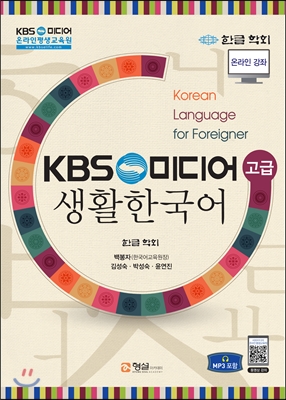
KBS Daily Korean (Advanced)
 |
Description
index
|Textbook Structure… … … … … … … … … … … … … … … … … … … … … … … … … … … … … … … … … … 10
|Note … … … … … … … … … … … … … … … … … … … … … … … … … … … … … … … … … … … 12
|Characters … … … … … … … … … … … … … … … … … … … … … … … … … … … … … … … … … … 14
1.
Shall we have some palm time? … … … … … … … … … … … … … … … … … … … … … … 16
2.
Global, you get punished for writing… … … … … … … … … … … … … … … … … … … 24
3.
Not very happy… … … … … … … … … … … … … … … … … … … … … … … … … … … … … 32
4.
The card doesn't come out and the money doesn't come out... … … … … … … … … … … … … … … … … … … 40
5.
Someone should not have picked it up… … … … … … … … … … … … … … … … … … … … … … 48
6.
There is a folk remedy… … … … … … … … … … … … … … … … … … … … … … … 56
7.
Could you please leave this at the security office? … … … … … … … … … … … … … … … … … … … … … … 64
8.
It's okay to use alone... … … … … … … … … … … … … … … … … … … … … … … … … 72
9.
I think it all depends on how you think… … … … … … … … … … … … … … … … … … 80
10.
What would be a good way to go? … … … … … … … … … … … … … … … … … … … … … … … 88
11.
Show me one with wheels… … … … … … … … … … … … … … … … … … … … … 96
12.
He's so handsome that I fell in love with him at first sight… … … … … … … … … … … … … … … … … … … … … 104
13.
You will learn how to do well in interviews… … … … … … … … … … … … … … … … … … … 112
14.
The stage design was also great… … … … … … … … … … … … … … … … … … … … … … … 120
15.
Is the manager shooting? … … … … … … … … … … … … … … … … … … … … … … … … 128
16.
I have no appetite and I'm depressed... … … … … … … … … … … … … … … … … … … … … … … … 136
17.
I don't know what to do... … … … … … … … … … … … … … … … … … … 144
18.
What do you plan to do after graduating from college? … … … … … … … … … … … … … … … … … 152
19.
My throat is so sore I can't speak… … … … … … … … … … … … … … … … … … … … 160
20.
I need to reduce waste… … … … … … … … … … … … … … … … … … … … … … … … 168
21.
Last month, I couldn't even pay my boarding fee... ... ... ... ... ... ... ... ... ... ... ... ... ... ... ... ... ... 176
22.
What kind of dream did you have?… … … … … … … … … … … … … … … … … … … … 184
23.
Shouldn't you start by apologizing? … … … … … … … … … … … … … … … … … … … 192
24.
It's not someone else's business anymore... ... ... ... ... ... ... ... ... ... ... ... ... ... ... ... ... ... ... ... ... 200
|Search
●Vocabulary… … … … … … … … … … … … … … … … … … … … … … … … … … … … … … … … … … … … … 208
●Grammar and Expressions … … … … … … … … … … … … … … … … … … … … … … … … … … … … … … 214
|Note … … … … … … … … … … … … … … … … … … … … … … … … … … … … … … … … … … … 12
|Characters … … … … … … … … … … … … … … … … … … … … … … … … … … … … … … … … … … 14
1.
Shall we have some palm time? … … … … … … … … … … … … … … … … … … … … … … 16
2.
Global, you get punished for writing… … … … … … … … … … … … … … … … … … … 24
3.
Not very happy… … … … … … … … … … … … … … … … … … … … … … … … … … … … … 32
4.
The card doesn't come out and the money doesn't come out... … … … … … … … … … … … … … … … … … … 40
5.
Someone should not have picked it up… … … … … … … … … … … … … … … … … … … … … … 48
6.
There is a folk remedy… … … … … … … … … … … … … … … … … … … … … … … 56
7.
Could you please leave this at the security office? … … … … … … … … … … … … … … … … … … … … … … 64
8.
It's okay to use alone... … … … … … … … … … … … … … … … … … … … … … … … … 72
9.
I think it all depends on how you think… … … … … … … … … … … … … … … … … … 80
10.
What would be a good way to go? … … … … … … … … … … … … … … … … … … … … … … … 88
11.
Show me one with wheels… … … … … … … … … … … … … … … … … … … … … 96
12.
He's so handsome that I fell in love with him at first sight… … … … … … … … … … … … … … … … … … … … … 104
13.
You will learn how to do well in interviews… … … … … … … … … … … … … … … … … … … 112
14.
The stage design was also great… … … … … … … … … … … … … … … … … … … … … … … 120
15.
Is the manager shooting? … … … … … … … … … … … … … … … … … … … … … … … … 128
16.
I have no appetite and I'm depressed... … … … … … … … … … … … … … … … … … … … … … … … 136
17.
I don't know what to do... … … … … … … … … … … … … … … … … … … 144
18.
What do you plan to do after graduating from college? … … … … … … … … … … … … … … … … … 152
19.
My throat is so sore I can't speak… … … … … … … … … … … … … … … … … … … … 160
20.
I need to reduce waste… … … … … … … … … … … … … … … … … … … … … … … … 168
21.
Last month, I couldn't even pay my boarding fee... ... ... ... ... ... ... ... ... ... ... ... ... ... ... ... ... ... 176
22.
What kind of dream did you have?… … … … … … … … … … … … … … … … … … … … 184
23.
Shouldn't you start by apologizing? … … … … … … … … … … … … … … … … … … … 192
24.
It's not someone else's business anymore... ... ... ... ... ... ... ... ... ... ... ... ... ... ... ... ... ... ... ... ... 200
|Search
●Vocabulary… … … … … … … … … … … … … … … … … … … … … … … … … … … … … … … … … … … … … 208
●Grammar and Expressions … … … … … … … … … … … … … … … … … … … … … … … … … … … … … … 214
Publisher's Review
Publisher
Ancient Greece did not lead world civilization because it was a large country or had a large population.
This is because it created a brilliant culture by stepping on the Greek alphabet, the world's first systematic phonetic alphabet.
The reason Rome built a great empire and conquered the world in the Middle Ages was because it had the Roman alphabet, and the reason England, a small island nation in the North Sea in the early modern era, built the British Empire and led world civilization was because it had the power of a culture built by accepting the superior phonetic alphabet, the Roman alphabet.
But now in the 21st century, surprisingly, Korean culture is overflowing all over the world.
This is by no means a strange or temporary phenomenon.
Because we have Hangul, an excellent writing system that cannot be compared to any other writing system in the world.
Anyone can easily learn, read, and write to become a poet, a writer, and a philosopher.
Korea is the only country in the world where anyone can read and write, become a poet, a writer, and a philosopher, just as they breathe and speak.
So how could that culture not overflow into the world?
Currently, there are Korean studies departments in over 1,000 universities around the world, and Hangul and the Korean language are taught and learned in over 4,000 official and unofficial institutions, including King Sejong Institute.
Isn't this a dreamlike story?
Just looking at the number of people from 61 countries who took the Korean Language Proficiency Test for Foreigners last year, which reached 167,000, one can easily guess how hot the enthusiasm is.
Now, Korean culture and Korean Wave culture have become an irreversible trend of the times.
Unfortunately, we have not been prepared to receive this fervent enthusiasm from the world's people.
We have not been able to develop a reliable guidebook that systematically guides foreigners who want to learn about Korean culture and the Korean language.
Accordingly, the Korean Language Society, which aspires to globalize the Korean language, has worked with KBS Media to develop teaching materials that can responsibly teach and learn the Korean language, Korean language, and Korean culture.
However, Korean language education for foreigners and the development of textbooks for it were quite difficult because the perspectives were completely different from those for Korean language education for domestic students.
However, how can we not be thankful that our society has Professor Baek Bong-ja, who has been aware of this problem early on and has dedicated her life to research and teaching Korean language education?
I believe that I am a more reliable author than anyone else, both in theory and practical experience, as I have accumulated a long history of teaching Korean to foreigners while serving as a professor at the Yonsei University Korean Language Institute.
This is why there are high expectations for "KBS Daily Korean," written by Professor Baek, a team led by over ten professors who have pooled their wisdom over a long period of time.
I speak on behalf of the publisher, hoping that the publication of this book will serve as a highway from Korea to the world, and from the world to Korea.
I am convinced that the 21st century is the era of Korean Wave culture and Hangul culture.
Kim Jong-taek, President of the Korean Language Society
On the Publication of This Book
It was not a large population that allowed ancient Greece to take the lead in world's civilization.
It was their language, the ancient Greek, the world's first fully phonemic alphabet, that enabled them to create such brilliant culture.
It was also the outstanding phonemic Roman alphabet that enabled the millennium Roman Empire to rule the world during the Middle Ages, and the great British Empire was able to take leadership in the world's civilizations even though England was a small island nation in the North Sea because they had the power of culture built upon the language that was based on the phonetic Roman alphabet.
Today, in the 21st century, the Hallyu Wave, or the Korean Wave, is sweeping
the world to our great surprise.
But this is not a temporary or unexplained phenomenon at all.
The spread of the Korean Wave has been possible because we have an outstanding language system, Hangul, of which no similar or comparable examples can be found anywhere in the world.
Hangul is a Korean alphabet anyone can easily learn how to read and write to become poets, writers, or philosophers.
Korea is the only country with a writing system that anyone can
read and write as easily as speaking and breathing to become poets, writers, and philosophers.
Given that, there is nothing unusual about its culture spreading like wild waves throughout the world.
As of today, over 1,000 colleges are offering Korean language courses in the world, and +here are an additional 4,000 and more official and non-official institutions including the King Sejong Institute that teaches Korean and Hangul.
This is a reality that is like a dream.
Last year, over 167,000 people from 61 countries around the world applied and took the Test of Proficiency in Korean, testifying to the boom in learning the Korean language.
The Hangul and the Hallyu cultures are the grand currents of times that nobody can go against any more.
But to our great regret, we are not prepared to accommodate the feverish demands from people around the world yet.
There are numerous foreigners who wish to know more about the Hallyu culture and learn Hangul and the Korean language but there hasn't been any reliable reference book to guide them towards the right direction.
Dreaming of the globalization of Hangul, the Korean Language Society joined hands with Korea's leading public broadcasting company KBS to develop a reliable Korean language book that people can teach or learn the Korean language and Korean culture.
But developing a Korean language text book and Korean language curriculum, not for the native Korean language speakers, but for the non-Korean foreigners, was more challenging that we had imagined largely because of the completely different perspectives on the language.
Fortunately, we had the support of Professor Paik Pong Ja who has devoted her entire life to the research and education of the Korean language education.
With her extensive experience in providing Korean language education to foreigners during the years of teaching the Korean language to foreigners as the professor of Yonsei Univ.
Korean Language Institute, we believed Prof.
Paik had the wealth of experience and theoretical knowledge of Korean education to become the ideal writer of this book.
That is the reason we have such a high expectation on this book, KBS Everyday Living Korean, which was compiled and published by a team of a dozen professors under the leadership of Prof.
Paik.
It is my sincere hope that the publication of this book will serve as the highway through which Korea moves to the world and the world comes to Korea, believing without a doubt that the 21st century is the era of the Hallyu and Hangeul cultures.
Kim Jong-taek
The President of the Korean Language Society
preface
Korean language education has steadily developed while preserving the characteristics of the language used by Koreans and the written language called Hangul.
Its history has now spanned half a century, and it has now become a language that people around the world aspire to learn.
It is truly significant that the Korean Language Society, which has been honing and preserving the Korean language for a century, and KBS Media have joined forces to open a new era in Korean language education and compile new textbooks.
This book was compiled for people around the world who want to learn Korean.
Some of you are young people with dreams for employment or further education, while others are simply interested in the Korean Wave as a hobby and want to utilize their free time.
There are overseas Koreans who are interested in the Korean language and culture while pursuing their own identity, and there are also those who, like married immigrants, migrant workers, and their children, are willing to risk their lives in Korea.
You will be able to achieve your goals through this book or broadcast.
Unlike the past, the 21st century is an era in which people refine themselves and improve their abilities through e-learning (smart-learning, mobile-learning, ubiquitous-learning).
This ability to transcend time and space and enjoy studying anytime, anywhere is the best teaching environment the 21st century has provided for language learning.
Language education should foster learners' creativity in an environment that appears controlled yet still provides freedom.
The educational effect is maximized in situations similar to real life.
This book takes advantage of the fact that it can utilize various learning methods by utilizing broadcasting, which is preferred by modern people.
This means that it is designed to be an open Korean language class, away from classroom instruction conducted in limited spaces with paper textbooks.
We have made a special effort to encourage learners' autonomy.
And, we focused on assignment activities so that students could directly experience living language and vibrant activities.
We also introduce diverse cultures from modern Korea and around the world, encouraging learners to be curious and challenged by new information.
If you all utilize the strengths of this book, you will all achieve great results.
In this book, we have tried to clearly represent the discourse characteristics of the Korean language.
Because discourse knowledge is fundamental to effective communication.
So, in both advanced and beginner textbooks, the content is structured around conversation.
For example, when explaining grammar or vocabulary, I explain the meaning and function of what it represents in a discourse situation, and then explain the characteristics of the form.
This book was written with the goal of broadening the understanding of people around the world.
As Korean culture spreads around the world, we have strived to create a venue for two-way exchange with world cultures.
By learning about each other's culture, we were able to improve our Korean language skills and prepare for the KLT.
Although the content is popular, I would also like to emphasize that this book aims for standard Korean.
Thank you for your hard work, both material and spiritual, in bringing this book to fruition.
President Kim Jong-taek of the Korean Language Society watched over me with interest and encouragement from beginning to end, and Research Director Kwon Jae-il spared no effort in providing heartfelt support.
I would like to express my gratitude to all the staff at Hyungseol Academy for their interest in Korean language education and for starting a great business despite the difficult circumstances.
We ask for your continued love, interest, and generous support for Korean language education.
Baek Bong-ja on behalf of the author
Preface
Korean language education has been continuously growing while remaining faithful to the characteristics of Hangul, which is the name of the Korean alphabet, for the past half a century.
Today, Korean has become a language the people around the world are passionate about learning.
I find it significant that the Korea's public broadcasting company KBS has joined hands with the Korean Language Institute---an organization that has been dedicated to the preservation and
advancement of the language for a hundred years---to publish a new Korean language learning text book and open a new chapter in the history of the Korean language education.
This book was published for the people around the world who wish to learn Korean.
Some of them are young people who dream of finding jobs or attending higher educational institutions in Korea, and some of them are simply interested in Hallyu and wish to find some meaningful activities to do with their extra time.
Among them are also Koreans living in overseas who are interested in the Korean language and culture, and those who have decided to spend their lives in Korea, such as the people who've come to live in Korea through marriage or jobs, and their children.
I believe they can all get what they are looking for through this book or the related educational TV program.
Unlike the past, the 21st century is a time where you can advance yourself and build your capabilities through e-learning (smart-learning, mobile-learning, ubiquitous-learning).
Now you can learn and study anywhere anytime beyond the limits of time and space, and this is the best teaching and learning environment the 21st century has in store for us in terms of language education.
A language education system needs to be designed to encourage the innovative participation of students in an environment that is controlled while at the same time liberal.
We can get the best results out of our education when we offer our instructions based on situations that are most close to reality.
This book incorporates a broadcasting program---the most preferred learning
channel among the people of the modern society---to ensure diverse approaches to teaching a language.
It means it is designed to move beyond the classroom instructions that are provided through paper books in restricted space and provide students with open Korean language studies.
In particular, special consideration was taken to promote the self-initiative of the students.
And we also made sure to focus on ensuring students to personally experience the living language and vivacious language-learning activities with our assignment activities.
We introduced diverse cultures of modern Korea and the world as well to inspire and challenge them to learn the Korean language with a sense of curiosity about Korea and the world.
I have no doubt that students can get the results they want if they follow through the instructions as they are intended in this book.
We tried to reflect the characteristics of Korean dialogues in this book, because the knowledge about dialogue is essential for proficient communication.
For this reason, this book is designed with the dialogues in focus from the beginner's level to the advanced level.
For example, when explaining grammar and vocabularies, we explained what they mean and how they work within a dialogue situation, before explaining their characteristics.
We write this book with the goal of broadening the understanding of the people around the world about each other.
We tried to provide students where cultural exchange activities on both ways are made possible at a time when the Hallyu culture is spreading throughout the world.
We made sure students can learn each other's cultures as they improve their Korean language proficiency while also preparing for the Korean language proficiency test.
The contents are largely drawn up from commonly used words and expressions, but they are geared towards the standard Korean.
This book was made possible with the support from many people.
Kim Jong-taek, the president of the Korean Language Institute, in particular, has been encouraging us on this project from the very beginning, and Kwon Jae-il, the research director also spared nothing in his support for this book.
Our appreciation extends to Jang Ji-ik, the president of Hyungseul Publishing Networks who has always supported the Korean language education, and his staffers.
I anticipate continuous support, interest, and affection in the Korean language education.
Paik, Pong Ja
Ancient Greece did not lead world civilization because it was a large country or had a large population.
This is because it created a brilliant culture by stepping on the Greek alphabet, the world's first systematic phonetic alphabet.
The reason Rome built a great empire and conquered the world in the Middle Ages was because it had the Roman alphabet, and the reason England, a small island nation in the North Sea in the early modern era, built the British Empire and led world civilization was because it had the power of a culture built by accepting the superior phonetic alphabet, the Roman alphabet.
But now in the 21st century, surprisingly, Korean culture is overflowing all over the world.
This is by no means a strange or temporary phenomenon.
Because we have Hangul, an excellent writing system that cannot be compared to any other writing system in the world.
Anyone can easily learn, read, and write to become a poet, a writer, and a philosopher.
Korea is the only country in the world where anyone can read and write, become a poet, a writer, and a philosopher, just as they breathe and speak.
So how could that culture not overflow into the world?
Currently, there are Korean studies departments in over 1,000 universities around the world, and Hangul and the Korean language are taught and learned in over 4,000 official and unofficial institutions, including King Sejong Institute.
Isn't this a dreamlike story?
Just looking at the number of people from 61 countries who took the Korean Language Proficiency Test for Foreigners last year, which reached 167,000, one can easily guess how hot the enthusiasm is.
Now, Korean culture and Korean Wave culture have become an irreversible trend of the times.
Unfortunately, we have not been prepared to receive this fervent enthusiasm from the world's people.
We have not been able to develop a reliable guidebook that systematically guides foreigners who want to learn about Korean culture and the Korean language.
Accordingly, the Korean Language Society, which aspires to globalize the Korean language, has worked with KBS Media to develop teaching materials that can responsibly teach and learn the Korean language, Korean language, and Korean culture.
However, Korean language education for foreigners and the development of textbooks for it were quite difficult because the perspectives were completely different from those for Korean language education for domestic students.
However, how can we not be thankful that our society has Professor Baek Bong-ja, who has been aware of this problem early on and has dedicated her life to research and teaching Korean language education?
I believe that I am a more reliable author than anyone else, both in theory and practical experience, as I have accumulated a long history of teaching Korean to foreigners while serving as a professor at the Yonsei University Korean Language Institute.
This is why there are high expectations for "KBS Daily Korean," written by Professor Baek, a team led by over ten professors who have pooled their wisdom over a long period of time.
I speak on behalf of the publisher, hoping that the publication of this book will serve as a highway from Korea to the world, and from the world to Korea.
I am convinced that the 21st century is the era of Korean Wave culture and Hangul culture.
Kim Jong-taek, President of the Korean Language Society
On the Publication of This Book
It was not a large population that allowed ancient Greece to take the lead in world's civilization.
It was their language, the ancient Greek, the world's first fully phonemic alphabet, that enabled them to create such brilliant culture.
It was also the outstanding phonemic Roman alphabet that enabled the millennium Roman Empire to rule the world during the Middle Ages, and the great British Empire was able to take leadership in the world's civilizations even though England was a small island nation in the North Sea because they had the power of culture built upon the language that was based on the phonetic Roman alphabet.
Today, in the 21st century, the Hallyu Wave, or the Korean Wave, is sweeping
the world to our great surprise.
But this is not a temporary or unexplained phenomenon at all.
The spread of the Korean Wave has been possible because we have an outstanding language system, Hangul, of which no similar or comparable examples can be found anywhere in the world.
Hangul is a Korean alphabet anyone can easily learn how to read and write to become poets, writers, or philosophers.
Korea is the only country with a writing system that anyone can
read and write as easily as speaking and breathing to become poets, writers, and philosophers.
Given that, there is nothing unusual about its culture spreading like wild waves throughout the world.
As of today, over 1,000 colleges are offering Korean language courses in the world, and +here are an additional 4,000 and more official and non-official institutions including the King Sejong Institute that teaches Korean and Hangul.
This is a reality that is like a dream.
Last year, over 167,000 people from 61 countries around the world applied and took the Test of Proficiency in Korean, testifying to the boom in learning the Korean language.
The Hangul and the Hallyu cultures are the grand currents of times that nobody can go against any more.
But to our great regret, we are not prepared to accommodate the feverish demands from people around the world yet.
There are numerous foreigners who wish to know more about the Hallyu culture and learn Hangul and the Korean language but there hasn't been any reliable reference book to guide them towards the right direction.
Dreaming of the globalization of Hangul, the Korean Language Society joined hands with Korea's leading public broadcasting company KBS to develop a reliable Korean language book that people can teach or learn the Korean language and Korean culture.
But developing a Korean language text book and Korean language curriculum, not for the native Korean language speakers, but for the non-Korean foreigners, was more challenging that we had imagined largely because of the completely different perspectives on the language.
Fortunately, we had the support of Professor Paik Pong Ja who has devoted her entire life to the research and education of the Korean language education.
With her extensive experience in providing Korean language education to foreigners during the years of teaching the Korean language to foreigners as the professor of Yonsei Univ.
Korean Language Institute, we believed Prof.
Paik had the wealth of experience and theoretical knowledge of Korean education to become the ideal writer of this book.
That is the reason we have such a high expectation on this book, KBS Everyday Living Korean, which was compiled and published by a team of a dozen professors under the leadership of Prof.
Paik.
It is my sincere hope that the publication of this book will serve as the highway through which Korea moves to the world and the world comes to Korea, believing without a doubt that the 21st century is the era of the Hallyu and Hangeul cultures.
Kim Jong-taek
The President of the Korean Language Society
preface
Korean language education has steadily developed while preserving the characteristics of the language used by Koreans and the written language called Hangul.
Its history has now spanned half a century, and it has now become a language that people around the world aspire to learn.
It is truly significant that the Korean Language Society, which has been honing and preserving the Korean language for a century, and KBS Media have joined forces to open a new era in Korean language education and compile new textbooks.
This book was compiled for people around the world who want to learn Korean.
Some of you are young people with dreams for employment or further education, while others are simply interested in the Korean Wave as a hobby and want to utilize their free time.
There are overseas Koreans who are interested in the Korean language and culture while pursuing their own identity, and there are also those who, like married immigrants, migrant workers, and their children, are willing to risk their lives in Korea.
You will be able to achieve your goals through this book or broadcast.
Unlike the past, the 21st century is an era in which people refine themselves and improve their abilities through e-learning (smart-learning, mobile-learning, ubiquitous-learning).
This ability to transcend time and space and enjoy studying anytime, anywhere is the best teaching environment the 21st century has provided for language learning.
Language education should foster learners' creativity in an environment that appears controlled yet still provides freedom.
The educational effect is maximized in situations similar to real life.
This book takes advantage of the fact that it can utilize various learning methods by utilizing broadcasting, which is preferred by modern people.
This means that it is designed to be an open Korean language class, away from classroom instruction conducted in limited spaces with paper textbooks.
We have made a special effort to encourage learners' autonomy.
And, we focused on assignment activities so that students could directly experience living language and vibrant activities.
We also introduce diverse cultures from modern Korea and around the world, encouraging learners to be curious and challenged by new information.
If you all utilize the strengths of this book, you will all achieve great results.
In this book, we have tried to clearly represent the discourse characteristics of the Korean language.
Because discourse knowledge is fundamental to effective communication.
So, in both advanced and beginner textbooks, the content is structured around conversation.
For example, when explaining grammar or vocabulary, I explain the meaning and function of what it represents in a discourse situation, and then explain the characteristics of the form.
This book was written with the goal of broadening the understanding of people around the world.
As Korean culture spreads around the world, we have strived to create a venue for two-way exchange with world cultures.
By learning about each other's culture, we were able to improve our Korean language skills and prepare for the KLT.
Although the content is popular, I would also like to emphasize that this book aims for standard Korean.
Thank you for your hard work, both material and spiritual, in bringing this book to fruition.
President Kim Jong-taek of the Korean Language Society watched over me with interest and encouragement from beginning to end, and Research Director Kwon Jae-il spared no effort in providing heartfelt support.
I would like to express my gratitude to all the staff at Hyungseol Academy for their interest in Korean language education and for starting a great business despite the difficult circumstances.
We ask for your continued love, interest, and generous support for Korean language education.
Baek Bong-ja on behalf of the author
Preface
Korean language education has been continuously growing while remaining faithful to the characteristics of Hangul, which is the name of the Korean alphabet, for the past half a century.
Today, Korean has become a language the people around the world are passionate about learning.
I find it significant that the Korea's public broadcasting company KBS has joined hands with the Korean Language Institute---an organization that has been dedicated to the preservation and
advancement of the language for a hundred years---to publish a new Korean language learning text book and open a new chapter in the history of the Korean language education.
This book was published for the people around the world who wish to learn Korean.
Some of them are young people who dream of finding jobs or attending higher educational institutions in Korea, and some of them are simply interested in Hallyu and wish to find some meaningful activities to do with their extra time.
Among them are also Koreans living in overseas who are interested in the Korean language and culture, and those who have decided to spend their lives in Korea, such as the people who've come to live in Korea through marriage or jobs, and their children.
I believe they can all get what they are looking for through this book or the related educational TV program.
Unlike the past, the 21st century is a time where you can advance yourself and build your capabilities through e-learning (smart-learning, mobile-learning, ubiquitous-learning).
Now you can learn and study anywhere anytime beyond the limits of time and space, and this is the best teaching and learning environment the 21st century has in store for us in terms of language education.
A language education system needs to be designed to encourage the innovative participation of students in an environment that is controlled while at the same time liberal.
We can get the best results out of our education when we offer our instructions based on situations that are most close to reality.
This book incorporates a broadcasting program---the most preferred learning
channel among the people of the modern society---to ensure diverse approaches to teaching a language.
It means it is designed to move beyond the classroom instructions that are provided through paper books in restricted space and provide students with open Korean language studies.
In particular, special consideration was taken to promote the self-initiative of the students.
And we also made sure to focus on ensuring students to personally experience the living language and vivacious language-learning activities with our assignment activities.
We introduced diverse cultures of modern Korea and the world as well to inspire and challenge them to learn the Korean language with a sense of curiosity about Korea and the world.
I have no doubt that students can get the results they want if they follow through the instructions as they are intended in this book.
We tried to reflect the characteristics of Korean dialogues in this book, because the knowledge about dialogue is essential for proficient communication.
For this reason, this book is designed with the dialogues in focus from the beginner's level to the advanced level.
For example, when explaining grammar and vocabularies, we explained what they mean and how they work within a dialogue situation, before explaining their characteristics.
We write this book with the goal of broadening the understanding of the people around the world about each other.
We tried to provide students where cultural exchange activities on both ways are made possible at a time when the Hallyu culture is spreading throughout the world.
We made sure students can learn each other's cultures as they improve their Korean language proficiency while also preparing for the Korean language proficiency test.
The contents are largely drawn up from commonly used words and expressions, but they are geared towards the standard Korean.
This book was made possible with the support from many people.
Kim Jong-taek, the president of the Korean Language Institute, in particular, has been encouraging us on this project from the very beginning, and Kwon Jae-il, the research director also spared nothing in his support for this book.
Our appreciation extends to Jang Ji-ik, the president of Hyungseul Publishing Networks who has always supported the Korean language education, and his staffers.
I anticipate continuous support, interest, and affection in the Korean language education.
Paik, Pong Ja
GOODS SPECIFICS
- Date of issue: June 5, 2015
- Page count, weight, size: 218 pages | 520g | 188*254mm
- ISBN13: 9791186320051
- ISBN10: 1186320052
You may also like
카테고리
korean


korean

![ELLE 엘르 스페셜 에디션 A형 : 12월 [2025]](http://librairie.coreenne.fr/cdn/shop/files/b8e27a3de6c9538896439686c6b0e8fb.jpg?v=1766436872&width=3840)


