

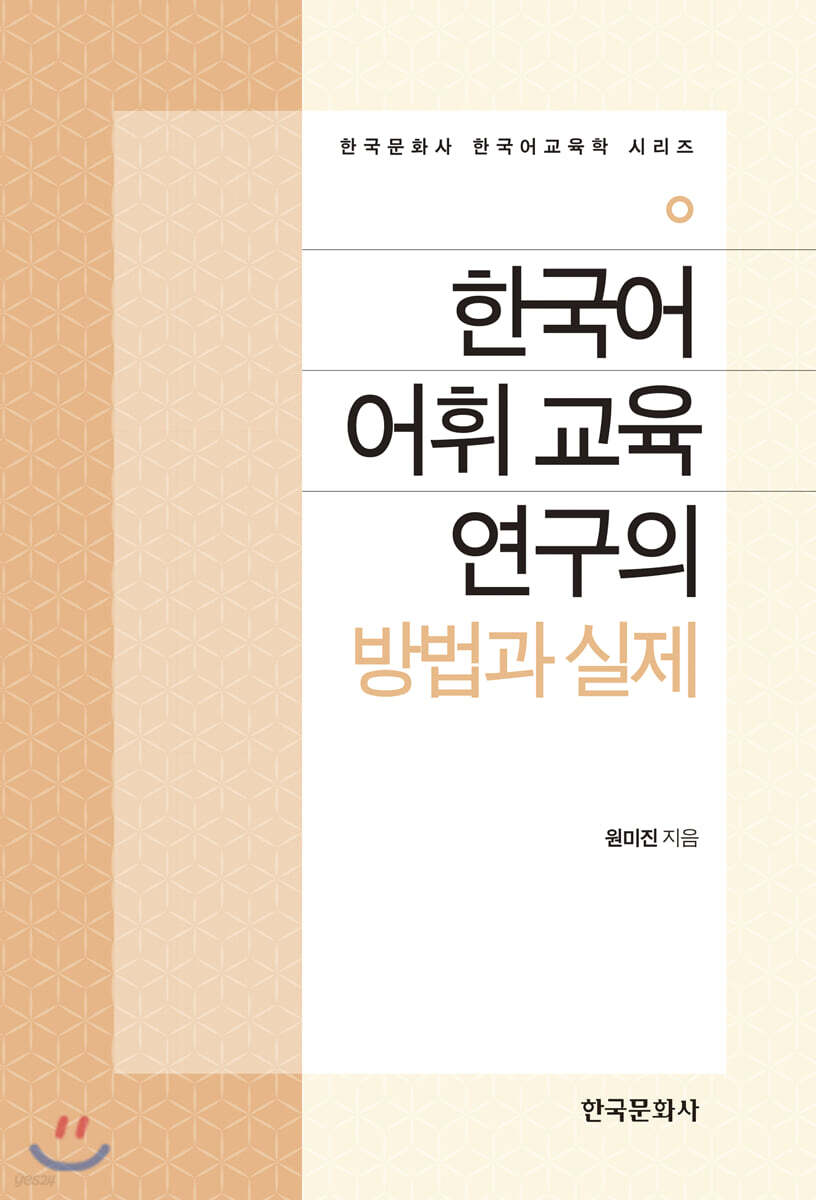
Methods and Practices of Korean Vocabulary Education Research
 |
Description
Book Introduction
The first part of each chapter introduces some issues in language education: what vocabulary knowledge is, what to teach, how to teach it, and how to assess it.
And I presented my research conducted to solve each topic, focusing on either the method or the research results depending on the research topic.
If you read this book with a focus on how the issues discussed in the first part are being researched in terms of the methods and practices of Korean vocabulary education research, which is the purpose of this book, it will be helpful in understanding the flow of vocabulary education research.
And I presented my research conducted to solve each topic, focusing on either the method or the research results depending on the research topic.
If you read this book with a focus on how the issues discussed in the first part are being researched in terms of the methods and practices of Korean vocabulary education research, which is the purpose of this book, it will be helpful in understanding the flow of vocabulary education research.
- You can preview some of the book's contents.
Preview
index
introduction
Structure of this book
Chapter 1.
What is Vocabulary Knowledge?: A Study of Vocabulary Competence and Vocabulary Knowledge
1.
The Importance of Vocabulary Education in Language Education
2.
Vocabulary and vocabulary skills
3.
Scope and depth of vocabulary knowledge
4.
Comprehension Vocabulary and Expressive Vocabulary
5.
Vocabulary knowledge information in the Korean language learning dictionary
- A study on the nature of dictionary definition vocabulary
- A study on how to write examples in a dictionary
Chapter 2.
What to Teach: A Study on the Scope of Vocabulary Instruction and the Selection of Vocabulary Lists for Instruction
1.
Discussion of vocabulary and basic vocabulary for Korean language education
2.
Trends in research related to vocabulary size in second language education
3.
Discussion on the selection and use of vocabulary lists
- Research on vocabulary list selection
- A study on the selection of derivative affixes for learners.
A study on the selection of foreign word origins
4.
Discussion on the scope of vocabulary instruction
- A study on the relationship between the use of standardized expressions and language ability.
Chapter 3.
How to Teach: Research on Vocabulary Acquisition and Effective Vocabulary Instruction
1.
Intentional and incidental vocabulary learning
2.
Discussion on the quality of participation in vocabulary activities
3.
Discussion on the principles of vocabulary teaching and effective vocabulary teaching methods
4.
Discussion on the use of vocabulary learning strategies according to learner characteristics
- A study on vocabulary learning strategies used by Korean language learners.
5.
Discussion on the role of the native language and dictionaries in vocabulary learning
- A study on the effects of dictionary use and native language use on vocabulary acquisition.
6.
Discussion of trends in research on vocabulary teaching methods in Korean language education
- A study on the effectiveness of Korean vocabulary teaching methods.
Chapter 4.
How to Assess: A Study on Assessing Learner Vocabulary Ability
1.
Measuring and assessing vocabulary as a vocabulary skill
- A study on measuring learners' vocabulary
2.
Measuring vocabulary richness
- A study on learners' vocabulary richness according to proficiency level.
3.
Measurement of comprehension and expressive vocabulary skills
- A study applying methods to measure comprehension vocabulary and expressive vocabulary.
References
Search
Into the book
2.
Vocabulary and vocabulary skills
Defining what vocabulary is is not simple, but vocabulary is defined as 'a set of words used within a certain range.'
Even without following this definition, a vocabulary is a collection of words, and so the question arises: what is a word or what is a word?
The dictionary definition of the word is 'a word or similar word that can be separated and used independently.
Or, it is defined in a complex way as ‘a word that is attached to the end of a word and indicates a grammatical function’ (Standard Korean Dictionary).
If we look at the dictionary definition, it is difficult to answer the question of what vocabulary and words are because they are defined in terms of form.
Therefore, in this chapter, rather than dwelling on the definition of vocabulary, we will approach the question of what vocabulary is by examining vocabulary ability as the basis of language ability.
According to the textbook definition, lexical competence is the ability to know and use words accurately and abundantly, to infer the meaning of unknown words based on words already known, and to understand and express indicative, contextual, and figurative meanings.
Shin Myeong-seon (2008) defined vocabulary ability as the ability to express and understand vocabulary, or in other words, the ability to appropriately name an object, event, or phenomenon in a specific communication situation by considering the situation, or to understand the name that has been given.
Chapelle (1994) explained vocabulary ability by dividing it into knowledge of language and knowledge of using it in context. He viewed vocabulary ability as not only knowing vocabulary knowledge and basic processing processes, but also knowledge of the context of vocabulary use and knowledge of metacognitive strategies for vocabulary use.
Capelle explained that the factors determining vocabulary ability are the amount of vocabulary, knowledge of word characteristics, knowledge of vocabulary structure, and differences in basic vocabulary processing.
And knowing the context of vocabulary usage means not only knowing that adverbs like 'never' are always used with negative sentences, but also that in the case of '잘하다', depending on the meaning within the sentence, you can use '잘하다!' sarcastically when you did not do well, that is, knowledge of the context of usage.
This paper presents a discussion of context theory, which considers not only differences in spoken and written language, formal and informal, everyday usage and academic usage, but also differences in interpretation resulting from linguistic diversity by examining the context from a social perspective, and suggests that factors such as generational differences should also be considered.
Looking at it this way, vocabulary ability is ultimately the most crucial factor that determines language ability or communication ability, and we will move further into a discussion of vocabulary knowledge as a way to explain knowing this vocabulary.
3.
Scope and depth of vocabulary knowledge
What is all the vocabulary learners need to know? All knowledge related to vocabulary is called vocabulary knowledge, but the discussion of what vocabulary knowledge is isn't simple.
First, let's define vocabulary knowledge by looking at the discussion related to vocabulary knowledge.
Stahl (1983, 1986) divided the forms of vocabulary knowledge into two types to define vocabulary knowledge: definitional information and contextual information.
Definitional information is composed of logical knowledge between a word and other words that are already known, in other words, it refers to information such as the definition, synonyms, antonyms, and affixes of a word that are included in the dictionary.
Contextual information is defined as the core concept of a word, and is information that includes how its meaning changes in various contexts.
It goes without saying that acquiring vocabulary knowledge is achieved properly when definitional information and contextual information are learned together.
Although Nagy & Scott's (2000) study focused on how native language learners learn new words, it systematically explains what vocabulary knowledge is.
The five characteristics of vocabulary knowledge pointed out here are as follows:
First, knowing vocabulary is not a matter of knowing everything or nothing, but rather a matter of degree. In this respect, vocabulary knowledge is knowledge that increases gradually.
Research on the gradual increase in vocabulary knowledge has been discussed by many scholars.
First, Dale (1965) divided the level of word knowledge into four levels: ① words that one has never seen before, ② words that one has heard but does not know what they mean, ③ words that one can know what they mean in context, and ④ words that one knows well (re-cited from Nagy and Scott, 2000).
After that, similar studies were conducted by several scholars, and steps were added and modified little by little.
Drum & Konopak (1987) divided vocabulary knowledge into six levels: ① words that are known verbally but not written; ② words that have a meaning but cannot be expressed; ③ words that have a meaning but do not know the corresponding word; ④ words that have a partial meaning; ⑤ words that have another meaning; and ⑥ words that have neither a concept nor a word.
Vocabulary and vocabulary skills
Defining what vocabulary is is not simple, but vocabulary is defined as 'a set of words used within a certain range.'
Even without following this definition, a vocabulary is a collection of words, and so the question arises: what is a word or what is a word?
The dictionary definition of the word is 'a word or similar word that can be separated and used independently.
Or, it is defined in a complex way as ‘a word that is attached to the end of a word and indicates a grammatical function’ (Standard Korean Dictionary).
If we look at the dictionary definition, it is difficult to answer the question of what vocabulary and words are because they are defined in terms of form.
Therefore, in this chapter, rather than dwelling on the definition of vocabulary, we will approach the question of what vocabulary is by examining vocabulary ability as the basis of language ability.
According to the textbook definition, lexical competence is the ability to know and use words accurately and abundantly, to infer the meaning of unknown words based on words already known, and to understand and express indicative, contextual, and figurative meanings.
Shin Myeong-seon (2008) defined vocabulary ability as the ability to express and understand vocabulary, or in other words, the ability to appropriately name an object, event, or phenomenon in a specific communication situation by considering the situation, or to understand the name that has been given.
Chapelle (1994) explained vocabulary ability by dividing it into knowledge of language and knowledge of using it in context. He viewed vocabulary ability as not only knowing vocabulary knowledge and basic processing processes, but also knowledge of the context of vocabulary use and knowledge of metacognitive strategies for vocabulary use.
Capelle explained that the factors determining vocabulary ability are the amount of vocabulary, knowledge of word characteristics, knowledge of vocabulary structure, and differences in basic vocabulary processing.
And knowing the context of vocabulary usage means not only knowing that adverbs like 'never' are always used with negative sentences, but also that in the case of '잘하다', depending on the meaning within the sentence, you can use '잘하다!' sarcastically when you did not do well, that is, knowledge of the context of usage.
This paper presents a discussion of context theory, which considers not only differences in spoken and written language, formal and informal, everyday usage and academic usage, but also differences in interpretation resulting from linguistic diversity by examining the context from a social perspective, and suggests that factors such as generational differences should also be considered.
Looking at it this way, vocabulary ability is ultimately the most crucial factor that determines language ability or communication ability, and we will move further into a discussion of vocabulary knowledge as a way to explain knowing this vocabulary.
3.
Scope and depth of vocabulary knowledge
What is all the vocabulary learners need to know? All knowledge related to vocabulary is called vocabulary knowledge, but the discussion of what vocabulary knowledge is isn't simple.
First, let's define vocabulary knowledge by looking at the discussion related to vocabulary knowledge.
Stahl (1983, 1986) divided the forms of vocabulary knowledge into two types to define vocabulary knowledge: definitional information and contextual information.
Definitional information is composed of logical knowledge between a word and other words that are already known, in other words, it refers to information such as the definition, synonyms, antonyms, and affixes of a word that are included in the dictionary.
Contextual information is defined as the core concept of a word, and is information that includes how its meaning changes in various contexts.
It goes without saying that acquiring vocabulary knowledge is achieved properly when definitional information and contextual information are learned together.
Although Nagy & Scott's (2000) study focused on how native language learners learn new words, it systematically explains what vocabulary knowledge is.
The five characteristics of vocabulary knowledge pointed out here are as follows:
First, knowing vocabulary is not a matter of knowing everything or nothing, but rather a matter of degree. In this respect, vocabulary knowledge is knowledge that increases gradually.
Research on the gradual increase in vocabulary knowledge has been discussed by many scholars.
First, Dale (1965) divided the level of word knowledge into four levels: ① words that one has never seen before, ② words that one has heard but does not know what they mean, ③ words that one can know what they mean in context, and ④ words that one knows well (re-cited from Nagy and Scott, 2000).
After that, similar studies were conducted by several scholars, and steps were added and modified little by little.
Drum & Konopak (1987) divided vocabulary knowledge into six levels: ① words that are known verbally but not written; ② words that have a meaning but cannot be expressed; ③ words that have a meaning but do not know the corresponding word; ④ words that have a partial meaning; ⑤ words that have another meaning; and ⑥ words that have neither a concept nor a word.
--- From the text
Publisher's Review
Structure of this book
To organize this book, we divided the research on vocabulary education into categories according to trends in vocabulary research.
Related research can be broadly categorized into research on what to teach, research on how to teach, and research on how to evaluate.
Research on what to teach can be divided into two categories: first, research on determining the number and scope of vocabulary for Korean language learners and grading it according to the learners' purpose or level; second, research on what content to teach by analyzing and classifying the characteristics of vocabulary, focusing on the characteristics of Korean vocabulary itself or the relationships between vocabulary; and third, research on clarifying the characteristics of Korean vocabulary from a contrastive linguistics perspective.
Research on how to teach varies slightly depending on the position of vocabulary education in foreign language teaching methods, but can be divided into research on vocabulary teaching activities or learning strategies related to effective vocabulary teaching methods.
Research on teaching and learning inevitably involves the question of how to evaluate the results of learning. Therefore, this book broadly divides vocabulary teaching into three categories: target, method, and evaluation.
This framework is not much different from the framework that I have followed as a vocabulary researcher, so each chapter of this book largely follows this classification.
In addition, to understand the nature of vocabulary as an educational object, the study of the nature of vocabulary knowledge and vocabulary ability was added and organized into four chapters.
The first part of each chapter introduces some issues in language education: what vocabulary knowledge is, what to teach, how to teach it, and how to assess it.
And I presented my research conducted to solve each topic, focusing on either the method or the research results depending on the research topic.
If you read this book with a focus on how the issues discussed in the first part are being researched in terms of the methods and practices of Korean vocabulary education research, which is the purpose of this book, it will be helpful in understanding the flow of vocabulary education research.
Chapter 1 addressed the issue of how to view vocabulary knowledge as a target of vocabulary education, the vocabulary information presented in dictionaries as a resource for exploring vocabulary knowledge, and research on how to present the meaning of vocabulary, which is an important part of presenting vocabulary.
Chapter 2 examined research on how to select the target of vocabulary education.
In addition to the selection of 50,000 words for the Basic Korean Dictionary, we also studied the selection of derivative affixes and foreign word forming elements in relation to the selection method of specific words.
In addition, we expanded the scope of vocabulary education to include standardized expressions and examined related research.
Chapter 3 deals with research related to the debate over the effectiveness of vocabulary teaching methods and examines the results of research that has revealed the methods suggested as effective in vocabulary education research.
We also examined the use of strategies that varied depending on the variables of learners using vocabulary teaching methods.
In the final chapter, we explore the problem of vocabulary assessment from various perspectives.
We present a study as an exploratory attempt to measure learners' vocabulary, and examine methods for measuring vocabulary richness as an attempt to examine the characteristics of learners' vocabulary along with their language abilities.
And, as a method of measuring the essence of learners' vocabulary knowledge, a study was introduced that examined the problem of measuring comprehension vocabulary and expressive vocabulary along with differences according to learner variables.
This book was written with the intention of being helpful to graduate students and researchers interested in teaching Korean vocabulary.
Examples of research by research topic are organized by research that I have conducted over the past 10 years based on my interest in vocabulary education as a researcher, so some important research topics that have not yet been studied are omitted.
While organizing past research, we re-examined the significance and limitations of the research, and based on this, we re-described the content of future research proposals.
As a researcher, it was a time when I could think a lot about future research areas.
I hope that this book will help readers critically examine the methods and content of research and plan future research.
GOODS SPECIFICS
- Date of publication: August 28, 2019
- Page count, weight, size: 280 pages | 434g | 153*225*20mm
- ISBN13: 9788968177972
- ISBN10: 896817797X
You may also like
카테고리
korean


korean

![GQ KOREA Mark (Monthly): December [2025]](http://librairie.coreenne.fr/cdn/shop/files/8ef265dbbfbf186523ed75ba7319009d.jpg?v=1765340328&width=3840)


