

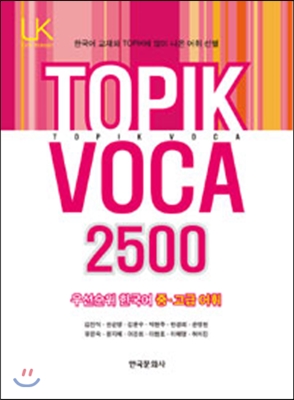
TOPIk Vocabulary 2500 Priority Korean Advanced Vocabulary
 |
Description
Book Introduction
It was created to enable intermediate and advanced learners of Korean to learn about 2,500 vocabulary words necessary for learning Korean as a foreign language.
In Korean language education as a foreign language, vocabulary education is a fundamental field that must be completed before phonemic or grammar education.
And in order for vocabulary education to be carried out properly, there must be a thorough analysis of what kind of vocabulary learners of Korean need at each level.
However, the current vocabulary teaching materials are not very diverse, and even those that are available are created without a precise analysis of the vocabulary needed for each level.
In Korean language education as a foreign language, vocabulary education is a fundamental field that must be completed before phonemic or grammar education.
And in order for vocabulary education to be carried out properly, there must be a thorough analysis of what kind of vocabulary learners of Korean need at each level.
However, the current vocabulary teaching materials are not very diverse, and even those that are available are created without a precise analysis of the vocabulary needed for each level.
index
Preface / 5
Note / 8
Noun (1-1333) 1
Verbs (1-749) 125
Adjectives (1-216) 199
Adjectives (1-86) 225
Adverbs (1-145) 235
Appendix 01 Proverbs 167 250
Appendix 02 Chinese Idioms 147 263
Appendix 03 TOPIK Elementary, Intermediate, and Advanced Causative and Passive Verbs List 273
Appendix 04 Intermediate and Advanced Vocabulary List by Part of Speech 289
Appendix 05 TOPIK Intermediate/Advanced Predicted Questions 50 Questions 321
TOPIK Intermediate/Advanced Predicted Questions Answers 371
Search / 374
Note / 8
Noun (1-1333) 1
Verbs (1-749) 125
Adjectives (1-216) 199
Adjectives (1-86) 225
Adverbs (1-145) 235
Appendix 01 Proverbs 167 250
Appendix 02 Chinese Idioms 147 263
Appendix 03 TOPIK Elementary, Intermediate, and Advanced Causative and Passive Verbs List 273
Appendix 04 Intermediate and Advanced Vocabulary List by Part of Speech 289
Appendix 05 TOPIK Intermediate/Advanced Predicted Questions 50 Questions 321
TOPIK Intermediate/Advanced Predicted Questions Answers 371
Search / 374
Publisher's Review
preface
This book was created to help intermediate and advanced learners learn Korean as a foreign language learn approximately 2,500 vocabulary words.
In Korean language education as a foreign language, vocabulary education is a fundamental field that must be completed before phonemic or grammar education.
And in order for vocabulary education to be carried out properly, there must be a thorough analysis of what kind of vocabulary learners of Korean need at each level.
However, the current vocabulary teaching materials are not very diverse, and even those that are available are created without a precise analysis of the vocabulary needed for each level.
This book is the second fruit of these reflections.
I had students majoring in Korean language education as a foreign language divide up the research, and I would supplement and organize the final work.
We analyzed the text from previous TOPIK exam questions [from the 2nd to the 29th] and extracted intermediate vocabulary.
Among the found vocabulary, approximately 1,300 nouns, 700 verbs, 200 adjectives, 80 determiners, and 140 adverbs with high frequency were selected as the headings for this textbook.
Of course, in the case of verbs, the basic form was presented.
Editing first clarified the parts of speech of the titles, translated them into English, Chinese, and Japanese, and included examples. Pronunciation symbols were added for learners, along with synonyms and antonyms.
Words with multiple meanings are listed separately as headings or have separate examples.
And in the appendix, 167 proverbs that appear more than twice in 7 proverb books, 147 Chinese character idioms, and all causative and passive verbs that appear in TOPIK are included.
We've also included 50 sets of expected vocabulary questions. We analyzed TOPIK Intermediate/Advanced (from Lessons 2 to 29) and grouped the vocabulary by part of speech. For learners' convenience, we've also included words derived from the headwords.
Although there are books out there for teaching intermediate and advanced vocabulary, this book has its own unique characteristics and, because it was created through a thorough analysis of existing TOPIK questions, I dare say that it can satisfy the needs of each educational institution to some extent.
This book was made possible by the efforts of many people, including the authors.
Professor Lim Jong-gang and Mr. Seo Tae-jung of Dalian University of Foreign Studies were in charge of the Chinese translation, Ms. Oh Hye-gyeong, a full-time lecturer at the Department of Liberal Arts at International Christian University (ICU) in Tokyo, Japan, was in charge of the Japanese translation, Ms. Kwon Soon-young of Chungbuk High School in Cheongju and Ms. Son Ji-seon of Eulji Middle School in Seoul were in charge of the English translation of the titles and example sentences, and Mr. Michael, who majored in journalism at the University of Florida in the U.S. and worked as a native English teacher in Seoul for two years, proofread the English example sentences.
Michael DeVoogd) was in charge.
Finally, I would like to express my gratitude to the president and staff of Hankuk Culture Publishing Co., Ltd., who took charge of publishing this book.
January 25, 2015
Kim Jin-sik, professor of Korean language education at Chungbuk National University College of Education
This book was created to help intermediate and advanced learners learn Korean as a foreign language learn approximately 2,500 vocabulary words.
In Korean language education as a foreign language, vocabulary education is a fundamental field that must be completed before phonemic or grammar education.
And in order for vocabulary education to be carried out properly, there must be a thorough analysis of what kind of vocabulary learners of Korean need at each level.
However, the current vocabulary teaching materials are not very diverse, and even those that are available are created without a precise analysis of the vocabulary needed for each level.
This book is the second fruit of these reflections.
I had students majoring in Korean language education as a foreign language divide up the research, and I would supplement and organize the final work.
We analyzed the text from previous TOPIK exam questions [from the 2nd to the 29th] and extracted intermediate vocabulary.
Among the found vocabulary, approximately 1,300 nouns, 700 verbs, 200 adjectives, 80 determiners, and 140 adverbs with high frequency were selected as the headings for this textbook.
Of course, in the case of verbs, the basic form was presented.
Editing first clarified the parts of speech of the titles, translated them into English, Chinese, and Japanese, and included examples. Pronunciation symbols were added for learners, along with synonyms and antonyms.
Words with multiple meanings are listed separately as headings or have separate examples.
And in the appendix, 167 proverbs that appear more than twice in 7 proverb books, 147 Chinese character idioms, and all causative and passive verbs that appear in TOPIK are included.
We've also included 50 sets of expected vocabulary questions. We analyzed TOPIK Intermediate/Advanced (from Lessons 2 to 29) and grouped the vocabulary by part of speech. For learners' convenience, we've also included words derived from the headwords.
Although there are books out there for teaching intermediate and advanced vocabulary, this book has its own unique characteristics and, because it was created through a thorough analysis of existing TOPIK questions, I dare say that it can satisfy the needs of each educational institution to some extent.
This book was made possible by the efforts of many people, including the authors.
Professor Lim Jong-gang and Mr. Seo Tae-jung of Dalian University of Foreign Studies were in charge of the Chinese translation, Ms. Oh Hye-gyeong, a full-time lecturer at the Department of Liberal Arts at International Christian University (ICU) in Tokyo, Japan, was in charge of the Japanese translation, Ms. Kwon Soon-young of Chungbuk High School in Cheongju and Ms. Son Ji-seon of Eulji Middle School in Seoul were in charge of the English translation of the titles and example sentences, and Mr. Michael, who majored in journalism at the University of Florida in the U.S. and worked as a native English teacher in Seoul for two years, proofread the English example sentences.
Michael DeVoogd) was in charge.
Finally, I would like to express my gratitude to the president and staff of Hankuk Culture Publishing Co., Ltd., who took charge of publishing this book.
January 25, 2015
Kim Jin-sik, professor of Korean language education at Chungbuk National University College of Education
GOODS SPECIFICS
- Date of issue: March 4, 2015
- Page count, weight, size: 380 pages | 153*225mm
- ISBN13: 9788968171994
- ISBN10: 8968171998
You may also like
카테고리
korean


korean

![GQ KOREA Mark (Monthly): December [2025]](http://librairie.coreenne.fr/cdn/shop/files/8ef265dbbfbf186523ed75ba7319009d.jpg?v=1765340328&width=3840)


