

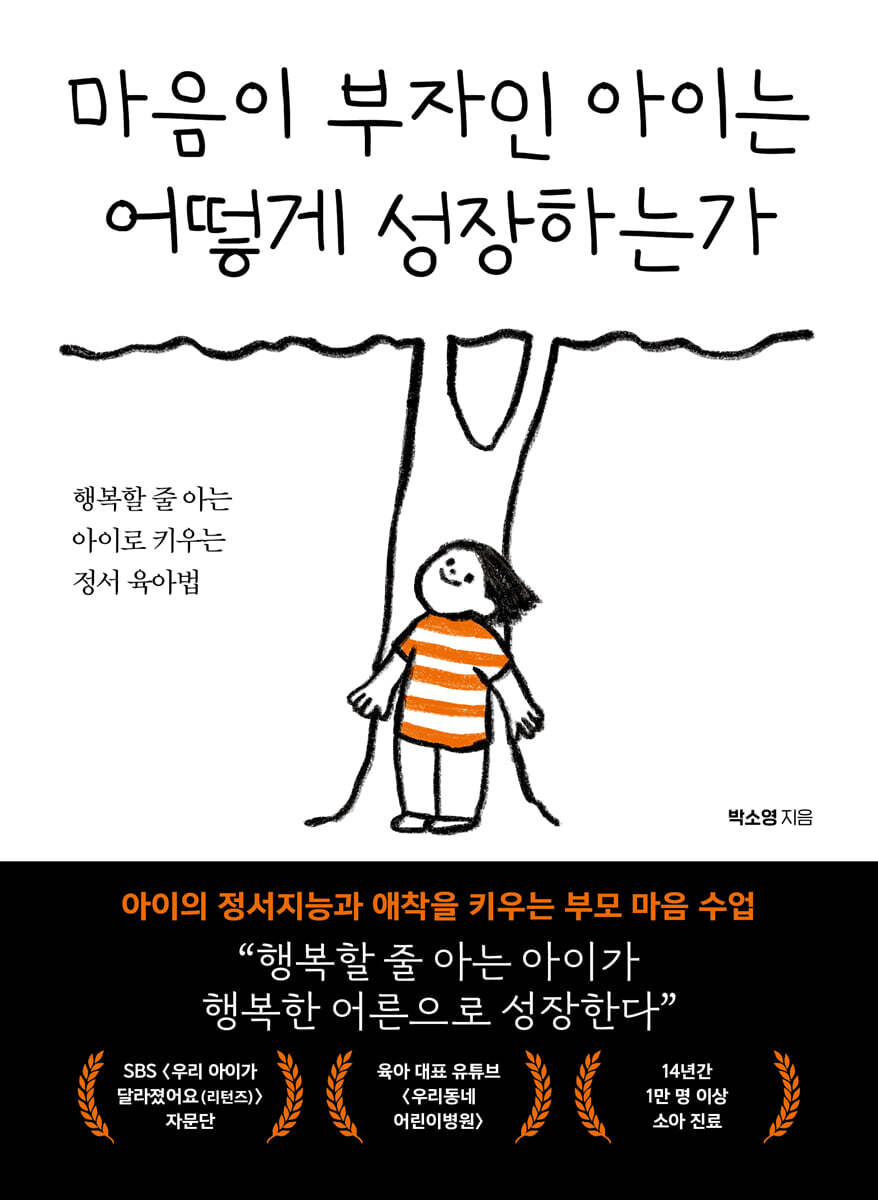
How do children with a rich heart grow up?
 |
Description
Book Introduction
“A child who knows how to be happy grows into a happy adult.” Parenting classes to foster children's emotional intelligence and attachment * SBS [My Child Has Changed (Returns)] Advisory Group * Representative parenting YouTube channel [Our Neighborhood Children's Hospital] * More than 10,000 children treated over 14 years Park So-young, a pediatric psychiatrist with 14 years of experience, began to wonder about something while treating children. “These days, children grow up with no shortage of attention from their parents, but why do they feel poorer at heart?” This book began with this question. Parents think that a 'good parent' is one who studies parenting and sacrifices himself for his child. However, the 'good parents' that children want are parents who empathize with them and are by their side. When we get one step closer to being the parent our children want us to be, rather than the parent we want to be, our children grow up to be strong, happy adults. This book, which incorporates both the author's professional knowledge and her experience as a mother, provides guidance on how to become a 'good parent.' In particular, the author notes that when parents and children share feelings and thoughts, children's emotions become more stable and their attachments become stronger. This state is called 'intersubjectivity', and as the experience of intersubjectivity accumulates, the child grows into an unshakable tree rooted in the solid soil of the parents. Furthermore, we introduce specific play and conversation methods that can build intersubjectivity and help parents apply them in their daily lives. Through this book, I will be able to raise my child to be a big-hearted and happy child. |
- You can preview some of the book's contents.
Preview
index
Prologue_To all parents who want to raise their children to be rich in spirit
Chapter 1: Does Enjoyable Parenting Exist?
1.
Parenting Today: More Difficult Than Parenting in the Past
2.
The more you know, the harder it becomes for both parents and children.
3.
Still, parenting is fun
Chapter 2: A Miraculous Moment of Sharing My Heart with My Child
1.
Have you ever experienced the true 'taste of parenthood'?
2.
Love my child like I'm in love
3.
The easiest way to increase intersubjectivity and attachment
Chapter 3: The Road to Happy Parenting
1.
Children: Meeting the world through the door of parents
2.
Parents: Finding Your True Self Through Parenting
3.
The relationship between a child and his parents: The most special bond in the world.
4.
What kind of parent am I?
Chapter 4: Being a "Good Parent" is Determined by Attitude, Not Skill
1.
Do parents just happen naturally? Or are they made through effort?
2.
4 Things Good Parents Have in Common
3.
Play: A Doorway into a Child's World
4.
Dialogue: A Powerful Channel Connecting the Hearts of Parents and Children
Chapter 5: 4 Weeks of Practice to Become a "Good Parent"
1.
What are my parenting goals?
2.
Parenting Check-In: What Does My Parenting Look Like Now?
3.
4-Week Worksheet to Strengthen Your Relationship with Your Child
4.
Happy parents bear the fruit of happy children.
Chapter 1: Does Enjoyable Parenting Exist?
1.
Parenting Today: More Difficult Than Parenting in the Past
2.
The more you know, the harder it becomes for both parents and children.
3.
Still, parenting is fun
Chapter 2: A Miraculous Moment of Sharing My Heart with My Child
1.
Have you ever experienced the true 'taste of parenthood'?
2.
Love my child like I'm in love
3.
The easiest way to increase intersubjectivity and attachment
Chapter 3: The Road to Happy Parenting
1.
Children: Meeting the world through the door of parents
2.
Parents: Finding Your True Self Through Parenting
3.
The relationship between a child and his parents: The most special bond in the world.
4.
What kind of parent am I?
Chapter 4: Being a "Good Parent" is Determined by Attitude, Not Skill
1.
Do parents just happen naturally? Or are they made through effort?
2.
4 Things Good Parents Have in Common
3.
Play: A Doorway into a Child's World
4.
Dialogue: A Powerful Channel Connecting the Hearts of Parents and Children
Chapter 5: 4 Weeks of Practice to Become a "Good Parent"
1.
What are my parenting goals?
2.
Parenting Check-In: What Does My Parenting Look Like Now?
3.
4-Week Worksheet to Strengthen Your Relationship with Your Child
4.
Happy parents bear the fruit of happy children.
Detailed image

Into the book
Parents were being bombarded with too much information, and misinformation.
Even though my child smiled at me, I suspected that he might have autism because he only made eye contact 8 out of 10 times. I also worried that he lacked social skills because he was startled by strangers and hid behind his mother.
As their children were dragged around all night by the YouTube algorithm, their anxiety grew like a snowball, and I just felt sorry for those parents.
The anxiety and worry that had built up over several months were not easily resolved even when I, as a professional, objectively explained them in the clinic.
So I decided.
I decided to start YouTube with half a sense of justice and half arrogance.
---From "Chapter 1: Does Enjoyable Parenting Exist?"
Some parents have little time to spend with their children because they are working, and many parents only have 1-2 hours a day to play with their children because they have to send them to daycare or kindergarten and do housework.
…But if you focus on the moments you spend with your child and build intersubjectivity during those times, the density of your relationship will increase, and your child will grow up to be a more resilient and enriched child.
A child learns to trust that his or her parents will love him or her and come back to him or her even if they are not always there.
In other words, even if they are physically apart, there is always a strong parent in the child's heart.
---From "Chapter 2: A Miraculous Moment of Sharing My Heart with My Child"
So parents don't need to be experts.
Instead of saying, “My child is highly stimulation-seeking and socially sensitive,” how about saying, “My child is active and curious, but also very aware of what others think.”
I hope we don't look at children in terms like stimulation seeking, anxiety avoidance, working memory...
Let's not confine our children to numbers like language intelligence and IQ.
Such things are merely tools needed by professionals who have relatively little time with children to professionally assess and approach them.
Isn't the privilege of being a parent to be with your child in everyday life and to observe him closely?
---From "Chapter 3: The Road to Happy Parenting"
As positive intersubjective experiences accumulate between parents and children, the likelihood of forming a secure attachment with the child increases.
Children form positive self-images and other-images based on secure attachments.
Therefore, a child who has trust in himself and others does not easily break down when he experiences conflict or hardship.
This is because he is a child with an inner strength that can overcome conflict and trials, that is, a child with a ‘rich heart.’
This child is likely to be able to build and develop relationships well with others beyond his or her family.
---From Chapter 4, “A Good Parent Is Determined by Attitude, Not Skill”
Sometimes, a seemingly normal, mature person can show a completely different side within their family.
For example, a person who is socially successful and recognized may be violent towards his or her children at home, or a mother who is very kind and polite outside and never gets angry may become cold at home and not be able to properly communicate emotionally with her children.
In such cases, parents themselves become confused.
I lived a good life, and I was proud of myself for being a decent person, but after giving birth and raising a child, I had the experience of seeing the bottom of myself for some reason.
Sometimes, I yell at a child who doesn't know anything or I hit a child without realizing it and feel a huge sense of guilt.
In that way, children are beings that stimulate their parents.
Even though my child smiled at me, I suspected that he might have autism because he only made eye contact 8 out of 10 times. I also worried that he lacked social skills because he was startled by strangers and hid behind his mother.
As their children were dragged around all night by the YouTube algorithm, their anxiety grew like a snowball, and I just felt sorry for those parents.
The anxiety and worry that had built up over several months were not easily resolved even when I, as a professional, objectively explained them in the clinic.
So I decided.
I decided to start YouTube with half a sense of justice and half arrogance.
---From "Chapter 1: Does Enjoyable Parenting Exist?"
Some parents have little time to spend with their children because they are working, and many parents only have 1-2 hours a day to play with their children because they have to send them to daycare or kindergarten and do housework.
…But if you focus on the moments you spend with your child and build intersubjectivity during those times, the density of your relationship will increase, and your child will grow up to be a more resilient and enriched child.
A child learns to trust that his or her parents will love him or her and come back to him or her even if they are not always there.
In other words, even if they are physically apart, there is always a strong parent in the child's heart.
---From "Chapter 2: A Miraculous Moment of Sharing My Heart with My Child"
So parents don't need to be experts.
Instead of saying, “My child is highly stimulation-seeking and socially sensitive,” how about saying, “My child is active and curious, but also very aware of what others think.”
I hope we don't look at children in terms like stimulation seeking, anxiety avoidance, working memory...
Let's not confine our children to numbers like language intelligence and IQ.
Such things are merely tools needed by professionals who have relatively little time with children to professionally assess and approach them.
Isn't the privilege of being a parent to be with your child in everyday life and to observe him closely?
---From "Chapter 3: The Road to Happy Parenting"
As positive intersubjective experiences accumulate between parents and children, the likelihood of forming a secure attachment with the child increases.
Children form positive self-images and other-images based on secure attachments.
Therefore, a child who has trust in himself and others does not easily break down when he experiences conflict or hardship.
This is because he is a child with an inner strength that can overcome conflict and trials, that is, a child with a ‘rich heart.’
This child is likely to be able to build and develop relationships well with others beyond his or her family.
---From Chapter 4, “A Good Parent Is Determined by Attitude, Not Skill”
Sometimes, a seemingly normal, mature person can show a completely different side within their family.
For example, a person who is socially successful and recognized may be violent towards his or her children at home, or a mother who is very kind and polite outside and never gets angry may become cold at home and not be able to properly communicate emotionally with her children.
In such cases, parents themselves become confused.
I lived a good life, and I was proud of myself for being a decent person, but after giving birth and raising a child, I had the experience of seeing the bottom of myself for some reason.
Sometimes, I yell at a child who doesn't know anything or I hit a child without realizing it and feel a huge sense of guilt.
In that way, children are beings that stimulate their parents.
---From Chapter 5, “4 Weeks of Practice to Become a ‘Good Parent’”
Publisher's Review
"A good parent is one who knows how to broaden their child's mind."
South Korea's children are poor in spirit, with happiness levels at an all-time low.
A top student at school, a child who grew up in a wealthy family, a child who grew up receiving lots of attention and affection from their parents…
Although they appear perfect on the outside, their hearts are sick and torn.
What could be the problem? The thread begins to become tangled, starting with the difference between parents and children's perspectives.
Parents are busy and even reduce their children's sleep time for their children.
I search for parenting information and study parenting diligently just to raise my child well.
However, children who grow up under such parents are said to be 'unhappy'.
In fact, according to the Child Happiness Index surveyed by UNICEF, South Korea ranked 38th out of 41 countries in 2024.
Children's happiness level is truly at the bottom.
So how can we make our children happy? How can we be "good parents"? The answer is "become the parent our children want."
Children want their parents to understand them, empathize with them, and be with them.
I just hope that you will understand my heart and be with me in an 'appropriate way'.
This book is about that 'proper method'.
"A good parent is one who knows how to broaden their child's mind."
Intersubjectivity: The Key to Building Children's Emotional Education and Attachment
The author is a child psychiatrist and a mother of a six-year-old son.
There was an unforgettable moment for the author: the moment when the children looked into each other's eyes when they were six months old and confirmed their love for each other.
This state in which two people exchange their feelings, thoughts, etc. is called 'intersubjectivity'.
It may seem strange, but intersubjectivity is actually happening every day in all of our homes.
‘Intersubjectivity’ is a concept well known among experts in psychiatry, psychology, and the humanities, but is still unknown to the general public.
Through this book, the author introduces ‘intersubjectivity’ to the public.
As intersubjectivity increases, emotional education and attachment formation occur naturally, and the child's inner self becomes stronger.
Not only the children but also the parents change.
The moment a child and parent share their thoughts and feelings, the parents can escape the hell of parenting and experience the true joy and happiness of parenting.
In fact, the author confessed that he considers intersubjective experiences with children to be the driving force behind his parenting.
“A good parent is determined by attitude, not skills.”
How should I play? How should I tell you?
Parents can dramatically increase intersubjectivity with just a little effort.
Intersubjectivity can be built naturally, especially during play and conversation times that occur most frequently in daily life.
Play is when a child invites their parents into their world.
When playing with a child, you should follow the child's flow so that he or she can express his or her imagination and desires.
You can also help your child become more immersed in play by imitating what he or she says and does or describing his or her actions.
When having a conversation, don't try to solve the problem.
Most parents try to resolve the current situation rather than listening to their child's feelings.
For example, when a child gets frustrated because he or she has been sitting in the car for a long time, it is easy for parents to respond with something like, “You can’t go faster if you cry” or “I told you not to cry while driving!”
However, we must be curious about what the child is feeling, and accept and empathize with that feeling.
For example, “Chaewon, are you really frustrated? You must be really bored.
Let's say, "I feel frustrated."
The child's attitude will also change.
As these emotionally focused plays and conversations accumulate daily, children become more trusting of their parents, like clothes getting wet in a drizzle, and learn to accept and regulate their emotions.
At the end of the book, there are worksheets to help you review your own parenting and increase your intersubjectivity.
Parents who have limited time with their children or want to strengthen their relationship with them can find worksheets to be of great help.
South Korea's children are poor in spirit, with happiness levels at an all-time low.
A top student at school, a child who grew up in a wealthy family, a child who grew up receiving lots of attention and affection from their parents…
Although they appear perfect on the outside, their hearts are sick and torn.
What could be the problem? The thread begins to become tangled, starting with the difference between parents and children's perspectives.
Parents are busy and even reduce their children's sleep time for their children.
I search for parenting information and study parenting diligently just to raise my child well.
However, children who grow up under such parents are said to be 'unhappy'.
In fact, according to the Child Happiness Index surveyed by UNICEF, South Korea ranked 38th out of 41 countries in 2024.
Children's happiness level is truly at the bottom.
So how can we make our children happy? How can we be "good parents"? The answer is "become the parent our children want."
Children want their parents to understand them, empathize with them, and be with them.
I just hope that you will understand my heart and be with me in an 'appropriate way'.
This book is about that 'proper method'.
"A good parent is one who knows how to broaden their child's mind."
Intersubjectivity: The Key to Building Children's Emotional Education and Attachment
The author is a child psychiatrist and a mother of a six-year-old son.
There was an unforgettable moment for the author: the moment when the children looked into each other's eyes when they were six months old and confirmed their love for each other.
This state in which two people exchange their feelings, thoughts, etc. is called 'intersubjectivity'.
It may seem strange, but intersubjectivity is actually happening every day in all of our homes.
‘Intersubjectivity’ is a concept well known among experts in psychiatry, psychology, and the humanities, but is still unknown to the general public.
Through this book, the author introduces ‘intersubjectivity’ to the public.
As intersubjectivity increases, emotional education and attachment formation occur naturally, and the child's inner self becomes stronger.
Not only the children but also the parents change.
The moment a child and parent share their thoughts and feelings, the parents can escape the hell of parenting and experience the true joy and happiness of parenting.
In fact, the author confessed that he considers intersubjective experiences with children to be the driving force behind his parenting.
“A good parent is determined by attitude, not skills.”
How should I play? How should I tell you?
Parents can dramatically increase intersubjectivity with just a little effort.
Intersubjectivity can be built naturally, especially during play and conversation times that occur most frequently in daily life.
Play is when a child invites their parents into their world.
When playing with a child, you should follow the child's flow so that he or she can express his or her imagination and desires.
You can also help your child become more immersed in play by imitating what he or she says and does or describing his or her actions.
When having a conversation, don't try to solve the problem.
Most parents try to resolve the current situation rather than listening to their child's feelings.
For example, when a child gets frustrated because he or she has been sitting in the car for a long time, it is easy for parents to respond with something like, “You can’t go faster if you cry” or “I told you not to cry while driving!”
However, we must be curious about what the child is feeling, and accept and empathize with that feeling.
For example, “Chaewon, are you really frustrated? You must be really bored.
Let's say, "I feel frustrated."
The child's attitude will also change.
As these emotionally focused plays and conversations accumulate daily, children become more trusting of their parents, like clothes getting wet in a drizzle, and learn to accept and regulate their emotions.
At the end of the book, there are worksheets to help you review your own parenting and increase your intersubjectivity.
Parents who have limited time with their children or want to strengthen their relationship with them can find worksheets to be of great help.
GOODS SPECIFICS
- Date of issue: September 25, 2024
- Page count, weight, size: 332 pages | 150*205*30mm
- ISBN13: 9791193937228
- ISBN10: 1193937221
You may also like
카테고리
korean


korean

![ELLE 엘르 스페셜 에디션 A형 : 12월 [2025]](http://librairie.coreenne.fr/cdn/shop/files/b8e27a3de6c9538896439686c6b0e8fb.jpg?v=1766436872&width=3840)


