

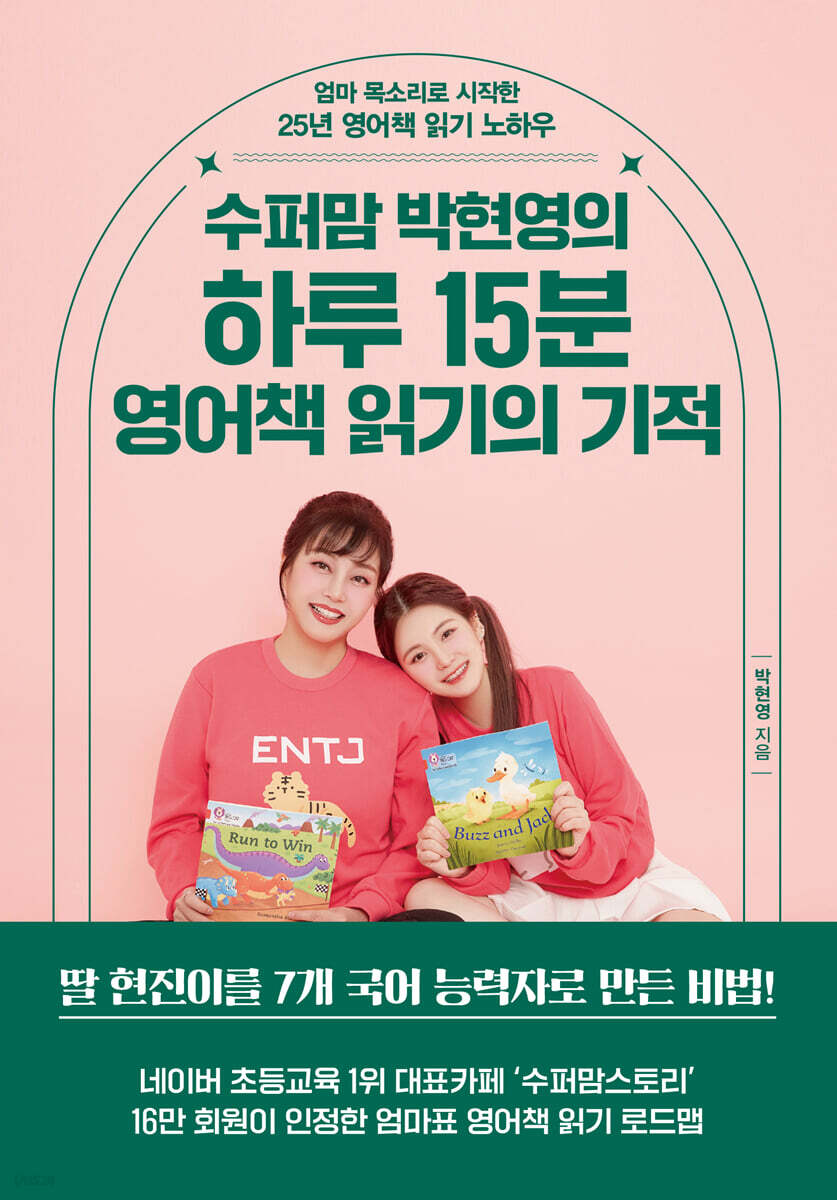
The Miracle of Supermom Park Hyun-young's 15-Minute Daily English Reading
 |
Description
Book Introduction
Naver's No. 1 elementary education cafe, "Super Mom Story"
Supermom Park Hyun-young's English Reading Roadmap, Endorsed by 160,000 Members
Park Hyun-young, who became known as one of the first-generation star English instructors in Korea in the 1990s, worked as a simultaneous interpreter, radio DJ, and foreign language MC.
The term "supermom" became her representative word after she showed off her clever parenting methods on a reality show that enabled her daughter Hyun-jin to speak not only English but also Japanese and Chinese fluently.
Hyunjin is now fluent in seven languages and graduated from Sorbonne University in France.
Based on this successful experience, we opened the Naver Cafe 'Super Mom Story' specializing in multilingual education in 2010 and have maintained the top spot among Naver elementary education cafes ever since.
As an English mentor for mothers in Korea, I have communicated with over 160,000 members and shared the many concerns they raise, accumulating a wealth of case studies and know-how.
This book is a compilation of the know-how and roadmap for reading English books, organized by age, that was the decisive factor in helping my daughter, who speaks seven languages, to speak English fluently.
In particular, the author emphasizes that it is important to read the book first with the mother's voice rather than with an audio machine, and then for the mother and child to read aloud together.
Supermom Park Hyun-young's English Reading Roadmap, Endorsed by 160,000 Members
Park Hyun-young, who became known as one of the first-generation star English instructors in Korea in the 1990s, worked as a simultaneous interpreter, radio DJ, and foreign language MC.
The term "supermom" became her representative word after she showed off her clever parenting methods on a reality show that enabled her daughter Hyun-jin to speak not only English but also Japanese and Chinese fluently.
Hyunjin is now fluent in seven languages and graduated from Sorbonne University in France.
Based on this successful experience, we opened the Naver Cafe 'Super Mom Story' specializing in multilingual education in 2010 and have maintained the top spot among Naver elementary education cafes ever since.
As an English mentor for mothers in Korea, I have communicated with over 160,000 members and shared the many concerns they raise, accumulating a wealth of case studies and know-how.
This book is a compilation of the know-how and roadmap for reading English books, organized by age, that was the decisive factor in helping my daughter, who speaks seven languages, to speak English fluently.
In particular, the author emphasizes that it is important to read the book first with the mother's voice rather than with an audio machine, and then for the mother and child to read aloud together.
- You can preview some of the book's contents.
Preview
index
Prologue: A mother is her child's best reading partner.
PART 1: The Secret to the Miracle of Reading English Books
01 The mother determines the child's English level.
02 The goal of reading English books by Mom is to get 3 hits out of 1.
03 The Power of a Mother's Voice to Stimulate a Child's Brain
04 Golden Time for Mom's English Reading
05 There is no conversational output without reading input.
06 The most important secret to reading English books is reading aloud.
07 Mom is a tosser, child is a spiker
08 Well-chosen equipment creates English bookworms.
09 Once you learn it, you can use it for life.
10 Leveled Reading that increases with age and skill level
11 Fluent Reading Methods That Make English Reading Easy
12 English Vocabulary Memorization Kings Have Their Own Memorization Tips
PART 2 Park Hyun-young's English Book Reading Roadmap
Ages 1-3: The Golden Time to Start Reading English Books
01 Focus on creating the optimal sound environment.
02 What books should I read to my child aged 1-3?
03 The mother should say what the child needs to say.
04 Repeat the reading to maintain the rhythm.
Ages 4-6: The best time to start reading English books with your child.
01 Read regularly, even if for a short time.
02 What books should children aged 4 to 6 read?
03 The ratio of English and Korean books is 50:50.
04 Start Preview Stage Phoenix
05 How to Choose an English Book That's Right for Your Child's Level Using the Five-Finger Rule
06 Video role that makes you fall in love with the book
07 Repeat the chant to create a sense of rhythm.
08 Mine Golden Sentence
09 Start the tossing with your mom's touch
7 Things You Should Never Do When Reading English Books
Ages 7-9: Phonics, the time when people begin to read letters.
01 Shadow reading is required for output to explode.
02 What books should children aged 7 to 9 read?
03 Don't read by pointing at each word with your finger.
04 Spell the words out loud
05 Until the most important sentences stick in your mouth
06 Read the book title out loud dozens of times.
07 Even if your child can read, have the mother read to him/her.
08 Start the Okopul, Ecopul Reading Coursebook
Ages 10-12: The foundation of English reading is established.
01 A perfect score on the English test is achieved through nonfiction and coursebooks.
02 'Iptuktu' Spelling Memorization Technique
03 Real English skills come from Korean.
04 Studying without a translation leaves you with gaps.
05 Habit of Solving the 5-Minute Coursebook
06 If you don't read Steam Readers, you'll become a loser.
07 Elementary 5th and 6th graders also need a mother's English partner.
08 Thick English novels No, thin early chapter books Yes
09 Prescription for a Child Who Refuses to Read English Books
PART 3 Mom's English Reading Clinic
_ Q&A that becomes blood and flesh
01 Panic: A Mother's Eternal Worry
02 What, how much, and when should I read?
03 Mom, is it okay if your pronunciation is 'orange' instead of 'eoreunji'?
Epilogue _ Behind them are super dads and super moms.
PART 1: The Secret to the Miracle of Reading English Books
01 The mother determines the child's English level.
02 The goal of reading English books by Mom is to get 3 hits out of 1.
03 The Power of a Mother's Voice to Stimulate a Child's Brain
04 Golden Time for Mom's English Reading
05 There is no conversational output without reading input.
06 The most important secret to reading English books is reading aloud.
07 Mom is a tosser, child is a spiker
08 Well-chosen equipment creates English bookworms.
09 Once you learn it, you can use it for life.
10 Leveled Reading that increases with age and skill level
11 Fluent Reading Methods That Make English Reading Easy
12 English Vocabulary Memorization Kings Have Their Own Memorization Tips
PART 2 Park Hyun-young's English Book Reading Roadmap
Ages 1-3: The Golden Time to Start Reading English Books
01 Focus on creating the optimal sound environment.
02 What books should I read to my child aged 1-3?
03 The mother should say what the child needs to say.
04 Repeat the reading to maintain the rhythm.
Ages 4-6: The best time to start reading English books with your child.
01 Read regularly, even if for a short time.
02 What books should children aged 4 to 6 read?
03 The ratio of English and Korean books is 50:50.
04 Start Preview Stage Phoenix
05 How to Choose an English Book That's Right for Your Child's Level Using the Five-Finger Rule
06 Video role that makes you fall in love with the book
07 Repeat the chant to create a sense of rhythm.
08 Mine Golden Sentence
09 Start the tossing with your mom's touch
7 Things You Should Never Do When Reading English Books
Ages 7-9: Phonics, the time when people begin to read letters.
01 Shadow reading is required for output to explode.
02 What books should children aged 7 to 9 read?
03 Don't read by pointing at each word with your finger.
04 Spell the words out loud
05 Until the most important sentences stick in your mouth
06 Read the book title out loud dozens of times.
07 Even if your child can read, have the mother read to him/her.
08 Start the Okopul, Ecopul Reading Coursebook
Ages 10-12: The foundation of English reading is established.
01 A perfect score on the English test is achieved through nonfiction and coursebooks.
02 'Iptuktu' Spelling Memorization Technique
03 Real English skills come from Korean.
04 Studying without a translation leaves you with gaps.
05 Habit of Solving the 5-Minute Coursebook
06 If you don't read Steam Readers, you'll become a loser.
07 Elementary 5th and 6th graders also need a mother's English partner.
08 Thick English novels No, thin early chapter books Yes
09 Prescription for a Child Who Refuses to Read English Books
PART 3 Mom's English Reading Clinic
_ Q&A that becomes blood and flesh
01 Panic: A Mother's Eternal Worry
02 What, how much, and when should I read?
03 Mom, is it okay if your pronunciation is 'orange' instead of 'eoreunji'?
Epilogue _ Behind them are super dads and super moms.
Detailed image

Into the book
Since I can't provide a customized English reading program that's just right for my child, ultimately, 'home reading' with the mother should be the focus.
Understanding your child's information isn't about where to fit your child, it's about knowing what's right for your child.
The only person who can accurately determine your child's English skills, reading ability, preferences, and weaknesses is you, the mother.
You can find out not only your child's English skills, but also what books your child focuses on, for how long, and at what time of day.
When choosing a book, don't just buy a best-selling English book; you should first understand your child's English reading habits.
Rather than thinking, "This book is famous," you should first think, "Will my child like this English book?"
---From "PART 1 - A child's English level is determined by the mother"
The most important reason to deliver the message in the mother's voice is to elicit feedback from the child.
Even if it is the native 'butter pronunciation', if it is said in a mechanical voice, the child will get bored, and it is impossible to elicit feedback from the child who is excitedly following along.
But when a mother makes eye contact with her child and reads a book in an interesting way, the child gets excited and starts shaking his body.
What if a voice actor with good pronunciation and voice continuously reads in the same tone? The child might become bored and lose interest after a while.
On the other hand, a mother's voice has the most powerful effect on a child.
It is especially powerful for children aged 1 to 3.
Because the mother's voice, which has been heard through the nerves in the stomach for 10 months, is the first sound in the world that a baby hears and is the sound that can be focused on the most.
It can only be effective if it is delivered in the mother's voice.
When a mother acts in a variety of ways with a familiar voice, the child listens more intently.
---From "PART 1 - 03 The Power of a Mother's Voice to Stimulate a Child's Brain"
If the mother is not a role model, the child will not change.
If the mother keeps her mouth shut, the child also keeps his mouth shut, and if the mother is blunt and only tells the child to dance, the child will also be hesitant and unable to dance.
But if the mother does it, the child does it too.
When mother dances, the child dances too.
If a mother reads with a sense of rhythm, the child will also read with a sense of rhythm, and if the mother enjoys reading, the child will also enjoy reading.
If you train your child to repeat the same words rhythmically, he or she will enjoy following along even if the mother does not scold him or her.
When children are young, you should read English books to them while creating an atmosphere as if they were playing.
The secret weapon that brings out the rhythm is onomatopoeia and mimetic words.
When a child is interested in a picture he or she sees for the first time and listens attentively, the effect is doubled if you read it while mixing in eye-catching body movements or fun onomatopoeia.
At the age of three, children really like repetitive onomatopoeia and mimetic words like 'jurukruk kid cha jurukruk kid cha'.
---「PART 2 - 1~3 years old 04.
From "Please read repeatedly to maintain the rhythm"
A true mother's way of reading English books is to constantly involve the child.
If a mother only tells her child to read out loud and keeps her mouth shut, the child's interest will also disappear.
They will just stare blankly, thinking, ‘Why are you asking me to do such difficult and hard things while Mom doesn’t?’
The mother reads the book aloud first, and then tosses the book to the child in between reading, and then practices pronunciation with the child while listening to the pronunciation of a native speaker through a CD.
When children listen to the CD after they have fully understood the content of the book, they will focus more on the native speaker's pronunciation.
During this process, the child automatically corrects his pronunciation.
This is because children are born with the ability to correct their own pronunciation.
However, if you don't understand the contents of the book, there is no use in listening to it for a hundred days.
You can never memorize an English book you read without even knowing its meaning.
How can you remember if you don't know?
---「PART 2 - 4~6 years old 09.
From "Start the tossing that your mom gave you"
These days, the course books for 7-9 year olds that are being released are designed to solve basic vocabulary, phonics, one-line sentences, and frequently appearing sight words through various activities such as coloring, underlining, connecting lines, filling in parentheses, and matching lines, so that children and mothers can solve them easily and enjoyably without feeling burdened.
So I shout out in the lecture hall, “Ecoful! Ecoful!”
Solving the '5-minute coursebook, every day coursebook'.
Because your skills will only improve if you solve the course book for at least 5 minutes every day.
If you rush through the course book only during exam time, you will memorize it in the short term, but it will be volatile and you will forget it quickly.
Kids who are good at playing the piano don't practice just once a week or once a month.
Then, your fingers will become stiff and your pitch will drop, so practice the piano for 20 minutes every day.
Likewise, solving English coursebooks a few times a week will never develop literacy, reading comprehension, or reasoning skills.
Even if you only solve it for 5 minutes every day, your problem-solving skills will improve and your solving speed will increase.
Understanding your child's information isn't about where to fit your child, it's about knowing what's right for your child.
The only person who can accurately determine your child's English skills, reading ability, preferences, and weaknesses is you, the mother.
You can find out not only your child's English skills, but also what books your child focuses on, for how long, and at what time of day.
When choosing a book, don't just buy a best-selling English book; you should first understand your child's English reading habits.
Rather than thinking, "This book is famous," you should first think, "Will my child like this English book?"
---From "PART 1 - A child's English level is determined by the mother"
The most important reason to deliver the message in the mother's voice is to elicit feedback from the child.
Even if it is the native 'butter pronunciation', if it is said in a mechanical voice, the child will get bored, and it is impossible to elicit feedback from the child who is excitedly following along.
But when a mother makes eye contact with her child and reads a book in an interesting way, the child gets excited and starts shaking his body.
What if a voice actor with good pronunciation and voice continuously reads in the same tone? The child might become bored and lose interest after a while.
On the other hand, a mother's voice has the most powerful effect on a child.
It is especially powerful for children aged 1 to 3.
Because the mother's voice, which has been heard through the nerves in the stomach for 10 months, is the first sound in the world that a baby hears and is the sound that can be focused on the most.
It can only be effective if it is delivered in the mother's voice.
When a mother acts in a variety of ways with a familiar voice, the child listens more intently.
---From "PART 1 - 03 The Power of a Mother's Voice to Stimulate a Child's Brain"
If the mother is not a role model, the child will not change.
If the mother keeps her mouth shut, the child also keeps his mouth shut, and if the mother is blunt and only tells the child to dance, the child will also be hesitant and unable to dance.
But if the mother does it, the child does it too.
When mother dances, the child dances too.
If a mother reads with a sense of rhythm, the child will also read with a sense of rhythm, and if the mother enjoys reading, the child will also enjoy reading.
If you train your child to repeat the same words rhythmically, he or she will enjoy following along even if the mother does not scold him or her.
When children are young, you should read English books to them while creating an atmosphere as if they were playing.
The secret weapon that brings out the rhythm is onomatopoeia and mimetic words.
When a child is interested in a picture he or she sees for the first time and listens attentively, the effect is doubled if you read it while mixing in eye-catching body movements or fun onomatopoeia.
At the age of three, children really like repetitive onomatopoeia and mimetic words like 'jurukruk kid cha jurukruk kid cha'.
---「PART 2 - 1~3 years old 04.
From "Please read repeatedly to maintain the rhythm"
A true mother's way of reading English books is to constantly involve the child.
If a mother only tells her child to read out loud and keeps her mouth shut, the child's interest will also disappear.
They will just stare blankly, thinking, ‘Why are you asking me to do such difficult and hard things while Mom doesn’t?’
The mother reads the book aloud first, and then tosses the book to the child in between reading, and then practices pronunciation with the child while listening to the pronunciation of a native speaker through a CD.
When children listen to the CD after they have fully understood the content of the book, they will focus more on the native speaker's pronunciation.
During this process, the child automatically corrects his pronunciation.
This is because children are born with the ability to correct their own pronunciation.
However, if you don't understand the contents of the book, there is no use in listening to it for a hundred days.
You can never memorize an English book you read without even knowing its meaning.
How can you remember if you don't know?
---「PART 2 - 4~6 years old 09.
From "Start the tossing that your mom gave you"
These days, the course books for 7-9 year olds that are being released are designed to solve basic vocabulary, phonics, one-line sentences, and frequently appearing sight words through various activities such as coloring, underlining, connecting lines, filling in parentheses, and matching lines, so that children and mothers can solve them easily and enjoyably without feeling burdened.
So I shout out in the lecture hall, “Ecoful! Ecoful!”
Solving the '5-minute coursebook, every day coursebook'.
Because your skills will only improve if you solve the course book for at least 5 minutes every day.
If you rush through the course book only during exam time, you will memorize it in the short term, but it will be volatile and you will forget it quickly.
Kids who are good at playing the piano don't practice just once a week or once a month.
Then, your fingers will become stiff and your pitch will drop, so practice the piano for 20 minutes every day.
Likewise, solving English coursebooks a few times a week will never develop literacy, reading comprehension, or reasoning skills.
Even if you only solve it for 5 minutes every day, your problem-solving skills will improve and your solving speed will increase.
---「PART 2 - 7~9 years old 08.
From "Okopul, Start the Ecopul Reading Coursebook"
From "Okopul, Start the Ecopul Reading Coursebook"
Publisher's Review
25 years of English book reading know-how revealed, starting with 15 minutes a day through mom's voice!
Park Hyun-young, an English education expert who worked as a first-generation star English teacher and simultaneous interpreter in Korea, helped her daughter Hyun-jin become fluent in seven languages by starting to read English books in her mother's voice.
Contrary to people's belief that since her mother is an English expert, her daughter will naturally be good at English, she also felt vague anxiety and frustration due to her daughter's English education, and went through numerous trials and errors.
After going through all that time, I came to the conclusion that mothers should become their children's reading partners by reading English books in their own voice for at least 15 minutes a day.
This book emphasizes that anyone can perfect their mother's English conversation skills by reading English books to their children in their own voice for just 15 minutes every day.
The most important reason to deliver the message in the mother's voice is to elicit feedback from the child.
Even if it is a native speaker's pronunciation, if it is played as a machine sound, the child will get bored, and it is impossible to elicit feedback from the child who is excitedly following along.
But when a mother reads a book to her child in an interesting way while making eye contact with the child, the child also gets excited and shakes his body.
Especially for children aged 1 to 3, their mother's voice is the first sound they hear in the world and the sound they can focus on the most.
Don't be discouraged if your mom doesn't speak English.
Just as a mother knows her child's constitution and taste best, the person who can best suit her child's taste and become the English study partner is none other than the mother.
If you follow the age-specific English book reading roadmap presented in this book, you can make English books familiar and interesting to your child.
'Repeated Reading' and 'Wide Reading'
These two are the beginning and end of reading English books.
The author of this book, Supermom Park Hyun-young, says that the beginning and end of Hyun-jin's ability to speak English and become fluent in foreign languages was reading English books with her mother in the 'wide reading' style.
When Hyunjin was in first grade, the most common comment I heard from people around me was, "Hyunjin's reading level seems too low. These days, elementary school students in Daechi-dong read chapter books that American teenagers read."
The author also said that the child had a hard time because he was in a hurry and raised the level to 2, but there were a lot of words he didn't know and the text became more complicated.
So, when we had them read a variety of one-line level 1 books for a year, they were able to read level 2 books fluently the following year.
Through this experience, I have confirmed the effectiveness of 'wide reading', which involves reading multiple books of similar level to build up your skills at that level, and I emphasize that it is the most important way to read English books.
There is no special secret to improving your English skills.
You can read various English books, learn the most difficult sentences by looking at translated versions, and then study them again when you come across a modified sentence in another book.
The magical process of reading thousands of books in this 'wide' manner, where sentences naturally catch your eye, stick in your mind, and you start speaking, is demonstrated through Hyunjin's example.
The greatest strength of reading English books with your mother is
Reading tailored to the child's level
This book points out the mistake made by mothers who focus on reading books according to their child's age rather than their child's level.
When introducing or recommending a good book, many mothers start by asking, “What age is this book for?” or “What is the reading index?” In response to these questions, I advise that customized learning by level, not age, is important.
This is because even if they are both 8-year-olds, there is a difference in vocabulary and reading comprehension between a child who starts elementary school and a child who is exposed to English early on, starting at the age of 3 or 4.
This book emphasizes that when first starting to read English books, it is more important to accurately understand your child's ability level than to consider age, level, or reading quotient. It also shows the importance of perseverance and determination to steadily improve your child's English grades according to their growth rate.
He also emphasizes that reading English books with children should be a 'fun playtime' rather than a study session.
If a mother reads an English book out loud in a fun way and the child shouts along, even if it's just one sentence from the book, it will stay in the child's memory for a long time.
This book is based on my 25 years of real-life experience as my daughter Hyunjin's reading partner, and systematically organizes essential books and reading methods by age, from infancy to elementary school, where self-directed reading is possible, from lower grades to upper grades.
Through this, you can make your child truly enjoy reading English books and further establish reading English books as a 'habit' rather than a study.
Park Hyun-young, an English education expert who worked as a first-generation star English teacher and simultaneous interpreter in Korea, helped her daughter Hyun-jin become fluent in seven languages by starting to read English books in her mother's voice.
Contrary to people's belief that since her mother is an English expert, her daughter will naturally be good at English, she also felt vague anxiety and frustration due to her daughter's English education, and went through numerous trials and errors.
After going through all that time, I came to the conclusion that mothers should become their children's reading partners by reading English books in their own voice for at least 15 minutes a day.
This book emphasizes that anyone can perfect their mother's English conversation skills by reading English books to their children in their own voice for just 15 minutes every day.
The most important reason to deliver the message in the mother's voice is to elicit feedback from the child.
Even if it is a native speaker's pronunciation, if it is played as a machine sound, the child will get bored, and it is impossible to elicit feedback from the child who is excitedly following along.
But when a mother reads a book to her child in an interesting way while making eye contact with the child, the child also gets excited and shakes his body.
Especially for children aged 1 to 3, their mother's voice is the first sound they hear in the world and the sound they can focus on the most.
Don't be discouraged if your mom doesn't speak English.
Just as a mother knows her child's constitution and taste best, the person who can best suit her child's taste and become the English study partner is none other than the mother.
If you follow the age-specific English book reading roadmap presented in this book, you can make English books familiar and interesting to your child.
'Repeated Reading' and 'Wide Reading'
These two are the beginning and end of reading English books.
The author of this book, Supermom Park Hyun-young, says that the beginning and end of Hyun-jin's ability to speak English and become fluent in foreign languages was reading English books with her mother in the 'wide reading' style.
When Hyunjin was in first grade, the most common comment I heard from people around me was, "Hyunjin's reading level seems too low. These days, elementary school students in Daechi-dong read chapter books that American teenagers read."
The author also said that the child had a hard time because he was in a hurry and raised the level to 2, but there were a lot of words he didn't know and the text became more complicated.
So, when we had them read a variety of one-line level 1 books for a year, they were able to read level 2 books fluently the following year.
Through this experience, I have confirmed the effectiveness of 'wide reading', which involves reading multiple books of similar level to build up your skills at that level, and I emphasize that it is the most important way to read English books.
There is no special secret to improving your English skills.
You can read various English books, learn the most difficult sentences by looking at translated versions, and then study them again when you come across a modified sentence in another book.
The magical process of reading thousands of books in this 'wide' manner, where sentences naturally catch your eye, stick in your mind, and you start speaking, is demonstrated through Hyunjin's example.
The greatest strength of reading English books with your mother is
Reading tailored to the child's level
This book points out the mistake made by mothers who focus on reading books according to their child's age rather than their child's level.
When introducing or recommending a good book, many mothers start by asking, “What age is this book for?” or “What is the reading index?” In response to these questions, I advise that customized learning by level, not age, is important.
This is because even if they are both 8-year-olds, there is a difference in vocabulary and reading comprehension between a child who starts elementary school and a child who is exposed to English early on, starting at the age of 3 or 4.
This book emphasizes that when first starting to read English books, it is more important to accurately understand your child's ability level than to consider age, level, or reading quotient. It also shows the importance of perseverance and determination to steadily improve your child's English grades according to their growth rate.
He also emphasizes that reading English books with children should be a 'fun playtime' rather than a study session.
If a mother reads an English book out loud in a fun way and the child shouts along, even if it's just one sentence from the book, it will stay in the child's memory for a long time.
This book is based on my 25 years of real-life experience as my daughter Hyunjin's reading partner, and systematically organizes essential books and reading methods by age, from infancy to elementary school, where self-directed reading is possible, from lower grades to upper grades.
Through this, you can make your child truly enjoy reading English books and further establish reading English books as a 'habit' rather than a study.
GOODS SPECIFICS
- Date of issue: August 16, 2024
- Page count, weight, size: 312 pages | 516g | 150*215*30mm
- ISBN13: 9791193540121
- ISBN10: 1193540127
You may also like
카테고리
korean


korean

![ELLE 엘르 스페셜 에디션 A형 : 12월 [2025]](http://librairie.coreenne.fr/cdn/shop/files/b8e27a3de6c9538896439686c6b0e8fb.jpg?v=1766436872&width=3840)


