

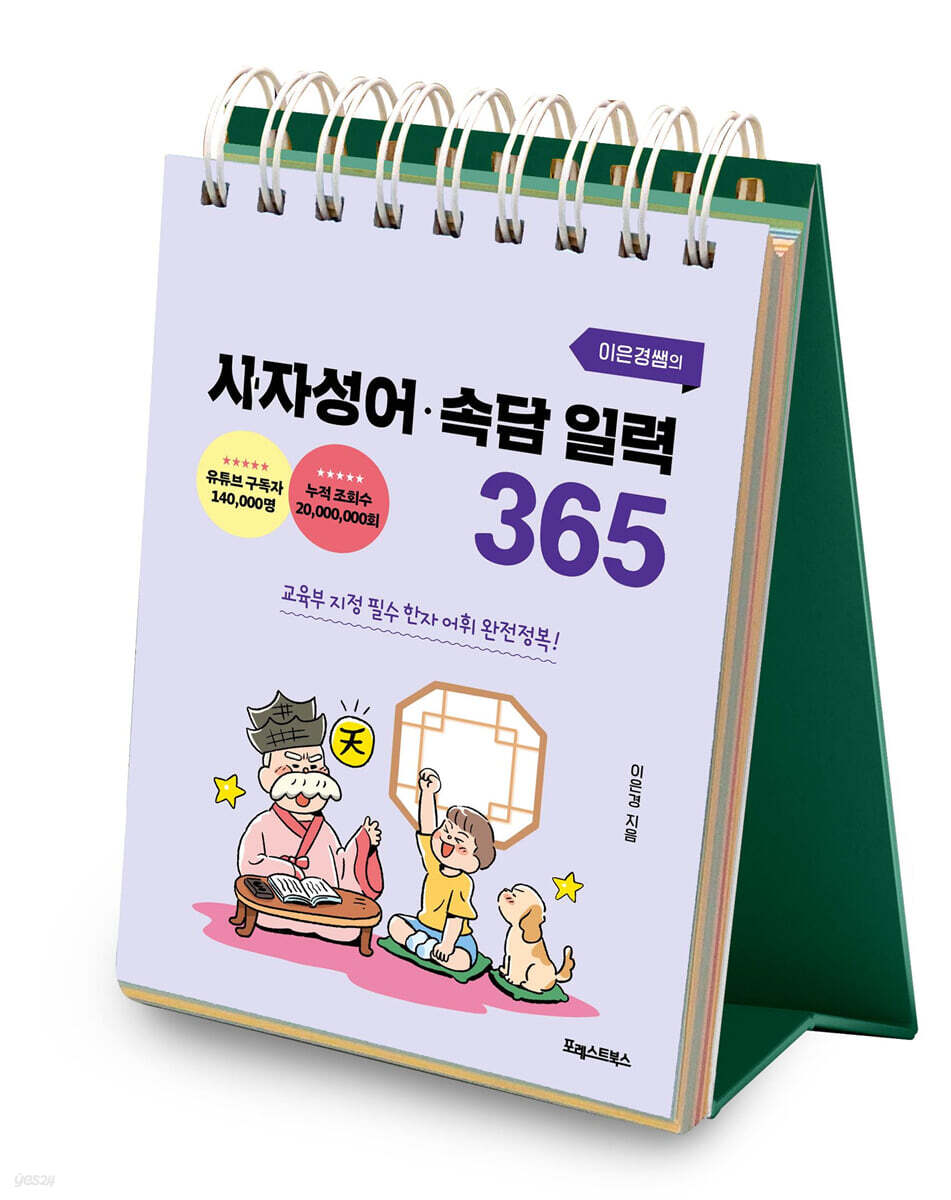
Teacher Lee Eun-kyung's 365-Day Calendar of Idioms and Proverbs
 |
Description
Book Introduction
- A word from MD
-
One page a day is enough for a vocabulary of Chinese characters.Teacher Eun-kyung Lee's four-character idiom and proverb calendar, which created a boom in elementary school learning calendars with English conversation and vocabulary calendars.
It contains a selection of idioms and proverbs that students need to know not only in elementary school but also in middle and high school.
A daily study diary that kills two birds with one stone, expanding your thinking and developing the power of expression beyond language acquisition.
November 7, 2023. PD Lee Joo-eun of Home Life
Four letters that contain thousands of years of wisdom and classical truth
“Frequently used in elementary, middle, and high school
“It contains all the idioms and proverbs!”
Teacher Eun-kyung Lee, who created a learning calendar boom with 『Teacher Eun-kyung Lee's Elementary English Conversation Calendar 365』 and 『Teacher Eun-kyung Lee's Elementary Vocabulary Calendar 365』, has returned with 『Teacher Eun-kyung Lee's Idiom and Proverb Calendar 365』 for teenagers.
This book by teacher Eun-kyung Lee, who has accumulated 20 million views on YouTube, is a mentor to 260,000 parents through Naver Cafe and YouTube's 'Smart Elementary School Life', and is a best-selling author of child education, and frequently appears in textbooks from January 1st to December 31st.
It provides idioms and proverbs that children can use in their daily lives.
It's no surprise that Teacher Lee Eun-kyung's signature friendly comfort and encouragement are included every day, each time with a specific idiom! This calendar warms the hearts of both children and parents who read it.
What teacher Lee Eun-kyung paid particular attention to in this calendar was selecting four-character idioms and proverbs that would help children overcome the various growing pains and trials and errors they naturally experience as they go through elementary, middle, and high school.
The author has been teaching children in schools for 15 years and has been writing and giving lectures to share the educational information and experience he has accumulated for nearly 20 years.
I created 『Lee Eun-kyung's 365-Day Idiom and Proverb Calendar』 to help children grow in mind as well as body while observing the countless children I met in the field.
Essential Chinese characters that you need to know in four-character idioms are marked separately and their meanings are written in detail so that you can learn two Chinese characters a day without any burden. In addition to four-character idioms and proverbs that appear every day, similar expressions and vocabulary that are used are included with fun illustrations.
You have to study English and math, but don't have time to memorize Chinese characters? Don't worry.
If you look at this calendar every day, you will be able to confirm the meaning of the four-character idioms and learn how to use them in everyday life.
10 minutes a day is enough!
“Frequently used in elementary, middle, and high school
“It contains all the idioms and proverbs!”
Teacher Eun-kyung Lee, who created a learning calendar boom with 『Teacher Eun-kyung Lee's Elementary English Conversation Calendar 365』 and 『Teacher Eun-kyung Lee's Elementary Vocabulary Calendar 365』, has returned with 『Teacher Eun-kyung Lee's Idiom and Proverb Calendar 365』 for teenagers.
This book by teacher Eun-kyung Lee, who has accumulated 20 million views on YouTube, is a mentor to 260,000 parents through Naver Cafe and YouTube's 'Smart Elementary School Life', and is a best-selling author of child education, and frequently appears in textbooks from January 1st to December 31st.
It provides idioms and proverbs that children can use in their daily lives.
It's no surprise that Teacher Lee Eun-kyung's signature friendly comfort and encouragement are included every day, each time with a specific idiom! This calendar warms the hearts of both children and parents who read it.
What teacher Lee Eun-kyung paid particular attention to in this calendar was selecting four-character idioms and proverbs that would help children overcome the various growing pains and trials and errors they naturally experience as they go through elementary, middle, and high school.
The author has been teaching children in schools for 15 years and has been writing and giving lectures to share the educational information and experience he has accumulated for nearly 20 years.
I created 『Lee Eun-kyung's 365-Day Idiom and Proverb Calendar』 to help children grow in mind as well as body while observing the countless children I met in the field.
Essential Chinese characters that you need to know in four-character idioms are marked separately and their meanings are written in detail so that you can learn two Chinese characters a day without any burden. In addition to four-character idioms and proverbs that appear every day, similar expressions and vocabulary that are used are included with fun illustrations.
You have to study English and math, but don't have time to memorize Chinese characters? Don't worry.
If you look at this calendar every day, you will be able to confirm the meaning of the four-character idioms and learn how to use them in everyday life.
10 minutes a day is enough!
- You can preview some of the book's contents.
Preview
index
january
february
March
april
May
June
July
August
September
october
November
december
february
March
april
May
June
July
August
September
october
November
december
Detailed image

Publisher's Review
One sentence a day
Complete mastery of essential Chinese characters for elementary, middle, and high school students!
“The higher your Chinese character vocabulary, the higher your literacy level.”
There are many books on idioms and proverbs on the market.
But I can assure you that the best way to learn idioms and proverbs is through a daily calendar.
Even if you buy a book of idioms and read them all in one day, almost nothing will remain in children's minds.
Spending 10 minutes each day discovering idioms and proverbs at your table or desk and discussing them with family and friends will help you remember them for much longer.
For example, “Mom, I’ll be blunt, but please give me some meat.”
Children do fun things without being told to do so.
The four-character idioms and proverbs that are learned every day, like getting wet in a drizzle, will become a strong lighthouse for a child going through puberty.
There are children whose grades improve as they advance in grade level.
What's the secret? Most of these children have a strong Chinese character vocabulary.
Chinese characters contain a variety of meanings, so if you have a high Chinese character vocabulary, your literacy will naturally improve.
Children with a high Chinese character vocabulary can guess words by guessing even if they don't know them.
Because the language has a high degree of applicability.
As students advance in grade level, not only Korean but also subjects like math and science become increasingly descriptive, so children with high levels of this ability will increasingly have an advantage in getting good grades on tests.
Children who look through Teacher Lee Eun-kyung's 365-day calendar of Chinese idioms and proverbs will learn at least two Chinese character vocabulary words that are frequently used in daily life through the Chinese characters in the four-character idioms.
It also contains a lot of vocabulary using today's Chinese characters, so you can acquire vocabulary one after another.
Children who diligently follow this calendar every day, every week, and every month will surely grow up to be completely different from how they are now after a year.
“Using idioms and proverbs will help you speak or write better.
“I can express it much more clearly.”
Let's say you have a friend who is better than you in every way and comes from a wealthy family.
Some children will undoubtedly envy and be jealous of that friend, but some children may recall the idiom '切磋琢磨' at that moment.
A child who thinks of that will surely study more diligently and develop himself, motivated by his own feelings of envy for his outstanding friend.
The above case is also an anecdote about former Samsung Electronics President Koh Dong-jin.
He said that he had established his standards in life through Chinese characters and four-character idioms since childhood, and that as he became interested in four-character idioms, he naturally came to know many proverbs and sayings left by his ancestors.
Among those who have achieved great success in their respective fields despite such difficult circumstances, many talk about the importance of four-character idioms.
No matter which language you search in the world, you will not find a word that compresses such a long and profound meaning into a single word as an idiom.
Learning idioms goes beyond simply learning a language; it is also about building up the essence of life hidden within it.
Old stories that have been passed down for thousands of years are powerful.
Because it has been tested by mankind for a long time.
If you know four-character idioms, your thinking will naturally broaden and your understanding of Korean will become faster.
Another great strength is that when you talk or write about your thoughts, you can convey them much more clearly by using idioms and proverbs.
Come experience the comfort and support of teacher Eun-kyung Lee every day.
Children who read Teacher Lee Eun-kyung's 365-Day Idiom and Proverb Calendar can encounter Teacher Lee Eun-kyung's words of comfort and warm encouragement that match the idiom of the day every day.
As you turn the page, you'll hear teacher Eun-kyung Lee's energetic encouragement for new semesters, exams, and vacations, and you'll also get advice on issues children face, such as relationships with friends and studying.
For example, through the idiom 'long-term waiting', we can comfort and encourage a child who is slower than his friends by conveying the message that 'it takes a long time to make a big bowl'.
Children who grow up hearing daily encouragement filled with the wisdom of thousands of years during their most sensitive and unstable teenage years will undoubtedly have a much stronger core than those who don't.
Complete mastery of essential Chinese characters for elementary, middle, and high school students!
“The higher your Chinese character vocabulary, the higher your literacy level.”
There are many books on idioms and proverbs on the market.
But I can assure you that the best way to learn idioms and proverbs is through a daily calendar.
Even if you buy a book of idioms and read them all in one day, almost nothing will remain in children's minds.
Spending 10 minutes each day discovering idioms and proverbs at your table or desk and discussing them with family and friends will help you remember them for much longer.
For example, “Mom, I’ll be blunt, but please give me some meat.”
Children do fun things without being told to do so.
The four-character idioms and proverbs that are learned every day, like getting wet in a drizzle, will become a strong lighthouse for a child going through puberty.
There are children whose grades improve as they advance in grade level.
What's the secret? Most of these children have a strong Chinese character vocabulary.
Chinese characters contain a variety of meanings, so if you have a high Chinese character vocabulary, your literacy will naturally improve.
Children with a high Chinese character vocabulary can guess words by guessing even if they don't know them.
Because the language has a high degree of applicability.
As students advance in grade level, not only Korean but also subjects like math and science become increasingly descriptive, so children with high levels of this ability will increasingly have an advantage in getting good grades on tests.
Children who look through Teacher Lee Eun-kyung's 365-day calendar of Chinese idioms and proverbs will learn at least two Chinese character vocabulary words that are frequently used in daily life through the Chinese characters in the four-character idioms.
It also contains a lot of vocabulary using today's Chinese characters, so you can acquire vocabulary one after another.
Children who diligently follow this calendar every day, every week, and every month will surely grow up to be completely different from how they are now after a year.
“Using idioms and proverbs will help you speak or write better.
“I can express it much more clearly.”
Let's say you have a friend who is better than you in every way and comes from a wealthy family.
Some children will undoubtedly envy and be jealous of that friend, but some children may recall the idiom '切磋琢磨' at that moment.
A child who thinks of that will surely study more diligently and develop himself, motivated by his own feelings of envy for his outstanding friend.
The above case is also an anecdote about former Samsung Electronics President Koh Dong-jin.
He said that he had established his standards in life through Chinese characters and four-character idioms since childhood, and that as he became interested in four-character idioms, he naturally came to know many proverbs and sayings left by his ancestors.
Among those who have achieved great success in their respective fields despite such difficult circumstances, many talk about the importance of four-character idioms.
No matter which language you search in the world, you will not find a word that compresses such a long and profound meaning into a single word as an idiom.
Learning idioms goes beyond simply learning a language; it is also about building up the essence of life hidden within it.
Old stories that have been passed down for thousands of years are powerful.
Because it has been tested by mankind for a long time.
If you know four-character idioms, your thinking will naturally broaden and your understanding of Korean will become faster.
Another great strength is that when you talk or write about your thoughts, you can convey them much more clearly by using idioms and proverbs.
Come experience the comfort and support of teacher Eun-kyung Lee every day.
Children who read Teacher Lee Eun-kyung's 365-Day Idiom and Proverb Calendar can encounter Teacher Lee Eun-kyung's words of comfort and warm encouragement that match the idiom of the day every day.
As you turn the page, you'll hear teacher Eun-kyung Lee's energetic encouragement for new semesters, exams, and vacations, and you'll also get advice on issues children face, such as relationships with friends and studying.
For example, through the idiom 'long-term waiting', we can comfort and encourage a child who is slower than his friends by conveying the message that 'it takes a long time to make a big bowl'.
Children who grow up hearing daily encouragement filled with the wisdom of thousands of years during their most sensitive and unstable teenage years will undoubtedly have a much stronger core than those who don't.
GOODS SPECIFICS
- Date of issue: October 28, 2023
- Format: Springbook book binding method guide
- Page count, weight, size: 384 pages | 524g | 126*178*30mm
- ISBN13: 9791192625881
- ISBN10: 1192625889
You may also like
카테고리
korean


korean

![ELLE 엘르 스페셜 에디션 A형 : 12월 [2025]](http://librairie.coreenne.fr/cdn/shop/files/b8e27a3de6c9538896439686c6b0e8fb.jpg?v=1766436872&width=3840)


