

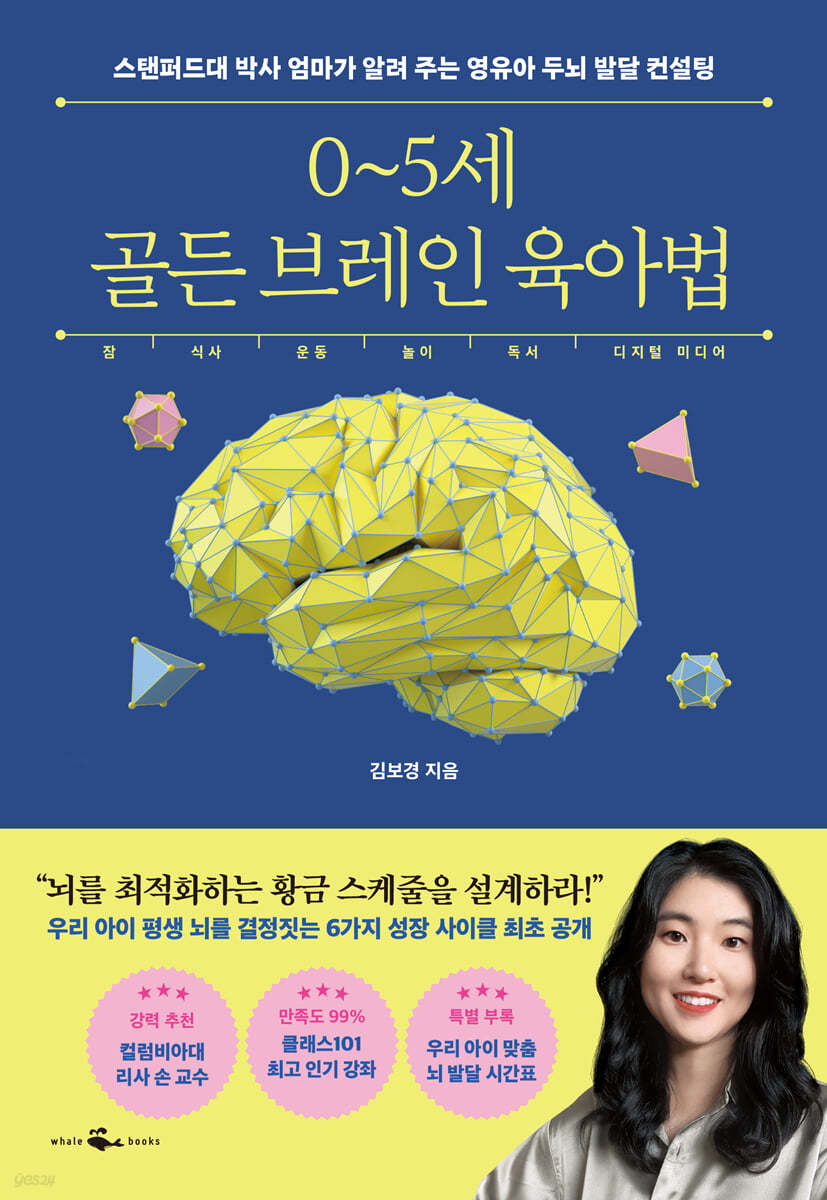
Golden Brain Parenting Method for Children Ages 0-5
 |
Description
Book Introduction
Sleep, eating, play, exercise, reading, and even digital media
6 Growth Cycles Parents of Children Ages 0-5 Must Know: Revealed for the First Time
“Our children’s brain development depends on the mother’s 24-hour planning ability!”
★★★The 24-Hour Golden Brain Development Schedule Designed by a Stanford University Doctorate Mom★★★
★★★Class 101's most popular course with 99% student satisfaction★★★
★★★Special Appendix - Your Child's Customized Brain Development Schedule ★★★
'They say there's a golden time for brain development, but maybe I missed it because I was busy?' 'They say 90% of the brain is determined before the age of 3, so where on earth should I start?' 'My child goes to bed late and doesn't eat; will that cause brain problems?' The biggest topic of conversation among parents these days is children's brain development.
In fact, mom cafes and online parenting communities are overflowing with the anxiety and complaints of parents who say that 24 hours is not enough to put their children to sleep and feed them, and they don't know how to tackle the homework of brain development.
《Golden Brain Parenting Method for 0-5 Year Olds》 is a brain development bible that wisely resolves the worries and concerns of such parents.
Dr. Kim Bo-kyung, 'Korea's only brain consultant,' is a brain science expert from Stanford University and a mother of two in California's Silicon Valley. She has generously included in this book the six crucial cycles of infant and toddler brain development and 24-hour design methods that parents of children aged 0 to 5 must know.
In addition, we offer specific and effective solutions to create optimal brains for our children, based on our extensive field experience in improving the brains and lifestyle habits of hundreds of children, as well as the latest scientific evidence from leading universities around the world, including Harvard and Yale.
Dr. Kim Bo-kyung emphasizes the importance of the six growth cycles—sleep, eating, exercise, play, reading, and media—that parents often overlook, and introduces ways to efficiently distribute these cycles, which fill a child's daily life, within a 24-hour period.
This golden schedule, which is even more realistic because it was planned while raising two children and verified through many trials and errors, encourages parents who are exhausted from the battle for time with their children even today, and instills strong confidence in parents that they can personally create a good environment for their children's brains.
Furthermore, for parents who want to apply what they learned in the book to their children's temperament and characteristics, Dr. Kim Bo-kyung has included a golden schedule and checklist that she actually uses during consulting.
If you have the essential guide to infant and toddler brain development, "Golden Brain Parenting for 0-5 Year Olds," you can achieve the triple benefit of efficiently managing your child's time, establishing good lifestyle habits, and laying a solid foundation for their brain for life.
6 Growth Cycles Parents of Children Ages 0-5 Must Know: Revealed for the First Time
“Our children’s brain development depends on the mother’s 24-hour planning ability!”
★★★The 24-Hour Golden Brain Development Schedule Designed by a Stanford University Doctorate Mom★★★
★★★Class 101's most popular course with 99% student satisfaction★★★
★★★Special Appendix - Your Child's Customized Brain Development Schedule ★★★
'They say there's a golden time for brain development, but maybe I missed it because I was busy?' 'They say 90% of the brain is determined before the age of 3, so where on earth should I start?' 'My child goes to bed late and doesn't eat; will that cause brain problems?' The biggest topic of conversation among parents these days is children's brain development.
In fact, mom cafes and online parenting communities are overflowing with the anxiety and complaints of parents who say that 24 hours is not enough to put their children to sleep and feed them, and they don't know how to tackle the homework of brain development.
《Golden Brain Parenting Method for 0-5 Year Olds》 is a brain development bible that wisely resolves the worries and concerns of such parents.
Dr. Kim Bo-kyung, 'Korea's only brain consultant,' is a brain science expert from Stanford University and a mother of two in California's Silicon Valley. She has generously included in this book the six crucial cycles of infant and toddler brain development and 24-hour design methods that parents of children aged 0 to 5 must know.
In addition, we offer specific and effective solutions to create optimal brains for our children, based on our extensive field experience in improving the brains and lifestyle habits of hundreds of children, as well as the latest scientific evidence from leading universities around the world, including Harvard and Yale.
Dr. Kim Bo-kyung emphasizes the importance of the six growth cycles—sleep, eating, exercise, play, reading, and media—that parents often overlook, and introduces ways to efficiently distribute these cycles, which fill a child's daily life, within a 24-hour period.
This golden schedule, which is even more realistic because it was planned while raising two children and verified through many trials and errors, encourages parents who are exhausted from the battle for time with their children even today, and instills strong confidence in parents that they can personally create a good environment for their children's brains.
Furthermore, for parents who want to apply what they learned in the book to their children's temperament and characteristics, Dr. Kim Bo-kyung has included a golden schedule and checklist that she actually uses during consulting.
If you have the essential guide to infant and toddler brain development, "Golden Brain Parenting for 0-5 Year Olds," you can achieve the triple benefit of efficiently managing your child's time, establishing good lifestyle habits, and laying a solid foundation for their brain for life.
- You can preview some of the book's contents.
Preview
index
◆Introduction: Parents' best efforts nurture the best brains.
Chapter 1.
Designing Your Child's Ultimate 24 Hours
The Three Cycles That Underlie Brain Development
Cycle 1.
sleep
Give the gift of the best sleeping environment
-Farming to nurture children's brains
-The impact of parental sleep on children's sleep
-The butterfly effect caused by sleep deprivation
-If you have a bad memory, check your sleep first.
-Children with ADHD have sleep problems.
-What is the recommended sleep time for my child?
- Stabilize your child's circadian rhythm
7 Techniques for Creating Healthy Sleep Patterns
■ Affectionate Brain Science Counseling Center
■ Brain Growth Checkpoints
Cycle 2.
meal
The brain has its own favorite table.
What a child eats is his or her future.
Why food is important in the first 1,000 days of life
-Hunger and fullness are signals sent by the brain.
Parents who give as they please create children who eat as they please.
-Let your body listen to you.
- A sense of table manners that develops the brain
-The cause of picky eating, perhaps food neophobia?
-Sweet temptations that threaten children's brains
-The risks of childhood obesity to the brain
-The powerful force of a cup of water
4 Eating Habits Your Brain Loves
■ Affectionate Brain Science Counseling Center
■ Today's checkpoints
Cycle 3.
work out
A moving brain grows smarter
-Why won't my child sit still?
-The body is weakening at an accelerating rate.
Why children who play learn better
-What kind of exercise does my child need?
-The problem of a child sitting still
-Don't take away your child's space and time to move.
-The magic of nature that raises happy children
■ Affectionate Brain Science Counseling Center
■ Brain Growth Checkpoints
Chapter 2.
Unleash your potential with a balanced schedule
3 Cycles to Blossom Your Brain
Cycle 4.
play
The beginning of self-discovery and social development
-Play is a child's instinct.
-Play necessary for social development
-The effects of body movement on developing self-regulation skills
-Role playing is the ability to read minds.
-“Is it okay to just repeat the same game?”
-4 Essentials of Play Parents Should Know
-What kind of games should we play to develop our brains?
■ Affectionate Brain Science Counseling Center
■ Brain Growth Checkpoints
Cycle 5.
reading
The Secret to Brain-Growing Literacy
-The brain that prepares to read books from the age of 0
-Should I read books to my child even if he or she can read?
The Power of Dad's Reading to Develop Language Skills
-“I’m good at speaking, but I’m not good at reading.”
-The process of becoming a skilled reader
-“Does reading books improve your empathy?”
-3 Keys to Improving Literacy
Five Principles for Raising a Book-Loving Child
■ Affectionate Brain Science Counseling Center
■ Brain Growth Checkpoints
Cycle 6.
digital media
Media habits: smart and healthy from the start
-The brain of Generation Alpha children that digital native parents don't know
-Smartphone, when should I start showing it?
-The reason why my child is late in speaking
-The illusion of studying with a learning app
-5 Criteria for Choosing Content by a Brain Science Mom
3 Tips for Creating Smart Media Habits
■ Affectionate Brain Science Counseling Center
■ Brain Growth Checkpoints
◆The brain also needs nurturing as it grows.
[★Practical Application] Creating a Golden Schedule Tailored to Your Child
[★Learn More] Brain Science Basics for Parents
References
Chapter 1.
Designing Your Child's Ultimate 24 Hours
The Three Cycles That Underlie Brain Development
Cycle 1.
sleep
Give the gift of the best sleeping environment
-Farming to nurture children's brains
-The impact of parental sleep on children's sleep
-The butterfly effect caused by sleep deprivation
-If you have a bad memory, check your sleep first.
-Children with ADHD have sleep problems.
-What is the recommended sleep time for my child?
- Stabilize your child's circadian rhythm
7 Techniques for Creating Healthy Sleep Patterns
■ Affectionate Brain Science Counseling Center
■ Brain Growth Checkpoints
Cycle 2.
meal
The brain has its own favorite table.
What a child eats is his or her future.
Why food is important in the first 1,000 days of life
-Hunger and fullness are signals sent by the brain.
Parents who give as they please create children who eat as they please.
-Let your body listen to you.
- A sense of table manners that develops the brain
-The cause of picky eating, perhaps food neophobia?
-Sweet temptations that threaten children's brains
-The risks of childhood obesity to the brain
-The powerful force of a cup of water
4 Eating Habits Your Brain Loves
■ Affectionate Brain Science Counseling Center
■ Today's checkpoints
Cycle 3.
work out
A moving brain grows smarter
-Why won't my child sit still?
-The body is weakening at an accelerating rate.
Why children who play learn better
-What kind of exercise does my child need?
-The problem of a child sitting still
-Don't take away your child's space and time to move.
-The magic of nature that raises happy children
■ Affectionate Brain Science Counseling Center
■ Brain Growth Checkpoints
Chapter 2.
Unleash your potential with a balanced schedule
3 Cycles to Blossom Your Brain
Cycle 4.
play
The beginning of self-discovery and social development
-Play is a child's instinct.
-Play necessary for social development
-The effects of body movement on developing self-regulation skills
-Role playing is the ability to read minds.
-“Is it okay to just repeat the same game?”
-4 Essentials of Play Parents Should Know
-What kind of games should we play to develop our brains?
■ Affectionate Brain Science Counseling Center
■ Brain Growth Checkpoints
Cycle 5.
reading
The Secret to Brain-Growing Literacy
-The brain that prepares to read books from the age of 0
-Should I read books to my child even if he or she can read?
The Power of Dad's Reading to Develop Language Skills
-“I’m good at speaking, but I’m not good at reading.”
-The process of becoming a skilled reader
-“Does reading books improve your empathy?”
-3 Keys to Improving Literacy
Five Principles for Raising a Book-Loving Child
■ Affectionate Brain Science Counseling Center
■ Brain Growth Checkpoints
Cycle 6.
digital media
Media habits: smart and healthy from the start
-The brain of Generation Alpha children that digital native parents don't know
-Smartphone, when should I start showing it?
-The reason why my child is late in speaking
-The illusion of studying with a learning app
-5 Criteria for Choosing Content by a Brain Science Mom
3 Tips for Creating Smart Media Habits
■ Affectionate Brain Science Counseling Center
■ Brain Growth Checkpoints
◆The brain also needs nurturing as it grows.
[★Practical Application] Creating a Golden Schedule Tailored to Your Child
[★Learn More] Brain Science Basics for Parents
References
Detailed image

Into the book
Raising our children's 'golden brain' starts with creating the best day possible.
It's a healthy, happy, and child-like day.
This book covers the six essential cycles you need to master every day to develop your best brain.
These cycles can be broadly divided into two.
One is that they create the basic foundation for children's brains to grow healthily.
(...) Today is likely not going to be perfect.
Maybe there is no such thing as a perfect day.
However, I want to tell you that if parents know in their hearts what is important for brain development and do the best they can, then that is enough for today.
I told you the brain is complex, right? That complex world isn't made up of just one or two small things.
Today's best is accumulated over time.
---From "Entering"
Children with ADHD often report having sleep problems or difficulty sleeping, or complaining of being more sleepy during the day than other children.
Symptoms of sleep deprivation resemble many of those of ADHD, and it can often be difficult to distinguish between the two at first glance.
Dr. Christopher Winter, a sleep specialist and neurologist, has seen cases where children with ADHD and sleep disorders have their ADHD symptoms alleviated when their sleep apnea or restless leg syndrome is treated, or their symptoms have completely surpassed the diagnostic criteria for ADHD and are no longer considered ADHD.
In this way, sleep affects children's cognitive abilities and concentration, which determines how well they learn what they need to know as they grow.
---From "ADHD Children Have Sleep Problems"
If sleep is like leveling the ground for farming, then eating is like watering it.
Adequate water is essential for rooted plants to grow.
The same goes for the human body.
Any part of the body needs nutrients to grow.
A healthy diet is key to growing taller and gaining weight, and it helps prevent health problems.
Your brain needs nutrients too.
To function well and to grow well.
Here, “eating well” doesn’t mean skipping vegetable side dishes or drinking low-fat milk.
It means that we have learned well how to eat food, which is the survival skill that allows us to live.
---From "What a Child Eats is His Future"
This is 'emotional eating', which is eating for emotional reasons even when you are not hungry.
The type of emotional eating we need to be aware of is eating food to relieve negative emotions.
The most common causes of emotional eating in children are boredom and stress.
(...) A 2014 study in the United States found that the biggest influence on emotional eating in children ages 8 to 12 was parents' attempts to comfort their children with food when they were feeling down.
Parents who feed emotionally create children who eat emotionally.
Moreover, the foods that are fed to children to appease them are likely to be high-calorie foods such as candy or chocolate.
Emotional eating patterns can later lead to secondary problems such as binge eating or obesity, which occur because the brain and body do not communicate well with each other to make eating decisions.
---From "Parents who give as they please create children who eat as they please"
According to a 2016 report by the WHO that surveyed 146 countries, 94 percent of Korean youth lack exercise, ranking last among the countries surveyed.
It is difficult for the bodies of children who do not move to grow stronger than before.
According to a study from the University of Essex in the UK, children today are weaker than those in 1998.
In this study, we compared and analyzed children's physical information accumulated over a long period of time.
Dr. Gavin Sandercock, the study's lead author, said in an interview:
“Today’s ten-year-olds are taller and heavier than children six or sixteen years ago.
So I thought it would be the healthiest.
But despite growing bigger, the children were actually getting weaker.” The children’s physical strength and muscle strength were gradually deteriorating.
So to speak, you could say that compared to the body that has grown larger than before, it has no strength.
---From "The speed at which my body is weakening is accelerating"
The term nature deficit disorder appears in Dr. Richard Lubb's book, "Children Out of Nature."
Although not an actual medical diagnosis, the author attributes many of the problems faced by modern children to their isolation from nature.
(...) It can be seen that the decreased sensory sensitivity in adults is due to the lack of opportunity to use those senses during childhood, which is why they were not well developed.
The problem is that these abilities that children are losing are crucial for brain development and, furthermore, for living.
A well-functioning brain means it can perceive the external environment well and create appropriate actions to achieve goals.
To do this well, children are designed to learn about the world through their senses.
We perceive the environment through our senses, and plan and create our final actions through cognitive and emotional processing.
Language and mathematical thinking skills are also included here.
---From "The Magic of Nature to Raise a Happy Child"
A 2020 study by the University of Cambridge and the LEGO Foundation analyzed 78 papers published over 40 years to examine the impact of "daddy play" on the development of children aged 0 to 3.
Because daddy play involves a lot of physical activity and encourages rough and tumble play, children develop emotional and self-regulation skills and develop social skills with their peers.
Rough body movements are exciting and fun, but there is a risk of overheating.
And then it ended with me crying.
However, through repetition of this process, children learn to recognize the limits of their bodies and minds and to regulate their emotions and behaviors to maintain an appropriate level.
Children who spend more time playing with their fathers are said to have fewer behaviors such as hyperactivity and tantrums.
Because playing intensely can be an outlet for a child's excitement and emotions.
I highly recommend Dad's rough body play.
---From “The Effects of Body Movement on Developing Self-Regulation Ability”
The joint attention skills developed through reading can be extended to other situations.
Even when children talk or play together, they can understand their parents' interests and interact well with their children to follow their interests, which has a positive effect on their development.
An example is the research of Dr. Ashling Murray of the Irish Institute for Economic and Social Research.
Research shows that children whose mothers read to them from the age of 0 have better interaction and problem-solving skills.
However, this effect could not be expected from children who were only shown pictures.
Rather, it had the same effect when mothers talked a lot to their children, regardless of the book.
In other words, rather than saying that children's cognitive abilities improved because they were exposed to visual stimuli in the form of pictures in books, it is important for mothers to interact with their children to elicit joint attention and, in the process, provide various language stimuli through books.
The positive impact on language and cognitive development is linked to children's later academic achievements, quality employment as adults, and higher salaries.
---From "The Brain That Reads Books Starting at Age 0"
As children read books, put themselves in the protagonist's shoes and experience emotional experiences along the plot, their empathy skills also develop.
A 2013 study by Professor David Kidd of the Harvard Graduate School of Education and Professor Emmanuel Castano of the University of Bergamo in Italy found that readers of literary fiction performed better on theory of mind tasks than readers of non-fiction.
(,..) A change in attitude can lead to empathetic behavior.
Reading good messages, kind words about the world, and words that respect other living beings can change our perspective.
It is especially important for children who are just beginning to learn about the world to read books with positive messages.
A child who develops the ability to understand other people's perspectives by reading good books will love the world more.
---From “Does reading books improve your empathy?”
These results demonstrate the experiential opportunities children are losing due to digital media use.
During this period, children develop the roots of language through interaction with their surroundings.
Even though songs and dialogues are constantly played while children are watching the video, this is not a 'give and take' interaction with the child.
This is why digital media usage guidelines are based on usage time.
This is because ‘time’ during infancy means opportunities for experiences for development.
If children sit alone in front of the television, they lose the opportunity to play with their parents, make eye contact, and talk to them.
Parents, not their children, using digital media can have similar consequences.
When parents look at a screen instead of their child, the child loses the opportunity to interact with their parents.
These are experiences that are essential for language development during this period.
---From "The Reasons Why My Child is Late in Speaking"
We found that the more digital media children spent on, the more they deteriorated in skills like vocabulary, phonemic processing, and early literacy.
Children's brain structure also reflects this.
Children who use digital media for an average of two hours a day have been shown to have impaired white matter development and structural disorganization in their brains.
In particular, they found that the level of connectivity between neurons was reduced in brain areas responsible for language, visual information processing, and executive functions.
This tendency is particularly prominent in the left brain.
These results confirm that the importance of the left brain in language function is linked to the decline in language skills in children who use a lot of digital media.
These results suggest that childhood digital media use may negatively impact the development of brain circuits responsible for later reading.
---From "The Illusion of Studying with Learning Apps"
There is no such thing as perfect growth in this world.
We, too, cannot help but be parents who are always lacking.
Some parents don't have time to go outside and play with their children, and some don't have time to read to their children every night.
No parent can give good answers to all of their child's questions, and no parent can never get angry at their child.
Yesterday this part was lacking, today another part is lacking.
None of us are perfect at raising children.
No matter how much parents know that sleep is important for brain development, there are bound to be days when their child wakes up crying all night.
But the child grows up beautifully because there is a warm back that carries him all night long.
Even the busiest parents can fully shape their children into better people by simply making eye contact and having a loving conversation for a short time.
Parents who hug their children a lot, make eye contact, listen to their children, and love them for who they are make their children's brains bloom.
It's a healthy, happy, and child-like day.
This book covers the six essential cycles you need to master every day to develop your best brain.
These cycles can be broadly divided into two.
One is that they create the basic foundation for children's brains to grow healthily.
(...) Today is likely not going to be perfect.
Maybe there is no such thing as a perfect day.
However, I want to tell you that if parents know in their hearts what is important for brain development and do the best they can, then that is enough for today.
I told you the brain is complex, right? That complex world isn't made up of just one or two small things.
Today's best is accumulated over time.
---From "Entering"
Children with ADHD often report having sleep problems or difficulty sleeping, or complaining of being more sleepy during the day than other children.
Symptoms of sleep deprivation resemble many of those of ADHD, and it can often be difficult to distinguish between the two at first glance.
Dr. Christopher Winter, a sleep specialist and neurologist, has seen cases where children with ADHD and sleep disorders have their ADHD symptoms alleviated when their sleep apnea or restless leg syndrome is treated, or their symptoms have completely surpassed the diagnostic criteria for ADHD and are no longer considered ADHD.
In this way, sleep affects children's cognitive abilities and concentration, which determines how well they learn what they need to know as they grow.
---From "ADHD Children Have Sleep Problems"
If sleep is like leveling the ground for farming, then eating is like watering it.
Adequate water is essential for rooted plants to grow.
The same goes for the human body.
Any part of the body needs nutrients to grow.
A healthy diet is key to growing taller and gaining weight, and it helps prevent health problems.
Your brain needs nutrients too.
To function well and to grow well.
Here, “eating well” doesn’t mean skipping vegetable side dishes or drinking low-fat milk.
It means that we have learned well how to eat food, which is the survival skill that allows us to live.
---From "What a Child Eats is His Future"
This is 'emotional eating', which is eating for emotional reasons even when you are not hungry.
The type of emotional eating we need to be aware of is eating food to relieve negative emotions.
The most common causes of emotional eating in children are boredom and stress.
(...) A 2014 study in the United States found that the biggest influence on emotional eating in children ages 8 to 12 was parents' attempts to comfort their children with food when they were feeling down.
Parents who feed emotionally create children who eat emotionally.
Moreover, the foods that are fed to children to appease them are likely to be high-calorie foods such as candy or chocolate.
Emotional eating patterns can later lead to secondary problems such as binge eating or obesity, which occur because the brain and body do not communicate well with each other to make eating decisions.
---From "Parents who give as they please create children who eat as they please"
According to a 2016 report by the WHO that surveyed 146 countries, 94 percent of Korean youth lack exercise, ranking last among the countries surveyed.
It is difficult for the bodies of children who do not move to grow stronger than before.
According to a study from the University of Essex in the UK, children today are weaker than those in 1998.
In this study, we compared and analyzed children's physical information accumulated over a long period of time.
Dr. Gavin Sandercock, the study's lead author, said in an interview:
“Today’s ten-year-olds are taller and heavier than children six or sixteen years ago.
So I thought it would be the healthiest.
But despite growing bigger, the children were actually getting weaker.” The children’s physical strength and muscle strength were gradually deteriorating.
So to speak, you could say that compared to the body that has grown larger than before, it has no strength.
---From "The speed at which my body is weakening is accelerating"
The term nature deficit disorder appears in Dr. Richard Lubb's book, "Children Out of Nature."
Although not an actual medical diagnosis, the author attributes many of the problems faced by modern children to their isolation from nature.
(...) It can be seen that the decreased sensory sensitivity in adults is due to the lack of opportunity to use those senses during childhood, which is why they were not well developed.
The problem is that these abilities that children are losing are crucial for brain development and, furthermore, for living.
A well-functioning brain means it can perceive the external environment well and create appropriate actions to achieve goals.
To do this well, children are designed to learn about the world through their senses.
We perceive the environment through our senses, and plan and create our final actions through cognitive and emotional processing.
Language and mathematical thinking skills are also included here.
---From "The Magic of Nature to Raise a Happy Child"
A 2020 study by the University of Cambridge and the LEGO Foundation analyzed 78 papers published over 40 years to examine the impact of "daddy play" on the development of children aged 0 to 3.
Because daddy play involves a lot of physical activity and encourages rough and tumble play, children develop emotional and self-regulation skills and develop social skills with their peers.
Rough body movements are exciting and fun, but there is a risk of overheating.
And then it ended with me crying.
However, through repetition of this process, children learn to recognize the limits of their bodies and minds and to regulate their emotions and behaviors to maintain an appropriate level.
Children who spend more time playing with their fathers are said to have fewer behaviors such as hyperactivity and tantrums.
Because playing intensely can be an outlet for a child's excitement and emotions.
I highly recommend Dad's rough body play.
---From “The Effects of Body Movement on Developing Self-Regulation Ability”
The joint attention skills developed through reading can be extended to other situations.
Even when children talk or play together, they can understand their parents' interests and interact well with their children to follow their interests, which has a positive effect on their development.
An example is the research of Dr. Ashling Murray of the Irish Institute for Economic and Social Research.
Research shows that children whose mothers read to them from the age of 0 have better interaction and problem-solving skills.
However, this effect could not be expected from children who were only shown pictures.
Rather, it had the same effect when mothers talked a lot to their children, regardless of the book.
In other words, rather than saying that children's cognitive abilities improved because they were exposed to visual stimuli in the form of pictures in books, it is important for mothers to interact with their children to elicit joint attention and, in the process, provide various language stimuli through books.
The positive impact on language and cognitive development is linked to children's later academic achievements, quality employment as adults, and higher salaries.
---From "The Brain That Reads Books Starting at Age 0"
As children read books, put themselves in the protagonist's shoes and experience emotional experiences along the plot, their empathy skills also develop.
A 2013 study by Professor David Kidd of the Harvard Graduate School of Education and Professor Emmanuel Castano of the University of Bergamo in Italy found that readers of literary fiction performed better on theory of mind tasks than readers of non-fiction.
(,..) A change in attitude can lead to empathetic behavior.
Reading good messages, kind words about the world, and words that respect other living beings can change our perspective.
It is especially important for children who are just beginning to learn about the world to read books with positive messages.
A child who develops the ability to understand other people's perspectives by reading good books will love the world more.
---From “Does reading books improve your empathy?”
These results demonstrate the experiential opportunities children are losing due to digital media use.
During this period, children develop the roots of language through interaction with their surroundings.
Even though songs and dialogues are constantly played while children are watching the video, this is not a 'give and take' interaction with the child.
This is why digital media usage guidelines are based on usage time.
This is because ‘time’ during infancy means opportunities for experiences for development.
If children sit alone in front of the television, they lose the opportunity to play with their parents, make eye contact, and talk to them.
Parents, not their children, using digital media can have similar consequences.
When parents look at a screen instead of their child, the child loses the opportunity to interact with their parents.
These are experiences that are essential for language development during this period.
---From "The Reasons Why My Child is Late in Speaking"
We found that the more digital media children spent on, the more they deteriorated in skills like vocabulary, phonemic processing, and early literacy.
Children's brain structure also reflects this.
Children who use digital media for an average of two hours a day have been shown to have impaired white matter development and structural disorganization in their brains.
In particular, they found that the level of connectivity between neurons was reduced in brain areas responsible for language, visual information processing, and executive functions.
This tendency is particularly prominent in the left brain.
These results confirm that the importance of the left brain in language function is linked to the decline in language skills in children who use a lot of digital media.
These results suggest that childhood digital media use may negatively impact the development of brain circuits responsible for later reading.
---From "The Illusion of Studying with Learning Apps"
There is no such thing as perfect growth in this world.
We, too, cannot help but be parents who are always lacking.
Some parents don't have time to go outside and play with their children, and some don't have time to read to their children every night.
No parent can give good answers to all of their child's questions, and no parent can never get angry at their child.
Yesterday this part was lacking, today another part is lacking.
None of us are perfect at raising children.
No matter how much parents know that sleep is important for brain development, there are bound to be days when their child wakes up crying all night.
But the child grows up beautifully because there is a warm back that carries him all night long.
Even the busiest parents can fully shape their children into better people by simply making eye contact and having a loving conversation for a short time.
Parents who hug their children a lot, make eye contact, listen to their children, and love them for who they are make their children's brains bloom.
---From "The brain also needs nurturing"
Publisher's Review
“A child’s brain changes depending on his or her daily routine.”
The Secret of 24 Hours That Lay the Foundation for a Lifelong Brain Between Ages 0 and 5
Parents raising children aged 0 to 5 have limited time and leisure.
You wake up a child who is acting up and have a fight at the dinner table, and before you know it, the day is over. And instead of buying a book that is good for brain development, your child is glued to their smartphone, so you get angry and regret it over and over again.
Knowing that parenting isn't all about feeding and putting your child to bed, but not having the energy to support their brain development, is there a solution?
Dr. Bo-Kyung Kim, a neuroscience expert who majored in decision-making neuroscience at Stanford University and is raising two children in Silicon Valley, deeply sympathizes with these realistic concerns of parents and wrote this book to provide help.
As the head of a brain consultant firm, I have collected vivid and rich case studies on improving the daily lives and brains of hundreds of children. I have compiled the most frequently asked questions from parents I have encountered in the field and organized them in an easy-to-understand and clear manner.
《Golden Brain Parenting Method for 0-5 Year Olds》 is a parenting bible that contains the secrets to efficiently designing the six critical cycles that develop our children's brains within 24 hours.
[Chapter 1] introduces how to successfully plan sleep, meals, and exercise, which are essential for growth, to the point that there is a saying, “Eat, play, sleep.”
It contains essential information on brain development, including the best amount of sleep, essential nutrients for the first 1000 days after birth, and types of physical activity for each age.
[Chapter 2] contains prescriptions for problems related to play, reading, and digital media faced by children of Generation Alpha, born after 2010.
We have compiled the essential information you need to know if you are concerned about your child being unable to discipline without a smartphone, or if your child is good at speaking but struggles with reading and only plays by himself.
“Bad lifestyle habits are caused by the brain.”
A multi-solution that kills two birds with one stone: cultivating your brain and habits!
A child who wakes up late and whines, a child who's always on their phone and excited—is it a brain problem or a habit? Parents of young children are likely familiar with these situations, often dismissing them as simply being young.
However, Dr. Kim Bo-kyung diagnoses that most lifestyle habits are problems that occur in a child's brain and that they are the result of the complex influence of six daily routines.
This is why we call sleep, eating, playing, exercising, reading, and media a 'cycle' that goes around the day.
Dr. Kim Bo-kyung advises that in order to improve a child's bad habits, it is important to accurately understand the child's own time and harmoniously restore the broken balance before harshly disciplining or scolding them.
She also says that many parents often become fixated on something when they hear that something is good or bad for brain development, and advises parents to look for gaps in their daily routine if their child is having particular issues.
A child's late sleeping may actually be due to irregular meal times, and smartphone addiction may be due to a lack of play.
If we truly understand this cycle and apply the author's multifaceted solutions for children with different temperaments, tendencies, and families to our own homes, we will be able to see much more clearly which of our children's problematic habits and which areas of their brain need to be addressed.
“Parents who love their children create the best brains.”
A day that is too short to just feed and put to bed,
A caring brain science class to comfort anxious and burdened parents.
“It’s hard to provide meals because both parents work.” “It costs too much money to send my child to a Taekwondo academy.” “I want to help them develop a reading habit, but I don’t have enough space to put books.” The author, who sympathizes with these realistic problems of parents, emphasizes that a stable attachment and parenting attitude are more important for children’s brain development, and gently comforts parents who are tired of raising children.
Even with the best schedule, if a child experiences extreme anxiety and stress, it can negatively impact areas crucial for cognitive and emotional development, such as the hippocampus and frontal lobe, hindering brain development.
Even if you feed your baby formula that lacks nutrients, there is scientific evidence that shows that holding your baby in your arms and making warm eye contact has a similar effect to breastfeeding.
“Even the busiest parents can truly shape their children into better people by simply making eye contact and having a loving conversation for a short time.
“Parents who hug their children a lot, make eye contact, listen to them, and love them for who they are make their children’s brains bloom.”
Every time a parent fails to provide their child with all the good things for his or her brain, his or her anxiety and regret only grow.
Many parents blame themselves for not being able to pay enough attention to their children because they are both working and are already overwhelmed with childcare, and for not knowing much about the brain, which may be delaying their child's development.
Moreover, parents cannot help but feel even more anxious when they hear the saying, “90% of a child’s brain is determined before the age of three.”
Dr. Kim Bo-kyung encourages us to use the fact that brain development is not a sprint but a marathon that requires long breaths, so instead of feeling frustrated about not being able to keep to today's plans, use it as a powerful leap forward to live a happier tomorrow.
This is because we believe that a ‘golden brain’ is born from a ‘healthy, happy, and childlike’ day.
Instead of feeling anxious or guilty, be grateful that tomorrow is the start of a new 24 hours for your child, and if you work hard, you can give your child a happier day than today and a balanced brain that will last a lifetime.
The Secret of 24 Hours That Lay the Foundation for a Lifelong Brain Between Ages 0 and 5
Parents raising children aged 0 to 5 have limited time and leisure.
You wake up a child who is acting up and have a fight at the dinner table, and before you know it, the day is over. And instead of buying a book that is good for brain development, your child is glued to their smartphone, so you get angry and regret it over and over again.
Knowing that parenting isn't all about feeding and putting your child to bed, but not having the energy to support their brain development, is there a solution?
Dr. Bo-Kyung Kim, a neuroscience expert who majored in decision-making neuroscience at Stanford University and is raising two children in Silicon Valley, deeply sympathizes with these realistic concerns of parents and wrote this book to provide help.
As the head of a brain consultant firm, I have collected vivid and rich case studies on improving the daily lives and brains of hundreds of children. I have compiled the most frequently asked questions from parents I have encountered in the field and organized them in an easy-to-understand and clear manner.
《Golden Brain Parenting Method for 0-5 Year Olds》 is a parenting bible that contains the secrets to efficiently designing the six critical cycles that develop our children's brains within 24 hours.
[Chapter 1] introduces how to successfully plan sleep, meals, and exercise, which are essential for growth, to the point that there is a saying, “Eat, play, sleep.”
It contains essential information on brain development, including the best amount of sleep, essential nutrients for the first 1000 days after birth, and types of physical activity for each age.
[Chapter 2] contains prescriptions for problems related to play, reading, and digital media faced by children of Generation Alpha, born after 2010.
We have compiled the essential information you need to know if you are concerned about your child being unable to discipline without a smartphone, or if your child is good at speaking but struggles with reading and only plays by himself.
“Bad lifestyle habits are caused by the brain.”
A multi-solution that kills two birds with one stone: cultivating your brain and habits!
A child who wakes up late and whines, a child who's always on their phone and excited—is it a brain problem or a habit? Parents of young children are likely familiar with these situations, often dismissing them as simply being young.
However, Dr. Kim Bo-kyung diagnoses that most lifestyle habits are problems that occur in a child's brain and that they are the result of the complex influence of six daily routines.
This is why we call sleep, eating, playing, exercising, reading, and media a 'cycle' that goes around the day.
Dr. Kim Bo-kyung advises that in order to improve a child's bad habits, it is important to accurately understand the child's own time and harmoniously restore the broken balance before harshly disciplining or scolding them.
She also says that many parents often become fixated on something when they hear that something is good or bad for brain development, and advises parents to look for gaps in their daily routine if their child is having particular issues.
A child's late sleeping may actually be due to irregular meal times, and smartphone addiction may be due to a lack of play.
If we truly understand this cycle and apply the author's multifaceted solutions for children with different temperaments, tendencies, and families to our own homes, we will be able to see much more clearly which of our children's problematic habits and which areas of their brain need to be addressed.
“Parents who love their children create the best brains.”
A day that is too short to just feed and put to bed,
A caring brain science class to comfort anxious and burdened parents.
“It’s hard to provide meals because both parents work.” “It costs too much money to send my child to a Taekwondo academy.” “I want to help them develop a reading habit, but I don’t have enough space to put books.” The author, who sympathizes with these realistic problems of parents, emphasizes that a stable attachment and parenting attitude are more important for children’s brain development, and gently comforts parents who are tired of raising children.
Even with the best schedule, if a child experiences extreme anxiety and stress, it can negatively impact areas crucial for cognitive and emotional development, such as the hippocampus and frontal lobe, hindering brain development.
Even if you feed your baby formula that lacks nutrients, there is scientific evidence that shows that holding your baby in your arms and making warm eye contact has a similar effect to breastfeeding.
“Even the busiest parents can truly shape their children into better people by simply making eye contact and having a loving conversation for a short time.
“Parents who hug their children a lot, make eye contact, listen to them, and love them for who they are make their children’s brains bloom.”
Every time a parent fails to provide their child with all the good things for his or her brain, his or her anxiety and regret only grow.
Many parents blame themselves for not being able to pay enough attention to their children because they are both working and are already overwhelmed with childcare, and for not knowing much about the brain, which may be delaying their child's development.
Moreover, parents cannot help but feel even more anxious when they hear the saying, “90% of a child’s brain is determined before the age of three.”
Dr. Kim Bo-kyung encourages us to use the fact that brain development is not a sprint but a marathon that requires long breaths, so instead of feeling frustrated about not being able to keep to today's plans, use it as a powerful leap forward to live a happier tomorrow.
This is because we believe that a ‘golden brain’ is born from a ‘healthy, happy, and childlike’ day.
Instead of feeling anxious or guilty, be grateful that tomorrow is the start of a new 24 hours for your child, and if you work hard, you can give your child a happier day than today and a balanced brain that will last a lifetime.
GOODS SPECIFICS
- Date of issue: June 15, 2023
- Page count, weight, size: 348 pages | 486g | 145*210*22mm
- ISBN13: 9791192097497
- ISBN10: 1192097491
You may also like
카테고리
korean


korean

![GQ KOREA Mark (Monthly): December [2025]](http://librairie.coreenne.fr/cdn/shop/files/8ef265dbbfbf186523ed75ba7319009d.jpg?v=1765340328&width=3840)


