

Bessa Parenting
 |
Description
Book Introduction
- A word from MD
-
Don't raise children without a vetTo avoid feeling anxious amidst the deluge of information and to determine the direction of parenting, you need a basis based on facts.
A mother who graduated from Seoul National University personally read and reviewed 2,000 related English papers to compile 'Baby Science'.
From the principles of feeding, eating, and sleeping to the core of development and discipline, it's all in one book.
January 6, 2023. Shin Eun-ji, PD of Home Life
"If you establish direction in the first four years of life, parenting becomes easier."
Bessa's 6 Parenting Principles for Parents and Children
Seoul National University mothers are among the most important research centers in the world for childcare.
The ultimate practical parenting method, based on science and facts, with only the most relevant knowledge.
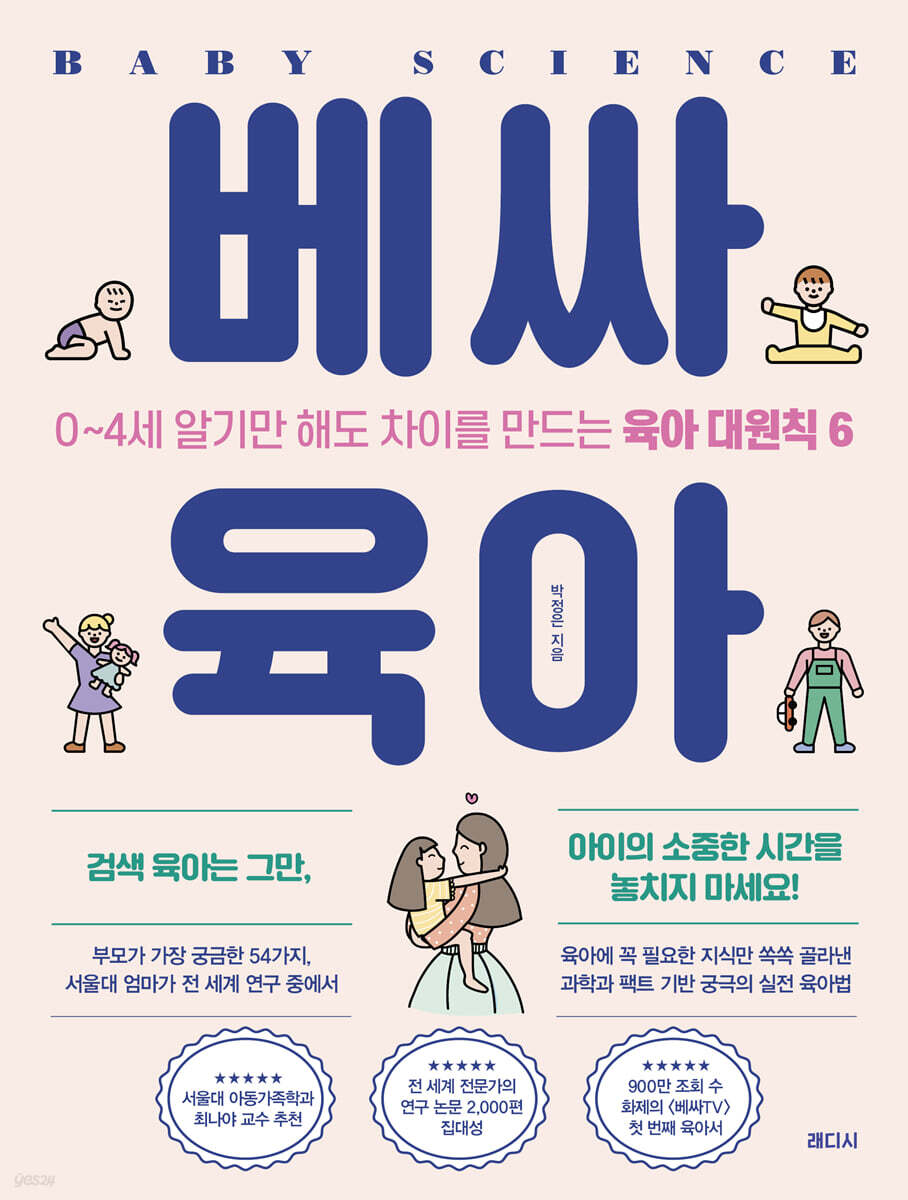
★★★★★ The first parenting book from the popular YouTube show 'Bessa TV' with 9 million views
★★★★★ Highly recommended by Professor Na-ya Choi of the Department of Child and Family Studies at Seoul National University
★★★★★A compilation of 2,000 research papers from experts around the world.
★★★★★ 54 Questions and Answers Most Frequently Asked by Parents of Children Ages 0-4
Park Jeong-eun, author of 'Bessa TV', which has established itself as a new parenting mentor with the enthusiastic support of 150,000 parents, has published 'Bessa Parenting', a 'parenting guidebook that parents of children aged 0-4 must know' after a long period of preparation.
He is famous for introducing only the most advanced, science-based parenting knowledge that has been thoroughly verified by experts.
To answer the questions of parents who are lost in the flood of parenting information, we conducted an in-depth study of papers by experts from around the world.
We also share the advice we've received from professors and major institutions both domestically and internationally, and host webinars with international experts on babies' bilingual development, creating unparalleled parenting content.
The author's study of parenting is not intended to acquire extraordinary knowledge that would burden parents.
He meticulously reviewed over 2,000 international papers and over 100 domestic and foreign books to create parenting content that would be helpful to parents and to write this book.
What I realized along the way was that there are at least some basic principles that can change a child's future and the quality of life of parents in the long run.
Once you learn how to support your child's autonomy and provide them with experiences of success, the importance of parental responses and interactions, and how to create a good parenting environment and structure for their lives, a new world of parenting opens up.
In the hope that more parents will be able to focus more on their child's precious moments without being swayed by their surroundings during the first four years of life, which will never come again, all the research results have been compiled into one volume, "Bessa Parenting."
This book presents a conclusion to numerous practical parenting topics that have been asked countless times on the Internet but for which no clear answers have been found.
It contains all the knowledge about healthy feeding methods from breastfeeding to baby food, the Happy Meal Project to develop happy eating habits, step-by-step principles of sleep parenting to raise a child who sleeps well, toy play that helps brain development and book parenting for language development, healthy discipline that supports a child's autonomy, and scientific fact-checking knowledge on issues that you will definitely search for at least once while raising a child.
The author's signature line, known to all fans, is "Today, let's start with the conclusion!"
As always, the answers are clear and the evidence is solid.
Above all, the author's most curious reality of parenting was covered in the 'Bessa and Dami Story' corner.
Just knowing how knowledge goes beyond theory and applies in practice will help you grow into a confident parent.
Bessa's 6 Parenting Principles for Parents and Children
Seoul National University mothers are among the most important research centers in the world for childcare.
The ultimate practical parenting method, based on science and facts, with only the most relevant knowledge.
★★★★★ The first parenting book from the popular YouTube show 'Bessa TV' with 9 million views
★★★★★ Highly recommended by Professor Na-ya Choi of the Department of Child and Family Studies at Seoul National University
★★★★★A compilation of 2,000 research papers from experts around the world.
★★★★★ 54 Questions and Answers Most Frequently Asked by Parents of Children Ages 0-4
Park Jeong-eun, author of 'Bessa TV', which has established itself as a new parenting mentor with the enthusiastic support of 150,000 parents, has published 'Bessa Parenting', a 'parenting guidebook that parents of children aged 0-4 must know' after a long period of preparation.
He is famous for introducing only the most advanced, science-based parenting knowledge that has been thoroughly verified by experts.
To answer the questions of parents who are lost in the flood of parenting information, we conducted an in-depth study of papers by experts from around the world.
We also share the advice we've received from professors and major institutions both domestically and internationally, and host webinars with international experts on babies' bilingual development, creating unparalleled parenting content.
The author's study of parenting is not intended to acquire extraordinary knowledge that would burden parents.
He meticulously reviewed over 2,000 international papers and over 100 domestic and foreign books to create parenting content that would be helpful to parents and to write this book.
What I realized along the way was that there are at least some basic principles that can change a child's future and the quality of life of parents in the long run.
Once you learn how to support your child's autonomy and provide them with experiences of success, the importance of parental responses and interactions, and how to create a good parenting environment and structure for their lives, a new world of parenting opens up.
In the hope that more parents will be able to focus more on their child's precious moments without being swayed by their surroundings during the first four years of life, which will never come again, all the research results have been compiled into one volume, "Bessa Parenting."
This book presents a conclusion to numerous practical parenting topics that have been asked countless times on the Internet but for which no clear answers have been found.
It contains all the knowledge about healthy feeding methods from breastfeeding to baby food, the Happy Meal Project to develop happy eating habits, step-by-step principles of sleep parenting to raise a child who sleeps well, toy play that helps brain development and book parenting for language development, healthy discipline that supports a child's autonomy, and scientific fact-checking knowledge on issues that you will definitely search for at least once while raising a child.
The author's signature line, known to all fans, is "Today, let's start with the conclusion!"
As always, the answers are clear and the evidence is solid.
Above all, the author's most curious reality of parenting was covered in the 'Bessa and Dami Story' corner.
Just knowing how knowledge goes beyond theory and applies in practice will help you grow into a confident parent.
- You can preview some of the book's contents.
Preview
index
prolog
Part 1.
Happiness through the Right Parenting Direction: The Fundamentals of Parenting That Make a Difference Between Ages 0 and 4
-Plus Parenting Principle 1: The Importance of a Childcare Environment Before Age 3
-Plus Parenting Principle 2: Responsiveness, Interaction, and Attachment
Plus Parenting Principle 3: Supporting Infant Autonomy
-Plus Parenting Principle 4: Supporting Autonomy in Early Childhood
Plus Parenting Principle 5: Creating Structure
Plus Parenting Principle 6: Creating a Language-Rich Environment
[Bessa Recommended Content for Smart Parenting]
Part 2.
Confident with Grounded Knowledge: Practical Guide to Parenting with Veterans
Chapter 1.
Early breastfeeding knowledge to raise a healthy baby
-Why are babies who don't have a feeding gap happy?
[Bessa & Dami Story]
-Is the amount of breast milk sufficient?
-Is it necessary to burp the baby after feeding?
[Bessa & Dami Story]
-How should I choose between breast milk and formula milk?
-Should I choose between whole milk and hind milk?
[Bessa & Dami Story]
-Breastfeeding mothers, what should I eat?
[Bessa & Dami Story]
-What nutritional supplements should I take while breastfeeding?
[Bessa & Dami Story]
-How do I choose good formula milk?
Formula feeding is both easy and difficult. How can you do it well?
Chapter 2.
Baby Food & Toddler Food Roadmap for Raising Well-Eating Babies
-When should I start giving solid food?
[Bessa & Dami Story]
-Do breastfed babies need iron supplements?
-Is it okay to rely heavily on rice in baby food?
[Bessa & Dami Story]
-Does the beef I feed my baby have to be Korean beef?
-Can I eat eggs before I turn one?
[Bessa & Dami Story]
-Is it bad to eat eggs every day?
-Are baby supplements really necessary?
[Bessa & Dami Story]
-How do I plan a baby food menu?
[Bessa & Dami Story]
-Useful baby food & toddler food tips to know
-Between milk and Kindermilk
-Happy Meal Project 1: Babies who don't eat well after turning 1 year old
[Bessa & Dami Story]
Happy Meal Project 2: Three Principles for a Happy Meal
[Bessa & Dami Story]
Chapter 3.
Proper Sleep Parenting for a Well-Sleeping Baby
-Why do 'back sensors' exist?
[Bessa & Dami Story]
-When should we start sleep training?
[Bessa & Dami Story]
-What are the ten principles for creating a good sleeping environment for babies?
[Bessa & Dami Story]
-Can I put my baby to sleep on a bouncer, cushion, or pacifier?
Is separate sleeping good or bad for babies?
[Bessa & Dami Story]
-What should I do when I have trouble sleeping?
[Bessa & Dami Story]
-What do I need to know before sleep training?
[Bessa & Dami Story]
-Do babies need to become sleep independent to sleep well?
[Bessa & Dami Story]
Chapter 4.
A Play & Book Parenting Guide for Smart Baby Development
-How should I choose toys for babies aged 0-2?
-How to guide play with a baby after 2 years of age?
-Are there any toys that I should particularly avoid?
-Why is play important?
-How to choose a baby picture book?
[Bessa & Dami Story]
-How should I read the book?
[Bessa & Dami Story]
-Watching videos is unavoidable, so how can you do it wisely?
-What video should I show?
[Bessa PICK Video]
Chapter 5.
The Keys to Development and Discipline for Happy Parenting
-What if your baby seems to be late in speaking?
[Bessa & Dami Story]
-What if the baby hits or pinches someone else?
[Bessa & Dami Story]
-If my baby seems to have difficulty concentrating, could it be ADHD?
-How should I communicate with a child with ADHD tendencies?
-What are some strategies to persuade a baby who refuses?
[Bessa & Dami Story]
-How should I approach my baby's tantrum?
-What are the characteristics of babies who often throw tantrums?
-Is there a way to prevent tantrums in advance?
[Bessa & Dami Story]
-What should I do if a tantrum occurs?
-What if the baby doesn't want to do it on his own?
[Bessa & Dami Story]
-What if you are worried about how your baby plays?
[Bessa & Dami Story]
Chapter 6.
Vessa's fact-checking to filter out uncertain information
-If I have yellow nasal discharge, should I take antibiotics?
[Bessa & Dami Story]
-Will watching videos when you're young damage your brain?
[Bessa & Dami Story]
-Are there any foods that increase the risk of precocious puberty?
-What kind of humidifier should I choose for my baby?
[Bessa & Dami Story]
-Should we never discipline children before the age of 3?
[Bessa & Dami Story]
-What parental mistakes can lead to attachment problems?
-Should we listen to conversations between adults to help with language development?
[Bessa & Dami Story]
-No pets in a house with a baby?
[Bessa & Dami Story]
-Is home care always the answer for children up to the age of 3?
[Bessa & Dami Story]
Epilogue
References
Part 1.
Happiness through the Right Parenting Direction: The Fundamentals of Parenting That Make a Difference Between Ages 0 and 4
-Plus Parenting Principle 1: The Importance of a Childcare Environment Before Age 3
-Plus Parenting Principle 2: Responsiveness, Interaction, and Attachment
Plus Parenting Principle 3: Supporting Infant Autonomy
-Plus Parenting Principle 4: Supporting Autonomy in Early Childhood
Plus Parenting Principle 5: Creating Structure
Plus Parenting Principle 6: Creating a Language-Rich Environment
[Bessa Recommended Content for Smart Parenting]
Part 2.
Confident with Grounded Knowledge: Practical Guide to Parenting with Veterans
Chapter 1.
Early breastfeeding knowledge to raise a healthy baby
-Why are babies who don't have a feeding gap happy?
[Bessa & Dami Story]
-Is the amount of breast milk sufficient?
-Is it necessary to burp the baby after feeding?
[Bessa & Dami Story]
-How should I choose between breast milk and formula milk?
-Should I choose between whole milk and hind milk?
[Bessa & Dami Story]
-Breastfeeding mothers, what should I eat?
[Bessa & Dami Story]
-What nutritional supplements should I take while breastfeeding?
[Bessa & Dami Story]
-How do I choose good formula milk?
Formula feeding is both easy and difficult. How can you do it well?
Chapter 2.
Baby Food & Toddler Food Roadmap for Raising Well-Eating Babies
-When should I start giving solid food?
[Bessa & Dami Story]
-Do breastfed babies need iron supplements?
-Is it okay to rely heavily on rice in baby food?
[Bessa & Dami Story]
-Does the beef I feed my baby have to be Korean beef?
-Can I eat eggs before I turn one?
[Bessa & Dami Story]
-Is it bad to eat eggs every day?
-Are baby supplements really necessary?
[Bessa & Dami Story]
-How do I plan a baby food menu?
[Bessa & Dami Story]
-Useful baby food & toddler food tips to know
-Between milk and Kindermilk
-Happy Meal Project 1: Babies who don't eat well after turning 1 year old
[Bessa & Dami Story]
Happy Meal Project 2: Three Principles for a Happy Meal
[Bessa & Dami Story]
Chapter 3.
Proper Sleep Parenting for a Well-Sleeping Baby
-Why do 'back sensors' exist?
[Bessa & Dami Story]
-When should we start sleep training?
[Bessa & Dami Story]
-What are the ten principles for creating a good sleeping environment for babies?
[Bessa & Dami Story]
-Can I put my baby to sleep on a bouncer, cushion, or pacifier?
Is separate sleeping good or bad for babies?
[Bessa & Dami Story]
-What should I do when I have trouble sleeping?
[Bessa & Dami Story]
-What do I need to know before sleep training?
[Bessa & Dami Story]
-Do babies need to become sleep independent to sleep well?
[Bessa & Dami Story]
Chapter 4.
A Play & Book Parenting Guide for Smart Baby Development
-How should I choose toys for babies aged 0-2?
-How to guide play with a baby after 2 years of age?
-Are there any toys that I should particularly avoid?
-Why is play important?
-How to choose a baby picture book?
[Bessa & Dami Story]
-How should I read the book?
[Bessa & Dami Story]
-Watching videos is unavoidable, so how can you do it wisely?
-What video should I show?
[Bessa PICK Video]
Chapter 5.
The Keys to Development and Discipline for Happy Parenting
-What if your baby seems to be late in speaking?
[Bessa & Dami Story]
-What if the baby hits or pinches someone else?
[Bessa & Dami Story]
-If my baby seems to have difficulty concentrating, could it be ADHD?
-How should I communicate with a child with ADHD tendencies?
-What are some strategies to persuade a baby who refuses?
[Bessa & Dami Story]
-How should I approach my baby's tantrum?
-What are the characteristics of babies who often throw tantrums?
-Is there a way to prevent tantrums in advance?
[Bessa & Dami Story]
-What should I do if a tantrum occurs?
-What if the baby doesn't want to do it on his own?
[Bessa & Dami Story]
-What if you are worried about how your baby plays?
[Bessa & Dami Story]
Chapter 6.
Vessa's fact-checking to filter out uncertain information
-If I have yellow nasal discharge, should I take antibiotics?
[Bessa & Dami Story]
-Will watching videos when you're young damage your brain?
[Bessa & Dami Story]
-Are there any foods that increase the risk of precocious puberty?
-What kind of humidifier should I choose for my baby?
[Bessa & Dami Story]
-Should we never discipline children before the age of 3?
[Bessa & Dami Story]
-What parental mistakes can lead to attachment problems?
-Should we listen to conversations between adults to help with language development?
[Bessa & Dami Story]
-No pets in a house with a baby?
[Bessa & Dami Story]
-Is home care always the answer for children up to the age of 3?
[Bessa & Dami Story]
Epilogue
References
Detailed image

Into the book
It's okay if you can't do much for your baby.
By focusing solely on responses and interactions, your baby's life is much more likely to be enriched.
The secure attachment and relationship that comes from positive parental responses and interactions is one of the best basic human abilities.
Babies who acquire these important skills early will enter society with the best weapons available.
Whatever you do, you will do well.
Have you ever heard the saying, "There's something different between a loved baby and an unloved baby?" I'd like to be a little more specific.
There is a clear difference between babies who respond and babies who don't.
---p.31 From “Plus Parenting Principle 2: Response and Interaction”
As babies grow, it's normal for their sleep patterns to change, including fewer naps, and for the amount of sleep they need to gradually decrease.
As the seasons change and the days get longer and shorter, the time we feel sleepy may change slightly.
If you observe your baby closely and think, "Hey, my baby doesn't seem very sleepy even though it's the same time as usual," you need to adjust your expectations about your baby's sleep time little by little, saying, "Is it time for them to go to bed a little later?"
However, in some cases, parents may not realize that their baby's sleep patterns may change or may force their baby to follow a sleep schedule that they have set arbitrarily.
“It’s normal to need to sleep for more than twelve hours,” they say, and they firmly believe that their baby needs to sleep that much even if he or she isn’t sleepy.
The amount of sleep each baby needs varies slightly depending on the situation, and there is no set 'time to sleep'.
Sticking to a bedtime schedule you see online is like parents not being 'responsive' enough when it comes to their baby's sleep.
---p.233 From “What to do when sleep refusal occurs?”
Trying to progress through the steps too quickly can be counterproductive.
If a parent suddenly leaves the room the next day after the baby has managed to sleep alone in bed, the baby may demand to be held back in his or her arms and put to sleep so that the parent cannot leave.
It is best to move on to the next step when you feel your baby is sufficiently adjusted.
If your baby won't stop crying no matter how gradually you try to help them, and you feel like it's never going to work, I think your baby isn't ready to overcome their anxiety and fall asleep on their own.
In this case, I'd try a few more days to be sure, but if it's the same, I think I'll wait a bit for sleep independence.
Also, if your baby is taking too long to get to sleep or is refusing to sleep at all, addressing that issue may be a priority.
---p.248 From “Should babies become sleep independent to sleep well?”
Through imaginative play, babies can practice regulating their emotions.
Babies develop the ability to regulate their emotions between the ages of one and two.
A baby's ability to regulate their emotions is very important from various perspectives, such as social skills and learning ability.
One environment in which babies can develop their emotional regulation skills is an imaginative play environment.
When babies engage in imaginative play, they create a kind of new set of rules for themselves.
When I declare, “I am a teacher!” I have to suppress the urge to act like my usual self and think about how a teacher would act and act accordingly.
In this process, impulse control is naturally trained.
Professor Greta Fein, a child psychologist, said this in her paper on imaginative play:
“Children who engage in imaginative play move through various scenarios and practice appropriately managing the emotions they might feel in each situation.”
---p.267 From “How to guide play for babies after 2 years of age?”
There is a reason why children try to repeat something.
Because I believe that the most learning comes from repeating that behavior.
Children know very well what actions help them learn the most.
The same goes for reading books.
Sometimes children ask me to read certain books over and over again, to the point where they get bored.
This phenomenon is not something to be concerned about at all; rather, parents should create an environment where their children can read several books repeatedly.
For example, rather than cramming a bookshelf with a large number of books, I recommend arranging a small number of books that interest your child.
It is better not to keep recommending new books or to intentionally hide books that you have read a lot in the hopes that they will read other books as well.
---p.293 From “How should we read books?”
It is often thought that babies need to hear a lot of 'speech sounds' to develop their language skills.
The mistaken belief that showing videos will help language development is also a conclusion that comes from this way of thinking.
But the essence of language is communication.
It would be good to think of it as consistently watering the sprout in babies' hearts of the desire to communicate with their mom and dad from a young age.
It's through reaction (no matter what you study, about half of it will eventually revert to reaction parenting.)
---p.318 From “What if your baby seems to be late in speaking?”
Rather than just giving negative feedback like, “You shouldn’t do that” when your baby attacks someone, you can discipline them much more effectively by capturing moments when they are able to control their behavior even when they are angry, or when they are behaving appropriately in situations that bring up negative emotions, and providing positive feedback.
This is an important point in overall discipline.
Discipline isn't just a simple matter of "eliminating your child's negative behavior."
If a positive relationship is not established between the disciplining parent and the baby, the baby will be less motivated to accept the parent's disciplinary messages.
Empathizing with your baby's emotions and giving positive feedback when your baby does something well will help build a positive parent-baby relationship, helping to maintain the bond with your baby.
If you give positive feedback repeatedly, your baby will grow up to be cooperative and follow along with you just once or twice, making parenting much easier.
---p.326 From “What happens when a baby hits or pinches someone else?”
There is nothing wrong or strange about a baby saying "no."
It's just a very common, natural, and even desirable phenomenon in development.
To acknowledge this fact, you tell yourself, “It could be so.”
Our baby is assertive.
You have a healthy desire to do what you want, and you can express that desire in words.
You're growing up well.
By changing your mode like this, you will be prepared to calmly find the strategy that best suits the situation without reacting emotionally to your baby.
---p.338 From "What is the strategy for persuading a baby who refuses?"
A strategy that focuses on the positive aspects of the behavior you dislike: “After I shower, I can wear this cute bathrobe, which Dami has been waiting to wear all day.”
You can also use special items that you can only wear after showering to keep yourself motivated.
Saying, “The bathrobe asked me to put it on,” might stimulate your baby’s prosocial motivation, killing two birds with one stone.
It's more effective if you approach it as a game, pretending to cry in a shower gown.
In a positive and fun atmosphere, babies are more willing to cooperate.
Praise strategy: “(After showering) Dami didn’t want to shower today, but Mom asked her to help, so she came in and showered with us. It was really cool how she bravely endured it even though she didn’t want to.”
Although it may not be immediately applicable to a refusal situation, it is a strategy that can increase motivation to cooperate in similar situations in the future.
Regardless of how smooth the process was, if you overcame your resistance and accomplished something, be sure to praise yourself.
This is a rare opportunity to show you how wonderful it is to know how to persevere and overcome your fears.
By focusing solely on responses and interactions, your baby's life is much more likely to be enriched.
The secure attachment and relationship that comes from positive parental responses and interactions is one of the best basic human abilities.
Babies who acquire these important skills early will enter society with the best weapons available.
Whatever you do, you will do well.
Have you ever heard the saying, "There's something different between a loved baby and an unloved baby?" I'd like to be a little more specific.
There is a clear difference between babies who respond and babies who don't.
---p.31 From “Plus Parenting Principle 2: Response and Interaction”
As babies grow, it's normal for their sleep patterns to change, including fewer naps, and for the amount of sleep they need to gradually decrease.
As the seasons change and the days get longer and shorter, the time we feel sleepy may change slightly.
If you observe your baby closely and think, "Hey, my baby doesn't seem very sleepy even though it's the same time as usual," you need to adjust your expectations about your baby's sleep time little by little, saying, "Is it time for them to go to bed a little later?"
However, in some cases, parents may not realize that their baby's sleep patterns may change or may force their baby to follow a sleep schedule that they have set arbitrarily.
“It’s normal to need to sleep for more than twelve hours,” they say, and they firmly believe that their baby needs to sleep that much even if he or she isn’t sleepy.
The amount of sleep each baby needs varies slightly depending on the situation, and there is no set 'time to sleep'.
Sticking to a bedtime schedule you see online is like parents not being 'responsive' enough when it comes to their baby's sleep.
---p.233 From “What to do when sleep refusal occurs?”
Trying to progress through the steps too quickly can be counterproductive.
If a parent suddenly leaves the room the next day after the baby has managed to sleep alone in bed, the baby may demand to be held back in his or her arms and put to sleep so that the parent cannot leave.
It is best to move on to the next step when you feel your baby is sufficiently adjusted.
If your baby won't stop crying no matter how gradually you try to help them, and you feel like it's never going to work, I think your baby isn't ready to overcome their anxiety and fall asleep on their own.
In this case, I'd try a few more days to be sure, but if it's the same, I think I'll wait a bit for sleep independence.
Also, if your baby is taking too long to get to sleep or is refusing to sleep at all, addressing that issue may be a priority.
---p.248 From “Should babies become sleep independent to sleep well?”
Through imaginative play, babies can practice regulating their emotions.
Babies develop the ability to regulate their emotions between the ages of one and two.
A baby's ability to regulate their emotions is very important from various perspectives, such as social skills and learning ability.
One environment in which babies can develop their emotional regulation skills is an imaginative play environment.
When babies engage in imaginative play, they create a kind of new set of rules for themselves.
When I declare, “I am a teacher!” I have to suppress the urge to act like my usual self and think about how a teacher would act and act accordingly.
In this process, impulse control is naturally trained.
Professor Greta Fein, a child psychologist, said this in her paper on imaginative play:
“Children who engage in imaginative play move through various scenarios and practice appropriately managing the emotions they might feel in each situation.”
---p.267 From “How to guide play for babies after 2 years of age?”
There is a reason why children try to repeat something.
Because I believe that the most learning comes from repeating that behavior.
Children know very well what actions help them learn the most.
The same goes for reading books.
Sometimes children ask me to read certain books over and over again, to the point where they get bored.
This phenomenon is not something to be concerned about at all; rather, parents should create an environment where their children can read several books repeatedly.
For example, rather than cramming a bookshelf with a large number of books, I recommend arranging a small number of books that interest your child.
It is better not to keep recommending new books or to intentionally hide books that you have read a lot in the hopes that they will read other books as well.
---p.293 From “How should we read books?”
It is often thought that babies need to hear a lot of 'speech sounds' to develop their language skills.
The mistaken belief that showing videos will help language development is also a conclusion that comes from this way of thinking.
But the essence of language is communication.
It would be good to think of it as consistently watering the sprout in babies' hearts of the desire to communicate with their mom and dad from a young age.
It's through reaction (no matter what you study, about half of it will eventually revert to reaction parenting.)
---p.318 From “What if your baby seems to be late in speaking?”
Rather than just giving negative feedback like, “You shouldn’t do that” when your baby attacks someone, you can discipline them much more effectively by capturing moments when they are able to control their behavior even when they are angry, or when they are behaving appropriately in situations that bring up negative emotions, and providing positive feedback.
This is an important point in overall discipline.
Discipline isn't just a simple matter of "eliminating your child's negative behavior."
If a positive relationship is not established between the disciplining parent and the baby, the baby will be less motivated to accept the parent's disciplinary messages.
Empathizing with your baby's emotions and giving positive feedback when your baby does something well will help build a positive parent-baby relationship, helping to maintain the bond with your baby.
If you give positive feedback repeatedly, your baby will grow up to be cooperative and follow along with you just once or twice, making parenting much easier.
---p.326 From “What happens when a baby hits or pinches someone else?”
There is nothing wrong or strange about a baby saying "no."
It's just a very common, natural, and even desirable phenomenon in development.
To acknowledge this fact, you tell yourself, “It could be so.”
Our baby is assertive.
You have a healthy desire to do what you want, and you can express that desire in words.
You're growing up well.
By changing your mode like this, you will be prepared to calmly find the strategy that best suits the situation without reacting emotionally to your baby.
---p.338 From "What is the strategy for persuading a baby who refuses?"
A strategy that focuses on the positive aspects of the behavior you dislike: “After I shower, I can wear this cute bathrobe, which Dami has been waiting to wear all day.”
You can also use special items that you can only wear after showering to keep yourself motivated.
Saying, “The bathrobe asked me to put it on,” might stimulate your baby’s prosocial motivation, killing two birds with one stone.
It's more effective if you approach it as a game, pretending to cry in a shower gown.
In a positive and fun atmosphere, babies are more willing to cooperate.
Praise strategy: “(After showering) Dami didn’t want to shower today, but Mom asked her to help, so she came in and showered with us. It was really cool how she bravely endured it even though she didn’t want to.”
Although it may not be immediately applicable to a refusal situation, it is a strategy that can increase motivation to cooperate in similar situations in the future.
Regardless of how smooth the process was, if you overcame your resistance and accomplished something, be sure to praise yourself.
This is a rare opportunity to show you how wonderful it is to know how to persevere and overcome your fears.
---p.344 From "What is the strategy for persuading a baby who refuses?"
Publisher's Review
Bessa TV, a smart parenting mentor for 150,000 parents
A must-read for new parents, organized by science and facts.
In order to raise children confidently and without feeling anxious amidst the flood of information, you must properly establish the 'direction of parenting.'
Because it becomes a standard that gives you the confidence that 'this is what good parenting is' in every moment you encounter while raising a child.
If you set the right direction for your child's upbringing from the beginning, you will be able to acknowledge yourself from time to time without comparing yourself to others.
“I interacted well with my child today.” “My child’s brain development must have been good today.” “I deserve to get some rest.” You can also develop positive thoughts that help you take care of yourself.
『Bessa Parenting』is about how parents can make a difference in the quality of their child-rearing just by knowing about it.
You will be able to make your own decisions based on the situation without being discouraged by other opinions or wasting time searching the Internet.
Additionally, even if your child occasionally shows unexpected behavior or behaves in a way that is difficult to understand, you can deal with it calmly and without anxiety based on accurate knowledge.
The ultimate goal of this book is to help parents take a step back and comprehensively examine their child's growth rather than focusing on the ups and downs of everyday life, and to help them feel proud and happy raising their children.
*What is Bessa Parenting?
'Bessa' is an abbreviation for 'Baby Science'.
This means that we help countless parents raise their children happily by introducing only verified parenting information based on scientific knowledge.
The parenting style that Bessa Parenting emphasizes is not subtraction, but addition.
Giving your child the best gift of his or her life in the first four years of his or her life, years that will never come again.
So, in the long run, the goal is healthy 'parenting independence' where children grow up to be good at what they do on their own, and parents can focus on their own growth.
I believe that this time can be a time of growth rather than sacrifice, so I go against the current trend of 'don't study parenting' and advocate the principle of plus parenting.
“It’s okay if you can’t do much for your child.
Please focus on what's important.
A child who receives good things early starts life with the most powerful weapons.
“Whatever you do, you will do well.”
Parenting principles that foster autonomy based on parental responses
From the principles of breastfeeding, eating, sleeping, reading, and playing
From tantrums and rejection coping techniques to the essentials of development and discipline, all in one book!
This book first introduces the '6 Plus Principles of Parenting' in Part 1.
It presents a clear guide to the importance of the child-rearing environment in the first three years of life, the principle of responsive parenting, which is the most important keyword in child-rearing, autonomy support that creates experiences of success in infancy and toddlerhood, principles for early language development, and establishing a healthy structure for life based on relationships with children.
Parenting should not be the focus of parenting.
There are many ways to create structure in your baby's life, including discipline, positive reinforcement like praise, and modeling.
Also, if you focus on developing a fundamentally cooperative relationship with your baby, you will find that discipline is not so difficult.
I wrote this book with the hope that all readers would choose that easy path.
Knowing how to satisfy your child's needs and build trust instead of saying "no" is the foundation of discipline.
If you clearly understand these important parental attitudes early in life, you will have the surprising experience of making parenting easier in the long run.
Part 2, "Practical Parenting," introduces everything from early breastfeeding knowledge to a roadmap for healthy weaning and infant food, types of baby play for each stage of growth and brain development play, and effective ways to read books, all in an easy-to-understand manner, using systematic evidence.
It also provides a fresh perspective on the fundamental principles of discipline and how to deal with tantrums and rejection, the biggest issues for children around the age of two, through research by experts from around the world and the author's own real-life examples.
To this end, we have re-divided the core knowledge introduced through YouTube's 'Bessa TV' into 54 life topics, and supplemented it with evidence and solutions to clearly answer common questions from many parents.
More detailed information is linked via QR code, and all books and content that the author has personally benefited from are also introduced.
The references provide irrefutable evidence, enhancing the book's credibility.
Unlike parenting books that only contain the pediatric health knowledge necessary for early childhood or that only deal with baby development and discipline, this book, which compiles all the parenting knowledge that any parent would be curious about, is sincerely hoped to completely change the parenting lives of parents in Korea.
A must-read for new parents, organized by science and facts.
In order to raise children confidently and without feeling anxious amidst the flood of information, you must properly establish the 'direction of parenting.'
Because it becomes a standard that gives you the confidence that 'this is what good parenting is' in every moment you encounter while raising a child.
If you set the right direction for your child's upbringing from the beginning, you will be able to acknowledge yourself from time to time without comparing yourself to others.
“I interacted well with my child today.” “My child’s brain development must have been good today.” “I deserve to get some rest.” You can also develop positive thoughts that help you take care of yourself.
『Bessa Parenting』is about how parents can make a difference in the quality of their child-rearing just by knowing about it.
You will be able to make your own decisions based on the situation without being discouraged by other opinions or wasting time searching the Internet.
Additionally, even if your child occasionally shows unexpected behavior or behaves in a way that is difficult to understand, you can deal with it calmly and without anxiety based on accurate knowledge.
The ultimate goal of this book is to help parents take a step back and comprehensively examine their child's growth rather than focusing on the ups and downs of everyday life, and to help them feel proud and happy raising their children.
*What is Bessa Parenting?
'Bessa' is an abbreviation for 'Baby Science'.
This means that we help countless parents raise their children happily by introducing only verified parenting information based on scientific knowledge.
The parenting style that Bessa Parenting emphasizes is not subtraction, but addition.
Giving your child the best gift of his or her life in the first four years of his or her life, years that will never come again.
So, in the long run, the goal is healthy 'parenting independence' where children grow up to be good at what they do on their own, and parents can focus on their own growth.
I believe that this time can be a time of growth rather than sacrifice, so I go against the current trend of 'don't study parenting' and advocate the principle of plus parenting.
“It’s okay if you can’t do much for your child.
Please focus on what's important.
A child who receives good things early starts life with the most powerful weapons.
“Whatever you do, you will do well.”
Parenting principles that foster autonomy based on parental responses
From the principles of breastfeeding, eating, sleeping, reading, and playing
From tantrums and rejection coping techniques to the essentials of development and discipline, all in one book!
This book first introduces the '6 Plus Principles of Parenting' in Part 1.
It presents a clear guide to the importance of the child-rearing environment in the first three years of life, the principle of responsive parenting, which is the most important keyword in child-rearing, autonomy support that creates experiences of success in infancy and toddlerhood, principles for early language development, and establishing a healthy structure for life based on relationships with children.
Parenting should not be the focus of parenting.
There are many ways to create structure in your baby's life, including discipline, positive reinforcement like praise, and modeling.
Also, if you focus on developing a fundamentally cooperative relationship with your baby, you will find that discipline is not so difficult.
I wrote this book with the hope that all readers would choose that easy path.
Knowing how to satisfy your child's needs and build trust instead of saying "no" is the foundation of discipline.
If you clearly understand these important parental attitudes early in life, you will have the surprising experience of making parenting easier in the long run.
Part 2, "Practical Parenting," introduces everything from early breastfeeding knowledge to a roadmap for healthy weaning and infant food, types of baby play for each stage of growth and brain development play, and effective ways to read books, all in an easy-to-understand manner, using systematic evidence.
It also provides a fresh perspective on the fundamental principles of discipline and how to deal with tantrums and rejection, the biggest issues for children around the age of two, through research by experts from around the world and the author's own real-life examples.
To this end, we have re-divided the core knowledge introduced through YouTube's 'Bessa TV' into 54 life topics, and supplemented it with evidence and solutions to clearly answer common questions from many parents.
More detailed information is linked via QR code, and all books and content that the author has personally benefited from are also introduced.
The references provide irrefutable evidence, enhancing the book's credibility.
Unlike parenting books that only contain the pediatric health knowledge necessary for early childhood or that only deal with baby development and discipline, this book, which compiles all the parenting knowledge that any parent would be curious about, is sincerely hoped to completely change the parenting lives of parents in Korea.
GOODS SPECIFICS
- Date of issue: January 18, 2023
- Page count, weight, size: 480 pages | 928g | 170*225*30mm
- ISBN13: 9791198129109
- ISBN10: 1198129107
You may also like
카테고리
korean


korean

![ELLE 엘르 스페셜 에디션 A형 : 12월 [2025]](http://librairie.coreenne.fr/cdn/shop/files/b8e27a3de6c9538896439686c6b0e8fb.jpg?v=1766436872&width=3840)


