

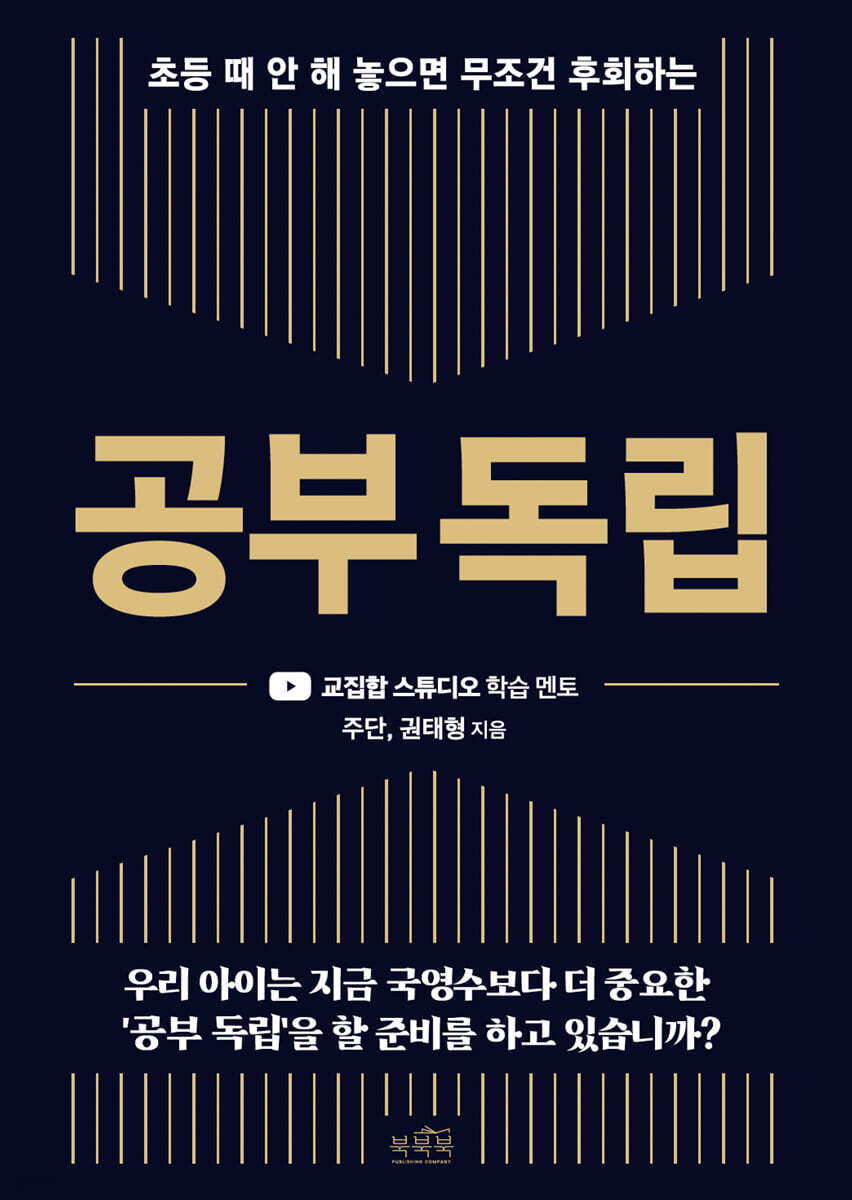
Study independence
 |
Description
Book Introduction
“Our child is more important than Korean, English, and math right now. Are you ready to become ‘study independent’? The second collaborative book by two education experts, Mr. Joo Dan-sam and Mr. Kwon Tae-hyung, who have been guiding children's learning in the field for a long time and currently run the practical education channel [Gyojiphap Studio] that is popular with 70,000 parents, has been published. From the perspective of teaching English and Math, the two most important subjects for children's learning, the two of them have guided children not only by imparting knowledge, but also by teaching them the reasons for studying, the mindset for studying, and practical methods to improve concentration and memory. This book introduces in detail the path to true "study independence" where children take responsibility for their own studies through five core competencies that must be acquired in elementary school, including practical literacy teaching methods that can be seen in the author's previous work, "Elementary Korean, English, Math Literacy", and self-directed learning that enables a shortcut to true study. From 'parents who are at a loss as to how long they should take care of their children's studies', 'parents with children who lack the habit and motivation to study on their own', to 'parents aiming for top grades in middle and high school,' I confidently recommend this book as a must-read for parents of elementary school children to guide their children. |
- You can preview some of the book's contents.
Preview
index
Introduction:
You can never succeed in your studies without 'study independence'.
Part 1.
Studying independently, what on earth is it that makes it the number one thing to do in elementary school?
01.
Is my child really the type to study?
- The first step in education for my child: objectification.
- If you have the 'basics', there will always be an opportunity.
02.
Reasons why children do not study well or are not good at studying
- Why balanced study is difficult
- After middle school, subject egoism becomes more severe.
03.
Children who have not been able to study independently, children who have done well, and children who are studying independently
- Correlation between independent study and grades
- Study methods for children who have succeeded in becoming independent in their studies
- A child's determination to begin independent study
04.
The Real Reason You Need to Study Independently
- Why independent study is the foundation of all 'independence'
05.
How can I start studying independently?
- Misconceptions to avoid before starting independent study
- Things you need to be independent in your studies: study mindset / concentration / memory / literacy / self-directedness
Part 2.
Five Study Independence Skills That Turn Ordinary Children into Geniuses
Chapter 1.
study mindset
01.
Why do I feel like studying?
- Children's honest thoughts about studying
02.
Children who experience failure too early
- Resilience to overcome failure
The Impact of a Perfectionist Mother on Her Child
03.
Anxious parents create anxious children.
- This is the very time when even ordinary mothers become anxious.
04.
A critical moment when children lose their desire to study
- If you bought it as a doll from your parents
- When parents' expectations are too high
- When parents nag excessively
- If you feel helpless in everything
05.
If parents go ahead, their children will naturally fall behind.
06.
5 Principles for Motivating Yourself to Study
- Increasing stability
- Recognized Experience: The Law of Praise That Always Works
- A fun experience: All learning in the world is 'studying' / A child who finds a reason to like it
- Principle of Compensation: The Power of Visible, Realistic Compensation / Principles of Effective Compensation and Points to Note
- Finding Your Dream: The Most Powerful Motivator for Learning: Dreams / The Role of Parents in the 'Finding Your Dream' Process
07.
How to Build Your Child's Ability and Self-Esteem
- Creating valuable self-esteem in and of itself
- Build self-efficacy to do anything
- Identify your child's strengths and strengths
08.
Things Parents Should Never Do to Help Their Children Study
- Sometimes even realistic advice hurts a child.
- Parents who only look ahead spoil their children.
Chapter 2.
concentration
01.
Why concentration?
- Why focus on concentration: The power to study efficiently
Symptoms of lack of concentration that must be avoided
- Reasons for lack of concentration: Why can't I concentrate when studying? / Does my child have ADHD?
02.
Everyone has the ability to concentrate.
- Concentration training begins with acknowledging your limitations.
03.
Three Conditions for Maximizing Concentration
- 1.
Goals and tasks must be clear
- 2.
Motivation will be maintained step by step
- 3.
Thoroughly eliminate distractions
04.
Hyper-focused training from athletes
05.
To properly focus on your studies
Why you should never multitask while studying
- Priorities that are absolutely necessary for concentration and systematic study
06.
How to Make a Real Plan That Will Boost Your Focus
- Let go of the preconceived notions about "making a study plan."
- How to properly understand your child's learning ability
- How to use the TO DO LIST
07.
You can focus by increasing output rather than input.
- Creating output that helps with active concentration
08.
The most practical way to eliminate distractions
- You need an escape route to focus.
The power of napping that overturns common sense
- Find your own place that maximizes your concentration
- The power of a routine that increases concentration
Chapter 3.
memory
01.
Why memory?
- Memory is not innate.
- What kind of study memory is needed for our children?
- Subjects where you can get good grades just by having a good memory: Math is also a subject that actually requires memorization.
- Pre-study is just as important as review in memory training.
02.
How to improve working memory, a learning memory
- Simplifying a problem makes it much easier to remember.
How to Use Simple Notes to Remember: Principles of Note-taking to Maximize Your Memory
03.
Traditional, accessible memory training methods
- Association: The weirder it is, the better you remember it.
- Place memory method: Create your own place in your head.
- Five Senses Memory Method: Stimulating the five senses makes memory easier.
- Classification memory method: Group by your own criteria
04.
'Tests' that help improve memory
- As part of memory training, daily tests
05.
Break time is key, distributed learning method
06.
Does sleep improve memory?
- Effective memory training 5 minutes before going to bed
Chapter 4.
literacy
01.
Why literacy?
02.
Literacy that affects all subjects, not just Korean
03.
A 3-Step Reading Instruction Method to Improve Literacy
- STEP1.
Read-aloud Reading: The Effects of Read-aloud Reading / How to Choose Books to Read
- STEP2.
Interesting Reading: How to Choose the Books You Want to Read / How to Use the Library Smartly / Principles for Buying Books
- STEP3.
Reading is a Learning Process: How to Choose Learning Books
04.
Why Reading Textbooks is the Beginning of Literacy for Elementary School Students
- Literacy learning method using textbooks
05.
Literacy Practice with Parents in Everyday Life
- Literacy practice through advertising materials
- Literacy practice with newspapers
06.
The Power of Question Literacy That Significantly Influences Grades
- The sad reality of children lacking question literacy skills
- Question literacy required in English and math: How to develop English question literacy / How to develop math question literacy
07.
The Core of Literacy: Vocabulary Learning
- What is the minimum vocabulary level that my child should have?
- How to guess unfamiliar vocabulary
- Should I study Chinese characters separately to improve my vocabulary?
How to use a dictionary to double your vocabulary
08.
Perfecting Literacy: Two Secrets to Raising Writing-Reading Children
- The beginning of writing, writing notes
- Any child who writes a diary can become a writer: Diary material found in conversation / Diary writing based on emotions / Diary writing while reading books / Daily review, writing a diary for school subjects
Chapter 5.
self-direction
01.
Why self-direction?
- 5th grade, the last line of defense for starting self-directed learning
- Why self-directed learning is necessary from elementary school
02.
What top kids have in common
- Metacognition: Objectively evaluating oneself: A learning method that fosters metacognition
- 'WHY' Obsessed Patients: How to Keep Curiosity and Exploration Alive
- I'm the best in the world: The rival effect
- How to deal with subjects you dislike
- An autonomous but strict home environment: Self-regulation skills that lead to academic success
-Trust and respect for teachers and adults: Why you should focus on school lessons.
- Children who know how to study
03.
5 Steps to Effective Self-Directed Learning
-STEP 1.
Diagnosing: How to Diagnose Your Child's Ability / How to Understand Your Child's Learning Capacity / Understanding Subject Characteristics to Improve Learning Efficiency
-STEP 2.
Goal Setting: 4 Keys to Achievable Goals / What to Watch Out for When Setting Final and Long-Term Goals
-STEP 3.
Planning: The World's Most Effective Study Plan / How to Plan for Exams / The Essential Study Tool: Choosing a Workbook / Checking Your Study Environment
-STEP 4.
How to Run: Table of Contents Study Method / Note Organization Method / Reading Study Method
-STEP 5.
Feedback: How to Deal with Wrong Answers in English / How to Deal with Wrong Answers in Math / Test Feedback
04.
For self-directed learning to be successful
- Raise your child to be a self-sufficient child who can do everything on his own.
- Creating a virtuous cycle of self-directed learning
What comes out:
No one cares about it, but the most important thing is independence in studying.
Only parents can make it
You can never succeed in your studies without 'study independence'.
Part 1.
Studying independently, what on earth is it that makes it the number one thing to do in elementary school?
01.
Is my child really the type to study?
- The first step in education for my child: objectification.
- If you have the 'basics', there will always be an opportunity.
02.
Reasons why children do not study well or are not good at studying
- Why balanced study is difficult
- After middle school, subject egoism becomes more severe.
03.
Children who have not been able to study independently, children who have done well, and children who are studying independently
- Correlation between independent study and grades
- Study methods for children who have succeeded in becoming independent in their studies
- A child's determination to begin independent study
04.
The Real Reason You Need to Study Independently
- Why independent study is the foundation of all 'independence'
05.
How can I start studying independently?
- Misconceptions to avoid before starting independent study
- Things you need to be independent in your studies: study mindset / concentration / memory / literacy / self-directedness
Part 2.
Five Study Independence Skills That Turn Ordinary Children into Geniuses
Chapter 1.
study mindset
01.
Why do I feel like studying?
- Children's honest thoughts about studying
02.
Children who experience failure too early
- Resilience to overcome failure
The Impact of a Perfectionist Mother on Her Child
03.
Anxious parents create anxious children.
- This is the very time when even ordinary mothers become anxious.
04.
A critical moment when children lose their desire to study
- If you bought it as a doll from your parents
- When parents' expectations are too high
- When parents nag excessively
- If you feel helpless in everything
05.
If parents go ahead, their children will naturally fall behind.
06.
5 Principles for Motivating Yourself to Study
- Increasing stability
- Recognized Experience: The Law of Praise That Always Works
- A fun experience: All learning in the world is 'studying' / A child who finds a reason to like it
- Principle of Compensation: The Power of Visible, Realistic Compensation / Principles of Effective Compensation and Points to Note
- Finding Your Dream: The Most Powerful Motivator for Learning: Dreams / The Role of Parents in the 'Finding Your Dream' Process
07.
How to Build Your Child's Ability and Self-Esteem
- Creating valuable self-esteem in and of itself
- Build self-efficacy to do anything
- Identify your child's strengths and strengths
08.
Things Parents Should Never Do to Help Their Children Study
- Sometimes even realistic advice hurts a child.
- Parents who only look ahead spoil their children.
Chapter 2.
concentration
01.
Why concentration?
- Why focus on concentration: The power to study efficiently
Symptoms of lack of concentration that must be avoided
- Reasons for lack of concentration: Why can't I concentrate when studying? / Does my child have ADHD?
02.
Everyone has the ability to concentrate.
- Concentration training begins with acknowledging your limitations.
03.
Three Conditions for Maximizing Concentration
- 1.
Goals and tasks must be clear
- 2.
Motivation will be maintained step by step
- 3.
Thoroughly eliminate distractions
04.
Hyper-focused training from athletes
05.
To properly focus on your studies
Why you should never multitask while studying
- Priorities that are absolutely necessary for concentration and systematic study
06.
How to Make a Real Plan That Will Boost Your Focus
- Let go of the preconceived notions about "making a study plan."
- How to properly understand your child's learning ability
- How to use the TO DO LIST
07.
You can focus by increasing output rather than input.
- Creating output that helps with active concentration
08.
The most practical way to eliminate distractions
- You need an escape route to focus.
The power of napping that overturns common sense
- Find your own place that maximizes your concentration
- The power of a routine that increases concentration
Chapter 3.
memory
01.
Why memory?
- Memory is not innate.
- What kind of study memory is needed for our children?
- Subjects where you can get good grades just by having a good memory: Math is also a subject that actually requires memorization.
- Pre-study is just as important as review in memory training.
02.
How to improve working memory, a learning memory
- Simplifying a problem makes it much easier to remember.
How to Use Simple Notes to Remember: Principles of Note-taking to Maximize Your Memory
03.
Traditional, accessible memory training methods
- Association: The weirder it is, the better you remember it.
- Place memory method: Create your own place in your head.
- Five Senses Memory Method: Stimulating the five senses makes memory easier.
- Classification memory method: Group by your own criteria
04.
'Tests' that help improve memory
- As part of memory training, daily tests
05.
Break time is key, distributed learning method
06.
Does sleep improve memory?
- Effective memory training 5 minutes before going to bed
Chapter 4.
literacy
01.
Why literacy?
02.
Literacy that affects all subjects, not just Korean
03.
A 3-Step Reading Instruction Method to Improve Literacy
- STEP1.
Read-aloud Reading: The Effects of Read-aloud Reading / How to Choose Books to Read
- STEP2.
Interesting Reading: How to Choose the Books You Want to Read / How to Use the Library Smartly / Principles for Buying Books
- STEP3.
Reading is a Learning Process: How to Choose Learning Books
04.
Why Reading Textbooks is the Beginning of Literacy for Elementary School Students
- Literacy learning method using textbooks
05.
Literacy Practice with Parents in Everyday Life
- Literacy practice through advertising materials
- Literacy practice with newspapers
06.
The Power of Question Literacy That Significantly Influences Grades
- The sad reality of children lacking question literacy skills
- Question literacy required in English and math: How to develop English question literacy / How to develop math question literacy
07.
The Core of Literacy: Vocabulary Learning
- What is the minimum vocabulary level that my child should have?
- How to guess unfamiliar vocabulary
- Should I study Chinese characters separately to improve my vocabulary?
How to use a dictionary to double your vocabulary
08.
Perfecting Literacy: Two Secrets to Raising Writing-Reading Children
- The beginning of writing, writing notes
- Any child who writes a diary can become a writer: Diary material found in conversation / Diary writing based on emotions / Diary writing while reading books / Daily review, writing a diary for school subjects
Chapter 5.
self-direction
01.
Why self-direction?
- 5th grade, the last line of defense for starting self-directed learning
- Why self-directed learning is necessary from elementary school
02.
What top kids have in common
- Metacognition: Objectively evaluating oneself: A learning method that fosters metacognition
- 'WHY' Obsessed Patients: How to Keep Curiosity and Exploration Alive
- I'm the best in the world: The rival effect
- How to deal with subjects you dislike
- An autonomous but strict home environment: Self-regulation skills that lead to academic success
-Trust and respect for teachers and adults: Why you should focus on school lessons.
- Children who know how to study
03.
5 Steps to Effective Self-Directed Learning
-STEP 1.
Diagnosing: How to Diagnose Your Child's Ability / How to Understand Your Child's Learning Capacity / Understanding Subject Characteristics to Improve Learning Efficiency
-STEP 2.
Goal Setting: 4 Keys to Achievable Goals / What to Watch Out for When Setting Final and Long-Term Goals
-STEP 3.
Planning: The World's Most Effective Study Plan / How to Plan for Exams / The Essential Study Tool: Choosing a Workbook / Checking Your Study Environment
-STEP 4.
How to Run: Table of Contents Study Method / Note Organization Method / Reading Study Method
-STEP 5.
Feedback: How to Deal with Wrong Answers in English / How to Deal with Wrong Answers in Math / Test Feedback
04.
For self-directed learning to be successful
- Raise your child to be a self-sufficient child who can do everything on his own.
- Creating a virtuous cycle of self-directed learning
What comes out:
No one cares about it, but the most important thing is independence in studying.
Only parents can make it
Detailed image

Into the book
We are usually interested in the question, 'What kind of education did the parents of children who are good at studying provide to their children?'
"Did they send their children to academies? If so, which ones? What workbooks did they have them work on? How much pre-school did they do? How far did they get into reading English books?" The questions are endless.
But after reading such a book to the end, it becomes clear that such things are usually not the reason why a child gets good results.
(Some of that information may be included.) That is the commonality found in the children who are the main characters of each book, who are all different in their achievements, learning processes, and tendencies.
Most of those children achieved ‘independence in their studies.’
Of course, parents played a huge role in helping their children become independent in their studies.
Until now, most of what you have focused on in your child's education has been accumulating 'knowledge'.
Like progressing through reading chapter books and leaders' books in phonics, building math skills through calculations, thinking, and solving advanced problems.
But what children really needed was a way to build their skills, that is, to build knowledge that could be used as a catalyst for their own growth.
Only by learning how to develop these skills can children achieve true academic independence.
---From "You can never succeed in learning without 'study independence'"
In some ways, children's difficulty concentrating during puberty can be considered growing pains.
Although there are differences depending on the child, it is common for parents to have experienced or heard of cases in which their children fall into deep contemplation, such as thinking about "what is life?" during this period.
Compared to pre-puberty, during this period the ability to understand and analyze abstract thinking and concepts develops, so various thoughts and ideas, such as philosophy and ethics, may be mixed in the mind, causing mental distraction.
So, your thoughts keep getting scattered and all kinds of delusions fill your head.
In addition, hormonal changes can cause mood swings, making it difficult to concentrate on studying.
However, since this is also a change that all children go through, you must acknowledge the parts that need to be acknowledged, but you must also find a way to control your scattered thoughts and emotions and practice it on your own.
---From "Reasons for Lack of Concentration"
Blank tests can be taken daily, at weekends, at the end of a unit, at the end of a semester, or at any other (personal) point in your learning journey.
The method I recommend is to list the table of contents at the end of each unit and then fill in the details.
If there are any parts that are not filled in, find them in an open book format and fill them in with a red pen.
The primary goal of using this method is to structure what you've learned through the first test, and then to distinguish between what you know and what you don't know, and then to find and fill in the gaps yourself. This process is effective in recalling forgotten memories.
But don't stop there. The next day, read the blank paper again carefully, and the day after that, do a second blank test.
At this time, depending on the level of your memory, you can either write down the table of contents first and then fill in the content, or you can start with a blank sheet of paper with only the topic written on it.
---From "Daily Tests as Part of Memory Training"
The generally recommended vocabulary level is 'your grade level vocabulary level + 1'.
You can judge your grade's vocabulary level based on major textbooks, including Korean, English, and math.
If you don't know one or two words in a unit, you can consider your skills to be intermediate to advanced.
When you first preview the textbook, you may not know more vocabulary than this.
However, if you have studied and reviewed properly and attended school classes, the number of unfamiliar words should be 0 if possible.
At least to have a vocabulary level that is at least for my grade level.
And you can think of +1 as something added to books and vocabulary books that children normally read, other than textbooks. In fact, it is best to learn additional vocabulary naturally during the reading process.
However, if your child doesn't have a good reading habit or doesn't normally like books, it's okay to use vocabulary learning materials related to vocabulary on the market.
---From "What is the minimum vocabulary level that my child should have?"
It doesn't matter if you get the answer right in English.
The problem is that the teacher is wrong.
The process of erasing one wrong choice, starting over, and finding the answer on your own among the remaining four choices is itself a learning experience.
So, wouldn't it be a good idea to help with grading? English workbooks are a tool and means of helping you learn English more systematically.
So it's not much more fun than studying English normally.
Therefore, forcing a child who is still lacking in English skills or has poor English study habits to solve a lot of English workbooks that are not suitable for their level can have a much greater negative effect of making them dislike and avoid studying English.
The most important role parents must play is to find easy workbooks that are not too difficult for their children, and to create a proper environment for their children to study using such textbooks, either at their own school or at an academy.
"Did they send their children to academies? If so, which ones? What workbooks did they have them work on? How much pre-school did they do? How far did they get into reading English books?" The questions are endless.
But after reading such a book to the end, it becomes clear that such things are usually not the reason why a child gets good results.
(Some of that information may be included.) That is the commonality found in the children who are the main characters of each book, who are all different in their achievements, learning processes, and tendencies.
Most of those children achieved ‘independence in their studies.’
Of course, parents played a huge role in helping their children become independent in their studies.
Until now, most of what you have focused on in your child's education has been accumulating 'knowledge'.
Like progressing through reading chapter books and leaders' books in phonics, building math skills through calculations, thinking, and solving advanced problems.
But what children really needed was a way to build their skills, that is, to build knowledge that could be used as a catalyst for their own growth.
Only by learning how to develop these skills can children achieve true academic independence.
---From "You can never succeed in learning without 'study independence'"
In some ways, children's difficulty concentrating during puberty can be considered growing pains.
Although there are differences depending on the child, it is common for parents to have experienced or heard of cases in which their children fall into deep contemplation, such as thinking about "what is life?" during this period.
Compared to pre-puberty, during this period the ability to understand and analyze abstract thinking and concepts develops, so various thoughts and ideas, such as philosophy and ethics, may be mixed in the mind, causing mental distraction.
So, your thoughts keep getting scattered and all kinds of delusions fill your head.
In addition, hormonal changes can cause mood swings, making it difficult to concentrate on studying.
However, since this is also a change that all children go through, you must acknowledge the parts that need to be acknowledged, but you must also find a way to control your scattered thoughts and emotions and practice it on your own.
---From "Reasons for Lack of Concentration"
Blank tests can be taken daily, at weekends, at the end of a unit, at the end of a semester, or at any other (personal) point in your learning journey.
The method I recommend is to list the table of contents at the end of each unit and then fill in the details.
If there are any parts that are not filled in, find them in an open book format and fill them in with a red pen.
The primary goal of using this method is to structure what you've learned through the first test, and then to distinguish between what you know and what you don't know, and then to find and fill in the gaps yourself. This process is effective in recalling forgotten memories.
But don't stop there. The next day, read the blank paper again carefully, and the day after that, do a second blank test.
At this time, depending on the level of your memory, you can either write down the table of contents first and then fill in the content, or you can start with a blank sheet of paper with only the topic written on it.
---From "Daily Tests as Part of Memory Training"
The generally recommended vocabulary level is 'your grade level vocabulary level + 1'.
You can judge your grade's vocabulary level based on major textbooks, including Korean, English, and math.
If you don't know one or two words in a unit, you can consider your skills to be intermediate to advanced.
When you first preview the textbook, you may not know more vocabulary than this.
However, if you have studied and reviewed properly and attended school classes, the number of unfamiliar words should be 0 if possible.
At least to have a vocabulary level that is at least for my grade level.
And you can think of +1 as something added to books and vocabulary books that children normally read, other than textbooks. In fact, it is best to learn additional vocabulary naturally during the reading process.
However, if your child doesn't have a good reading habit or doesn't normally like books, it's okay to use vocabulary learning materials related to vocabulary on the market.
---From "What is the minimum vocabulary level that my child should have?"
It doesn't matter if you get the answer right in English.
The problem is that the teacher is wrong.
The process of erasing one wrong choice, starting over, and finding the answer on your own among the remaining four choices is itself a learning experience.
So, wouldn't it be a good idea to help with grading? English workbooks are a tool and means of helping you learn English more systematically.
So it's not much more fun than studying English normally.
Therefore, forcing a child who is still lacking in English skills or has poor English study habits to solve a lot of English workbooks that are not suitable for their level can have a much greater negative effect of making them dislike and avoid studying English.
The most important role parents must play is to find easy workbooks that are not too difficult for their children, and to create a proper environment for their children to study using such textbooks, either at their own school or at an academy.
---From "How to Choose a Workbook: An Essential Tool for Study Planning"
Publisher's Review
To achieve the goal of 'study independence', where children take responsibility for their own studies,
These skills are absolutely necessary in elementary school!
Elementary education in the past tended to focus only on accumulating children's 'knowledge' and their 'attitude' toward learning.
This book preaches the importance of all the “basic skills” of “studying” that are necessary even as an adult, and is full of useful tips that can be easily applied while teaching children at home to develop “a study mindset, concentration, memory, literacy, and self-directedness.”
This is the bible for 'study independence' that parents should read first, practice with their children, and ultimately pass on to their children.
◆ The second installment of a fantastic collaboration between experts in learning, entrance exams, English, and math education!
This book is the second installment of a fantastic collaboration between two learning mentors, Teacher Joo Dan and Director Kwon Tae-hyung of [Gyojiphap Studio], a practical education YouTube channel for parents in Korea, and has returned as a practical secret book just as much as their previous work, Elementary Korean, English, Math Literacy.
I hope that the two experts will help children develop these five key study skills, which are truly essential but have never been properly taught, one by one.
[Contents of this book]
Part 1.
Studying independently, what on earth is it that makes it the number one thing to do in elementary school?
We will examine the reasons why our children wanted to study well but were unable to do so, and examine the real reasons why independent study is necessary and why it should be done.
This part also provides a kind explanation of how parents should begin and continue to guide their children to achieve such important 'study independence', while also feeling empathy, pity, and hope through the stories of the two students.
Part 2.
5 Study Independence Skills That Turn Ordinary Children into Geniuses: Chapter 1.
study mindset
The first ability to achieve independence in study is the will to study.
The first step to building knowledge and developing good study habits is to look back on children's 'emotions'.
We will examine, through detailed examples, why children easily give up, become frustrated, and struggle with studying, and introduce the role of parents in stimulating children's 'desire to study' and ways to build self-esteem in studying.
Those who have been unable to find a clear standard for how to educate and discipline their children and what is educationally correct will be able to establish that standard.
Part 2.
5 Study Independence Skills That Turn Ordinary Children into Geniuses: Chapter 2.
concentration
Everyone has the ability to concentrate, but not many people are able to utilize that concentration for studying.
We're introducing some sweet tips for parents who wish their children would just focus, as well as those who are wondering how to help their children study more effectively.
From creating a plan to boost your focus to eliminating distractions, reading this will leave you feeling inspired to put it into practice today.
Part 2.
5 Study Independence Skills That Turn Ordinary Children into Geniuses: Chapter 3.
memory
If you've ever thought memory was something you were born with, you should first abandon that preconception! This section introduces various methods for developing memory to utilize it for learning.
At the learning planning stage, the memory learning know-how acquired through the practical process will make children's studies much easier and more effective.
You can look forward to it!
Part 2.
5 Study Independence Skills That Turn Ordinary Children into Geniuses: Chapter 4.
literacy
This book kindly explains literacy, which affects not only Korean but all subjects, but which our children are infinitely lacking in, in a practical way that can be applied to the curriculum, rather than in a simple way such as "make them read."
In particular, the know-how to improve English and math literacy, which is a strength of both of you, is so powerful that it can immediately change your child's grades, so let's actively introduce it to your children's reading and writing training!
Part 2.
5 Study Independence Skills That Turn Ordinary Children into Geniuses: Chapter 5.
self-direction
We introduce 'self-directed learning', which should be reinforced as a finishing touch for children who are on the verge of 'completing independent learning' by developing a study mindset, concentration, memory, and literacy skills and confidently taking charge of their own studies.
By gaining insight from the examples of top-tier students already self-directed and learning the effective five-step self-directed learning process contained in this book, your child will be able to confidently declare "study independence."
This part is also a part that strongly contains the know-how of the two people's 'study methods' that they have taught and preached to elementary, middle, and high school children for a long time.
These skills are absolutely necessary in elementary school!
Elementary education in the past tended to focus only on accumulating children's 'knowledge' and their 'attitude' toward learning.
This book preaches the importance of all the “basic skills” of “studying” that are necessary even as an adult, and is full of useful tips that can be easily applied while teaching children at home to develop “a study mindset, concentration, memory, literacy, and self-directedness.”
This is the bible for 'study independence' that parents should read first, practice with their children, and ultimately pass on to their children.
◆ The second installment of a fantastic collaboration between experts in learning, entrance exams, English, and math education!
This book is the second installment of a fantastic collaboration between two learning mentors, Teacher Joo Dan and Director Kwon Tae-hyung of [Gyojiphap Studio], a practical education YouTube channel for parents in Korea, and has returned as a practical secret book just as much as their previous work, Elementary Korean, English, Math Literacy.
I hope that the two experts will help children develop these five key study skills, which are truly essential but have never been properly taught, one by one.
[Contents of this book]
Part 1.
Studying independently, what on earth is it that makes it the number one thing to do in elementary school?
We will examine the reasons why our children wanted to study well but were unable to do so, and examine the real reasons why independent study is necessary and why it should be done.
This part also provides a kind explanation of how parents should begin and continue to guide their children to achieve such important 'study independence', while also feeling empathy, pity, and hope through the stories of the two students.
Part 2.
5 Study Independence Skills That Turn Ordinary Children into Geniuses: Chapter 1.
study mindset
The first ability to achieve independence in study is the will to study.
The first step to building knowledge and developing good study habits is to look back on children's 'emotions'.
We will examine, through detailed examples, why children easily give up, become frustrated, and struggle with studying, and introduce the role of parents in stimulating children's 'desire to study' and ways to build self-esteem in studying.
Those who have been unable to find a clear standard for how to educate and discipline their children and what is educationally correct will be able to establish that standard.
Part 2.
5 Study Independence Skills That Turn Ordinary Children into Geniuses: Chapter 2.
concentration
Everyone has the ability to concentrate, but not many people are able to utilize that concentration for studying.
We're introducing some sweet tips for parents who wish their children would just focus, as well as those who are wondering how to help their children study more effectively.
From creating a plan to boost your focus to eliminating distractions, reading this will leave you feeling inspired to put it into practice today.
Part 2.
5 Study Independence Skills That Turn Ordinary Children into Geniuses: Chapter 3.
memory
If you've ever thought memory was something you were born with, you should first abandon that preconception! This section introduces various methods for developing memory to utilize it for learning.
At the learning planning stage, the memory learning know-how acquired through the practical process will make children's studies much easier and more effective.
You can look forward to it!
Part 2.
5 Study Independence Skills That Turn Ordinary Children into Geniuses: Chapter 4.
literacy
This book kindly explains literacy, which affects not only Korean but all subjects, but which our children are infinitely lacking in, in a practical way that can be applied to the curriculum, rather than in a simple way such as "make them read."
In particular, the know-how to improve English and math literacy, which is a strength of both of you, is so powerful that it can immediately change your child's grades, so let's actively introduce it to your children's reading and writing training!
Part 2.
5 Study Independence Skills That Turn Ordinary Children into Geniuses: Chapter 5.
self-direction
We introduce 'self-directed learning', which should be reinforced as a finishing touch for children who are on the verge of 'completing independent learning' by developing a study mindset, concentration, memory, and literacy skills and confidently taking charge of their own studies.
By gaining insight from the examples of top-tier students already self-directed and learning the effective five-step self-directed learning process contained in this book, your child will be able to confidently declare "study independence."
This part is also a part that strongly contains the know-how of the two people's 'study methods' that they have taught and preached to elementary, middle, and high school children for a long time.
GOODS SPECIFICS
- Publication date: December 19, 2022
- Page count, weight, size: 368 pages | 732g | 148*210*30mm
- ISBN13: 9791197748516
- ISBN10: 1197748512
You may also like
카테고리
korean


korean

![GQ KOREA Mark (Monthly): December [2025]](http://librairie.coreenne.fr/cdn/shop/files/8ef265dbbfbf186523ed75ba7319009d.jpg?v=1765340328&width=3840)


