

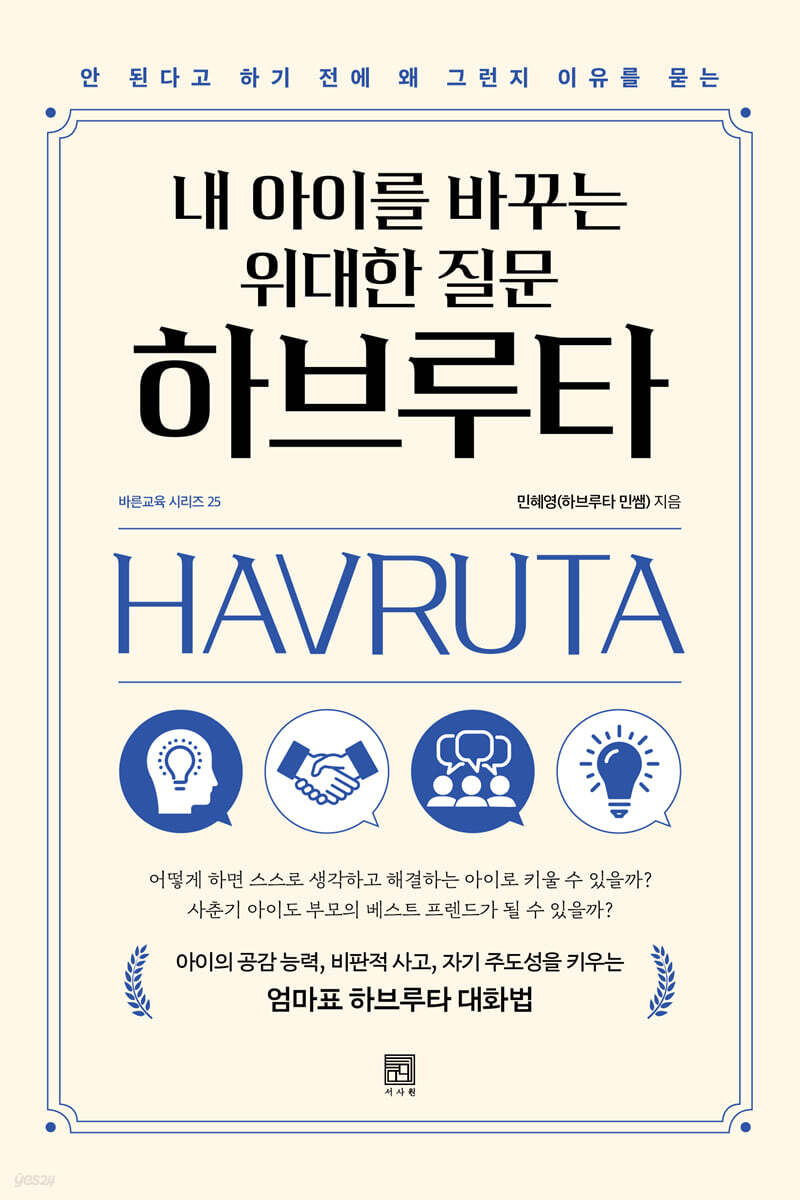
The Great Question That Changed My Child: Havruta
 |
Description
Book Introduction
“Highly recommended by Professor Lee Hyo-jeong of the Garangbi Education Research Institute!” "Havruta expert Min's practical Havruta conversation method" "A simple yet effective way to practice Havruta on a busy morning, at the family table." The author, a Havruta expert and mother of two siblings, encountered Havruta while raising her own children, and overcame the difficulties she faced while raising them through Havruta. The author, who has personally experienced the power of Havruta, introduces Havruta to readers by incorporating real-life episodes from her experiences with her children into her book, “Havruta: The Great Question That Changes My Child.” As a working mom, I couldn't take care of my children as thoroughly as other mothers, but the author's children, who practiced Havruta in their daily lives, are growing into self-directed children who not only think for themselves and solve problems, but also don't hesitate to express their thoughts. The message the author wants to convey in this book is that, even if you don't provide everything your child needs, or don't have enough time to spend with them, both mother and child can grow through consistent Havruta. In addition, it contains specific Havruta methods that can be easily practiced at home. The core of Havruta is ‘understanding’ and ‘respect’ for the other person. It's about asking and understanding what the other person is thinking. However, Havruta is not easy for the parent generation who are more accustomed to one-sided, vertical conversations. Havruta is not something grand. Havruta can be easily started anytime, anywhere in your daily life. There are endless topics to ask questions about and discuss, from what was on the table this morning, to the movies you saw last weekend, to your summer vacation plans this summer. In this book, the author conveys the effectiveness and importance of Havruta through various examples from everyday life. Putting aside the theoretical content, it provides questions and conversation topics that can be applied in real life. This book will be a guide to asking "open questions" that open up conversations instead of "closed questions" that ask your child every day whether he or she has eaten or done his or her homework. Also, through this book, instead of unconditionally saying no to what your child wants, you can ask them first, "Why do you think so?" and through this conversation, you will see your child realize and change on his own. |
- You can preview some of the book's contents.
Preview
index
Both mother and child can grow through Havruta, a relationship based on understanding and respect.
Prologue: There is no mother in the world who is not great.
Chapter 1.
Children Who Need Havruta_Children Who Have Poor Reading Skills
Children who need questions
Parents who need questions
Children who don't understand the question
Chapter 2.
Parents Who Need Havruta Parents Who Don't Ask Questions_Children Who Don't Ask Questions
Be a mirror for your child
The Lie or Truth of 'Sungsilpyo Mom'
The Great Question That Changed My Child
The beginning of Havruta is at the family table.
Are there any schools without exams?
A Picture Book User's Guide for Beginner Havruta Moms
Chapter 3.
Be a mother who seeks questions rather than a mother who chases answers.
A child's self-directedness is created by a mother who asks questions.
To foster your child's self-directedness, start by asking them questions.
Right now, our child is most curious about that 'why?'
Start your busy morning with Havruta
Do you know the secret of table havruta?
How to prevent your child from repeating the same mistakes?
Children raised with their mother's faith have a different level of confidence.
Children learn by watching their parents' backs.
Chapter 4.
Havruta is the answer for our children right now. Havruta_Parents' Practice
When is the best time to spend fully with your child? · Family Havruta 1
Tired Parents and Energetic Kids: What to Do? · Family Havruta 2
The experience of being asked a question makes you ask questions · Family Havruta 3
Son's 3,000 Won · Leadership Havruta 1
My Son's Gold Medal · Leadership Havruta 2
Friends' Money and Discipline Havruta
Is lying always bad? · Critical Thinking Havruta
The bad mom made triangle kimbap,
Grandmother gives a table filled with love · Inseong Havruta
Observation mode ON Interference mode OFF · Adolescent Havruta
Where are you going? Have a great day! · Havruta for Improving Parental Awareness
Why is it wrong to be different from others? · Respect Havruta
Epilogue: A mother is a child's lifelong teacher.
Prologue: There is no mother in the world who is not great.
Chapter 1.
Children Who Need Havruta_Children Who Have Poor Reading Skills
Children who need questions
Parents who need questions
Children who don't understand the question
Chapter 2.
Parents Who Need Havruta Parents Who Don't Ask Questions_Children Who Don't Ask Questions
Be a mirror for your child
The Lie or Truth of 'Sungsilpyo Mom'
The Great Question That Changed My Child
The beginning of Havruta is at the family table.
Are there any schools without exams?
A Picture Book User's Guide for Beginner Havruta Moms
Chapter 3.
Be a mother who seeks questions rather than a mother who chases answers.
A child's self-directedness is created by a mother who asks questions.
To foster your child's self-directedness, start by asking them questions.
Right now, our child is most curious about that 'why?'
Start your busy morning with Havruta
Do you know the secret of table havruta?
How to prevent your child from repeating the same mistakes?
Children raised with their mother's faith have a different level of confidence.
Children learn by watching their parents' backs.
Chapter 4.
Havruta is the answer for our children right now. Havruta_Parents' Practice
When is the best time to spend fully with your child? · Family Havruta 1
Tired Parents and Energetic Kids: What to Do? · Family Havruta 2
The experience of being asked a question makes you ask questions · Family Havruta 3
Son's 3,000 Won · Leadership Havruta 1
My Son's Gold Medal · Leadership Havruta 2
Friends' Money and Discipline Havruta
Is lying always bad? · Critical Thinking Havruta
The bad mom made triangle kimbap,
Grandmother gives a table filled with love · Inseong Havruta
Observation mode ON Interference mode OFF · Adolescent Havruta
Where are you going? Have a great day! · Havruta for Improving Parental Awareness
Why is it wrong to be different from others? · Respect Havruta
Epilogue: A mother is a child's lifelong teacher.
Detailed image

Into the book
No matter how many books you read, it is useless if you cannot explain, ask questions, and speak back to what you have read.
So, the best way to develop metacognition is through Havruta, where we ask each other questions, talk, discuss, and argue, repeatedly understanding the content, listening to it, and expressing our thoughts again.
To speak what I know, I must first understand it.
Because in Havruta, you have to listen to your partner and understand what they say before you can express your thoughts and even engage in discussion and debate.
If families become partners with their children and regularly spend time asking questions and engaging in conversations in their daily lives, they will naturally develop not only vocabulary but also literacy skills to understand the meaning of sentences.
--- p.
30
Asking and respecting a child's thoughts is never optional.
A truly devoted mother does not express her love by doing everything unconditionally.
We must respect the child's thoughts, watch over them, and support and encourage them with our hearts.
The butterfly begins to flap its wings as it tears itself out of its pupa.
If the pupa helps the butterfly shed its skin easily, the butterfly will not be able to flap its wings.
This is because the wings gain strength as the pupa tears off its own skin.
Perhaps, instead, the mother of the child is feeding the child, tying the child's hair, and carrying the child's bag, preventing the child from flapping his wings.
A child who lacks initiative will not develop the ability to solve problems on his own and will become afraid of having to do things alone.
--- p.
47
Most parents often ask closed questions and then give up easily, thinking that they can't communicate with their children.
As you ask questions and observe your child's reactions, you will begin to think about where your questions went wrong or if you could have asked them differently. This will help you improve your questioning skills and come up with better questions.
Open-ended questions that allow for a variety of answers create a strong bridge between parent and child, allowing for easy ping-pong conversations.
Questions become familiar only with consistent practice.
Once a child becomes accustomed to asking questions, thinking becomes less of a struggle.
The joy of being asked questions and thinking for yourself will naturally lead your child to become more self-directed.
--- p.
77
If you hesitate or hesitate because it is not easy to express your thoughts, the mother who watches will become frustrated and exhausted.
But if you do that once or twice, the child will change.
When a child becomes accustomed to his mother's questions, which he has never asked before, he begins to think of answers.
Don't be impatient if your child doesn't respond right away.
Once you get used to that time, it becomes much easier to ask questions and think about them.
The answers come much faster and before you know it, a ping-pong conversation is taking place.
It's fun for the mother who asks and for the child who answers.
I find it enjoyable to think.
This is why you must do Havruta.
We need to instill in our children, the smartphone generation, the joy of thinking rather than just search functions that provide quick answers.
You need to strengthen your thinking muscles.
--- p.
92
Critical thinking is asking others why they think that way, providing reasons for different opinions, and looking at things from a different perspective.
As critical thinking becomes more active, the sharing of ideas also becomes richer.
It can also help you reduce the mistakes you make by being stuck in your own thoughts.
The reason fake news is so prevalent in today's world is because this kind of critical thinking is gradually disappearing.
Now, rather than teaching children, "It's okay to be bad at studying, just be honest," we need to help them decide for themselves why lying is justified in certain situations and why honesty can be criticized or supported depending on the situation.
When you encourage critical thinking that sees things differently from others, your child's thinking muscles become stronger.
That's why we do havruta, and why we must constantly ask questions.
So, the best way to develop metacognition is through Havruta, where we ask each other questions, talk, discuss, and argue, repeatedly understanding the content, listening to it, and expressing our thoughts again.
To speak what I know, I must first understand it.
Because in Havruta, you have to listen to your partner and understand what they say before you can express your thoughts and even engage in discussion and debate.
If families become partners with their children and regularly spend time asking questions and engaging in conversations in their daily lives, they will naturally develop not only vocabulary but also literacy skills to understand the meaning of sentences.
--- p.
30
Asking and respecting a child's thoughts is never optional.
A truly devoted mother does not express her love by doing everything unconditionally.
We must respect the child's thoughts, watch over them, and support and encourage them with our hearts.
The butterfly begins to flap its wings as it tears itself out of its pupa.
If the pupa helps the butterfly shed its skin easily, the butterfly will not be able to flap its wings.
This is because the wings gain strength as the pupa tears off its own skin.
Perhaps, instead, the mother of the child is feeding the child, tying the child's hair, and carrying the child's bag, preventing the child from flapping his wings.
A child who lacks initiative will not develop the ability to solve problems on his own and will become afraid of having to do things alone.
--- p.
47
Most parents often ask closed questions and then give up easily, thinking that they can't communicate with their children.
As you ask questions and observe your child's reactions, you will begin to think about where your questions went wrong or if you could have asked them differently. This will help you improve your questioning skills and come up with better questions.
Open-ended questions that allow for a variety of answers create a strong bridge between parent and child, allowing for easy ping-pong conversations.
Questions become familiar only with consistent practice.
Once a child becomes accustomed to asking questions, thinking becomes less of a struggle.
The joy of being asked questions and thinking for yourself will naturally lead your child to become more self-directed.
--- p.
77
If you hesitate or hesitate because it is not easy to express your thoughts, the mother who watches will become frustrated and exhausted.
But if you do that once or twice, the child will change.
When a child becomes accustomed to his mother's questions, which he has never asked before, he begins to think of answers.
Don't be impatient if your child doesn't respond right away.
Once you get used to that time, it becomes much easier to ask questions and think about them.
The answers come much faster and before you know it, a ping-pong conversation is taking place.
It's fun for the mother who asks and for the child who answers.
I find it enjoyable to think.
This is why you must do Havruta.
We need to instill in our children, the smartphone generation, the joy of thinking rather than just search functions that provide quick answers.
You need to strengthen your thinking muscles.
--- p.
92
Critical thinking is asking others why they think that way, providing reasons for different opinions, and looking at things from a different perspective.
As critical thinking becomes more active, the sharing of ideas also becomes richer.
It can also help you reduce the mistakes you make by being stuck in your own thoughts.
The reason fake news is so prevalent in today's world is because this kind of critical thinking is gradually disappearing.
Now, rather than teaching children, "It's okay to be bad at studying, just be honest," we need to help them decide for themselves why lying is justified in certain situations and why honesty can be criticized or supported depending on the situation.
When you encourage critical thinking that sees things differently from others, your child's thinking muscles become stronger.
That's why we do havruta, and why we must constantly ask questions.
--- pp.
182~183
182~183
Publisher's Review
Abundant examples and cases, the author's vivid experiences are incorporated into Havruta.
A more accessible introduction to Havruta
Instead of providing abstract theoretical explanations about Havruta, the author presents Havruta conversations that all mothers can relate to and apply directly through episodes she personally experienced.
It contains episodes that any parent can experience, such as a child taking out summer clothes in the middle of winter and saying they wanted to go out, a first-grade daughter being surprised by a teacher's call saying she stole money from another friend and used it for snacks, and a son who is now going through puberty taking money out and going on a long trip without his mother's permission.
The author introduces how he looked into the heart of a child and how he was able to overcome it through Havruta, which is a great help in learning Havruta.
Not only children, but also parents grow through Havruta.
We come to understand each other better by learning about the child's mind that we didn't know about, and we reflect on our thoughts that we should listen to adults because we are young.
The author says:
Children also have their own thoughts, and even if they are imperfect and immature, they should be respected.
Through this, the child will grow into a self-directed child with outstanding empathy and problem-solving skills.
If you want your child to not only study well, but also develop good character, lead a self-directed life, and succeed, you should start Havruta today.
A truly sincere mother helps her child grow through conversations that build respect and trust.
Let's start together with "The Great Question that Changes My Child, Havruta."
Children living in the era of the 4th Industrial Revolution
Become a future-oriented talent by asking questions and discussing through Havruta.
Children today, who have grown up surrounded by smart devices since birth, are experiencing a completely different growing environment than our generation.
In the era of the Fourth Industrial Revolution, represented by big data and artificial intelligence, the times are changing so rapidly that even adults are having a hard time keeping up.
Accordingly, the way of thinking and lifestyle of each generation has also changed significantly.
However, more than anything else, child education is lagging far behind in this change.
Treat your children the way our generation was raised.
We need to reflect on whether we are treating children, who need free conversation, discussion, and expansion of thought more than ever, in a somewhat vertical and coercive manner.
A child's education begins at home.
More important than the knowledge taught in schools and academies is education at home.
If you want your child to do well at school and be socially adept, you need to foster social skills and empathy at home.
If you want your child to be interested in studying and do well, you need to talk to them, motivate them, and encourage them to do it.
Literacy, self-direction, and creativity—all of which are required in the era of the Fourth Industrial Revolution—can be fostered through conversation and discussion at home.
In this book, the author explains in detail how Havruta helps improve literacy, self-direction, and creativity.
Sending your child to an essay academy and having them read books at home may be one way, but the most important thing is to develop metacognitive skills by repeatedly talking to others, understanding their opinions, and expressing your own opinions.
The core of Havruta is 'understanding' and 'respect'.
A Mom's Havruta for Becoming Best Friends with Your Teenager
It can be frustrating to see a child entering puberty.
If you see them slamming the door or not opening their mouth when something seems to be going on, you will start to feel a nagging feeling welling up inside.
However, raising your voice and lecturing or nagging when you are frustrated and worried is the worst way to go.
The author says that the secret to becoming best friends with a teenager is to put aside your anxiety for a moment, trust the child, and wait for them.
The words, “You’re young, so you should listen to your parents” and “I’m saying this with you in mind” do not resonate with children at all.
We too have grown up and gone through a difficult adolescence, just like my child.
That's why I actually know what a teenager needs most.
Before we rush and become impatient, let's start the havruta with, "What do you think?"
When children and their parents communicate equally and feel respected, their self-esteem grows and their ability to overcome obstacles grows.
By comparing your own perspective with that of others, you understand that each person's thoughts may differ, and your thinking ability expands.
Mothers will also be able to glimpse into their children's minds in ways they never imagined, and their relationship with their children will become stronger. They will also be able to understand each other and grow further as good parents.
Let's experience the power of Havruta, where mothers and children become close friends with their adolescent children and grow together, through "Havruta, the Great Question that Changes My Child."
A more accessible introduction to Havruta
Instead of providing abstract theoretical explanations about Havruta, the author presents Havruta conversations that all mothers can relate to and apply directly through episodes she personally experienced.
It contains episodes that any parent can experience, such as a child taking out summer clothes in the middle of winter and saying they wanted to go out, a first-grade daughter being surprised by a teacher's call saying she stole money from another friend and used it for snacks, and a son who is now going through puberty taking money out and going on a long trip without his mother's permission.
The author introduces how he looked into the heart of a child and how he was able to overcome it through Havruta, which is a great help in learning Havruta.
Not only children, but also parents grow through Havruta.
We come to understand each other better by learning about the child's mind that we didn't know about, and we reflect on our thoughts that we should listen to adults because we are young.
The author says:
Children also have their own thoughts, and even if they are imperfect and immature, they should be respected.
Through this, the child will grow into a self-directed child with outstanding empathy and problem-solving skills.
If you want your child to not only study well, but also develop good character, lead a self-directed life, and succeed, you should start Havruta today.
A truly sincere mother helps her child grow through conversations that build respect and trust.
Let's start together with "The Great Question that Changes My Child, Havruta."
Children living in the era of the 4th Industrial Revolution
Become a future-oriented talent by asking questions and discussing through Havruta.
Children today, who have grown up surrounded by smart devices since birth, are experiencing a completely different growing environment than our generation.
In the era of the Fourth Industrial Revolution, represented by big data and artificial intelligence, the times are changing so rapidly that even adults are having a hard time keeping up.
Accordingly, the way of thinking and lifestyle of each generation has also changed significantly.
However, more than anything else, child education is lagging far behind in this change.
Treat your children the way our generation was raised.
We need to reflect on whether we are treating children, who need free conversation, discussion, and expansion of thought more than ever, in a somewhat vertical and coercive manner.
A child's education begins at home.
More important than the knowledge taught in schools and academies is education at home.
If you want your child to do well at school and be socially adept, you need to foster social skills and empathy at home.
If you want your child to be interested in studying and do well, you need to talk to them, motivate them, and encourage them to do it.
Literacy, self-direction, and creativity—all of which are required in the era of the Fourth Industrial Revolution—can be fostered through conversation and discussion at home.
In this book, the author explains in detail how Havruta helps improve literacy, self-direction, and creativity.
Sending your child to an essay academy and having them read books at home may be one way, but the most important thing is to develop metacognitive skills by repeatedly talking to others, understanding their opinions, and expressing your own opinions.
The core of Havruta is 'understanding' and 'respect'.
A Mom's Havruta for Becoming Best Friends with Your Teenager
It can be frustrating to see a child entering puberty.
If you see them slamming the door or not opening their mouth when something seems to be going on, you will start to feel a nagging feeling welling up inside.
However, raising your voice and lecturing or nagging when you are frustrated and worried is the worst way to go.
The author says that the secret to becoming best friends with a teenager is to put aside your anxiety for a moment, trust the child, and wait for them.
The words, “You’re young, so you should listen to your parents” and “I’m saying this with you in mind” do not resonate with children at all.
We too have grown up and gone through a difficult adolescence, just like my child.
That's why I actually know what a teenager needs most.
Before we rush and become impatient, let's start the havruta with, "What do you think?"
When children and their parents communicate equally and feel respected, their self-esteem grows and their ability to overcome obstacles grows.
By comparing your own perspective with that of others, you understand that each person's thoughts may differ, and your thinking ability expands.
Mothers will also be able to glimpse into their children's minds in ways they never imagined, and their relationship with their children will become stronger. They will also be able to understand each other and grow further as good parents.
Let's experience the power of Havruta, where mothers and children become close friends with their adolescent children and grow together, through "Havruta, the Great Question that Changes My Child."
GOODS SPECIFICS
- Date of issue: July 7, 2022
- Page count, weight, size: 220 pages | 320g | 140*210*18mm
- ISBN13: 9791168220782
- ISBN10: 1168220785
You may also like
카테고리
korean


korean

![ELLE 엘르 스페셜 에디션 A형 : 12월 [2025]](http://librairie.coreenne.fr/cdn/shop/files/b8e27a3de6c9538896439686c6b0e8fb.jpg?v=1766436872&width=3840)


