

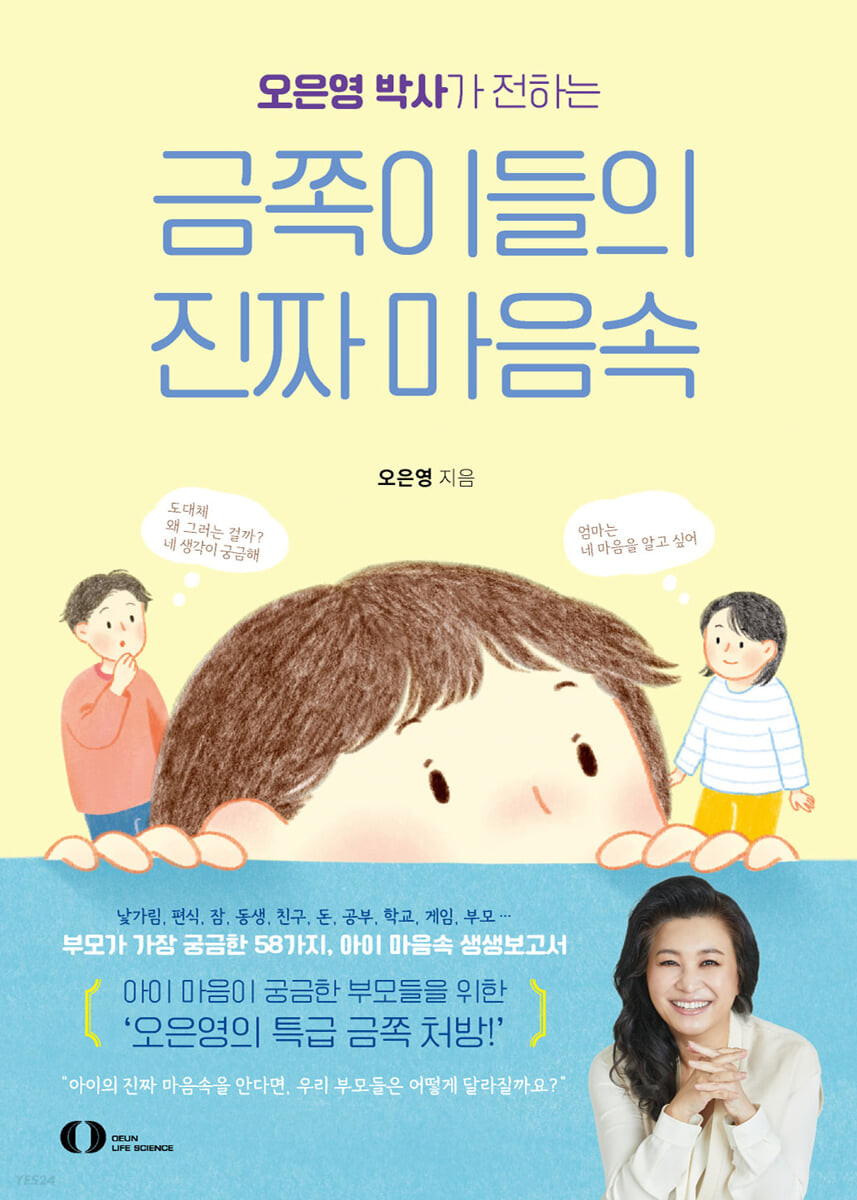
The true feelings of the golden children as told by Dr. Oh Eun-young
 |
Description
Book Introduction
Dr. Oh Eun-young's new book, "Parenting Today: My Precious Child"! The secret to parenting that makes both precious children and precious parents happy Meet Oh Eun-young's 'Special Golden Prescription' for parents who are curious about their children's minds! There is something Dr. Oh Eun-young often hears from parents. “If you ask them at home, they say they don’t know anything, but when they come in front of the director, they start talking about everything.” Whether on TV or at the hospital, children talk about everything in front of Dr. Oh Eun-young, whether it’s about their school life, their relationships with friends, or their thoughts about their parents. Why is that? The secret lies in the way we communicate. Depending on how they communicate, children may want to be more open about their lives or more hidden and guarded. This book selects 58 topics that parents find most frustrating while raising children and provides helpful information on communication. It contains detailed conversation methods on how to recognize and deal with difficulties faced by children, including shyness, walking, eating, potty training, Korean, the presence of younger siblings, sharing toys, fair rules, pranks and bullying, waking up in the morning, academy, parental tone of voice, marital fights, smartphones, and even game time. The key to communication, according to Dr. Oh Eun-young, is the ‘child’s heart.’ It is important to understand the child's true feelings. Only when you understand each other's hearts can you communicate with each other, and only when your hearts communicate with each other can your child listen to you. Therefore, this book vividly captures the true feelings of children, pierced by Dr. Oh Eun-young's deep and warm insight. It also covers what signals your child is sending when he or she is stressed and how to recognize and help those signals. The real reason Dr. Oh Eun-young wants to convey the inner thoughts of children to parents is because she trusts parents' boundless love for their children more than anyone else. When Dr. Oh met the parents and learned about their child's true feelings, they all shed tears and said, "I didn't know you felt that way." I thought to myself how I could help. That was the consistent behavior of those who called themselves 'parents' when they came to know the 'mind of a child'. This book, which contains both the true heart of a child and the special secrets of realistic parenting for parents, will make you feel as if you are receiving a golden prescription from Dr. Oh Eun-young herself for each topic. |
- You can preview some of the book's contents.
Preview
index
prolog
Children's "Our Idols" 4
Chapter 1: The "Growth Challenge" That Never Happens Automatically
A child's circumstances seem obvious, but they're not at all obvious! 18
Shyness - Not because I hate it, but because I feel like it might hurt me 23
Baby Steps - It feels like the sky is spinning and the ground is shaking 31
Eating - "Ah, yum," "Honey cake," "Swallow!" Stop it 39
Toilet Training - Poop is my pride 46
First words - I want to say something too.
Please teach me verbally 55
Hangul-oh, what a headache.
Do I really need to learn this now? 65
My Little Brother's Presence - My Mom Has Changed! Now, I Feel Like She Doesn't Love Me 74
First daycare - I like a home where I can do whatever I want.
82
You're not going to send me off and have fun, are you?
School Lunch Guide - If I Eat It I'll Die, But If I Don't I'll Get Scolded 92
If I sleep, I'm the only one who's going to lose.
I can't play 97
Short stature - Is there really nothing you can say to me other than 'height'? 103
Picture Interpretation - I'm too overwhelmed to draw anything 109
----------------------------------------------------------------------------------
Honestly, this kind of thing is annoying too①
Time-outs, play order or number of picture books, overly long explanations, errands 115
----------------------------------------------------------------------------------
Chapter 2: Good, but Not So Good 'Peers'
A Child's Mind: "Peer": A Good Thing, But Also Difficult 122
Toy sharing - this is my safety boundary.
I feel anxious when I come over 127
Just passing by - I think I hit someone, but it was a mistake. 131
Fair Rules - Losing is just unbearable 141
Prank or Bullying—How Do You Tell the Difference? 151
Non-mainstream - I have nothing to offer 168
Can I swear? Honestly, I'm worried about not being able to. 179
Peer-to-peer trading - I bought it for less with my own money, what's the problem? 188
Allowance - I have my own social status 196
----------------------------------------------------------------------------------
Honestly, this kind of thing is annoying too②
Experiential learning, allowance book, asking about future aspirations, holidays 206
----------------------------------------------------------------------------------
Chapter 3: School Life: A Burdensome Life in Many Ways
The child's perspective is overwhelming, the rules are strict, and studying is a struggle. 212
Waking up in the morning - I don't do it on purpose.
I swear I want to wake up early 216
Homeroom teacher - We don't get along at all.
I don't want to go to school 227
School Rules - Why Can't You Get Me to Give In? 234
Studying - will it work? I've already screwed up, I'll give up. 246
Group Punishment - I Did Nothing Wrong, Why Am I Being Punished? 255
School - Whatever Mom Wants 261
After-school supplementary classes - others don't, but I do... It's embarrassing. 269
----------------------------------------------------------------------------------
Honestly, this kind of thing is annoying too ③
Facial expression interference, Sundays, vacations, and not being able to freely watch webtoons, cartoons, and dramas 274
----------------------------------------------------------------------------------
Chapter 4: Children's Greatest Challenge: Parents
A child's voice is the best in the world, so why is it so difficult? 280
Working Mom - My Sanctuary, I Want to Be With You Always 285
Busy Dad - What on earth keeps you so busy? 294
Mom's Friend - "Mom's Friend" is more problematic than my friend 302
Parents' tone of voice - it sounds like they're really angry.
Please be gentle with me 310
Scolding - Mom and Dad make mistakes too, so why do they scold me? 315
"Read a book"—do you really have to read something this boring and difficult? 321
Marital Fight - Are You Divorcing? Are You Leaving Me? 329
Not Playing - Why Won't You Play? Play with Me Sometime 336
Smartphones - Just like adults want luxury goods, I want the latest. 343
Media Content & Game Time - It's Hard to Cut Down Like Dad's Drinking 349
Parents' Promises - When they keep saying "I promised you," I feel suffocated. 360
----------------------------------------------------------------------------------
Types of Parents Who Make Their Children Feel Worried ①
Scary Mom, Scary Dad, Frequently Crying Mom, 370
A father who wants to raise his children to be strong, a parent who sets conditions before anything else
----------------------------------------------------------------------------------
Chapter 5 A Child's Mind Always Sends Signals
378 Children who feel anxious, lonely, and resentful and feel emotionally burdened
Being able to express negative emotions is essential for a healthy child's mind. 384
All stress in a child requires help 391
396 Signs Your Child Is Stressed
If my child says, "Oh, I'm stressed," 401
A child's heart is a child's, and even the uncomfortable feelings are a child's 406
If you don't know, don't know, but it's always best to be honest with your heart. 410
----------------------------------------------------------------------------------
Types of Parents Who Make Their Children Feel Worried②
Parents who are blunt and expressionless, parents who only talk about the past, 416
Parents who are unconditionally anti-child, parents who are confident that they know their child well
----------------------------------------------------------------------------------
Children's "Our Idols" 4
Chapter 1: The "Growth Challenge" That Never Happens Automatically
A child's circumstances seem obvious, but they're not at all obvious! 18
Shyness - Not because I hate it, but because I feel like it might hurt me 23
Baby Steps - It feels like the sky is spinning and the ground is shaking 31
Eating - "Ah, yum," "Honey cake," "Swallow!" Stop it 39
Toilet Training - Poop is my pride 46
First words - I want to say something too.
Please teach me verbally 55
Hangul-oh, what a headache.
Do I really need to learn this now? 65
My Little Brother's Presence - My Mom Has Changed! Now, I Feel Like She Doesn't Love Me 74
First daycare - I like a home where I can do whatever I want.
82
You're not going to send me off and have fun, are you?
School Lunch Guide - If I Eat It I'll Die, But If I Don't I'll Get Scolded 92
If I sleep, I'm the only one who's going to lose.
I can't play 97
Short stature - Is there really nothing you can say to me other than 'height'? 103
Picture Interpretation - I'm too overwhelmed to draw anything 109
----------------------------------------------------------------------------------
Honestly, this kind of thing is annoying too①
Time-outs, play order or number of picture books, overly long explanations, errands 115
----------------------------------------------------------------------------------
Chapter 2: Good, but Not So Good 'Peers'
A Child's Mind: "Peer": A Good Thing, But Also Difficult 122
Toy sharing - this is my safety boundary.
I feel anxious when I come over 127
Just passing by - I think I hit someone, but it was a mistake. 131
Fair Rules - Losing is just unbearable 141
Prank or Bullying—How Do You Tell the Difference? 151
Non-mainstream - I have nothing to offer 168
Can I swear? Honestly, I'm worried about not being able to. 179
Peer-to-peer trading - I bought it for less with my own money, what's the problem? 188
Allowance - I have my own social status 196
----------------------------------------------------------------------------------
Honestly, this kind of thing is annoying too②
Experiential learning, allowance book, asking about future aspirations, holidays 206
----------------------------------------------------------------------------------
Chapter 3: School Life: A Burdensome Life in Many Ways
The child's perspective is overwhelming, the rules are strict, and studying is a struggle. 212
Waking up in the morning - I don't do it on purpose.
I swear I want to wake up early 216
Homeroom teacher - We don't get along at all.
I don't want to go to school 227
School Rules - Why Can't You Get Me to Give In? 234
Studying - will it work? I've already screwed up, I'll give up. 246
Group Punishment - I Did Nothing Wrong, Why Am I Being Punished? 255
School - Whatever Mom Wants 261
After-school supplementary classes - others don't, but I do... It's embarrassing. 269
----------------------------------------------------------------------------------
Honestly, this kind of thing is annoying too ③
Facial expression interference, Sundays, vacations, and not being able to freely watch webtoons, cartoons, and dramas 274
----------------------------------------------------------------------------------
Chapter 4: Children's Greatest Challenge: Parents
A child's voice is the best in the world, so why is it so difficult? 280
Working Mom - My Sanctuary, I Want to Be With You Always 285
Busy Dad - What on earth keeps you so busy? 294
Mom's Friend - "Mom's Friend" is more problematic than my friend 302
Parents' tone of voice - it sounds like they're really angry.
Please be gentle with me 310
Scolding - Mom and Dad make mistakes too, so why do they scold me? 315
"Read a book"—do you really have to read something this boring and difficult? 321
Marital Fight - Are You Divorcing? Are You Leaving Me? 329
Not Playing - Why Won't You Play? Play with Me Sometime 336
Smartphones - Just like adults want luxury goods, I want the latest. 343
Media Content & Game Time - It's Hard to Cut Down Like Dad's Drinking 349
Parents' Promises - When they keep saying "I promised you," I feel suffocated. 360
----------------------------------------------------------------------------------
Types of Parents Who Make Their Children Feel Worried ①
Scary Mom, Scary Dad, Frequently Crying Mom, 370
A father who wants to raise his children to be strong, a parent who sets conditions before anything else
----------------------------------------------------------------------------------
Chapter 5 A Child's Mind Always Sends Signals
378 Children who feel anxious, lonely, and resentful and feel emotionally burdened
Being able to express negative emotions is essential for a healthy child's mind. 384
All stress in a child requires help 391
396 Signs Your Child Is Stressed
If my child says, "Oh, I'm stressed," 401
A child's heart is a child's, and even the uncomfortable feelings are a child's 406
If you don't know, don't know, but it's always best to be honest with your heart. 410
----------------------------------------------------------------------------------
Types of Parents Who Make Their Children Feel Worried②
Parents who are blunt and expressionless, parents who only talk about the past, 416
Parents who are unconditionally anti-child, parents who are confident that they know their child well
----------------------------------------------------------------------------------
Detailed image
.jpg)
Into the book
Every child needs support from their parents at every stage of growth.
Some children need more, some need less, and some just need to be watched, but all children definitely need help.
Do you remember the moment your child first stood on his or her own two feet? You were so thrilled, you cheered, and you were so proud of him or her.
A child may not remember with his head how his parents reacted at that moment, but he remembers with his heart.
That memory remains as a feeling you get after overcoming difficulties.
--- From "Chapter 1 Growth Tasks - First Steps"
For children who are patient, how you ask questions is important.
When a child who is good at patience asks, “Are you having a hard time?”, it is very difficult for him to answer, “Yes, I am having a hard time.”
Even though it's obvious that he hates his younger sibling, if you ask him, "Do you hate your younger sibling?" he answers, "No."
“Your little brother, sometimes you can be really annoying, don’t you think?” If you say this, I’ll say “Yes.”
If you ask them directly, they may think that those feelings are bad and not be able to express their feelings honestly.
--- From "Chapter 1 Growth Challenges - First Early Childhood Institution"
You shouldn't continue to give a sensitive child excessive stress just to raise them to be strong.
When these children are very difficult or resistant to any stimulus, they should be stopped right there.
And then you have to repeat that same stimulus several times.
After experiencing this many times and the child becomes comfortable and feels like, "Oh, it's okay," you should move on to the next step.
If your child is not comfortable, you should not try to move quickly to the next step.
You have to proceed very slowly, little by little, to a level that the child can accept.
--- From "Chapter 2 Peers - Just Passing By"
Sometimes parents say this.
No matter how many times I tell the child, he doesn't change.
A child really needs to be taught a thousand, ten thousand times.
Saying it 'many times' won't make a difference.
And if that 'many times' is always the same way, then it doesn't change anything.
Parents who constantly find themselves asking their children, “Do you know how many times this is going to be said?” should consider whether they are trying to solve problems the same way every time.
--- From "Chapter 2 Peers - Pranks or Bullying"
Even children who really don't wake up have their own circumstances.
Most of these children are the type whose brains don't wake up quickly.
Even among adults, there are those who need a strong cup of espresso in the morning or a recovery drink to wake up.
No matter how many alarm clocks I set, I still can't wake up in the morning.
Since I'm the type of person who wakes up late, I actually hear the alarm that's been going off for 30 minutes only 5 minutes before I wake up.
Parents may say they woke the child up for an hour, but the child may only have heard the parent wake them up for five minutes.
--- From "Chapter 3 School Life - Waking Up in the Morning"
If your child asks, “Are you embarrassed, Mom?” tell them clearly.
“No, that’s not true.
Of course, I would be happy if you studied hard.
But I don't feel ashamed of you for not being able to do it.
“This is just a problem you need to improve on in the future.” When something like this happens, it hurts a child’s pride much more than a parent’s pride.
Children are suffering enough on their own without their parents putting any stress on them.
It takes wisdom to handle the situation carefully so that the child's self-esteem is not further damaged.
--- From "Chapter 3 School Life - After-School Supplementary Lessons"
As parents, we have interactions with our children and love to give.
This is not something that is given to a child when he or she is good to his or her parents, but it is something that should be given unconditionally.
If children don't receive it, it's so hard on their minds.
To a child, parents are the universe.
A child can grow up comfortably only when he or she feels safe in that universe, loved and respected, and trust is formed.
You can also overcome the stress that you inevitably experience in life.
Because the basic prerequisite for overcoming any kind of stress is ‘parents.’
--- From "Chapter 4 Parents - The Voice of the Child"
Parents should remember that their children's reasoning abilities are not yet fully developed.
A child needs to see and touch things rather than just think about them in his head.
Parents need to hug and tell their children that they love them so they know that they are loved.
So if you love your child, you need to increase the time you spend together.
During that time, try to enjoy yourself as much as possible rather than complaining or getting angry.
Spend time together and talk.
--- From "Chapter 4 Parents - Busy Dads"
Even if the parents themselves have no intention of doing so, unloving language can make children feel that their parents do not respect them.
The child feels that his parents ignore him and treat him rudely.
Shouting loudly means that you will only speak your mind rather than listen to the child.
The child's words are naturally drowned out by my loud voice.
This kind of parental tone causes the child's heart to become increasingly distant from the parent.
--- From "Chapter 4 Parents - Parents' Speech"
Parents should always be interested in their children's minds.
Because parents have to become their child's 'other self' when the child is young.
When a child tries to learn something but fails, instead of just saying, “Try it,” you stay right behind the child like a shadow and help the child’s immature development.
It's not just about performance, it's also about emotional aspects.
“Even if it was my dad, he would have been very angry at that time.
You need to explain the child's feelings by saying, "It hurts and upsets me so much when he does that."
Through it, the child realizes, 'Ah, so this is what my heart was like.
It's natural to be angry.
You start to feel like, 'I should be angry.'
--- From "Chapter 5: A Child's Heart Always Sends Signals"
Remember when you taught your child to walk for the first time? The parent walked in front, holding the child's hand.
If the child seems to be pulling away, the parents take a step back.
It's about teaching the child the direction to come forward.
When a child sees that image of their parent, they know, 'Oh, I have to go that way.'
When parents laugh and step back, they think, 'Oh, it's safer to go that way.'
You should do the same when dealing with your child's stress.
If you provide encouragement and support with comfortable words and a relaxed atmosphere, the child will feel safe and go through the process.
Some children need more, some need less, and some just need to be watched, but all children definitely need help.
Do you remember the moment your child first stood on his or her own two feet? You were so thrilled, you cheered, and you were so proud of him or her.
A child may not remember with his head how his parents reacted at that moment, but he remembers with his heart.
That memory remains as a feeling you get after overcoming difficulties.
--- From "Chapter 1 Growth Tasks - First Steps"
For children who are patient, how you ask questions is important.
When a child who is good at patience asks, “Are you having a hard time?”, it is very difficult for him to answer, “Yes, I am having a hard time.”
Even though it's obvious that he hates his younger sibling, if you ask him, "Do you hate your younger sibling?" he answers, "No."
“Your little brother, sometimes you can be really annoying, don’t you think?” If you say this, I’ll say “Yes.”
If you ask them directly, they may think that those feelings are bad and not be able to express their feelings honestly.
--- From "Chapter 1 Growth Challenges - First Early Childhood Institution"
You shouldn't continue to give a sensitive child excessive stress just to raise them to be strong.
When these children are very difficult or resistant to any stimulus, they should be stopped right there.
And then you have to repeat that same stimulus several times.
After experiencing this many times and the child becomes comfortable and feels like, "Oh, it's okay," you should move on to the next step.
If your child is not comfortable, you should not try to move quickly to the next step.
You have to proceed very slowly, little by little, to a level that the child can accept.
--- From "Chapter 2 Peers - Just Passing By"
Sometimes parents say this.
No matter how many times I tell the child, he doesn't change.
A child really needs to be taught a thousand, ten thousand times.
Saying it 'many times' won't make a difference.
And if that 'many times' is always the same way, then it doesn't change anything.
Parents who constantly find themselves asking their children, “Do you know how many times this is going to be said?” should consider whether they are trying to solve problems the same way every time.
--- From "Chapter 2 Peers - Pranks or Bullying"
Even children who really don't wake up have their own circumstances.
Most of these children are the type whose brains don't wake up quickly.
Even among adults, there are those who need a strong cup of espresso in the morning or a recovery drink to wake up.
No matter how many alarm clocks I set, I still can't wake up in the morning.
Since I'm the type of person who wakes up late, I actually hear the alarm that's been going off for 30 minutes only 5 minutes before I wake up.
Parents may say they woke the child up for an hour, but the child may only have heard the parent wake them up for five minutes.
--- From "Chapter 3 School Life - Waking Up in the Morning"
If your child asks, “Are you embarrassed, Mom?” tell them clearly.
“No, that’s not true.
Of course, I would be happy if you studied hard.
But I don't feel ashamed of you for not being able to do it.
“This is just a problem you need to improve on in the future.” When something like this happens, it hurts a child’s pride much more than a parent’s pride.
Children are suffering enough on their own without their parents putting any stress on them.
It takes wisdom to handle the situation carefully so that the child's self-esteem is not further damaged.
--- From "Chapter 3 School Life - After-School Supplementary Lessons"
As parents, we have interactions with our children and love to give.
This is not something that is given to a child when he or she is good to his or her parents, but it is something that should be given unconditionally.
If children don't receive it, it's so hard on their minds.
To a child, parents are the universe.
A child can grow up comfortably only when he or she feels safe in that universe, loved and respected, and trust is formed.
You can also overcome the stress that you inevitably experience in life.
Because the basic prerequisite for overcoming any kind of stress is ‘parents.’
--- From "Chapter 4 Parents - The Voice of the Child"
Parents should remember that their children's reasoning abilities are not yet fully developed.
A child needs to see and touch things rather than just think about them in his head.
Parents need to hug and tell their children that they love them so they know that they are loved.
So if you love your child, you need to increase the time you spend together.
During that time, try to enjoy yourself as much as possible rather than complaining or getting angry.
Spend time together and talk.
--- From "Chapter 4 Parents - Busy Dads"
Even if the parents themselves have no intention of doing so, unloving language can make children feel that their parents do not respect them.
The child feels that his parents ignore him and treat him rudely.
Shouting loudly means that you will only speak your mind rather than listen to the child.
The child's words are naturally drowned out by my loud voice.
This kind of parental tone causes the child's heart to become increasingly distant from the parent.
--- From "Chapter 4 Parents - Parents' Speech"
Parents should always be interested in their children's minds.
Because parents have to become their child's 'other self' when the child is young.
When a child tries to learn something but fails, instead of just saying, “Try it,” you stay right behind the child like a shadow and help the child’s immature development.
It's not just about performance, it's also about emotional aspects.
“Even if it was my dad, he would have been very angry at that time.
You need to explain the child's feelings by saying, "It hurts and upsets me so much when he does that."
Through it, the child realizes, 'Ah, so this is what my heart was like.
It's natural to be angry.
You start to feel like, 'I should be angry.'
--- From "Chapter 5: A Child's Heart Always Sends Signals"
Remember when you taught your child to walk for the first time? The parent walked in front, holding the child's hand.
If the child seems to be pulling away, the parents take a step back.
It's about teaching the child the direction to come forward.
When a child sees that image of their parent, they know, 'Oh, I have to go that way.'
When parents laugh and step back, they think, 'Oh, it's safer to go that way.'
You should do the same when dealing with your child's stress.
If you provide encouragement and support with comfortable words and a relaxed atmosphere, the child will feel safe and go through the process.
--- From "Chapter 5: A Child's Heart Always Sends Signals"
Publisher's Review
A book that is a gift for adults who are curious about children's minds!
I hope that this will alleviate some of the parents' thirst for '1st Album 1 Oh Eun-young'...
The most common thoughts while raising a child are, ‘What on earth is this child thinking?’, ‘What was in their heart to do that?’…
My child will definitely resemble half of his mother and half of his father, but there are times when I can't understand my child's heart at all.
I wonder if this is why memes like “I have to meet Dr. Oh Eun-young”, “Is she golden?”, and “I’m golden too” have emerged these days.
This is because Dr. Oh Eun-young delicately perceives the difficulties in the hearts of children and carefully refines the love of clumsy parents.
This book is full of the 'heart of a child'.
These are the real feelings of children that Dr. Oh Eun-young has personally encountered in clinical settings for over 30 years.
And it also contains precious parenting tips that are perfect for the child's heart, learned through long clinical experience.
Parents these days are honestly very smart.
Some parents have parenting knowledge and information that rivals that of experts.
That means you study a lot about children.
That means you love your child that much.
But despite all that knowledge and information, parenting doesn't get any easier.
Why? The number of children believed to have problems is increasing, as are the number of parents growing increasingly exhausted.
Why is that?
Dr. Oh Eun-young says that this is because the ‘child’s circumstances,’ ‘the child’s heart,’ and ‘the child’s voice’ are missing from that knowledge and information.
The way we have solved children's problems up until now has often been from an adult's perspective, and has often only tried to eliminate problems that adults find uncomfortable.
Adults often try to solve children's problems by controlling their children's behavior in the direction they want.
We didn't ask the children what was bothering them and didn't solve their problems in a way that would make their lives more comfortable.
So, there were things that were not problems for the child but were overreacted to as problems, and there were things that were really serious problems for the child but were passed over as if they were nothing.
As a result, I wonder if parenting is becoming more and more difficult and complicated.
There was a child.
He starts crying whenever he sees a stranger.
The parents thought it was because the child did not meet many people.
Expose it to more people more often.
I thought that if the people I met were kinder and more affectionate, my child would get better.
The child did not cry because he did not meet many people or because the people he met were not kind to him.
Because he felt like strangers would hurt him.
The more people the child met, and the more kind and affectionate they were to him, the stronger the threat of harm he felt.
The more parents tried to overcome their child's shyness, the worse the child's symptoms became.
Parenting has become increasingly difficult for parents.
Dr. Oh Eun-young explains the mind of a shy child like this.
'Mom, why do you keep taking me to people I don't know?
I'm scared to death, why does that person keep laughing at me?
It's scarier when you laugh.
Oh, oh, it's touching my finger.
Save me, Mom! I think she's going to hurt me.
"Ugh! You want me to hug that guy? No! If I hug that guy, I might die."
When you open 『The Real Hearts of the Golden Children』, you will encounter the diverse hearts of children.
Sometimes, it's so bold and cheeky that it makes you think, 'Oh my, is that how you really felt?', sometimes it's so sad that you think, 'I'm sorry for all this time, what should I do...', and sometimes it's so pure and honest that you think, 'Oh my, how cute!'
While reading, you might laugh out loud, feel a pang of emotion, or even shed a tear.
As you get to know your child's mind, and start to think, "Oh, how can I help?", Dr. Oh Eun-young comes up with her own unique practical parenting tips.
As always, the strategy is very specific, from word to action, so that most can be read and put into practice immediately.
Therefore, it will be able to provide a lot of realistic and practical help to those who are having a hard time raising children now, as well as those who are worried about raising children in the future, and all adults who are curious about their children's feelings.
Dr. Oh Eun-young says that children can only listen when they understand each other's hearts and when hearts connect.
The ‘heart’ comes first.
If you think about it the other way around, the fact that a child is whining and disobeying means that they are not communicating well with their parents.
That means parents don't know their children's minds.
So, if parents could understand their child's heart, what changes would occur in both the child and the parent? I sincerely hope this book will become a "magic bead" for parents, like those found in fairy tales, that allows them to see the hearts of others, and thus empower us parents to love our children with the utmost sincerity.
I hope that this will alleviate some of the parents' thirst for '1st Album 1 Oh Eun-young'...
The most common thoughts while raising a child are, ‘What on earth is this child thinking?’, ‘What was in their heart to do that?’…
My child will definitely resemble half of his mother and half of his father, but there are times when I can't understand my child's heart at all.
I wonder if this is why memes like “I have to meet Dr. Oh Eun-young”, “Is she golden?”, and “I’m golden too” have emerged these days.
This is because Dr. Oh Eun-young delicately perceives the difficulties in the hearts of children and carefully refines the love of clumsy parents.
This book is full of the 'heart of a child'.
These are the real feelings of children that Dr. Oh Eun-young has personally encountered in clinical settings for over 30 years.
And it also contains precious parenting tips that are perfect for the child's heart, learned through long clinical experience.
Parents these days are honestly very smart.
Some parents have parenting knowledge and information that rivals that of experts.
That means you study a lot about children.
That means you love your child that much.
But despite all that knowledge and information, parenting doesn't get any easier.
Why? The number of children believed to have problems is increasing, as are the number of parents growing increasingly exhausted.
Why is that?
Dr. Oh Eun-young says that this is because the ‘child’s circumstances,’ ‘the child’s heart,’ and ‘the child’s voice’ are missing from that knowledge and information.
The way we have solved children's problems up until now has often been from an adult's perspective, and has often only tried to eliminate problems that adults find uncomfortable.
Adults often try to solve children's problems by controlling their children's behavior in the direction they want.
We didn't ask the children what was bothering them and didn't solve their problems in a way that would make their lives more comfortable.
So, there were things that were not problems for the child but were overreacted to as problems, and there were things that were really serious problems for the child but were passed over as if they were nothing.
As a result, I wonder if parenting is becoming more and more difficult and complicated.
There was a child.
He starts crying whenever he sees a stranger.
The parents thought it was because the child did not meet many people.
Expose it to more people more often.
I thought that if the people I met were kinder and more affectionate, my child would get better.
The child did not cry because he did not meet many people or because the people he met were not kind to him.
Because he felt like strangers would hurt him.
The more people the child met, and the more kind and affectionate they were to him, the stronger the threat of harm he felt.
The more parents tried to overcome their child's shyness, the worse the child's symptoms became.
Parenting has become increasingly difficult for parents.
Dr. Oh Eun-young explains the mind of a shy child like this.
'Mom, why do you keep taking me to people I don't know?
I'm scared to death, why does that person keep laughing at me?
It's scarier when you laugh.
Oh, oh, it's touching my finger.
Save me, Mom! I think she's going to hurt me.
"Ugh! You want me to hug that guy? No! If I hug that guy, I might die."
When you open 『The Real Hearts of the Golden Children』, you will encounter the diverse hearts of children.
Sometimes, it's so bold and cheeky that it makes you think, 'Oh my, is that how you really felt?', sometimes it's so sad that you think, 'I'm sorry for all this time, what should I do...', and sometimes it's so pure and honest that you think, 'Oh my, how cute!'
While reading, you might laugh out loud, feel a pang of emotion, or even shed a tear.
As you get to know your child's mind, and start to think, "Oh, how can I help?", Dr. Oh Eun-young comes up with her own unique practical parenting tips.
As always, the strategy is very specific, from word to action, so that most can be read and put into practice immediately.
Therefore, it will be able to provide a lot of realistic and practical help to those who are having a hard time raising children now, as well as those who are worried about raising children in the future, and all adults who are curious about their children's feelings.
Dr. Oh Eun-young says that children can only listen when they understand each other's hearts and when hearts connect.
The ‘heart’ comes first.
If you think about it the other way around, the fact that a child is whining and disobeying means that they are not communicating well with their parents.
That means parents don't know their children's minds.
So, if parents could understand their child's heart, what changes would occur in both the child and the parent? I sincerely hope this book will become a "magic bead" for parents, like those found in fairy tales, that allows them to see the hearts of others, and thus empower us parents to love our children with the utmost sincerity.
GOODS SPECIFICS
- Publication date: May 25, 2022
- Page count, weight, size: 420 pages | 592g | 150*210*27mm
- ISBN13: 9791192255323
You may also like
카테고리
korean


korean

![GQ KOREA Mark (Monthly): December [2025]](http://librairie.coreenne.fr/cdn/shop/files/8ef265dbbfbf186523ed75ba7319009d.jpg?v=1765340328&width=3840)


