

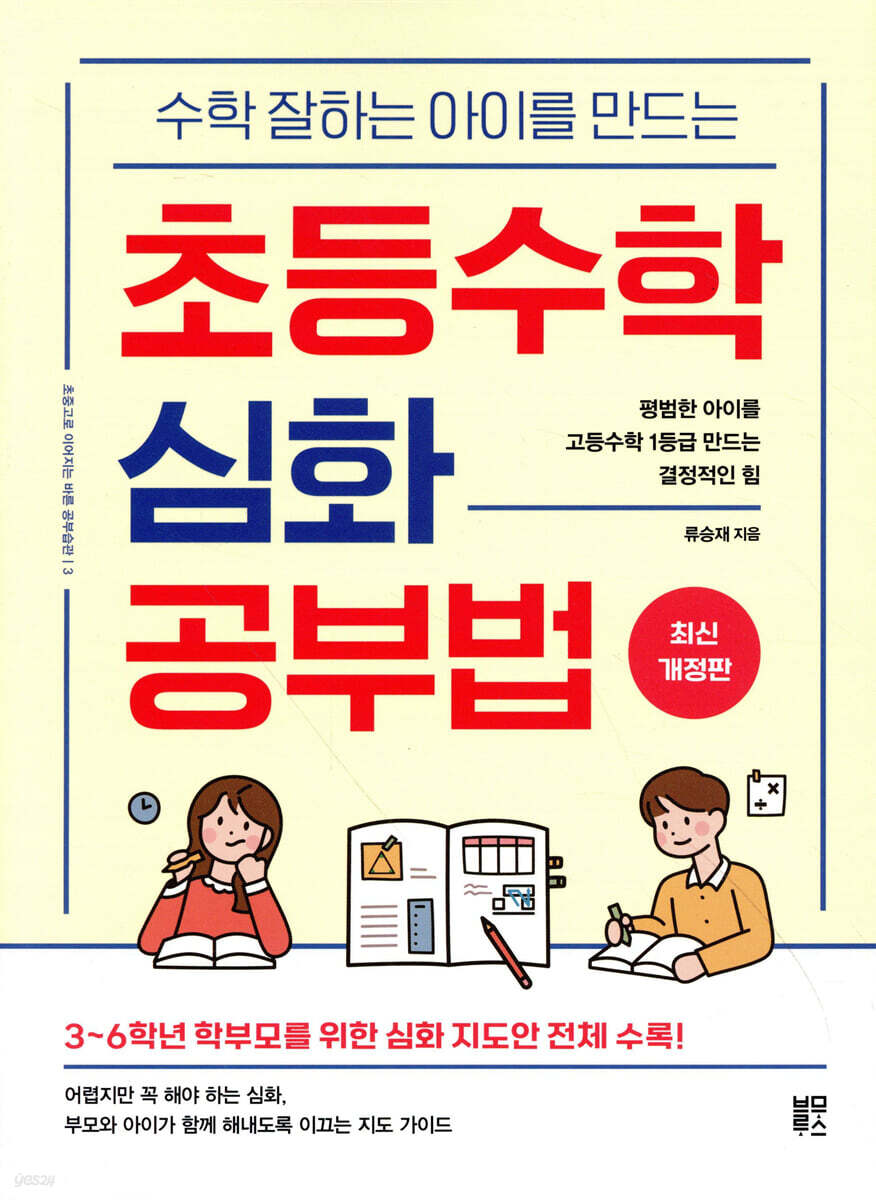
Advanced study methods for elementary school mathematics
 |
Description
Book Introduction
Many children only solve problems that they can do and then collapse in high school math! Deepening is not an option, it is a must! In January 2020, "This is How Kids Who Are Good at Math Study" received an enthusiastic response from readers as soon as it was published. He changed the framework of mathematics education by saying that children who embody the right study method of learning concepts on their own and deepening their knowledge can do well in advanced mathematics. This book presents examples of children who were good at math in elementary and middle school but failed in high school, and the reasons for this. It points out that the reasons for the failure of children who did "fake math study" by excessively prioritizing learning and repeatedly solving problems in a shepherd-like manner are lack of in-depth ability and passive study habits. This book is author Ryu Seung-jae's second book. "So, how do I specifically develop advanced math skills?" "Will my child be able to study concepts on their own?" "I think I'm going to go crazy studying advanced math with my child! What should I do?" "My child seems to have a hard time with advanced math. Does that mean he'll never be able to do math?" Etc. This book offers concrete and practical answers to the frustrations of countless parents. I'll tell you everything I wanted to say in the previous work that I couldn't tell you before. It is no exaggeration to say that all the secrets of teaching are poured out here, and it can also be called the 'practical version' of 'This is how children who are good at math study'. |
- You can preview some of the book's contents.
Preview
index
Introduction: Any child can excel at math.
How to use this book
Part 1: A Math Study Manual from Concept to Advanced
- Real study to build math skills
Q&A How to study math properly with my child
How to Build Math Skills
- Understanding my child comes first.
Q&A How to Determine Your Child's Level
- Choosing textbooks is also a strategy.
Q&A on the math textbook, but still having trouble?
- Start by developing study habits.
- How to study concepts, teach like this
When you are worried about Q&A study methods
- This is how to study advanced textbooks
- Group 3: Math for children who find math very difficult.
Q&A When you are concerned about your child's progress
- The technique of completing the soul
Determining Q&A Test Scores
- A level-based learning roadmap looking ahead to middle and high school
If you have to send your child to a Q&A academy
- This is how an ordinary 4th grader studies advanced math.
Part 2: Elementary Math Lesson Plans to Help Children Study
- Overview and application of elementary mathematics lesson plans
3rd year, 1st semester
2nd semester of 3rd year
4th grade, 1st semester
4th grade, 2nd semester
5th grade, first semester
5th grade, 2nd semester
6th grade, first semester
6th grade, 2nd semester
How to use this book
Part 1: A Math Study Manual from Concept to Advanced
- Real study to build math skills
Q&A How to study math properly with my child
How to Build Math Skills
- Understanding my child comes first.
Q&A How to Determine Your Child's Level
- Choosing textbooks is also a strategy.
Q&A on the math textbook, but still having trouble?
- Start by developing study habits.
- How to study concepts, teach like this
When you are worried about Q&A study methods
- This is how to study advanced textbooks
- Group 3: Math for children who find math very difficult.
Q&A When you are concerned about your child's progress
- The technique of completing the soul
Determining Q&A Test Scores
- A level-based learning roadmap looking ahead to middle and high school
If you have to send your child to a Q&A academy
- This is how an ordinary 4th grader studies advanced math.
Part 2: Elementary Math Lesson Plans to Help Children Study
- Overview and application of elementary mathematics lesson plans
3rd year, 1st semester
2nd semester of 3rd year
4th grade, 1st semester
4th grade, 2nd semester
5th grade, first semester
5th grade, 2nd semester
6th grade, first semester
6th grade, 2nd semester
Detailed image
.jpg)
Into the book
Elementary advanced study is ultimately a gateway that must be passed to become good at math.
Most children, with very few exceptions, will not be able to advance further if they do not advance further in elementary school.
In my experience, there are many students in foreign language high schools or international high schools who did not study in depth in elementary and middle school and only focused on concepts.
Even if these students try to take advanced courses to prepare for their grades after entering high school, most of them give up on taking advanced courses because they have not yet developed advanced skills and do not have enough time.
Since higher mathematics is a relative evaluation, questions with discriminatory power are given on the exam.
It is on a different level from elementary and middle school exam questions that can be solved by properly understanding the concepts and memorizing the types.
So, to do well on the high school exam, you need to practice even the more advanced problems.
--- p.
24 From “Real Study to Build Math Skills”
Part 2 of this book contains lesson plans to assist with elementary school mathematics and advanced mathematics.
The reason why it is included starting from the 3rd grade of elementary school, or in other words, the reason why it is not included in the advanced level for the 1st and 2nd grades of elementary school, is because in terms of children's cognitive and behavioral development, advanced mathematics that focuses on descriptive (sentence problems) is not suitable for children in the 2nd grade of elementary school or lower.
If you teach advanced math to a child whose brain is not fully developed and who is not yet capable of advanced math, you could end up teaching the child in a 'teaching' manner (in fact, this is how most people teach).
We interpret the problem in a way that explains it to a child who does not understand the sentence, and even teach the solution.
But once a child gets used to this teaching method when they first start learning math, they will forever need someone to teach them the concepts and interpret the problems for them to be able to do math.
--- p.
30 From “Building Math Skills, How Should I Prepare?”
In general, we recommend studying an average of three textbooks per semester.
Especially for an average child, this amount of learning is appropriate.
Students can lead a balanced elementary school life by securing time for other subjects, arts and physical education, reading, and play.
From a learning perspective, you can challenge yourself by thinking deeply about it for a long time, and at the same time, you have the freedom to do good deeds.
We provide simple guidelines on how to combine teaching materials according to your child's level.
--- p.
73 From “Choosing Textbooks is also a Strategy”
Even if you have children solve problems according to the procedure described above, most Group 2 children who are just starting to learn the proper in-depth skills are likely to be unable to solve the problems themselves.
You have to be persistent.
Surprisingly, if you just let your child read the problem properly, he or she will be able to solve it well.
So, during the outline writing stage, I ask you to look at the outline you wrote and think about it again for more than 10 minutes.
If you still can't solve it after going through this process, you need to give hints, and as explained above, you need to give hints line by line.
The key is to always remember that it is not 'difficult' but 'by yourself'.
--- p.
118 From “Studying In-Depth Textbooks Like This”
The most unsettling and difficult thing is teaching advanced materials.
The textbook concept is that school teachers teach the principles slowly, but there is no place to rely on for in-depth study.
In fact, even academy instructors often have difficulty figuring out what to explain and in what direction when it comes to advanced textbooks.
Therefore, the advanced concept teaching method describes the extended concepts and advanced types required when teaching an advanced textbook for a unit.
By analyzing the contents of commercially available advanced textbooks, we have compiled common advanced concepts (concepts that can be expanded upon from basic concepts) and advanced teaching methods.
--- p.
175 From “Elementary Mathematics Teaching Plan Overview and Utilization Methods”
Sometimes a child may ask what a dot or line is.
In modern mathematics (school mathematics), points and lines are not defined.
That is, points and lines are expressed in indefinite terms as “a point is a point” and “a line is a line.”
To avoid chain reactions where one term is needed to describe another, mathematicians have decided to call the initial term an undefined term.
The point and the line are the starting point.
You can simply tell your child that a dot is a dot and a line is a line, and that this is the convention of mathematicians.
From this concept comes the definition of a shape.
--- p.
192 From “3rd Grade, 1st Semester, Unit 2 Plane Figures”
Elementary advanced level content is repeated similarly in each grade.
Therefore, the first intensive course in the third year is the most difficult and challenging.
Once you get through that process, the next ones will be much easier, so it's important to finish the first intensive without giving up.
Therefore, this study guide is most effective when studied starting from the third grade level. If your child is not progressing, you should refer to the advanced content from the previous grade level.
If you need any specific information, please go back and check it out as it will guide you to where to refer specifically.
--- p.
286 From “4th Grade, 2nd Semester, Unit 1: Addition and Subtraction of Fractions”
The reason 5th grade math is difficult is because it focuses on learning fractions, the most difficult concept.
Even children who do not have difficulty with fractions often solve problems by memorizing calculation algorithms without knowing the principles.
In addition to fractions, there are many new things to learn, such as mixed calculations with natural numbers, factors and multiples, rules and correspondences, congruence and symmetry, which children find difficult.
In fact, most children start to attend private academies when they reach the fifth grade.
It is difficult to endure the content alone any longer, and the children are also exhausted.
So what's the best way to prevent blisters? It's to improve your conceptual understanding.
These skills are acquired through reading and conceptual study as described in Part 1.
In particular, we recommend that you start conceptual transcription from the 5th grade, so please be sure to take note.
If you don't improve your conceptual understanding now and only focus on solving simple problems or learning calculation algorithms, you will never be able to overcome the difficulty level that lies ahead.
In order to successfully complete middle and high school mathematics, which can be considered a challenging subject for most students, instructors must guide students to study exactly as described in this book.
--- p.
318 From "5th Grade Mathematics Overview"
6th grade is also a time to prepare for middle school.
Therefore, because of the secondary prerequisites, it is a good idea to study the algebra part (division of fractions and decimals, ratios and rates, proportions and proportional expressions) thoroughly up to a high level, and to establish a learning strategy of only accurately understanding the concepts and moving on to the geometry part.
Because after entering middle school, we review the geometry part in the second semester of the first year.
Most children, with very few exceptions, will not be able to advance further if they do not advance further in elementary school.
In my experience, there are many students in foreign language high schools or international high schools who did not study in depth in elementary and middle school and only focused on concepts.
Even if these students try to take advanced courses to prepare for their grades after entering high school, most of them give up on taking advanced courses because they have not yet developed advanced skills and do not have enough time.
Since higher mathematics is a relative evaluation, questions with discriminatory power are given on the exam.
It is on a different level from elementary and middle school exam questions that can be solved by properly understanding the concepts and memorizing the types.
So, to do well on the high school exam, you need to practice even the more advanced problems.
--- p.
24 From “Real Study to Build Math Skills”
Part 2 of this book contains lesson plans to assist with elementary school mathematics and advanced mathematics.
The reason why it is included starting from the 3rd grade of elementary school, or in other words, the reason why it is not included in the advanced level for the 1st and 2nd grades of elementary school, is because in terms of children's cognitive and behavioral development, advanced mathematics that focuses on descriptive (sentence problems) is not suitable for children in the 2nd grade of elementary school or lower.
If you teach advanced math to a child whose brain is not fully developed and who is not yet capable of advanced math, you could end up teaching the child in a 'teaching' manner (in fact, this is how most people teach).
We interpret the problem in a way that explains it to a child who does not understand the sentence, and even teach the solution.
But once a child gets used to this teaching method when they first start learning math, they will forever need someone to teach them the concepts and interpret the problems for them to be able to do math.
--- p.
30 From “Building Math Skills, How Should I Prepare?”
In general, we recommend studying an average of three textbooks per semester.
Especially for an average child, this amount of learning is appropriate.
Students can lead a balanced elementary school life by securing time for other subjects, arts and physical education, reading, and play.
From a learning perspective, you can challenge yourself by thinking deeply about it for a long time, and at the same time, you have the freedom to do good deeds.
We provide simple guidelines on how to combine teaching materials according to your child's level.
--- p.
73 From “Choosing Textbooks is also a Strategy”
Even if you have children solve problems according to the procedure described above, most Group 2 children who are just starting to learn the proper in-depth skills are likely to be unable to solve the problems themselves.
You have to be persistent.
Surprisingly, if you just let your child read the problem properly, he or she will be able to solve it well.
So, during the outline writing stage, I ask you to look at the outline you wrote and think about it again for more than 10 minutes.
If you still can't solve it after going through this process, you need to give hints, and as explained above, you need to give hints line by line.
The key is to always remember that it is not 'difficult' but 'by yourself'.
--- p.
118 From “Studying In-Depth Textbooks Like This”
The most unsettling and difficult thing is teaching advanced materials.
The textbook concept is that school teachers teach the principles slowly, but there is no place to rely on for in-depth study.
In fact, even academy instructors often have difficulty figuring out what to explain and in what direction when it comes to advanced textbooks.
Therefore, the advanced concept teaching method describes the extended concepts and advanced types required when teaching an advanced textbook for a unit.
By analyzing the contents of commercially available advanced textbooks, we have compiled common advanced concepts (concepts that can be expanded upon from basic concepts) and advanced teaching methods.
--- p.
175 From “Elementary Mathematics Teaching Plan Overview and Utilization Methods”
Sometimes a child may ask what a dot or line is.
In modern mathematics (school mathematics), points and lines are not defined.
That is, points and lines are expressed in indefinite terms as “a point is a point” and “a line is a line.”
To avoid chain reactions where one term is needed to describe another, mathematicians have decided to call the initial term an undefined term.
The point and the line are the starting point.
You can simply tell your child that a dot is a dot and a line is a line, and that this is the convention of mathematicians.
From this concept comes the definition of a shape.
--- p.
192 From “3rd Grade, 1st Semester, Unit 2 Plane Figures”
Elementary advanced level content is repeated similarly in each grade.
Therefore, the first intensive course in the third year is the most difficult and challenging.
Once you get through that process, the next ones will be much easier, so it's important to finish the first intensive without giving up.
Therefore, this study guide is most effective when studied starting from the third grade level. If your child is not progressing, you should refer to the advanced content from the previous grade level.
If you need any specific information, please go back and check it out as it will guide you to where to refer specifically.
--- p.
286 From “4th Grade, 2nd Semester, Unit 1: Addition and Subtraction of Fractions”
The reason 5th grade math is difficult is because it focuses on learning fractions, the most difficult concept.
Even children who do not have difficulty with fractions often solve problems by memorizing calculation algorithms without knowing the principles.
In addition to fractions, there are many new things to learn, such as mixed calculations with natural numbers, factors and multiples, rules and correspondences, congruence and symmetry, which children find difficult.
In fact, most children start to attend private academies when they reach the fifth grade.
It is difficult to endure the content alone any longer, and the children are also exhausted.
So what's the best way to prevent blisters? It's to improve your conceptual understanding.
These skills are acquired through reading and conceptual study as described in Part 1.
In particular, we recommend that you start conceptual transcription from the 5th grade, so please be sure to take note.
If you don't improve your conceptual understanding now and only focus on solving simple problems or learning calculation algorithms, you will never be able to overcome the difficulty level that lies ahead.
In order to successfully complete middle and high school mathematics, which can be considered a challenging subject for most students, instructors must guide students to study exactly as described in this book.
--- p.
318 From "5th Grade Mathematics Overview"
6th grade is also a time to prepare for middle school.
Therefore, because of the secondary prerequisites, it is a good idea to study the algebra part (division of fractions and decimals, ratios and rates, proportions and proportional expressions) thoroughly up to a high level, and to establish a learning strategy of only accurately understanding the concepts and moving on to the geometry part.
Because after entering middle school, we review the geometry part in the second semester of the first year.
--- p.
387 From "6th Grade Mathematics Overview"
387 From "6th Grade Mathematics Overview"
Publisher's Review
“What should I do to help my child do well in advanced studies?”
Korea's first in-depth guidance guide to help parents and children achieve success together
This book meticulously designs a process for improving math scores by properly building a foundation in math from the very beginning and learning how to study math on your own up to advanced levels.
First, let's start by checking where your child is right now.
Children are divided into three groups based on their math skills, and parents are given specific and detailed instructions on what to do based on their child's level.
How to guide your child to study concepts on their own, how to help them do the difficult work that needs to be done, how to help them step by step if that is difficult for them, and other things that parents need to do.
A Q&A page that answers questions directly from parents may also be helpful.
The most notable feature of this book is that it contains two parts that provide detailed instructions on how to teach children basic and advanced concepts of the subject.
In reality, it is not easy for parents to support their children's math studies.
Since I am not a math expert, it is difficult to check whether my child is studying the concepts properly, and especially when it comes to advanced concepts, even parents have a hard time understanding the concepts themselves.
Part 2 of this book explains in great detail how to guide children from third grade to sixth grade in studying basic and advanced concepts.
It is worth noting not only for parents but also for beginner academy instructors.
The author has a lot of knowledge and experience to impart, so for parents who might be intimidated by the sheer volume, the book includes a section called 'How to Use This Book' at the very beginning, providing specific methods for reading and utilizing the book.
Even if you are an ordinary child, you should be able to study even more in-depth!
The art of advanced elementary school study that no one taught you
This book was created specifically to help ordinary children make the leap forward.
Many parents questioned the previous work, which said, "It's difficult, but you have to go deeper," by saying, "That's absolutely impossible unless you have an outstanding child."
To that question, this book does not provide an answer by sending children to an academy or forcing them to go.
If you send your child to an academy or teach them every little detail because they are not good at math, they will never be good at math.
Instead, even if it is a little slow, an average elementary school student must learn how to study properly on his own up to advanced level.
The end goal of studying mathematics is to look at a problem, pull out the concepts you know from your head, and solve the problem.
This requires a very long period of self-exploration and active study to understand the concepts, memorize them, and apply them to problems.
This is by no means an area that can be solved through passive learning.
Based on the author's experience and data, the book shows that even children who are a little behind and average in elementary school can improve their skills by learning proper study methods and deepening their knowledge on their own.
The author adds credibility by including the story of his own child who successfully completed the advanced course despite his poor skills.
Children who study like this eventually win in high school.
Is that possible? With this book, it is.
The children the author has taught prove this.
The difficult intensive study in elementary school will lead to a big leap forward in high school and lead your child to victory in the entrance exam league.
Korea's first in-depth guidance guide to help parents and children achieve success together
This book meticulously designs a process for improving math scores by properly building a foundation in math from the very beginning and learning how to study math on your own up to advanced levels.
First, let's start by checking where your child is right now.
Children are divided into three groups based on their math skills, and parents are given specific and detailed instructions on what to do based on their child's level.
How to guide your child to study concepts on their own, how to help them do the difficult work that needs to be done, how to help them step by step if that is difficult for them, and other things that parents need to do.
A Q&A page that answers questions directly from parents may also be helpful.
The most notable feature of this book is that it contains two parts that provide detailed instructions on how to teach children basic and advanced concepts of the subject.
In reality, it is not easy for parents to support their children's math studies.
Since I am not a math expert, it is difficult to check whether my child is studying the concepts properly, and especially when it comes to advanced concepts, even parents have a hard time understanding the concepts themselves.
Part 2 of this book explains in great detail how to guide children from third grade to sixth grade in studying basic and advanced concepts.
It is worth noting not only for parents but also for beginner academy instructors.
The author has a lot of knowledge and experience to impart, so for parents who might be intimidated by the sheer volume, the book includes a section called 'How to Use This Book' at the very beginning, providing specific methods for reading and utilizing the book.
Even if you are an ordinary child, you should be able to study even more in-depth!
The art of advanced elementary school study that no one taught you
This book was created specifically to help ordinary children make the leap forward.
Many parents questioned the previous work, which said, "It's difficult, but you have to go deeper," by saying, "That's absolutely impossible unless you have an outstanding child."
To that question, this book does not provide an answer by sending children to an academy or forcing them to go.
If you send your child to an academy or teach them every little detail because they are not good at math, they will never be good at math.
Instead, even if it is a little slow, an average elementary school student must learn how to study properly on his own up to advanced level.
The end goal of studying mathematics is to look at a problem, pull out the concepts you know from your head, and solve the problem.
This requires a very long period of self-exploration and active study to understand the concepts, memorize them, and apply them to problems.
This is by no means an area that can be solved through passive learning.
Based on the author's experience and data, the book shows that even children who are a little behind and average in elementary school can improve their skills by learning proper study methods and deepening their knowledge on their own.
The author adds credibility by including the story of his own child who successfully completed the advanced course despite his poor skills.
Children who study like this eventually win in high school.
Is that possible? With this book, it is.
The children the author has taught prove this.
The difficult intensive study in elementary school will lead to a big leap forward in high school and lead your child to victory in the entrance exam league.
GOODS SPECIFICS
- Publication date: March 15, 2022
- Page count, weight, size: 448 pages | 1,070g | 170*230*26mm
- ISBN13: 9791191426359
- ISBN10: 1191426351
You may also like
카테고리
korean


korean

![ELLE 엘르 스페셜 에디션 A형 : 12월 [2025]](http://librairie.coreenne.fr/cdn/shop/files/b8e27a3de6c9538896439686c6b0e8fb.jpg?v=1766436872&width=3840)


