

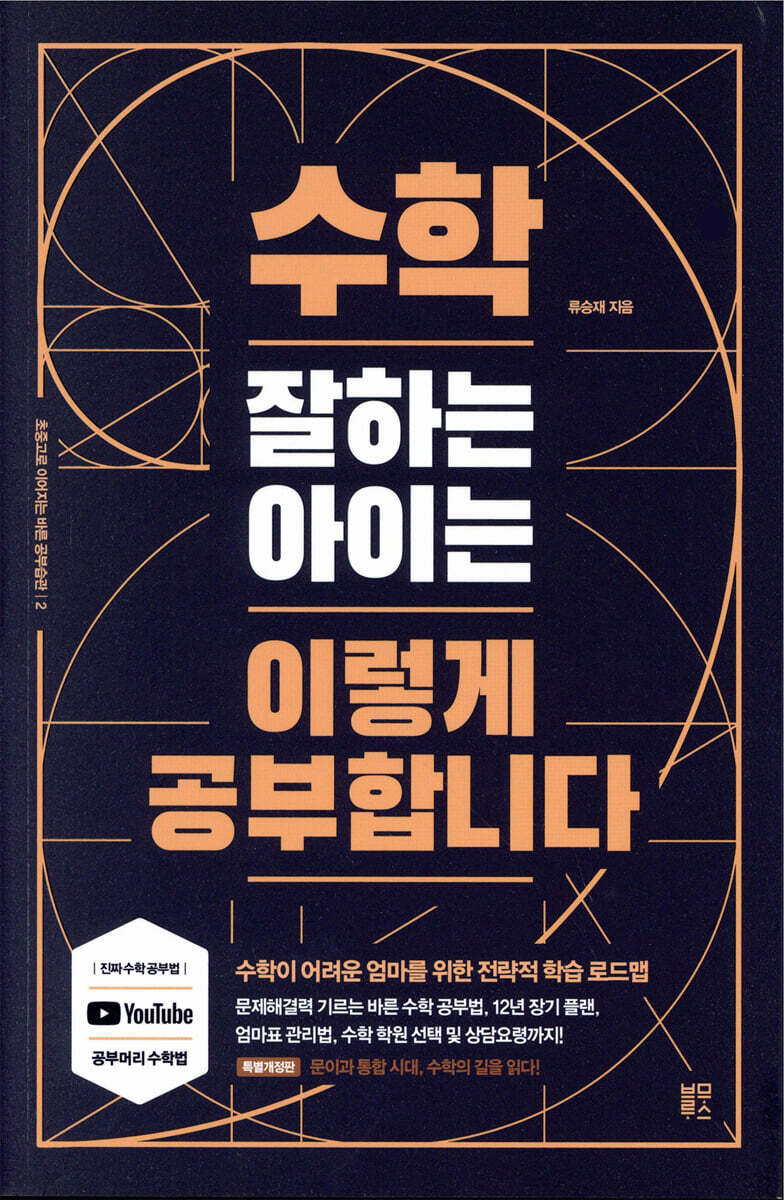
This is how kids who are good at math study
 |
Description
Book Introduction
A Real Math Study Method That Develops Thinking Power "Study Head Reading Method" by Seungpil Choi, highly recommended! The mathematics bestseller, a special revised edition to be published in 2023. Mathematics is a subject that accounts for a large proportion of overall study and has a large score difference, so much so that it is called the 'key' to college entrance exams. It is also the subject that children hate the most and in which they do not perform well. Because it's a spiral subject with similar concepts that become increasingly difficult and repetitive, it's crucial to establish good study habits from the beginning! This is why elementary school, the beginning of entrance exam math, is so crucial. This book guides you through a detailed process of improving your math grades by building a solid foundation in math from the basics and learning how to properly study on your own, from concepts to advanced levels. This starts with how to check where your child's skills are now, divides children into three groups based on their math skills, and provides specific guidance on what parents should do based on their child's level. We've compiled specific and practical information on how to guide your child to learn math concepts on their own, how to adjust the pace of deepening and advancing, how to choose appropriate textbooks, how to choose an academy that suits your child's personality, and even how to manage math as a mother. The newly published special revised edition, in line with the 2022 era of integrated liberal arts and sciences, contains a more detailed analysis of the revised curriculum. It contains a wealth of resources to help you prepare for the changing mathematics education landscape. It also provides a keen insight into the areas students need to prepare for in elementary and middle school, keeping pace with the changing college entrance exam system, through the eyes of a college entrance exam expert with 25 years of experience. |
- You can preview some of the book's contents.
Preview
index
Publishing a Revised Edition│Reading the Path of Mathematics in the Era of Liberal Arts and Science Integration
Prologue│The Right Way to Study Elementary Math for High School Math
Recommendation│Real Math Study that Cultivates the Power of Thinking
Chapter 1.
Why Math Grades Decline as Students Advance
I don't know my child's true abilities.
A math test that's too easy is hiding my child's true abilities.
I have to compete with kids who are getting better and better.
Lack of long-term vision
Private academies interfere with math studies.
Repeated learning of shepherds in elementary and middle school academies
Children who are losing the ability to study on their own
I don't know how to study math properly.
I don't know how to study math concepts
Lack of mathematical problem-solving skills
Failure to balance learning load
lack of language skills
● If my child goes to high school at his/her current level, what grade will he/she get?
Chapter 2.
Proper math study determines math grades.
To be good at math, you need to understand math properly.
What is the essence of studying mathematics?
Studying math properly takes a lot of time!
Math habits that must be instilled from elementary school
Good habits are easier to develop at a young age.
Habit 1 for being good at math.
self-directedness
Habits for being good at math 2.
The habit of organizing in my own language
Habit 3 for being good at math.
Counter question
Habits for being good at math 4.
Integrity
5 Habits for Being Good at Math
Self-made study plan
In-depth, not prior, study determines math skills.
Why Good Deeds Became So Popular: An Empirical Look at Good Deeds
Why Do We Do Good Deeds From Elementary School?: A Phenomenological Examination of Good Deeds
How to do good deeds correctly
Why Deepening is More Important than Precedence: Problem-Solving Skills
What is Mathematical Problem Solving?
What you need to practice to develop problem-solving skills
Completion of a virtuous cycle
Elementary Math: Everything You Need to Know About It
When solving a math problem, should I organize the equation and solve it?
What if my child does a lot of good deeds, but can't do the actual work?
Elementary, if you want to develop problem-solving skills, don't give wrong answers?
Do I really need to solve the math textbook?
Is critical thinking mathematics necessary?
What level of skill is required to advance to elementary school?
Can I skip the concept textbook and go straight to the advanced textbook during pre-learning?
● What is mathematical thinking?
Chapter 3.
Developing Good Study Habits for Elementary School Children
There is no effective study method.
What is the essence of study?
Why there are so many different brands of elementary school academies
Studying is a habit
No motivation needed to study
What happens when you study hard
A critical period that determines the formation of study habits
Preschool period to develop concentration
Elementary school period, when serious study habits are formed
Middle and high school years are a time when things roll on their own.
When you can't develop study habits
Build strength in your hips first
Develop the habit of always finishing things.
How to Get Unconscious Help When Studying
● To help your child study math properly, take away the answer sheets from them.
Chapter 4.
How to avoid failing at math with Mom's Math and self-study.
Is there any way to make homeschooling more efficient?
The reason homeschooling is difficult is because of the 'brain'
Effective Home Study 1.
Make a schedule
Effective home learning 2.
Set aside a separate place to study
Effective home learning 3.
Don't teach
Effective home learning 4.
Time-based study method
Things to watch out for in Mom's Math
Consistency in parenting attitude
Studying with your child while he or she studies
Studying about the subject being taught
Treat it rationally
Praise but don't be overly optimistic
Maintaining Appropriate Expectations for Children
Things to keep in mind when studying math on your own
Why Self-Taught Students Don't Reach Top Ranks
Develop self-directed thinking in math problems
Developing language skills through reading
Mom's Math: Elementary, Middle, and High School Roadmap
Preschool period
Elementary school period
Middle school
High school years
● Which Math Textbook Should I Choose?
Chapter 5.
Math academy, if you want to go and do well
Types and characteristics of math academies
Study rooms and officetels
training center
Small and medium-sized lecture-style math academy
Large-scale lecture-style math academy
Math academy specializing in individual tutoring
Math department academy
Comprehensive academy
Choosing the Right Math Academy for Your Child
Choosing an Elementary Math Academy
Choosing a Middle School Math Academy
Choosing a High School Math Academy
Things to check when consulting with an academy
Why grades don't improve even after attending academy for a long time
If you don't study hard
If you go to too many academies
If the academy gives you too much homework
If you are making progress quickly
If you don't rely on academies to develop your learning ability
Math academy fun
Just doing your homework properly will make you feel good.
What does it mean to "skip" your math homework?
What Parents Can Do to Prevent Bullying
How to help a child who quickly forgets what he or she learned at school
● Winter School, Should I Send My Child?
● Do I really need to attend the academy's vacation special lectures?
Chapter 6.
My child cannot become a water blisters
If you don't want to become a loser
Why and when do people become water blisters?
Crisis zone 1 for water blisters.
1st year of middle school
Crisis zone 2 for water blisters.
High school 1st year course
How to memorize math concepts
A thorough look at the characteristics of those who have failed
Why is my child bad at math?
Common characteristics of water blisters
The most effective way to prevent blisters
What should I do if I am already a water buffalo?
Types of blisters and how to overcome them
A child who seems like he or she would be good at math but is bad at it
A child who solves many problems and makes many mistakes vs. a child who solves few problems and makes few mistakes
A child who makes a lot of mistakes the first time they try to solve the puzzle, but gets them all right when they try again.
There's a kid who's only good at math?
Achieving a balance between prioritization and deepening prevents dropouts.
The pre-advancement strategy determines high school grades.
Advancement and enrichment appropriate to my child's level
● Is math follow-up necessary?
● If you have done advanced precepts but do not know anything about them
Chapter 7.
How to Study Math to Jump to the Top
How to Practice for a Math Test
A child who cannot read the problem accurately
A child who makes a lot of calculation mistakes
A child swayed by the environment
How to Correct Math Mistakes
The necessity of wrong answers
A formal wrong answer is not a wrong answer.
How to get the wrong answer periodically
Explain to yourself
How to properly read multiple times
What is multiple readings?
If multiple readings fail
3 Steps to Proper Rereading
How to Use Math Concept Notebooks, Worksheets, and Solution Notebooks
How to Organize Math Concept Notes Effectively
How to use the practice sheet
How to use the solution notes
Everything You Need to Know About Math Concepts
What are the basic concepts of mathematics?
What is the concept of mathematical type?
What is Advanced Mathematics?
How to teach yourself concepts
Students, to avoid falling into a slump
Negative views create slumps
Overcoming a slump 1.
regular life
Overcoming a slump 2.
Create a schedule
Overcoming a slump 3.
Creating a positive unconscious
Effective study methods
How to memorize efficiently
How to always stay focused
Follow the example of a good student
● Adolescents who don't study: causes and solutions
Epilogue│Experience Shows There's No Royal Road to Math Studying
Analysis of the Revised Curriculum│What Should We Prepare for in the Era of Liberal Arts and Science Integration?
Prologue│The Right Way to Study Elementary Math for High School Math
Recommendation│Real Math Study that Cultivates the Power of Thinking
Chapter 1.
Why Math Grades Decline as Students Advance
I don't know my child's true abilities.
A math test that's too easy is hiding my child's true abilities.
I have to compete with kids who are getting better and better.
Lack of long-term vision
Private academies interfere with math studies.
Repeated learning of shepherds in elementary and middle school academies
Children who are losing the ability to study on their own
I don't know how to study math properly.
I don't know how to study math concepts
Lack of mathematical problem-solving skills
Failure to balance learning load
lack of language skills
● If my child goes to high school at his/her current level, what grade will he/she get?
Chapter 2.
Proper math study determines math grades.
To be good at math, you need to understand math properly.
What is the essence of studying mathematics?
Studying math properly takes a lot of time!
Math habits that must be instilled from elementary school
Good habits are easier to develop at a young age.
Habit 1 for being good at math.
self-directedness
Habits for being good at math 2.
The habit of organizing in my own language
Habit 3 for being good at math.
Counter question
Habits for being good at math 4.
Integrity
5 Habits for Being Good at Math
Self-made study plan
In-depth, not prior, study determines math skills.
Why Good Deeds Became So Popular: An Empirical Look at Good Deeds
Why Do We Do Good Deeds From Elementary School?: A Phenomenological Examination of Good Deeds
How to do good deeds correctly
Why Deepening is More Important than Precedence: Problem-Solving Skills
What is Mathematical Problem Solving?
What you need to practice to develop problem-solving skills
Completion of a virtuous cycle
Elementary Math: Everything You Need to Know About It
When solving a math problem, should I organize the equation and solve it?
What if my child does a lot of good deeds, but can't do the actual work?
Elementary, if you want to develop problem-solving skills, don't give wrong answers?
Do I really need to solve the math textbook?
Is critical thinking mathematics necessary?
What level of skill is required to advance to elementary school?
Can I skip the concept textbook and go straight to the advanced textbook during pre-learning?
● What is mathematical thinking?
Chapter 3.
Developing Good Study Habits for Elementary School Children
There is no effective study method.
What is the essence of study?
Why there are so many different brands of elementary school academies
Studying is a habit
No motivation needed to study
What happens when you study hard
A critical period that determines the formation of study habits
Preschool period to develop concentration
Elementary school period, when serious study habits are formed
Middle and high school years are a time when things roll on their own.
When you can't develop study habits
Build strength in your hips first
Develop the habit of always finishing things.
How to Get Unconscious Help When Studying
● To help your child study math properly, take away the answer sheets from them.
Chapter 4.
How to avoid failing at math with Mom's Math and self-study.
Is there any way to make homeschooling more efficient?
The reason homeschooling is difficult is because of the 'brain'
Effective Home Study 1.
Make a schedule
Effective home learning 2.
Set aside a separate place to study
Effective home learning 3.
Don't teach
Effective home learning 4.
Time-based study method
Things to watch out for in Mom's Math
Consistency in parenting attitude
Studying with your child while he or she studies
Studying about the subject being taught
Treat it rationally
Praise but don't be overly optimistic
Maintaining Appropriate Expectations for Children
Things to keep in mind when studying math on your own
Why Self-Taught Students Don't Reach Top Ranks
Develop self-directed thinking in math problems
Developing language skills through reading
Mom's Math: Elementary, Middle, and High School Roadmap
Preschool period
Elementary school period
Middle school
High school years
● Which Math Textbook Should I Choose?
Chapter 5.
Math academy, if you want to go and do well
Types and characteristics of math academies
Study rooms and officetels
training center
Small and medium-sized lecture-style math academy
Large-scale lecture-style math academy
Math academy specializing in individual tutoring
Math department academy
Comprehensive academy
Choosing the Right Math Academy for Your Child
Choosing an Elementary Math Academy
Choosing a Middle School Math Academy
Choosing a High School Math Academy
Things to check when consulting with an academy
Why grades don't improve even after attending academy for a long time
If you don't study hard
If you go to too many academies
If the academy gives you too much homework
If you are making progress quickly
If you don't rely on academies to develop your learning ability
Math academy fun
Just doing your homework properly will make you feel good.
What does it mean to "skip" your math homework?
What Parents Can Do to Prevent Bullying
How to help a child who quickly forgets what he or she learned at school
● Winter School, Should I Send My Child?
● Do I really need to attend the academy's vacation special lectures?
Chapter 6.
My child cannot become a water blisters
If you don't want to become a loser
Why and when do people become water blisters?
Crisis zone 1 for water blisters.
1st year of middle school
Crisis zone 2 for water blisters.
High school 1st year course
How to memorize math concepts
A thorough look at the characteristics of those who have failed
Why is my child bad at math?
Common characteristics of water blisters
The most effective way to prevent blisters
What should I do if I am already a water buffalo?
Types of blisters and how to overcome them
A child who seems like he or she would be good at math but is bad at it
A child who solves many problems and makes many mistakes vs. a child who solves few problems and makes few mistakes
A child who makes a lot of mistakes the first time they try to solve the puzzle, but gets them all right when they try again.
There's a kid who's only good at math?
Achieving a balance between prioritization and deepening prevents dropouts.
The pre-advancement strategy determines high school grades.
Advancement and enrichment appropriate to my child's level
● Is math follow-up necessary?
● If you have done advanced precepts but do not know anything about them
Chapter 7.
How to Study Math to Jump to the Top
How to Practice for a Math Test
A child who cannot read the problem accurately
A child who makes a lot of calculation mistakes
A child swayed by the environment
How to Correct Math Mistakes
The necessity of wrong answers
A formal wrong answer is not a wrong answer.
How to get the wrong answer periodically
Explain to yourself
How to properly read multiple times
What is multiple readings?
If multiple readings fail
3 Steps to Proper Rereading
How to Use Math Concept Notebooks, Worksheets, and Solution Notebooks
How to Organize Math Concept Notes Effectively
How to use the practice sheet
How to use the solution notes
Everything You Need to Know About Math Concepts
What are the basic concepts of mathematics?
What is the concept of mathematical type?
What is Advanced Mathematics?
How to teach yourself concepts
Students, to avoid falling into a slump
Negative views create slumps
Overcoming a slump 1.
regular life
Overcoming a slump 2.
Create a schedule
Overcoming a slump 3.
Creating a positive unconscious
Effective study methods
How to memorize efficiently
How to always stay focused
Follow the example of a good student
● Adolescents who don't study: causes and solutions
Epilogue│Experience Shows There's No Royal Road to Math Studying
Analysis of the Revised Curriculum│What Should We Prepare for in the Era of Liberal Arts and Science Integration?
Detailed image

Into the book
To do well in advanced mathematics, you must develop good mathematics study habits from elementary school, and to develop good mathematics study habits, you must understand the essence of mathematics (the essence of studying mathematics).
Going back a little further, parents' parenting styles and attitudes during preschool years have a major impact on elementary school math study habits.
Everything is not independent, but organically intertwined.
This book details what you need to do from preschool through elementary and middle school to excel in higher mathematics.
--- p.8, from “The Correct Study Method for Elementary School Mathematics to Do Well in Advanced Mathematics”
It is said that there are many schools that are in the 40th percentile when converting an A grade into a relative evaluation.
If you convert the 40th percentile to a high school grade, it would be equivalent to a 4th grade.
This means that even if you received an A grade in math in middle school, you could get a 1st grade or a 4th grade depending on your ability when you advance to high school.
Usually, an A grade in a middle school where students are good at studying is spread out to high school grades 1-3, and an A grade in a middle school where students are not good at studying is spread out to high school grades 2-4.
--- p.23, from “Why Math Grades Decrease as Grade Levels Increase”
Just quietly observe your children solving math problems at home.
Most of the time, you will see them quickly solving the excessive amount of homework assigned by the academy, and instead of trying to solve the problems they can't solve on their own, they will mark them with stars or read the answer sheet to ask questions at the academy.
No matter how much homework there is, he has the magical ability to solve it in 1-2 hours.
This habit of thinking a little, asking questions about things you don't know, or looking at explanations is usually developed from elementary school.
If you don't get this habit, you'll never be good at math.
Solving a lot of problems doesn't improve your math skills.
Your skills will improve only when you gain the experience of thinking through and solving all problems on your own, no matter how small.
--- p.35~36, from “Why Math Grades Decrease as Grade Levels Increase”
To be good at math, you need to develop good habits from elementary school.
What singer Park Jin-young always emphasizes on audition programs is that there should be no bad habits.
It is easier to develop good habits when you are in a pure blank state with nothing on it.
When teaching students, there are times when bad habits are ingrained in them from their mother's math classes or other academies.
It is difficult to correct even if you are a middle school student, and it is almost impossible to correct from high school.
This is why we need to develop good habits from the moment we first start learning math in elementary school.
The following five 'math-successful habits' are essential to learn in elementary school.
It would be no exaggeration to say that the contents of this book are a methodology for developing these five habits.
--- p.55~56, from “Proper Math Study Determines Math Grades”
In general academies, if your skills are lacking, they do not allow you to take advanced classes.
Therefore, it is virtually impossible for students without problem-solving skills to develop them through academies.
Only students who have developed advanced skills before attending the academy will be given the highest level of advanced skills.
Therefore, even when students advance to higher grades, their math skills often remain the same as when they first entered the academy, with only a difference in progress.
Therefore, even if your child's skills are lacking, if you want to help them improve, you can gradually help them improve at home.
It is recommended to start with the most advanced textbooks starting from the third grade of elementary school.
If your child is very talented, he or she will learn quickly, and even if he or she is lacking, he or she can finish a semester of study in six months.
And the pace will gradually increase, so that by the time you reach 6th grade, you will be able to finish one high-level advanced textbook in one to two months.
--- p.97~98, from “Proper Math Study Determines Math Grades”
Teaching math in the early elementary grades requires a lot of caution.
Because children still lack the ability to understand letters and grasp their meaning, they often fail to understand the problem itself in descriptive or applied problems.
In that case, it is easy for learning to become a method where parents stay by the child's side and interpret and explain each problem one by one like a private tutor.
However, if this is done, the child will not be able to develop self-directed habits from the beginning, and will develop bad learning habits in which the child will continue to expect the mother to teach everything.
Children who start off on the wrong foot develop dependent study habits, and in middle and high school, when their mother's math is difficult, they will have to learn through private tutoring or academies to be able to study.
Going back a little further, parents' parenting styles and attitudes during preschool years have a major impact on elementary school math study habits.
Everything is not independent, but organically intertwined.
This book details what you need to do from preschool through elementary and middle school to excel in higher mathematics.
--- p.8, from “The Correct Study Method for Elementary School Mathematics to Do Well in Advanced Mathematics”
It is said that there are many schools that are in the 40th percentile when converting an A grade into a relative evaluation.
If you convert the 40th percentile to a high school grade, it would be equivalent to a 4th grade.
This means that even if you received an A grade in math in middle school, you could get a 1st grade or a 4th grade depending on your ability when you advance to high school.
Usually, an A grade in a middle school where students are good at studying is spread out to high school grades 1-3, and an A grade in a middle school where students are not good at studying is spread out to high school grades 2-4.
--- p.23, from “Why Math Grades Decrease as Grade Levels Increase”
Just quietly observe your children solving math problems at home.
Most of the time, you will see them quickly solving the excessive amount of homework assigned by the academy, and instead of trying to solve the problems they can't solve on their own, they will mark them with stars or read the answer sheet to ask questions at the academy.
No matter how much homework there is, he has the magical ability to solve it in 1-2 hours.
This habit of thinking a little, asking questions about things you don't know, or looking at explanations is usually developed from elementary school.
If you don't get this habit, you'll never be good at math.
Solving a lot of problems doesn't improve your math skills.
Your skills will improve only when you gain the experience of thinking through and solving all problems on your own, no matter how small.
--- p.35~36, from “Why Math Grades Decrease as Grade Levels Increase”
To be good at math, you need to develop good habits from elementary school.
What singer Park Jin-young always emphasizes on audition programs is that there should be no bad habits.
It is easier to develop good habits when you are in a pure blank state with nothing on it.
When teaching students, there are times when bad habits are ingrained in them from their mother's math classes or other academies.
It is difficult to correct even if you are a middle school student, and it is almost impossible to correct from high school.
This is why we need to develop good habits from the moment we first start learning math in elementary school.
The following five 'math-successful habits' are essential to learn in elementary school.
It would be no exaggeration to say that the contents of this book are a methodology for developing these five habits.
--- p.55~56, from “Proper Math Study Determines Math Grades”
In general academies, if your skills are lacking, they do not allow you to take advanced classes.
Therefore, it is virtually impossible for students without problem-solving skills to develop them through academies.
Only students who have developed advanced skills before attending the academy will be given the highest level of advanced skills.
Therefore, even when students advance to higher grades, their math skills often remain the same as when they first entered the academy, with only a difference in progress.
Therefore, even if your child's skills are lacking, if you want to help them improve, you can gradually help them improve at home.
It is recommended to start with the most advanced textbooks starting from the third grade of elementary school.
If your child is very talented, he or she will learn quickly, and even if he or she is lacking, he or she can finish a semester of study in six months.
And the pace will gradually increase, so that by the time you reach 6th grade, you will be able to finish one high-level advanced textbook in one to two months.
--- p.97~98, from “Proper Math Study Determines Math Grades”
Teaching math in the early elementary grades requires a lot of caution.
Because children still lack the ability to understand letters and grasp their meaning, they often fail to understand the problem itself in descriptive or applied problems.
In that case, it is easy for learning to become a method where parents stay by the child's side and interpret and explain each problem one by one like a private tutor.
However, if this is done, the child will not be able to develop self-directed habits from the beginning, and will develop bad learning habits in which the child will continue to expect the mother to teach everything.
Children who start off on the wrong foot develop dependent study habits, and in middle and high school, when their mother's math is difficult, they will have to learn through private tutoring or academies to be able to study.
--- p.171~172, from “How to not fail at math with mom and self-study”
Publisher's Review
“A child who was good at elementary school math,
“What good is it if your high school grades drop?”
Math is difficult and unsettling, so moms need to be strategists!
“Is my child really good at math?”
It is now almost an established fact that elementary school math skills do not guarantee advanced math skills.
So even if their child gets a perfect score on the test, passes the difficult entrance exam for a private academy, or attends two or three private academies, parents are still anxious.
Like everyone else, I'm sending my child to cram schools and solving workbooks, but is this the right thing to do? What should parents do to ensure their children continue to excel in math through high school?
A book has been published that provides refreshing answers to the subject of mathematics, which can be unsettling even if you do well and even more so if you do poorly.
"This is how kids who are good at math study" proposes a roadmap for elementary, middle, and high school math learning that will ensure success in advanced math.
The author, who has worked in the field of mathematics for 23 years, has systematically organized the things that parents must check and practice for their children over the 12 years of elementary, middle, and high school.
It covers specific and practical information, including how to guide your child to study properly, how to adjust the pace of in-depth and advanced study, how to select appropriate textbooks, how to choose an academy that suits your child's personality, and even how to manage math as a mother.
In this harsh reality of mathematics where you never know what might happen, this can be called the math version of 'Beep Beep 119', which helps you overcome difficulties by referring to it whenever you don't know something.
If you want to raise a child who is good at math, this is a must-read!
◆ A 'long-term roadmap' that is not taught in typical math study methods
The roadmap presented in this book was developed by the author over 23 years of teaching and observing children from elementary to high school, from dropouts to top-tier students, in private education settings like Gangnam and Mokdong.
By clearly explaining what parents can do for their children according to their age, level, and situation, we can help them achieve success in math.
It is more specific, based on the author's experience of sending students to prestigious universities, the author's experience teaching elementary school children, and even examples of students who dropped out of school.
◆ A math study method that will make you good at math
The core of studying mathematics is 'problem-solving skills' that must be developed from elementary school, and the core of problem-solving skills lies in 'self-initiative'.
This book presents detailed methods and parental strategies for fostering problem-solving skills and self-directed learning.
Because it is broken down by age and skill level, anyone can read and apply this book.
However, the golden time for developing problem-solving skills is clear, so it is a good book to pick up when your child is even one year younger.
Study habits that will help you excel in all subjects, not just math
Apart from teaching you how to study math correctly, it also teaches you study habits to develop from elementary school.
Developing strength in your hips and studying diligently and independently is a key part of studying math, and it will help you do well in all subjects.
Of course, it is far from any of the 'special or efficient' memory or study methods available on the market.
It is faithful to the essence of study habits and is full of methods for understanding and knowing the essence.
“What good is it if your high school grades drop?”
Math is difficult and unsettling, so moms need to be strategists!
“Is my child really good at math?”
It is now almost an established fact that elementary school math skills do not guarantee advanced math skills.
So even if their child gets a perfect score on the test, passes the difficult entrance exam for a private academy, or attends two or three private academies, parents are still anxious.
Like everyone else, I'm sending my child to cram schools and solving workbooks, but is this the right thing to do? What should parents do to ensure their children continue to excel in math through high school?
A book has been published that provides refreshing answers to the subject of mathematics, which can be unsettling even if you do well and even more so if you do poorly.
"This is how kids who are good at math study" proposes a roadmap for elementary, middle, and high school math learning that will ensure success in advanced math.
The author, who has worked in the field of mathematics for 23 years, has systematically organized the things that parents must check and practice for their children over the 12 years of elementary, middle, and high school.
It covers specific and practical information, including how to guide your child to study properly, how to adjust the pace of in-depth and advanced study, how to select appropriate textbooks, how to choose an academy that suits your child's personality, and even how to manage math as a mother.
In this harsh reality of mathematics where you never know what might happen, this can be called the math version of 'Beep Beep 119', which helps you overcome difficulties by referring to it whenever you don't know something.
If you want to raise a child who is good at math, this is a must-read!
◆ A 'long-term roadmap' that is not taught in typical math study methods
The roadmap presented in this book was developed by the author over 23 years of teaching and observing children from elementary to high school, from dropouts to top-tier students, in private education settings like Gangnam and Mokdong.
By clearly explaining what parents can do for their children according to their age, level, and situation, we can help them achieve success in math.
It is more specific, based on the author's experience of sending students to prestigious universities, the author's experience teaching elementary school children, and even examples of students who dropped out of school.
◆ A math study method that will make you good at math
The core of studying mathematics is 'problem-solving skills' that must be developed from elementary school, and the core of problem-solving skills lies in 'self-initiative'.
This book presents detailed methods and parental strategies for fostering problem-solving skills and self-directed learning.
Because it is broken down by age and skill level, anyone can read and apply this book.
However, the golden time for developing problem-solving skills is clear, so it is a good book to pick up when your child is even one year younger.
Study habits that will help you excel in all subjects, not just math
Apart from teaching you how to study math correctly, it also teaches you study habits to develop from elementary school.
Developing strength in your hips and studying diligently and independently is a key part of studying math, and it will help you do well in all subjects.
Of course, it is far from any of the 'special or efficient' memory or study methods available on the market.
It is faithful to the essence of study habits and is full of methods for understanding and knowing the essence.
GOODS SPECIFICS
- Publication date: December 9, 2022
- Page count, weight, size: 336 pages | 508g | 147*223*21mm
- ISBN13: 9791196848194
- ISBN10: 119684819X
You may also like
카테고리
korean


korean

![ELLE 엘르 스페셜 에디션 A형 : 12월 [2025]](http://librairie.coreenne.fr/cdn/shop/files/b8e27a3de6c9538896439686c6b0e8fb.jpg?v=1766436872&width=3840)


