

There is no grade more important than third grade.
 |
Description
Book Introduction
The learning gap begins in third grade and deepens in fifth grade! My third grader has probably adjusted to school life to some extent, so I feel relieved. But did you know that the learning gap that will determine future middle and high school grades and college entrance exam scores begins to appear in the third grade and worsens in the fifth grade? That's why third grade is so crucial, as the saying goes, "If you miss it, you miss everything." Third graders, who have barely shed their elementary school image, are receiving the most difficult classes of their lives, and even though they can't tell their parents, they are in a world of chaos. “Hey, what’s wrong with a third grader with such a learning gap?”, “Even if they can’t do it now, they’ll do well later.” Please don’t let these denials and baseless hopes hold back your child’s future, when with just a little bit of support, they could easily reach the top. Happy Lee, an elementary school teacher who has seen and guided countless children like this, offers practical advice on elementary school study methods for parents of third-grade students, whose gaps are beginning to emerge, and fifth-grade students, whose gaps are widening! She offers detailed guidance for each semester, vacation, and subject. A third grader is like an unscratched lottery ticket. The child's future depends on what the parents do. |
- You can preview some of the book's contents.
Preview
index
Preface 05
PART 1: Third Grade: The Learning Gap Begins
Don't miss your second year winter break!
Chapter 1: 3rd Grade: Don't Let Your Guard Down, You'll Regret It
01 Why the learning gap appears in third grade
Peaceful 1st and 2nd grades
Third year, when turbulence begins
The most important role of parents of third graders
02 Subjects and fields with the greatest gaps
The first subject that gave me a mental breakdown
Math: Getting More Difficult
- Happy Teacher Lee's On-the-Spot Advice: The Truth About Unit Assessments
03 Third grader, is my child ahead or behind the gap?
Korean language checklist
English Checklist
Math Checklist
Social Checklist
Science Checklist
04 Characteristics of children who show a gap
Super Gap Kids
Children at the Edge of the Gap
Happy Lee's On-the-Spot Advice: The Problem with Your Child's Smartphone Addiction and 5 Solutions
05 The Reality of a Third Grade Elementary Classroom
Korean Language Class: I have difficulty thinking and writing.
English Class: The Difference in Skills Is Clear
Math Lessons: Lack of Concentration Leads to Underachievement
Social Studies: I hate it because it's boring and there's a lot of homework.
Science class: Actively participating but unable to summarize results
- Happy Lee's On-the-Spot Advice: Third-Grade Students' Boundless Concern for Grades
06 What happens when the revealed gap cannot be narrowed?
Korean: Even if you read books, your literacy skills will decline.
Confidence is falling
Math: It's Doodling Time
Social Studies & Science: Difficulty participating in class activities
Happy Lee's On-the-Spot Advice: Parents' Endless Concerns: Pre-Learning Math and English
Chapter 2: It's Not Too Late for Third Graders
01 Reducing the gap between subjects during the semester
Korean: Pre-study is important
Parental attention and guidance are needed.
Math: Developing Good Problem-Solving Habits
Society: Gain background knowledge through reading.
Science: Learn terminology and organize your experimental observation book.
- Happy Mr. Lee's on-site advice: The truth about report cards?
02 Reducing subject gaps during vacation
Korean: Read textbooks carefully and read books consistently.
Repeat your favorite content
Math: Review with textbooks and workbooks
Chapter 3: A good third grader, so he needs to improve further.
01 Learning Suggestions for Children with Super-Gap Disabilities
Korean: Read the book in Korean
Provides various study methods
Math: Review with repetitive learning and advanced problem solving.
Society: Studying with an address
Science: Structuring Learning Content
02 Extracurricular Activity Suggestions for Children with Disabilities
Reading pre-learning
Preparation for the gifted academy
- Happy Lee's On-the-Spot Advice: Repeated Reading & Copying
03 Parents' Attitudes Toward Children with Super-Gap Disabilities
04 Arts and Physical Education that will boost your confidence when you fill it out
- Happy Lee's on-site advice: Is private arts and physical education really necessary?
PART 2: Fifth Grade: The Learning Gap Widens
Chapter 1: Already in 5th grade, there's still time.
01 The period of change for children, 5th grade of elementary school
- Happy Teacher Lee's on-the-spot advice: What if your child asks why they should study?
02 Subjects and fields with the greatest gaps
It gets harder
Math: Difficult concepts pour in
Society: Korean history is so unfamiliar.
03 5th grader, is my child ahead or behind the gap?
Korean language checklist
English Checklist
Math Checklist
Social Checklist
Science Checklist
04 Characteristics of children who show a gap
Super-gap children beyond imagination
Children at the Edge of the Gap
- Happy Lee's On-the-Spot Advice: 5 Surprising Things High-School Students Have in Common
05 The Reality of a Fifth Grade Classroom
Korean Language Class: Academic Disparity Severe
English Class: There Are Many Silent Children
Math Class: Everyone's Ability to Calculate Varies
Social Studies: I'm having trouble with Korean history when I first learn it.
Science class: Kids who excel at studying take the lead in group activities.
06 What happens when the revealed gap cannot be narrowed?
Korean: It has a negative impact on other subjects.
English: English speakers are popping up in droves.
Mathematics: The mathematics system leading up to secondary school is collapsing.
Society: I don't understand the material presented.
Science: Misconceptions Can Persist
- Happy Teacher Lee's on-site advice: If your 5th grader is studying middle school math
Chapter 2: The Last Golden Time to Close the Learning Gap: Fifth Graders in Elementary School
01 Reducing the gap between subjects during the semester
Korean: Reading according to the child's characteristics
- Happy Lee's on-site advice: Would it be a good idea to review Korean grammar before entering middle school?
Read short, easy storybooks repeatedly.
Math: Repeatedly solve problems from your math textbook and workbook.
Society: Build background knowledge of society and Korean history.
Science: Summary of Key Points 246
- Happy Teacher Lee's On-the-Spot Advice: Do you know how to purchase teacher's guides?
02 Reducing subject gaps during vacation
Korean: Make dictionary search and reading a Korean language a part of your daily life.
Memorize vocabulary and key sentences from last semester.
Math: A comprehensive review of math up to grade 5.
Chapter 3: A good fifth grader, so he needs to improve further.
01 Learning Suggestions for Children with Super-Gap Disabilities
Korean: Find and read the original text of the work included in the textbook.
Study by dividing into areas
Math: Organize core math concepts in a notebook.
Society: Study world history in advance.
Science: Use scientific magazines and programs.
- Happy Lee's On-the-Spot Advice: 3 Ways to Develop Self-Study Habits
02 Extracurricular Activity Suggestions for Children with Disabilities
Develop three writing habits
Software training
03 Parents' Attitudes Toward Children with Super-Gap Disabilities
- Happy Teacher Lee's On-the-Spot Advice: 4 Study Habits of Highly Effective Students
Conclusion
Appendix: Recommended Reading List for 3rd and 5th Graders
PART 1: Third Grade: The Learning Gap Begins
Don't miss your second year winter break!
Chapter 1: 3rd Grade: Don't Let Your Guard Down, You'll Regret It
01 Why the learning gap appears in third grade
Peaceful 1st and 2nd grades
Third year, when turbulence begins
The most important role of parents of third graders
02 Subjects and fields with the greatest gaps
The first subject that gave me a mental breakdown
Math: Getting More Difficult
- Happy Teacher Lee's On-the-Spot Advice: The Truth About Unit Assessments
03 Third grader, is my child ahead or behind the gap?
Korean language checklist
English Checklist
Math Checklist
Social Checklist
Science Checklist
04 Characteristics of children who show a gap
Super Gap Kids
Children at the Edge of the Gap
Happy Lee's On-the-Spot Advice: The Problem with Your Child's Smartphone Addiction and 5 Solutions
05 The Reality of a Third Grade Elementary Classroom
Korean Language Class: I have difficulty thinking and writing.
English Class: The Difference in Skills Is Clear
Math Lessons: Lack of Concentration Leads to Underachievement
Social Studies: I hate it because it's boring and there's a lot of homework.
Science class: Actively participating but unable to summarize results
- Happy Lee's On-the-Spot Advice: Third-Grade Students' Boundless Concern for Grades
06 What happens when the revealed gap cannot be narrowed?
Korean: Even if you read books, your literacy skills will decline.
Confidence is falling
Math: It's Doodling Time
Social Studies & Science: Difficulty participating in class activities
Happy Lee's On-the-Spot Advice: Parents' Endless Concerns: Pre-Learning Math and English
Chapter 2: It's Not Too Late for Third Graders
01 Reducing the gap between subjects during the semester
Korean: Pre-study is important
Parental attention and guidance are needed.
Math: Developing Good Problem-Solving Habits
Society: Gain background knowledge through reading.
Science: Learn terminology and organize your experimental observation book.
- Happy Mr. Lee's on-site advice: The truth about report cards?
02 Reducing subject gaps during vacation
Korean: Read textbooks carefully and read books consistently.
Repeat your favorite content
Math: Review with textbooks and workbooks
Chapter 3: A good third grader, so he needs to improve further.
01 Learning Suggestions for Children with Super-Gap Disabilities
Korean: Read the book in Korean
Provides various study methods
Math: Review with repetitive learning and advanced problem solving.
Society: Studying with an address
Science: Structuring Learning Content
02 Extracurricular Activity Suggestions for Children with Disabilities
Reading pre-learning
Preparation for the gifted academy
- Happy Lee's On-the-Spot Advice: Repeated Reading & Copying
03 Parents' Attitudes Toward Children with Super-Gap Disabilities
04 Arts and Physical Education that will boost your confidence when you fill it out
- Happy Lee's on-site advice: Is private arts and physical education really necessary?
PART 2: Fifth Grade: The Learning Gap Widens
Chapter 1: Already in 5th grade, there's still time.
01 The period of change for children, 5th grade of elementary school
- Happy Teacher Lee's on-the-spot advice: What if your child asks why they should study?
02 Subjects and fields with the greatest gaps
It gets harder
Math: Difficult concepts pour in
Society: Korean history is so unfamiliar.
03 5th grader, is my child ahead or behind the gap?
Korean language checklist
English Checklist
Math Checklist
Social Checklist
Science Checklist
04 Characteristics of children who show a gap
Super-gap children beyond imagination
Children at the Edge of the Gap
- Happy Lee's On-the-Spot Advice: 5 Surprising Things High-School Students Have in Common
05 The Reality of a Fifth Grade Classroom
Korean Language Class: Academic Disparity Severe
English Class: There Are Many Silent Children
Math Class: Everyone's Ability to Calculate Varies
Social Studies: I'm having trouble with Korean history when I first learn it.
Science class: Kids who excel at studying take the lead in group activities.
06 What happens when the revealed gap cannot be narrowed?
Korean: It has a negative impact on other subjects.
English: English speakers are popping up in droves.
Mathematics: The mathematics system leading up to secondary school is collapsing.
Society: I don't understand the material presented.
Science: Misconceptions Can Persist
- Happy Teacher Lee's on-site advice: If your 5th grader is studying middle school math
Chapter 2: The Last Golden Time to Close the Learning Gap: Fifth Graders in Elementary School
01 Reducing the gap between subjects during the semester
Korean: Reading according to the child's characteristics
- Happy Lee's on-site advice: Would it be a good idea to review Korean grammar before entering middle school?
Read short, easy storybooks repeatedly.
Math: Repeatedly solve problems from your math textbook and workbook.
Society: Build background knowledge of society and Korean history.
Science: Summary of Key Points 246
- Happy Teacher Lee's On-the-Spot Advice: Do you know how to purchase teacher's guides?
02 Reducing subject gaps during vacation
Korean: Make dictionary search and reading a Korean language a part of your daily life.
Memorize vocabulary and key sentences from last semester.
Math: A comprehensive review of math up to grade 5.
Chapter 3: A good fifth grader, so he needs to improve further.
01 Learning Suggestions for Children with Super-Gap Disabilities
Korean: Find and read the original text of the work included in the textbook.
Study by dividing into areas
Math: Organize core math concepts in a notebook.
Society: Study world history in advance.
Science: Use scientific magazines and programs.
- Happy Lee's On-the-Spot Advice: 3 Ways to Develop Self-Study Habits
02 Extracurricular Activity Suggestions for Children with Disabilities
Develop three writing habits
Software training
03 Parents' Attitudes Toward Children with Super-Gap Disabilities
- Happy Teacher Lee's On-the-Spot Advice: 4 Study Habits of Highly Effective Students
Conclusion
Appendix: Recommended Reading List for 3rd and 5th Graders
Detailed image
Publisher's Review
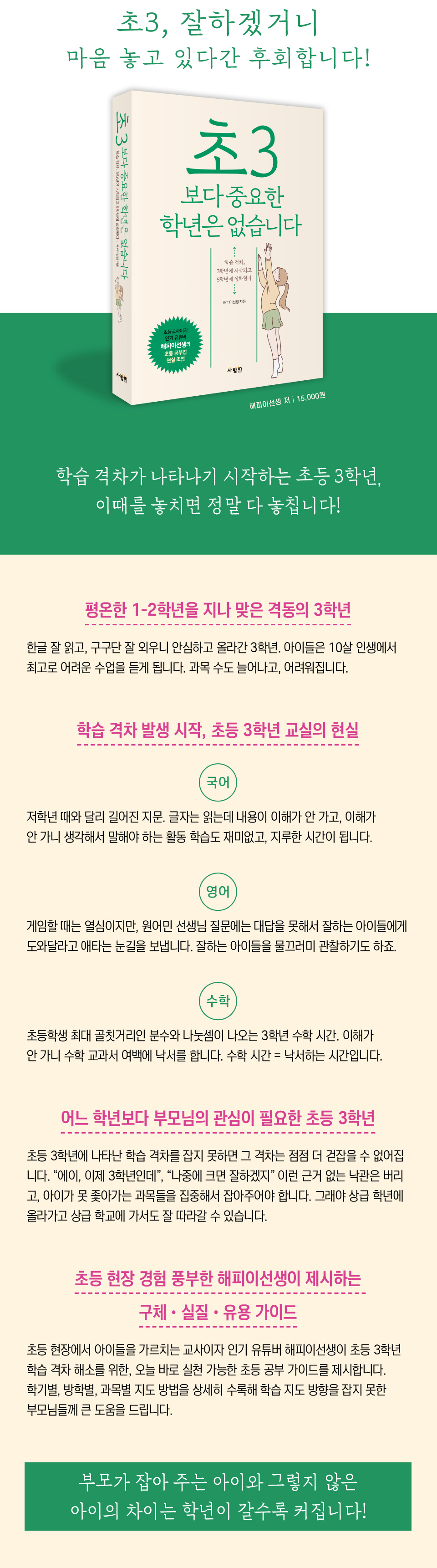
3rd grade, don't let your guard down and think you'll do well, or you'll regret it!
5th grade, the last golden time to catch up!
Don't be fooled by the 80 points you received on the relatively easy unit test designed to motivate you to study, or the behavioral development section on your report card, which is written down as best as possible even if you are a troublemaker and have poor academic performance, because it will be recorded on your NICE record.
For a child who has passed the peaceful first and second grades and entered the turbulent third grade without any preparation, everything is unfamiliar and difficult.
The English alphabet is confusing and words are read sporadically, but then a self-introduction sentence suddenly appears, and division and fractions, the biggest headaches for elementary school students, also appear at this time.
Since I can't understand what the teacher is saying, the teacher's explanation at the podium sounds like an alien language.
So, math class becomes a time to scribble in the margins of the textbook, and English class becomes a time to observe the children who are doing well.
Isn't that an exaggeration? This is the reality of a third-grade classroom.
The same goes for 5th graders.
Fifth grade is the time when children learn things that are related to what they will learn in middle school, and parents who are interested in education should pay more attention to their children's studies in fifth grade than in sixth grade.
It is really difficult for children who are not good at studying in the 5th grade to do well in their studies when they move on to higher grades.
By the time they reach fifth grade, children begin to judge themselves as either good at studying or not, and act accordingly.
But parents who foolishly believe that their children will do well later because they are only in 3rd or 5th grade, if they do not try to narrow the gap that starts to appear in 3rd grade and gets worse in 5th grade with the thought, "They will do well later, they have to study on their own," the gap will only widen uncontrollably.
This is not simply a learning issue, but a critical issue that affects a child's self-esteem, confidence, and even future college entrance exam scores.
Now, my child is 10 years old and in 3rd grade, and my child is 12 years old and in 5th grade. There are still nearly 10 years left to go, so I can't afford to be left behind.
If the gap between a good student and a good student is 10 centimeters in the third grade, it will increase in size as the grade level increases, and eventually become unmanageable.
Now, when I'm in third grade, please help me close the gap.
Fifth grade is your last chance to close this gap.
For parents who are worried about how to properly support their children's learning, Happy Teacher, who has taught many children in the educational field, has gathered her experience and provides parents with a practical and specific guide that can be put into practice today.
This book provides practical and useful information on how to support your child when he or she becomes a super-smart learner, providing clear guidance for guiding your child's learning.
Please remember that the difference between children who are supported by their parents and those who are not is enormous, and please join us in bridging the learning gap between children.
5th grade, the last golden time to catch up!
Don't be fooled by the 80 points you received on the relatively easy unit test designed to motivate you to study, or the behavioral development section on your report card, which is written down as best as possible even if you are a troublemaker and have poor academic performance, because it will be recorded on your NICE record.
For a child who has passed the peaceful first and second grades and entered the turbulent third grade without any preparation, everything is unfamiliar and difficult.
The English alphabet is confusing and words are read sporadically, but then a self-introduction sentence suddenly appears, and division and fractions, the biggest headaches for elementary school students, also appear at this time.
Since I can't understand what the teacher is saying, the teacher's explanation at the podium sounds like an alien language.
So, math class becomes a time to scribble in the margins of the textbook, and English class becomes a time to observe the children who are doing well.
Isn't that an exaggeration? This is the reality of a third-grade classroom.
The same goes for 5th graders.
Fifth grade is the time when children learn things that are related to what they will learn in middle school, and parents who are interested in education should pay more attention to their children's studies in fifth grade than in sixth grade.
It is really difficult for children who are not good at studying in the 5th grade to do well in their studies when they move on to higher grades.
By the time they reach fifth grade, children begin to judge themselves as either good at studying or not, and act accordingly.
But parents who foolishly believe that their children will do well later because they are only in 3rd or 5th grade, if they do not try to narrow the gap that starts to appear in 3rd grade and gets worse in 5th grade with the thought, "They will do well later, they have to study on their own," the gap will only widen uncontrollably.
This is not simply a learning issue, but a critical issue that affects a child's self-esteem, confidence, and even future college entrance exam scores.
Now, my child is 10 years old and in 3rd grade, and my child is 12 years old and in 5th grade. There are still nearly 10 years left to go, so I can't afford to be left behind.
If the gap between a good student and a good student is 10 centimeters in the third grade, it will increase in size as the grade level increases, and eventually become unmanageable.
Now, when I'm in third grade, please help me close the gap.
Fifth grade is your last chance to close this gap.
For parents who are worried about how to properly support their children's learning, Happy Teacher, who has taught many children in the educational field, has gathered her experience and provides parents with a practical and specific guide that can be put into practice today.
This book provides practical and useful information on how to support your child when he or she becomes a super-smart learner, providing clear guidance for guiding your child's learning.
Please remember that the difference between children who are supported by their parents and those who are not is enormous, and please join us in bridging the learning gap between children.
GOODS SPECIFICS
- Publication date: October 28, 2020
- Page count, weight, size: 340 pages | 554g | 148*210*22mm
- ISBN13: 9788960498679
- ISBN10: 896049867X
You may also like
카테고리
korean


korean

![ELLE 엘르 스페셜 에디션 A형 : 12월 [2025]](http://librairie.coreenne.fr/cdn/shop/files/b8e27a3de6c9538896439686c6b0e8fb.jpg?v=1766436872&width=3840)


