

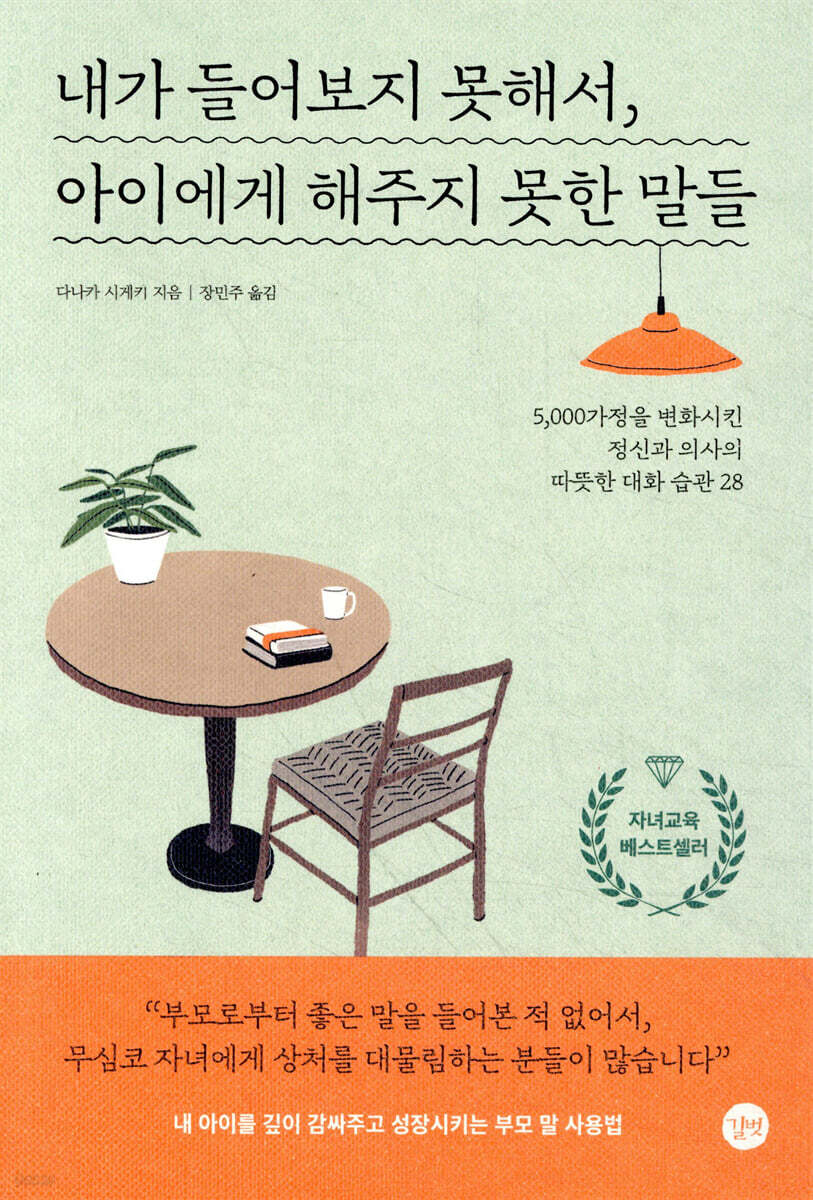
Words I couldn't say to my child because I hadn't heard them
 |
Description
Book Introduction
- A word from MD
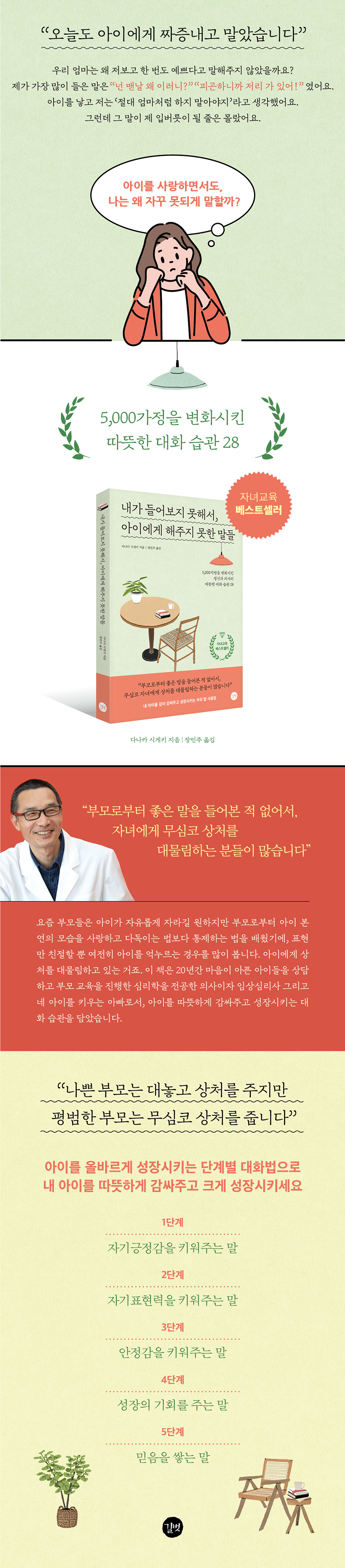
- "I ended up getting annoyed with my child again today.
"Why do we keep saying mean things to our children even though we love them?" A psychiatrist who majored in psychology and a father of four shares his tips on how to use warm parenting words to deeply embrace and nurture your children.
We introduce a step-by-step conversation method to raise your child properly and how to warmly embrace and help them grow up well.
- Kim Hyun-joo, MD of Home Living
“I never heard anything good from my parents.
“There are many parents who inadvertently pass on their wounds to their children.”
"I don't want to raise my child like my parents did. I just want to give them lots of love. Why do I keep getting irritated and being rude to them?" Many parents only want to be good to their children, but they think and act the same way their parents did to them.
The author of Amazon's bestselling book on parenting, "Things I Never Heard, So I Couldn't Say to My Child," is a doctor and clinical psychologist with a degree in psychology, and a working father who raised four children on his own.
What he realized after counseling children and their parents in pain for over 20 years is that “there are many parents who inadvertently pass on their hurt to their children because they have never heard kind words from their parents.”
"Words I Couldn't Say to My Child Because I Never Heard Them" contains the author's insights into how to use parental language, learned through counseling heartbroken children and their parents for over 20 years, and words that warmly embrace children while helping them break the cycle of hurt and develop their potential.
“There are many parents who inadvertently pass on their wounds to their children.”
"I don't want to raise my child like my parents did. I just want to give them lots of love. Why do I keep getting irritated and being rude to them?" Many parents only want to be good to their children, but they think and act the same way their parents did to them.
The author of Amazon's bestselling book on parenting, "Things I Never Heard, So I Couldn't Say to My Child," is a doctor and clinical psychologist with a degree in psychology, and a working father who raised four children on his own.
What he realized after counseling children and their parents in pain for over 20 years is that “there are many parents who inadvertently pass on their hurt to their children because they have never heard kind words from their parents.”
"Words I Couldn't Say to My Child Because I Never Heard Them" contains the author's insights into how to use parental language, learned through counseling heartbroken children and their parents for over 20 years, and words that warmly embrace children while helping them break the cycle of hurt and develop their potential.
- You can preview some of the book's contents.
Preview
index
To parents who love their children but end up hurting them unintentionally
Part 1.
Words that help build a child's self-esteem
When you are afraid of hospital visits or injections
Words said without thinking, “Don’t cry, just endure it bravely.” Words that boost self-esteem, “You were in pain, weren’t you? You endured it bravely.”
When you don't want to brush your teeth
Words we say without thinking “If you don’t brush your teeth, you’ll get cavities.” Words that boost self-esteem “I hate brushing my teeth so much, it’s embarrassing!”
When a child urges
Words said without thinking, “I told you to wait!” 〉〉 Words that boost self-esteem, “I’m really looking forward to it~”
When eating and spilling food
Words said without thinking, “I told you it would spill if you did that! Why are you so careless?” Words that build self-esteem, “It’s okay, that’s possible.
“I’ll wipe it for you.”
When you act like you want to do whatever you want
A thought that comes to mind without thinking, 'Is it okay to accept this kind of behavior?' 〉〉 A thought that builds self-esteem, 'It's only now that I'm crying because things don't go my way.'
[Thinking More About Your Child | A Parenting Book That Gives You Peace of Mind, Not a Grim Reaper]
Part 2.
Words that help children develop self-expression skills
When you don't want to eat vegetables
A thoughtless remark: “Let’s eat vegetables too.”
“It’s good for your health.” 〉〉 Phrases that help you develop self-expression “Hmm, eating vegetables is hard.”
[Thinking More About Your Child | Should You Teach English From a Young Age?]
When my younger sibling was born, I became more stubborn.
Words said without thinking “The baby is crying, so wait a minute!” Words that help develop self-expression “Mom and Dad were so happy when you were born.”
When you finish eating without spilling or spilling food
A casual remark: “Good job.”
“It’s great!” 〉〉 Phrases that help develop self-expression “Was it delicious?”
When sucking your fingers or biting your nails
Words said without thinking, “You’re in elementary school now, so you shouldn’t act like that!” 〉〉 Words that help develop self-expression, “I hope elementary school is fun.”
Part 3.
Words that help children feel secure
When you're completely absorbed in watching TV
A thoughtless remark: “Why don’t you study when you’re watching TV like that?” A remark that builds a sense of stability: “You’re so focused! I’ll put a drink right next to you.”
When you refuse to go to school, saying, “I’m not going to school anymore!”
Words said without thinking “That’s not what I meant!” Words that build a sense of security “You must hate it that much.”
[Thinking More About Your Child | When You Think Your Child Might Have a Developmental Disability]
When your child asks to exercise together
Words said without thinking, “If you’re going to do it, do it right.” Words that build a sense of stability, “This is so much fun.”
If you want to raise a confident child
Words said without thinking, “It’s cool that you did such a great job!” Words that build a sense of stability, “You’re cool just the way you are.”
When making a false claim
A casual remark: “No, that’s wrong.
Because~” 〉〉 Words that foster a sense of security “It’s a good thing to be able to say what you think.”
[Thinking More About Children | Even Obedient Children Have Problems]
When the toy is clumsy and seems like it might break
Words said without thinking, “If you touch it, it will break.” Words that build a sense of security, “It’s broken.”
What should I do?
Part 4.
Words that give children a chance to grow
When you don't do your homework on time and just put it off
A thoughtless remark: “Have you finished your homework?” A remark that provides an opportunity for growth: “When is the best time to do your homework?”
When I'm watching TV late at night
Words said without thinking, “How long are you going to watch TV?” Words that give you a chance to grow, “I’ll sleep first~.”
good night!"
[Thinking More About Your Child | What It Means to Play with Your Child]
When you feel uncomfortable even after helping another family's child
A thought that comes to mind: "How did this child's parents raise him?" A thought that provides an opportunity for growth: "It's a happy thing to be able to help a child in trouble."
When you are very upset by your child's behavior
Words said without thinking, “If you’re going to do whatever you want, get out of my house!” Words that give you a chance to grow, “You are my treasure!”
When you think you can barely do it even if your parents tell you to
A careless remark: “Do you really have to do this?” 〉〉 A remark that gives you an opportunity for growth: “I’m sorry I made you do it before you could do it yourself.”
When you talk loudly at an amusement park
Words said without thinking, “If you keep talking like that, I won’t bring you back!” Words that give you a chance to grow, “I won’t nag you today!”
[Thinking More About Your Child | Always Express Gratitude]
When I got a call from school
Words said without thinking, “Behave yourself at school!” Words that give you a chance to grow, “I think the teacher really likes you.”
When you only say rebellious things
Words said without thinking “That’s something you should say to your parents!” 〉〉 Words that give you a chance to grow “Are you speaking too loudly?”
[Thinking More About Your Child | It's Better to Scold Than Get Angry]
Part 5.
Words that build trust in children
When you take off your clothes and leave them anywhere
A thoughtless remark: “I told you to put the laundry in the washing machine!” 〉〉 A thought that builds trust: “Organizing is good exercise!”
When a child fails
Words said without thinking “If you had just done as Mom said, things wouldn’t have turned out like this!” 〉〉 Words that build trust “Was it hard?”
If you want to support your child's life
Words said without thinking, “I hope you can live freely doing what you like.” Words that build trust, “I like it the way it is now.
I really like you the way you are now.
"
[Thinking More About Your Child | How Should You Respond If Your Child Self-Harms?]
When you are worried about your career path
Words said without thinking, “If you just get into that school, everything will be solved!” 〉〉 Words that build trust, “You’ve worked hard.
“I see you’re worried.”
When you keep looking at your smartphone
Words said without thinking, “I’ll confiscate your smartphone for a moment!” 〉〉 Words that build trust, “This is important, so tell me what you think.”
[Thinking More About Children | The People Who Support My Parenting]
In conclusion | At some point, parents must change from being warm to watching.
Part 1.
Words that help build a child's self-esteem
When you are afraid of hospital visits or injections
Words said without thinking, “Don’t cry, just endure it bravely.” Words that boost self-esteem, “You were in pain, weren’t you? You endured it bravely.”
When you don't want to brush your teeth
Words we say without thinking “If you don’t brush your teeth, you’ll get cavities.” Words that boost self-esteem “I hate brushing my teeth so much, it’s embarrassing!”
When a child urges
Words said without thinking, “I told you to wait!” 〉〉 Words that boost self-esteem, “I’m really looking forward to it~”
When eating and spilling food
Words said without thinking, “I told you it would spill if you did that! Why are you so careless?” Words that build self-esteem, “It’s okay, that’s possible.
“I’ll wipe it for you.”
When you act like you want to do whatever you want
A thought that comes to mind without thinking, 'Is it okay to accept this kind of behavior?' 〉〉 A thought that builds self-esteem, 'It's only now that I'm crying because things don't go my way.'
[Thinking More About Your Child | A Parenting Book That Gives You Peace of Mind, Not a Grim Reaper]
Part 2.
Words that help children develop self-expression skills
When you don't want to eat vegetables
A thoughtless remark: “Let’s eat vegetables too.”
“It’s good for your health.” 〉〉 Phrases that help you develop self-expression “Hmm, eating vegetables is hard.”
[Thinking More About Your Child | Should You Teach English From a Young Age?]
When my younger sibling was born, I became more stubborn.
Words said without thinking “The baby is crying, so wait a minute!” Words that help develop self-expression “Mom and Dad were so happy when you were born.”
When you finish eating without spilling or spilling food
A casual remark: “Good job.”
“It’s great!” 〉〉 Phrases that help develop self-expression “Was it delicious?”
When sucking your fingers or biting your nails
Words said without thinking, “You’re in elementary school now, so you shouldn’t act like that!” 〉〉 Words that help develop self-expression, “I hope elementary school is fun.”
Part 3.
Words that help children feel secure
When you're completely absorbed in watching TV
A thoughtless remark: “Why don’t you study when you’re watching TV like that?” A remark that builds a sense of stability: “You’re so focused! I’ll put a drink right next to you.”
When you refuse to go to school, saying, “I’m not going to school anymore!”
Words said without thinking “That’s not what I meant!” Words that build a sense of security “You must hate it that much.”
[Thinking More About Your Child | When You Think Your Child Might Have a Developmental Disability]
When your child asks to exercise together
Words said without thinking, “If you’re going to do it, do it right.” Words that build a sense of stability, “This is so much fun.”
If you want to raise a confident child
Words said without thinking, “It’s cool that you did such a great job!” Words that build a sense of stability, “You’re cool just the way you are.”
When making a false claim
A casual remark: “No, that’s wrong.
Because~” 〉〉 Words that foster a sense of security “It’s a good thing to be able to say what you think.”
[Thinking More About Children | Even Obedient Children Have Problems]
When the toy is clumsy and seems like it might break
Words said without thinking, “If you touch it, it will break.” Words that build a sense of security, “It’s broken.”
What should I do?
Part 4.
Words that give children a chance to grow
When you don't do your homework on time and just put it off
A thoughtless remark: “Have you finished your homework?” A remark that provides an opportunity for growth: “When is the best time to do your homework?”
When I'm watching TV late at night
Words said without thinking, “How long are you going to watch TV?” Words that give you a chance to grow, “I’ll sleep first~.”
good night!"
[Thinking More About Your Child | What It Means to Play with Your Child]
When you feel uncomfortable even after helping another family's child
A thought that comes to mind: "How did this child's parents raise him?" A thought that provides an opportunity for growth: "It's a happy thing to be able to help a child in trouble."
When you are very upset by your child's behavior
Words said without thinking, “If you’re going to do whatever you want, get out of my house!” Words that give you a chance to grow, “You are my treasure!”
When you think you can barely do it even if your parents tell you to
A careless remark: “Do you really have to do this?” 〉〉 A remark that gives you an opportunity for growth: “I’m sorry I made you do it before you could do it yourself.”
When you talk loudly at an amusement park
Words said without thinking, “If you keep talking like that, I won’t bring you back!” Words that give you a chance to grow, “I won’t nag you today!”
[Thinking More About Your Child | Always Express Gratitude]
When I got a call from school
Words said without thinking, “Behave yourself at school!” Words that give you a chance to grow, “I think the teacher really likes you.”
When you only say rebellious things
Words said without thinking “That’s something you should say to your parents!” 〉〉 Words that give you a chance to grow “Are you speaking too loudly?”
[Thinking More About Your Child | It's Better to Scold Than Get Angry]
Part 5.
Words that build trust in children
When you take off your clothes and leave them anywhere
A thoughtless remark: “I told you to put the laundry in the washing machine!” 〉〉 A thought that builds trust: “Organizing is good exercise!”
When a child fails
Words said without thinking “If you had just done as Mom said, things wouldn’t have turned out like this!” 〉〉 Words that build trust “Was it hard?”
If you want to support your child's life
Words said without thinking, “I hope you can live freely doing what you like.” Words that build trust, “I like it the way it is now.
I really like you the way you are now.
"
[Thinking More About Your Child | How Should You Respond If Your Child Self-Harms?]
When you are worried about your career path
Words said without thinking, “If you just get into that school, everything will be solved!” 〉〉 Words that build trust, “You’ve worked hard.
“I see you’re worried.”
When you keep looking at your smartphone
Words said without thinking, “I’ll confiscate your smartphone for a moment!” 〉〉 Words that build trust, “This is important, so tell me what you think.”
[Thinking More About Children | The People Who Support My Parenting]
In conclusion | At some point, parents must change from being warm to watching.
Detailed image
Into the book
Having counseled families over 5,000 times over the past 20 years and run weekly playgroups for children for over 15 years, I have learned something.
There are too many parents who define their child's future, assign roles for parents, and then live to achieve that.
And the more parents try to do well, the more they find parenting difficult and constantly worry and feel anxious.
As a result, parents cannot find joy in raising their children, and children have a hard time keeping an eye on their parents' opinions.
--- From "To Parents Who Treat Their Children with Love But Inadvertently Hurt Them"
I'm not saying that parents these days don't love their children.
The difference is whether you secretly control your child because you love him or whether you wait for him to grow up in his or her natural state.
It's the difference between trying to raise your child properly or giving your child hints to grow on his own.
Usually, the former is more common.
We need to reflect on whether we are kindly and subtly taking away the opportunity for our children to grow.
Some people believe they have a good relationship with their children, but they fail to read the SOS signals their children are secretly sending and leave them in dangerous situations.
--- From "To Parents Who Treat Their Children with Love But Inadvertently Hurt Them"
When most parents were children, they didn't have as many things to play with and experience as children do today.
I couldn't travel often either.
I take my children to water parks and amusement parks because I don't want them to have that kind of regret.
Let's not forget that the primary purpose of going out with your child is to truly experience "This must be fun!" and to keep your child smiling.
--- From "When a Child Urges"
There's a reason for this 'seemingly careless' behavior in children.
This is because they still lack information about space and body movement, so they cannot imagine that if they hit the cup, it will fall to the floor and spill the food inside.
Also, their hand movements are not yet sophisticated enough to avoid cups or bowls when reaching out.
It is only around elementary school that children develop the ability to process information about space and body movements, allowing them to observe their surroundings and take action.
--- From "When Eating While Spilling Food"
Eating food is one of the basic human needs and a means of obtaining the nutrients necessary for activity.
Here, it is a very important element in life, as it is time spent with family and friends and gives us strength to live.
In that sense, forcing a child to eat food they don't like in the name of curing picky eating is like taking away the many joys of eating from a child.
--- From "When I Don't Want to Eat Vegetables"
However, if the reason for refusing to go to school is 'I want to go to school but I can't get up in the morning,' the problem is not simple.
It could be that there is a genuine health problem, but such cases are extremely rare.
In many cases, these children are better at reading and being considerate of others' feelings than their own.
In your head you think, 'I have to go to school,' but your body and mind reject it.
Unlike a child who can confidently say, "I don't want to go," there are clear reasons why they "want to go but can't," but they say, "It's hard to wake up in the morning," because they don't want to worry their parents or don't want to think deeply about the reason.
--- From "When you refuse to go to school, saying, "I'm not going to school anymore!""
What would a parent feel if they got angry at their child for being so excited and noisy on a day off? One possibility is that they themselves experienced being scolded when they were young, whenever their child went somewhere fun and made a fuss.
So now that you're a parent, you might be unconsciously thinking, 'I have to take on that role.'
Another possibility is that you are afraid of what other people think.
You may become compulsive in disciplining your children for fear that others will criticize you, saying, "The kids are being noisy, and you're not paying attention."
If this is really the case, parents need to free themselves from the gaze of others first.
There are too many parents who define their child's future, assign roles for parents, and then live to achieve that.
And the more parents try to do well, the more they find parenting difficult and constantly worry and feel anxious.
As a result, parents cannot find joy in raising their children, and children have a hard time keeping an eye on their parents' opinions.
--- From "To Parents Who Treat Their Children with Love But Inadvertently Hurt Them"
I'm not saying that parents these days don't love their children.
The difference is whether you secretly control your child because you love him or whether you wait for him to grow up in his or her natural state.
It's the difference between trying to raise your child properly or giving your child hints to grow on his own.
Usually, the former is more common.
We need to reflect on whether we are kindly and subtly taking away the opportunity for our children to grow.
Some people believe they have a good relationship with their children, but they fail to read the SOS signals their children are secretly sending and leave them in dangerous situations.
--- From "To Parents Who Treat Their Children with Love But Inadvertently Hurt Them"
When most parents were children, they didn't have as many things to play with and experience as children do today.
I couldn't travel often either.
I take my children to water parks and amusement parks because I don't want them to have that kind of regret.
Let's not forget that the primary purpose of going out with your child is to truly experience "This must be fun!" and to keep your child smiling.
--- From "When a Child Urges"
There's a reason for this 'seemingly careless' behavior in children.
This is because they still lack information about space and body movement, so they cannot imagine that if they hit the cup, it will fall to the floor and spill the food inside.
Also, their hand movements are not yet sophisticated enough to avoid cups or bowls when reaching out.
It is only around elementary school that children develop the ability to process information about space and body movements, allowing them to observe their surroundings and take action.
--- From "When Eating While Spilling Food"
Eating food is one of the basic human needs and a means of obtaining the nutrients necessary for activity.
Here, it is a very important element in life, as it is time spent with family and friends and gives us strength to live.
In that sense, forcing a child to eat food they don't like in the name of curing picky eating is like taking away the many joys of eating from a child.
--- From "When I Don't Want to Eat Vegetables"
However, if the reason for refusing to go to school is 'I want to go to school but I can't get up in the morning,' the problem is not simple.
It could be that there is a genuine health problem, but such cases are extremely rare.
In many cases, these children are better at reading and being considerate of others' feelings than their own.
In your head you think, 'I have to go to school,' but your body and mind reject it.
Unlike a child who can confidently say, "I don't want to go," there are clear reasons why they "want to go but can't," but they say, "It's hard to wake up in the morning," because they don't want to worry their parents or don't want to think deeply about the reason.
--- From "When you refuse to go to school, saying, "I'm not going to school anymore!""
What would a parent feel if they got angry at their child for being so excited and noisy on a day off? One possibility is that they themselves experienced being scolded when they were young, whenever their child went somewhere fun and made a fuss.
So now that you're a parent, you might be unconsciously thinking, 'I have to take on that role.'
Another possibility is that you are afraid of what other people think.
You may become compulsive in disciplining your children for fear that others will criticize you, saying, "The kids are being noisy, and you're not paying attention."
If this is really the case, parents need to free themselves from the gaze of others first.
--- From "When You're Talking Loud at the Amusement Park"
Publisher's Review
Bad parents are openly hurtful,
Wise parents hurt without thinking.
So, if you don't yell at your child or get angry, are you a good parent? "That seems like a lot better treatment than our parents, but why doesn't my child listen to me?" asks the author of "Things I Never Hear, So I Never Said to My Child."
“Parents of today’s generation are busy making a living, so they focus on developing their children’s social skills.
As a result, there were many cases where children were raised under strict control.
Times have changed a lot, and these days parents want their children to grow up freely.
However, because parents have learned to control their children rather than to love and comfort them for who they are, I often see cases where they only express kindness but still suppress their children.
“You are passing the wounds on to your child.”
The author points out that many parents who truly love and cherish their children, but don't know how far to acknowledge their children's true selves or where to draw the line between strict discipline and unnecessary control.
On the surface, they may seem like loving and good parents, but because they learned from their parents how to strictly control their children rather than how to love and comfort them, they often end up kindly suppressing their children.
In this case, contrary to your goal of becoming a 'good parent', you secretly pass on the hurt to your child.
Parents of our generation, who have not been properly loved, need to learn the 'skill of expressing love' in order to raise their children happily without suppressing their natural selves.
This also frees parents from the pressure of having to 'raise their children well'.
Wrap my child warmly
Words to help you grow properly
"Things I Couldn't Say to My Child Because I Never Heard Them" contains five stages of conversation habits that will help you raise your child to be their natural self.
Step 1 is 'Words that foster a child's self-affirmation', which helps the child establish a correct self-image and lay the foundation for self-esteem.
'Stage 2 is about developing self-expression skills', and it contains words that help children know what they want and confidently express their opinions without being intimidated by others.
'Stage 3: Words that help build a child's sense of security' are words that let the child know that it is okay to experience failure and that parents are always on their side.
'Words that give children a chance to grow at Stage 4' are words that stand aside and watch over children so that they can step out into the world on their own, decide their own actions, and accept the consequences that come with them.
'Stage 5: Building a Child's Faith' is a phrase that gives a child who must live in the world separated from his or her family the confidence that his or her parents are always by his or her side.
This book not only provides a warm embrace for children, but also contains the words parents need to help their children grow up healthy and active members of the world.
Wise parents hurt without thinking.
So, if you don't yell at your child or get angry, are you a good parent? "That seems like a lot better treatment than our parents, but why doesn't my child listen to me?" asks the author of "Things I Never Hear, So I Never Said to My Child."
“Parents of today’s generation are busy making a living, so they focus on developing their children’s social skills.
As a result, there were many cases where children were raised under strict control.
Times have changed a lot, and these days parents want their children to grow up freely.
However, because parents have learned to control their children rather than to love and comfort them for who they are, I often see cases where they only express kindness but still suppress their children.
“You are passing the wounds on to your child.”
The author points out that many parents who truly love and cherish their children, but don't know how far to acknowledge their children's true selves or where to draw the line between strict discipline and unnecessary control.
On the surface, they may seem like loving and good parents, but because they learned from their parents how to strictly control their children rather than how to love and comfort them, they often end up kindly suppressing their children.
In this case, contrary to your goal of becoming a 'good parent', you secretly pass on the hurt to your child.
Parents of our generation, who have not been properly loved, need to learn the 'skill of expressing love' in order to raise their children happily without suppressing their natural selves.
This also frees parents from the pressure of having to 'raise their children well'.
Wrap my child warmly
Words to help you grow properly
"Things I Couldn't Say to My Child Because I Never Heard Them" contains five stages of conversation habits that will help you raise your child to be their natural self.
Step 1 is 'Words that foster a child's self-affirmation', which helps the child establish a correct self-image and lay the foundation for self-esteem.
'Stage 2 is about developing self-expression skills', and it contains words that help children know what they want and confidently express their opinions without being intimidated by others.
'Stage 3: Words that help build a child's sense of security' are words that let the child know that it is okay to experience failure and that parents are always on their side.
'Words that give children a chance to grow at Stage 4' are words that stand aside and watch over children so that they can step out into the world on their own, decide their own actions, and accept the consequences that come with them.
'Stage 5: Building a Child's Faith' is a phrase that gives a child who must live in the world separated from his or her family the confidence that his or her parents are always by his or her side.
This book not only provides a warm embrace for children, but also contains the words parents need to help their children grow up healthy and active members of the world.
GOODS SPECIFICS
- Date of issue: September 1, 2020
- Page count, weight, size: 200 pages | 308g | 140*205*15mm
- ISBN13: 9791165212650
- ISBN10: 116521265X
You may also like
카테고리
korean


korean

![ELLE 엘르 스페셜 에디션 A형 : 12월 [2025]](http://librairie.coreenne.fr/cdn/shop/files/b8e27a3de6c9538896439686c6b0e8fb.jpg?v=1766436872&width=3840)


