

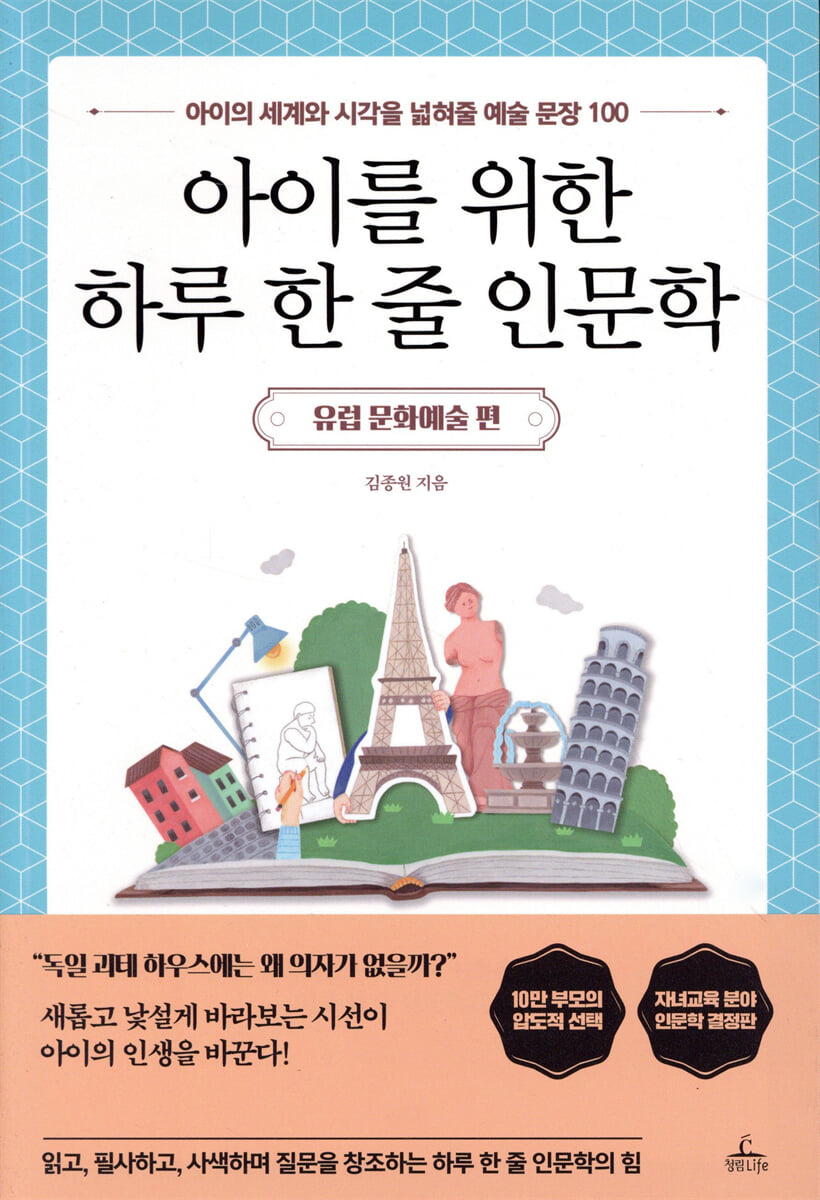
A Line a Day for Children: European Culture and Arts
 |
Description
Book Introduction
- A word from MD
-
The power of the humanities: reading, transcribing, and questioningThe world's most wonderful journey to Europe, the birthplace of philosophy that has nurtured some of the world's greatest philosophers, thinkers, and artists.
A daily one-line humanities lesson that guides children to explore the essence of ordinary things and discover wisdom in knowledge.
Keep it close to your child and read to them to broaden their world and horizons.
September 29, 2020. Kim Hyun-joo, PD of Home Life
A special educational journey for European intellectuals, the 'Grand Tour'
Rediscover the power of 'One Line a Day' of Humanities: Reading, Copying, and Questioning!
The Grand Tour was popular in Europe from the mid-17th century to the early 19th century for children's educational and cultural purposes.
Richard Russell, the British priest who first used the term "Grand Tour," said that if you want to learn about the world, economy, architecture, classics, and art, you must gain intellectual experience by traveling to the ruins of ancient Greece and Rome and the cities that gave birth to the Renaissance.
In fact, during this period, British aristocrats sent their children on trips to France, Germany, Italy, Austria, and other places to raise them as international gentlemen.
What did they see, hear, and experience on their long journeys, lasting from as little as three or four months to as long as eight years? What is the secret of the education that gave birth to countless intellectuals like Mozart, Adam Smith, Michelangelo, John Locke, Rodin, and Goethe?
“To gain broad knowledge, you must break out of the limitations of your familiar existing environment.
“We must seek spatial change, to go to new and unfamiliar places.” ―John Locke
The author, a leading humanities education mentor in Korea, visits Europe, the birthplace of philosophy, every year to immerse himself in new and unfamiliar stimulation.
And based on that experience, he has introduced the results of his daily thoughts and creations in his own unique language.
This time, we will introduce the value of classics discovered by following the lives of the artists who created Europe's finest architecture and works of art.
It is said that travelers who went on the Grand Tour returned home with books, paintings, crafts, and other items that contained memories of their travels.
What gifts does the author bring to parents and children in Korea? Let's explore eight essential humanities values in this era of contactless learning and a new era of education.
This will be a wonderful journey that will not only provide essential knowledge for intellectuals around the world, but also gift your child with unique answers and a wonderful new perspective on the world.
Rediscover the power of 'One Line a Day' of Humanities: Reading, Copying, and Questioning!
The Grand Tour was popular in Europe from the mid-17th century to the early 19th century for children's educational and cultural purposes.
Richard Russell, the British priest who first used the term "Grand Tour," said that if you want to learn about the world, economy, architecture, classics, and art, you must gain intellectual experience by traveling to the ruins of ancient Greece and Rome and the cities that gave birth to the Renaissance.
In fact, during this period, British aristocrats sent their children on trips to France, Germany, Italy, Austria, and other places to raise them as international gentlemen.
What did they see, hear, and experience on their long journeys, lasting from as little as three or four months to as long as eight years? What is the secret of the education that gave birth to countless intellectuals like Mozart, Adam Smith, Michelangelo, John Locke, Rodin, and Goethe?
“To gain broad knowledge, you must break out of the limitations of your familiar existing environment.
“We must seek spatial change, to go to new and unfamiliar places.” ―John Locke
The author, a leading humanities education mentor in Korea, visits Europe, the birthplace of philosophy, every year to immerse himself in new and unfamiliar stimulation.
And based on that experience, he has introduced the results of his daily thoughts and creations in his own unique language.
This time, we will introduce the value of classics discovered by following the lives of the artists who created Europe's finest architecture and works of art.
It is said that travelers who went on the Grand Tour returned home with books, paintings, crafts, and other items that contained memories of their travels.
What gifts does the author bring to parents and children in Korea? Let's explore eight essential humanities values in this era of contactless learning and a new era of education.
This will be a wonderful journey that will not only provide essential knowledge for intellectuals around the world, but also gift your child with unique answers and a wonderful new perspective on the world.
- You can preview some of the book's contents.
Preview
index
prolog.
A great change has begun that will change a child's life.
Part 1.
The World's Most Intelligent Journey, The Grand Tour: A Guide for Travelers Who Dream of Everyday Art
· Michelangelo's Gift: A Different Way of Seeing the World
· Discovering the Humanities on the Streets of Europe: People Who Walk Their Own Paths, Not Competitive
· Why Underdrawing Matters: 4 Languages to Let Go of When Starting Something
· Like Rodin, like a thinker: Children grow as much as their parents think.
· The smallest space to foster creative thinking: Change begins in the smallest of places.
· Awesome Kids Who Start and Finish on Their Own: A Parent's Eye Contact That Changes a Child's Attitude to Life
· Sources of Artistic Inspiration: 5 Questions That Will Make You a Creator of Your Own Life
· Children are born creators: Why we should look at children through the eyes of an artist.
· Goethe's Mother's Educational Method: Contemplation is an Invisible Art
· The Spire That Talks: The ability to see the world through your own eyes
· Where the artist's gaze lingers: A person who has filled himself with various perspectives.
· The God of Beauty at the Louvre: Children Need a Warmer, Deeper Love
Part 2.
The Child Who Lives Everyday Life as Art: How to Make the Most of Alone Time
· Chapter 1 [Strong Inner Self]
Saving a child's life is a fine art.
[Children's Art Sentence Transcription] Children who spend long periods of time alone learn fiercely and differently.
[Parenting's Educational Points] Develop the Power to Ask Questions and Never Give Up
How to Raise a Child Who Enjoys Everyday Art
[Children's Art Sentence Transcription] A child's transformation begins with the stories their parents tell.
[Parenting's Educational Point] Turn Everyday Life into Art
Parental self-control leads to children's self-efficacy.
[Children's Art Sentence Transcription] The Power of Advice to Blossom Talent
[Parents' Educational Points] A small expression can change a child's life, more than a great knowledge.
A child who knows the meaning and purpose of life is unwavering.
[Children's Art Sentence Transcription] You can become noble when you establish clear principles in life.
[Parenting Education Points] Remember the Beginnings That Support Everyday Life
· Chapter 2 [Love]
The thoughts of a loved one give better answers
[Children's Art Sentence Transcription] The more difficult the thinking process, the better the answer.
[Parenting Education Points] As time spent alone accumulates, everyday life shines like a jewel.
The beginning of an artistic daily life of believing in and loving yourself
[Children's Art Sentence Transcription] An artistic life unfolds when you make your own decisions and create habits.
[Parenting's Educational Points] If you follow the rules, everyday life becomes art.
How to discover the wonders of nature in ordinary things
[Children's Art Sentence Transcription] Observation Helps Discover the Extraordinary in the Ordinary
[Parenting Education Tips] Parents' Questions Broaden Their Perspectives and Develop Their Children's Creativity
A child who lives as the master of his own space
[Children's Art Sentence Transcription] Developing the Power of Vision Grows Creativity
[Parenting Education Points] Different Thinking Makes Children Masters of Their Own Space
A child who allows for other possibilities can discover other futures.
[Children's Art Sentence Transcription] Children who learn to interpret their own words will advance to greatness.
[Parenting's Educational Points] Thought-provoking questions help children become the protagonists of their own lives.
Part 3.
Growing up as a creator of one's own life: The best weapon to expand a child's world
· Chapter 3 [Language of Empathy]
When you finish something you started, the accomplishment shines.
[Child's Art Sentence Transcription] Why did Napoleon read 'The Sorrows of Young Werther' on the battlefield?
[Parenting Education Points] If you can empathize with the subject, you can discover things you haven't learned before.
3 Conversation Habits to Raise Children Who Grow Through Writing
[Children's Art Sentence Transcription] Give meaning to everything your child creates.
[Parenting Education Points] Let's spend our days writing things down, not just taking notes.
A child's sense of language begins with conversations with their parents.
[Children's Art Sentence Transcription] How to Make Children Master Their Own Words
[Parenting Tips] 6 Ways to Teach Your Child the Language of Intellect
One expression that even language masters never use
[Children's Art Sentence Transcription] The Importance of Seemingly Trivial Expressions
[Parenting Education Points] Parents' Language is the Food That Nurtures Their Children's Souls
30 Minutes of Reading a Day to Create Color in Language
[Children's Art Sentence Transcription] How to Read 30 Minutes a Day
[Parenting Tips] Encourage Reflection Through Reading
To transform the rough language of children into something beautiful
[Children's Art Sentences Transcription] Parents' Language that Fills a Child's Heart
[Parenting Education Points] Parents' language should be a philosophy that shapes their children's lives.
· Section 4 [Self-direction]
What is different about the gaze of a child who discovers a thousand lights?
[Children's Art Sentence Transcription] The Gifts We Receive from the World
[Parenting Education Tips] Small considerations are the beginning of great change.
How to ignite your child's intellectual growth engine
[Children's Art Sentence Transcription] The 4-Step Process for Dealing with Wounds
[Parenting Education Points] Parents are the judges who determine their children's future.
A delicate inner self that frees us from all addictions
[Children's Art Sentence Transcription] Why Children Should Be Given Decision-Making Rights
[Parenting Education Tips] Children who find new ways to lead their daily lives.
How to wisely bring your child's talents to life
[Children's Art Sentences] The Aspirations and Immersion That Turned Children into Geniuses
[Parenting Education Points] Allow Your Child to Have Serious Time
· Section 5 [Question]
When a child changes his or her own questions, miracles happen.
[Children's Art Sentence Transcription] Education that Creates Questions
[Parenting Education Tips] Questions Change a Child's Worldview
A child can only explore words he or she has defined himself or herself.
[Children's Art Sentence Transcription] How to Give Advice and Attention to Children Without Interfering
[Parents' Educational Points] Children's ability to explore is unleashed when they manage their own space.
A wise child learns from his parents' questions.
[Children's Art Sentence Transcription] All children's miracles begin with a parent's question.
[Parenting Education Points] Why We Should Focus on Being, Not Results
Raise them to become everyday artists who lead the questioning.
[Children's Art Sentence Transcription] Questions Make Children the Conductors of Their Own Lives
[Parenting's Educational Points] Asking questions without limits will help you find the answers that will overcome your limitations.
Part 4.
The Child Who Leads His Own Life Outside the Box: How to Break Free from the Standard and Discover the Real
· Chapter 6 [Thoughts]
A joy that only those who live by their own principles can realize
[Children's Art Sentence Transcription] Forcing Questions is Wrong
[Parenting Education Points] Children Should Be the Decision Makers in Their Own Lives
A parent's perspective determines a child's perspective.
[Children's Art Sentence Transcription] When you control your anger, your vision naturally expands.
[Parents' Educational Points] Children Grow as Much as Their Parents See and Say
A Week of Art Appreciation: Solving Every Child's Problems in Everyday Life
[Children's Art Sentence Transcription] How to Change Your Child's Language
[Parenting Education Tips] Why Classical Music is Good for Children
The art of thinking to discover subtle differences
[Children's Art Sentence Transcription] Travel is not a competition.
[Parents' Educational Points] Differences in Perspective Determine Differences in Level
There is a separate education for raising independent children.
[Children's Art Sentences] A noble spirit is the power that protects a child's future.
[Parenting Education Points] Parents' Life and Love Are the Answer
· Section 7 [Consideration]
A child who knows how to bring together diverse opinions
[Children's Art Sentence Transcription] How to Live Beautifully in Different Thoughts
[Parents' Educational Points] A Child Who Knows How to Shine as One by Embracing Everyone's Heart
What's the difference between what you're good at and what you love to do?
[Children's Art Sentence Transcription] How to Discover Why You Study
[Parenting Education Points] Break Free from the Life of Imitation
Writing that Transcends Competition
[Children's Art Sentence Transcription] The Value of Life with Paper and Pencil
[Parents' Educational Points] Every Child Needs Their Own Language
The art of thinking that fosters creativity
[Children's Art Sentence Transcription] Let them think of 'creation' as a friend.
[Parents' Educational Points] Creative Power Comes from Effort
· Chapter 8 [Creative Destruction]
The beginning of creative destruction: discovering ten from one
[Children's Art Sentences] The Master Raises Himself Like a Child
[Parenting Education Tips] 3 Secrets of People on a Different Level
The natural way a child uses the world through constant change
[Children's Art Sentence Transcription] Things You Can See Only When You Become Human
[Parents' Education Points] You need to succeed at least three times to become someone who knows how to utilize nature.
Only by breaking free from the world's standards can you establish your own.
[Children's Art Sentence Transcription] A passionate purpose unleashes diverse talents.
[Parenting Education Points] Break Free from the World's Standards
How to Break Free from Game Addiction and Become a Game Creator
[Children's Art Sentence Transcription] Value is determined in places that are not noticeable.
[Parenting Education Tips] What Parents Can Teach Their Children When They Turn Off Their Smartphones
You have to approach the child from his/her perspective to see the child.
[Children's Art Sentence Transcription] Looking and Thinking Like a Child
[Parents' Educational Points] Thinking from a Child's Perspective Reveals Their Talent
Epilogue.
Receiving is the completion of love.
A great change has begun that will change a child's life.
Part 1.
The World's Most Intelligent Journey, The Grand Tour: A Guide for Travelers Who Dream of Everyday Art
· Michelangelo's Gift: A Different Way of Seeing the World
· Discovering the Humanities on the Streets of Europe: People Who Walk Their Own Paths, Not Competitive
· Why Underdrawing Matters: 4 Languages to Let Go of When Starting Something
· Like Rodin, like a thinker: Children grow as much as their parents think.
· The smallest space to foster creative thinking: Change begins in the smallest of places.
· Awesome Kids Who Start and Finish on Their Own: A Parent's Eye Contact That Changes a Child's Attitude to Life
· Sources of Artistic Inspiration: 5 Questions That Will Make You a Creator of Your Own Life
· Children are born creators: Why we should look at children through the eyes of an artist.
· Goethe's Mother's Educational Method: Contemplation is an Invisible Art
· The Spire That Talks: The ability to see the world through your own eyes
· Where the artist's gaze lingers: A person who has filled himself with various perspectives.
· The God of Beauty at the Louvre: Children Need a Warmer, Deeper Love
Part 2.
The Child Who Lives Everyday Life as Art: How to Make the Most of Alone Time
· Chapter 1 [Strong Inner Self]
Saving a child's life is a fine art.
[Children's Art Sentence Transcription] Children who spend long periods of time alone learn fiercely and differently.
[Parenting's Educational Points] Develop the Power to Ask Questions and Never Give Up
How to Raise a Child Who Enjoys Everyday Art
[Children's Art Sentence Transcription] A child's transformation begins with the stories their parents tell.
[Parenting's Educational Point] Turn Everyday Life into Art
Parental self-control leads to children's self-efficacy.
[Children's Art Sentence Transcription] The Power of Advice to Blossom Talent
[Parents' Educational Points] A small expression can change a child's life, more than a great knowledge.
A child who knows the meaning and purpose of life is unwavering.
[Children's Art Sentence Transcription] You can become noble when you establish clear principles in life.
[Parenting Education Points] Remember the Beginnings That Support Everyday Life
· Chapter 2 [Love]
The thoughts of a loved one give better answers
[Children's Art Sentence Transcription] The more difficult the thinking process, the better the answer.
[Parenting Education Points] As time spent alone accumulates, everyday life shines like a jewel.
The beginning of an artistic daily life of believing in and loving yourself
[Children's Art Sentence Transcription] An artistic life unfolds when you make your own decisions and create habits.
[Parenting's Educational Points] If you follow the rules, everyday life becomes art.
How to discover the wonders of nature in ordinary things
[Children's Art Sentence Transcription] Observation Helps Discover the Extraordinary in the Ordinary
[Parenting Education Tips] Parents' Questions Broaden Their Perspectives and Develop Their Children's Creativity
A child who lives as the master of his own space
[Children's Art Sentence Transcription] Developing the Power of Vision Grows Creativity
[Parenting Education Points] Different Thinking Makes Children Masters of Their Own Space
A child who allows for other possibilities can discover other futures.
[Children's Art Sentence Transcription] Children who learn to interpret their own words will advance to greatness.
[Parenting's Educational Points] Thought-provoking questions help children become the protagonists of their own lives.
Part 3.
Growing up as a creator of one's own life: The best weapon to expand a child's world
· Chapter 3 [Language of Empathy]
When you finish something you started, the accomplishment shines.
[Child's Art Sentence Transcription] Why did Napoleon read 'The Sorrows of Young Werther' on the battlefield?
[Parenting Education Points] If you can empathize with the subject, you can discover things you haven't learned before.
3 Conversation Habits to Raise Children Who Grow Through Writing
[Children's Art Sentence Transcription] Give meaning to everything your child creates.
[Parenting Education Points] Let's spend our days writing things down, not just taking notes.
A child's sense of language begins with conversations with their parents.
[Children's Art Sentence Transcription] How to Make Children Master Their Own Words
[Parenting Tips] 6 Ways to Teach Your Child the Language of Intellect
One expression that even language masters never use
[Children's Art Sentence Transcription] The Importance of Seemingly Trivial Expressions
[Parenting Education Points] Parents' Language is the Food That Nurtures Their Children's Souls
30 Minutes of Reading a Day to Create Color in Language
[Children's Art Sentence Transcription] How to Read 30 Minutes a Day
[Parenting Tips] Encourage Reflection Through Reading
To transform the rough language of children into something beautiful
[Children's Art Sentences Transcription] Parents' Language that Fills a Child's Heart
[Parenting Education Points] Parents' language should be a philosophy that shapes their children's lives.
· Section 4 [Self-direction]
What is different about the gaze of a child who discovers a thousand lights?
[Children's Art Sentence Transcription] The Gifts We Receive from the World
[Parenting Education Tips] Small considerations are the beginning of great change.
How to ignite your child's intellectual growth engine
[Children's Art Sentence Transcription] The 4-Step Process for Dealing with Wounds
[Parenting Education Points] Parents are the judges who determine their children's future.
A delicate inner self that frees us from all addictions
[Children's Art Sentence Transcription] Why Children Should Be Given Decision-Making Rights
[Parenting Education Tips] Children who find new ways to lead their daily lives.
How to wisely bring your child's talents to life
[Children's Art Sentences] The Aspirations and Immersion That Turned Children into Geniuses
[Parenting Education Points] Allow Your Child to Have Serious Time
· Section 5 [Question]
When a child changes his or her own questions, miracles happen.
[Children's Art Sentence Transcription] Education that Creates Questions
[Parenting Education Tips] Questions Change a Child's Worldview
A child can only explore words he or she has defined himself or herself.
[Children's Art Sentence Transcription] How to Give Advice and Attention to Children Without Interfering
[Parents' Educational Points] Children's ability to explore is unleashed when they manage their own space.
A wise child learns from his parents' questions.
[Children's Art Sentence Transcription] All children's miracles begin with a parent's question.
[Parenting Education Points] Why We Should Focus on Being, Not Results
Raise them to become everyday artists who lead the questioning.
[Children's Art Sentence Transcription] Questions Make Children the Conductors of Their Own Lives
[Parenting's Educational Points] Asking questions without limits will help you find the answers that will overcome your limitations.
Part 4.
The Child Who Leads His Own Life Outside the Box: How to Break Free from the Standard and Discover the Real
· Chapter 6 [Thoughts]
A joy that only those who live by their own principles can realize
[Children's Art Sentence Transcription] Forcing Questions is Wrong
[Parenting Education Points] Children Should Be the Decision Makers in Their Own Lives
A parent's perspective determines a child's perspective.
[Children's Art Sentence Transcription] When you control your anger, your vision naturally expands.
[Parents' Educational Points] Children Grow as Much as Their Parents See and Say
A Week of Art Appreciation: Solving Every Child's Problems in Everyday Life
[Children's Art Sentence Transcription] How to Change Your Child's Language
[Parenting Education Tips] Why Classical Music is Good for Children
The art of thinking to discover subtle differences
[Children's Art Sentence Transcription] Travel is not a competition.
[Parents' Educational Points] Differences in Perspective Determine Differences in Level
There is a separate education for raising independent children.
[Children's Art Sentences] A noble spirit is the power that protects a child's future.
[Parenting Education Points] Parents' Life and Love Are the Answer
· Section 7 [Consideration]
A child who knows how to bring together diverse opinions
[Children's Art Sentence Transcription] How to Live Beautifully in Different Thoughts
[Parents' Educational Points] A Child Who Knows How to Shine as One by Embracing Everyone's Heart
What's the difference between what you're good at and what you love to do?
[Children's Art Sentence Transcription] How to Discover Why You Study
[Parenting Education Points] Break Free from the Life of Imitation
Writing that Transcends Competition
[Children's Art Sentence Transcription] The Value of Life with Paper and Pencil
[Parents' Educational Points] Every Child Needs Their Own Language
The art of thinking that fosters creativity
[Children's Art Sentence Transcription] Let them think of 'creation' as a friend.
[Parents' Educational Points] Creative Power Comes from Effort
· Chapter 8 [Creative Destruction]
The beginning of creative destruction: discovering ten from one
[Children's Art Sentences] The Master Raises Himself Like a Child
[Parenting Education Tips] 3 Secrets of People on a Different Level
The natural way a child uses the world through constant change
[Children's Art Sentence Transcription] Things You Can See Only When You Become Human
[Parents' Education Points] You need to succeed at least three times to become someone who knows how to utilize nature.
Only by breaking free from the world's standards can you establish your own.
[Children's Art Sentence Transcription] A passionate purpose unleashes diverse talents.
[Parenting Education Points] Break Free from the World's Standards
How to Break Free from Game Addiction and Become a Game Creator
[Children's Art Sentence Transcription] Value is determined in places that are not noticeable.
[Parenting Education Tips] What Parents Can Teach Their Children When They Turn Off Their Smartphones
You have to approach the child from his/her perspective to see the child.
[Children's Art Sentence Transcription] Looking and Thinking Like a Child
[Parents' Educational Points] Thinking from a Child's Perspective Reveals Their Talent
Epilogue.
Receiving is the completion of love.
Detailed image
Into the book
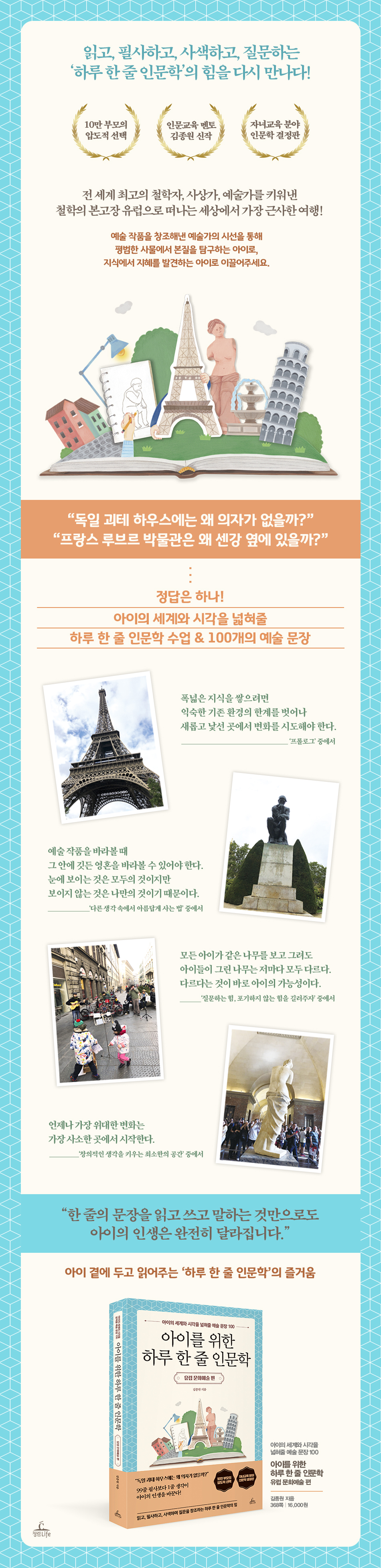
“How could you paint from that high up?”
“How should we appreciate this work of art?”
The best answer is, “Lie down and admire the painting, just as they drew it while lying down.”
Only by appreciating the way they painted can you get a sense of what they put so much effort into painting.
Even with the same object, you can discover completely different aspects depending on how you look at it and from what perspective.
You don't have to travel far to find something new.
Let us remember that the answers are always right here with us.
Simply by focusing our gaze at a different height, we can completely reshape our child's perspective.
--- From "The Gift Michelangelo Left Behind: A Different Way of Seeing the World"
No matter where you go in Europe, for Europeans, appreciation and observation are not just about hearing with their ears and seeing with their eyes.
I think that only after playing and drawing it myself can I truly appreciate and observe it.
This student was the same.
I asked him how long he had been painting Rodin's sculptures, and I was surprised when he said an hour had passed.
He painted Rodin's sculptures for an hour, constantly changing his perspective, which allowed him to fully absorb what he was looking at.
--- From "Like Rodin, Like a Thinker: A Child Grows as Much as His Parents Think"
Even if you look at the same thing for 10 hours, you get the same inspiration as if you looked at thousands of different things for 10 hours.
That is the everyday power of a person who lives by asking questions.
To the questioner, the novelty of things and the movement of space are of little importance.
It is not new knowledge or space that gives us new things, but new perspectives that give us new things.
--- From "Sources of Artistic Inspiration: 5 Questions That Will Make You Live as the Creator of Your Own Life"
Reflection is discovery.
It is something that already exists in the world, but that no one else knows about.
What was the biggest reason Newton was able to discover the law of universal gravitation while sitting under an apple tree, something that already existed but no one else had discovered? Because he sat under the apple tree for the longest time.
So let's rephrase the question and think about it this way.
What was the secret to his ability to sit under an apple tree for so long? Because he could see things that no one else could.
The reason why thinking leads to creation is because thinking itself gives pleasure to the thinker.
The ability to think is the most essential capital for a child to find his or her own path in life.
--- From "The Spire That Talks: The Ability to See the World Through Your Own Eyes"
Even though all children see and draw the same tree, each child's drawing is different.
Being different is the child's potential.
Living without knowing art is no different from living without being able to realize one's own potential.
Let your child see his or her own tree.
“How should we appreciate this work of art?”
The best answer is, “Lie down and admire the painting, just as they drew it while lying down.”
Only by appreciating the way they painted can you get a sense of what they put so much effort into painting.
Even with the same object, you can discover completely different aspects depending on how you look at it and from what perspective.
You don't have to travel far to find something new.
Let us remember that the answers are always right here with us.
Simply by focusing our gaze at a different height, we can completely reshape our child's perspective.
--- From "The Gift Michelangelo Left Behind: A Different Way of Seeing the World"
No matter where you go in Europe, for Europeans, appreciation and observation are not just about hearing with their ears and seeing with their eyes.
I think that only after playing and drawing it myself can I truly appreciate and observe it.
This student was the same.
I asked him how long he had been painting Rodin's sculptures, and I was surprised when he said an hour had passed.
He painted Rodin's sculptures for an hour, constantly changing his perspective, which allowed him to fully absorb what he was looking at.
--- From "Like Rodin, Like a Thinker: A Child Grows as Much as His Parents Think"
Even if you look at the same thing for 10 hours, you get the same inspiration as if you looked at thousands of different things for 10 hours.
That is the everyday power of a person who lives by asking questions.
To the questioner, the novelty of things and the movement of space are of little importance.
It is not new knowledge or space that gives us new things, but new perspectives that give us new things.
--- From "Sources of Artistic Inspiration: 5 Questions That Will Make You Live as the Creator of Your Own Life"
Reflection is discovery.
It is something that already exists in the world, but that no one else knows about.
What was the biggest reason Newton was able to discover the law of universal gravitation while sitting under an apple tree, something that already existed but no one else had discovered? Because he sat under the apple tree for the longest time.
So let's rephrase the question and think about it this way.
What was the secret to his ability to sit under an apple tree for so long? Because he could see things that no one else could.
The reason why thinking leads to creation is because thinking itself gives pleasure to the thinker.
The ability to think is the most essential capital for a child to find his or her own path in life.
--- From "The Spire That Talks: The Ability to See the World Through Your Own Eyes"
Even though all children see and draw the same tree, each child's drawing is different.
Being different is the child's potential.
Living without knowing art is no different from living without being able to realize one's own potential.
Let your child see his or her own tree.
--- From "Let's cultivate the power to ask questions and the power to not give up"
Publisher's Review
From Mozart to Napoleon, Michelangelo, Rodin, and Goethe
A wonderful humanities journey to Europe, the birthplace of philosophy.
In 2020, the COVID-19 pandemic shook the very foundations of society, culture, and economy, not only in South Korea but also around the world, ushering in a new era of education.
In an age of unpredictable, rapid change, the ability our children need most is the ability to lead their own lives without wavering, regardless of the circumstances.
The author, who sparked a craze for humanities and writing among Korean parents through years of intense reflection, questioning, and unwavering writing, presents yet another key to new education through European culture and arts.
After delving into the works and lives of intellectuals of the century, including Mozart, Michelangelo, Rodin, and Goethe, I have summarized the unchanging values of the humanities into eight.
1.
Strong Inner Self: Children who know how to use their alone time wisely survive.
2.
Love: Education and principles may fail, but love never fails.
3.
Language of Empathy: What children need is the language of empathy, not the language of evaluation.
4.
Self-direction: You must be able to discover your true self in the ‘here and now.’
5.
The Creation of Questions: Humans grow and become more beautiful as they ask questions.
6.
Discovering what matters most: It takes discernment to see true value.
7.
A life without competition: You must exist as the 'only you', not the 'best you'.
8.
Creative question: A child who sets his own standards can step outside the box.
Even if you read dozens of books or travel to countless cities, if you don't properly absorb their value, your daily life will easily be shaken by even the smallest fluctuations.
As children advance to higher grades, they have difficulty answering questions properly, let alone asking them, and are easily swayed by the judgments of others. What they need is the strength to have their own language and live as the masters of their own lives.
In the era of contactless, "diversity of perspective," which involves seeing the same thing differently rather than experiencing something different, is emerging as a core element of education.
For children who appreciate the essence of everyday life as they appreciate art with its enduring value, and who discover wisdom in knowledge, let's embark on a wonderful journey of reflection, questioning, and finding their own answers, drawing on the experiences of Europe's greatest minds.
“Why are there no chairs in the Goethe House in Germany?”
“Why is the Louvre Museum in France located next to the Seine River?”
A daily humanities lesson to raise children who ask questions and think.
Just like the must-read books that children must read in elementary, middle, and high school, the list of masterpieces that must be appreciated and the list of art galleries and museums that must be visited at least once are treasures held in the hands of Korean parents.
They don't hesitate to go on expensive overseas trips to broaden their children's horizons.
In reality, children carry out the mission by superficially observing things without knowing what to look at or how to look at them.
What children and parents need in the post-COVID era is not more experiences, but learning how to properly appreciate even just one work of art.
The author introduces a completely new way to discover art and see it not only in famous European landmarks such as the Vatican Museum in Italy, the Rodin Museum in France, and the Goethe House in Germany, but also on ordinary streets and in familiar elevators.
Let's enjoy the photos captured through the author's unique perspective.
Trying to look at a painting while lying down like Michelangelo, who spent four years and eight months lying down in the Sistine Chapel painting the ceiling [Creation of Adam], having the courage to stand on the opposite side of a sculpture rather than in front of it, and trying to approach the artist's intention by striking a pose like Rodin's [The Thinker] will broaden a child's perspective.
And the world of a child who looks at everyday life as if appreciating art will be completely new.
One line of thought can change a child's life more than 99 lines of writing!
100 Art Sentences to Expand Your Child's World and Perspective
The 'One Line of Humanities a Day' class consists of three stages.
The first lesson begins with the author's long-standing questions, which he explores and organizes the great works and lives of Europe's greatest artists, philosophers, and thinkers, planting seeds of thought in parents and children.
The second class is the 'Children's Art Sentence Transcription' corner included in each chapter.
Like a work of art with unchanging value, read aloud and copy a single sentence of life that will illuminate your child's inner self, building up nourishment for your mind.
The last class is a time for parents and children to talk together.
Through the 'Parents' Education Points' corner, you can talk with your child about what you felt after writing, and bring the flowers of philosophy and humanities into your daily life.
You can learn specifically what kind of conversations you should have with your child on a regular basis and what kind of educational methods you should apply to your child to raise them to be able to lead their own life outside the box.
A wonderful humanities journey to Europe, the birthplace of philosophy.
In 2020, the COVID-19 pandemic shook the very foundations of society, culture, and economy, not only in South Korea but also around the world, ushering in a new era of education.
In an age of unpredictable, rapid change, the ability our children need most is the ability to lead their own lives without wavering, regardless of the circumstances.
The author, who sparked a craze for humanities and writing among Korean parents through years of intense reflection, questioning, and unwavering writing, presents yet another key to new education through European culture and arts.
After delving into the works and lives of intellectuals of the century, including Mozart, Michelangelo, Rodin, and Goethe, I have summarized the unchanging values of the humanities into eight.
1.
Strong Inner Self: Children who know how to use their alone time wisely survive.
2.
Love: Education and principles may fail, but love never fails.
3.
Language of Empathy: What children need is the language of empathy, not the language of evaluation.
4.
Self-direction: You must be able to discover your true self in the ‘here and now.’
5.
The Creation of Questions: Humans grow and become more beautiful as they ask questions.
6.
Discovering what matters most: It takes discernment to see true value.
7.
A life without competition: You must exist as the 'only you', not the 'best you'.
8.
Creative question: A child who sets his own standards can step outside the box.
Even if you read dozens of books or travel to countless cities, if you don't properly absorb their value, your daily life will easily be shaken by even the smallest fluctuations.
As children advance to higher grades, they have difficulty answering questions properly, let alone asking them, and are easily swayed by the judgments of others. What they need is the strength to have their own language and live as the masters of their own lives.
In the era of contactless, "diversity of perspective," which involves seeing the same thing differently rather than experiencing something different, is emerging as a core element of education.
For children who appreciate the essence of everyday life as they appreciate art with its enduring value, and who discover wisdom in knowledge, let's embark on a wonderful journey of reflection, questioning, and finding their own answers, drawing on the experiences of Europe's greatest minds.
“Why are there no chairs in the Goethe House in Germany?”
“Why is the Louvre Museum in France located next to the Seine River?”
A daily humanities lesson to raise children who ask questions and think.
Just like the must-read books that children must read in elementary, middle, and high school, the list of masterpieces that must be appreciated and the list of art galleries and museums that must be visited at least once are treasures held in the hands of Korean parents.
They don't hesitate to go on expensive overseas trips to broaden their children's horizons.
In reality, children carry out the mission by superficially observing things without knowing what to look at or how to look at them.
What children and parents need in the post-COVID era is not more experiences, but learning how to properly appreciate even just one work of art.
The author introduces a completely new way to discover art and see it not only in famous European landmarks such as the Vatican Museum in Italy, the Rodin Museum in France, and the Goethe House in Germany, but also on ordinary streets and in familiar elevators.
Let's enjoy the photos captured through the author's unique perspective.
Trying to look at a painting while lying down like Michelangelo, who spent four years and eight months lying down in the Sistine Chapel painting the ceiling [Creation of Adam], having the courage to stand on the opposite side of a sculpture rather than in front of it, and trying to approach the artist's intention by striking a pose like Rodin's [The Thinker] will broaden a child's perspective.
And the world of a child who looks at everyday life as if appreciating art will be completely new.
One line of thought can change a child's life more than 99 lines of writing!
100 Art Sentences to Expand Your Child's World and Perspective
The 'One Line of Humanities a Day' class consists of three stages.
The first lesson begins with the author's long-standing questions, which he explores and organizes the great works and lives of Europe's greatest artists, philosophers, and thinkers, planting seeds of thought in parents and children.
The second class is the 'Children's Art Sentence Transcription' corner included in each chapter.
Like a work of art with unchanging value, read aloud and copy a single sentence of life that will illuminate your child's inner self, building up nourishment for your mind.
The last class is a time for parents and children to talk together.
Through the 'Parents' Education Points' corner, you can talk with your child about what you felt after writing, and bring the flowers of philosophy and humanities into your daily life.
You can learn specifically what kind of conversations you should have with your child on a regular basis and what kind of educational methods you should apply to your child to raise them to be able to lead their own life outside the box.
GOODS SPECIFICS
- Date of publication: October 7, 2020
- Page count, weight, size: 368 pages | 662g | 152*224*25mm
- ISBN13: 9791188700691
- ISBN10: 1188700693
You may also like
카테고리
korean


korean

![GQ KOREA Mark (Monthly): December [2025]](http://librairie.coreenne.fr/cdn/shop/files/8ef265dbbfbf186523ed75ba7319009d.jpg?v=1765340328&width=3840)


