

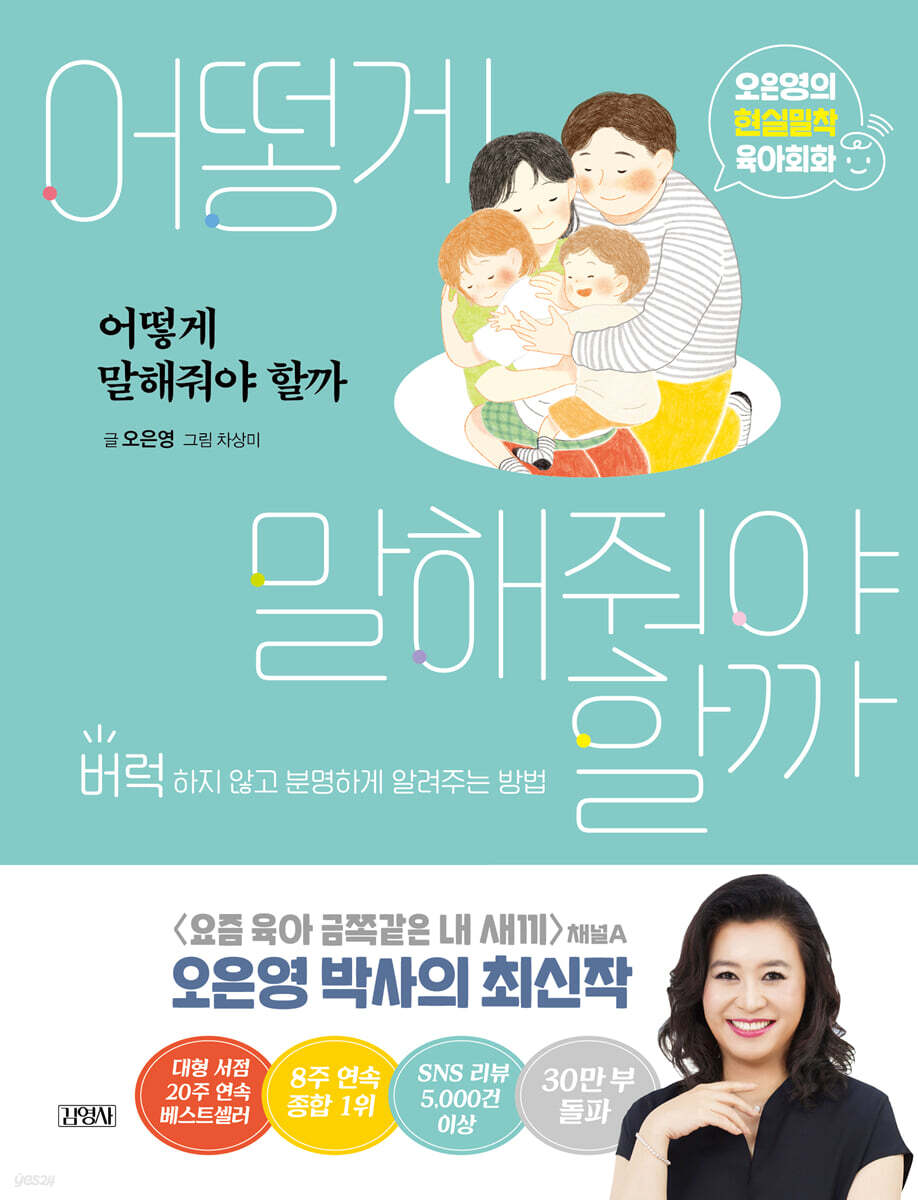
How should I say it?
 |
Description
Book Introduction
- A word from MD
-
National parenting mentor Oh Eun-young's realistic parenting conversation!"If you want to change your child's behavior, you have to change what you say." This is what parents need to know from Dr. Oh Eun-young, a national parenting mentor.
Through 130 realistic case studies and conversation techniques that reflect 200% of actual parenting situations, this book introduces methods for clearly educating children without getting angry, and for disciplining them effectively rather than nagging them.
October 23, 2020. Kim Hyun-joo, PD of Home Life
Channel A [Parenting Today: My Precious Child] SBS [My Child Has Changed]
"Parents' Words" from National Parenting Mentor Dr. Oh Eun-young
130 phrases that 200% reflect the reality of parenting.
A new book by Dr. Oh Eun-young, the 'national parenting mentor' and 'mother of Korean mothers and fathers.'
This is a parenting book that kindly introduces 'parents' words' that can be easily followed.
Compared to Dr. Oh Eun-young's previous books, this one is smaller and the content is easier to understand.
That doesn't mean the content is poor.
It is packed with 130 practical phrases that can be immediately applied to parenting.
The book also features illustrations by Cha Sang-mi, the illustrator of the children's book 『The Lottery Machine That Always Wins』 (winner of the Biryongso Literary Award), adding a warm and friendly atmosphere.
A child who throws a tantrum and insists on wearing different clothes when he or she has to go out right away, a child who touches other people's belongings without permission, a child who frequently fights with friends or siblings, a child who is extremely stubborn, a child who is emotionally sensitive, etc...
This book presents specific situations that anyone who lives with a child can experience and relate to.
And Dr. Oh Eun-young, Korea's leading parenting expert, suggests appropriate teaching methods for each situation.
The advice presented in the book has one thing in common: first listen to the child, acknowledge their feelings, and then clearly tell them what they need to learn.
The key is to speak concisely without making your parents angry.
Of course it's not easy.
Therefore, the author emphasizes that we must continue to give children opportunities to practice and repeat ‘parenting conversation.’
With just a little more effort, what you say to your child can become effective discipline rather than nagging.
As a result, children grow up with high self-esteem and self-direction, and family relationships become healthier.
The first part of the book contains relatively easy-to-follow and understand phrases, while the second part contains more specific and thought-provoking phrases, and contains content that can be applied to children of various ages, from infancy to adolescence.
Dr. Oh Eun-young also sends warm encouragement to readers who consistently strive for good parenting.
In this way, this book provides comfort and consolation along with practical information about 'parents' words.'
"Parents' Words" from National Parenting Mentor Dr. Oh Eun-young
130 phrases that 200% reflect the reality of parenting.
A new book by Dr. Oh Eun-young, the 'national parenting mentor' and 'mother of Korean mothers and fathers.'
This is a parenting book that kindly introduces 'parents' words' that can be easily followed.
Compared to Dr. Oh Eun-young's previous books, this one is smaller and the content is easier to understand.
That doesn't mean the content is poor.
It is packed with 130 practical phrases that can be immediately applied to parenting.
The book also features illustrations by Cha Sang-mi, the illustrator of the children's book 『The Lottery Machine That Always Wins』 (winner of the Biryongso Literary Award), adding a warm and friendly atmosphere.
A child who throws a tantrum and insists on wearing different clothes when he or she has to go out right away, a child who touches other people's belongings without permission, a child who frequently fights with friends or siblings, a child who is extremely stubborn, a child who is emotionally sensitive, etc...
This book presents specific situations that anyone who lives with a child can experience and relate to.
And Dr. Oh Eun-young, Korea's leading parenting expert, suggests appropriate teaching methods for each situation.
The advice presented in the book has one thing in common: first listen to the child, acknowledge their feelings, and then clearly tell them what they need to learn.
The key is to speak concisely without making your parents angry.
Of course it's not easy.
Therefore, the author emphasizes that we must continue to give children opportunities to practice and repeat ‘parenting conversation.’
With just a little more effort, what you say to your child can become effective discipline rather than nagging.
As a result, children grow up with high self-esteem and self-direction, and family relationships become healthier.
The first part of the book contains relatively easy-to-follow and understand phrases, while the second part contains more specific and thought-provoking phrases, and contains content that can be applied to children of various ages, from infancy to adolescence.
Dr. Oh Eun-young also sends warm encouragement to readers who consistently strive for good parenting.
In this way, this book provides comfort and consolation along with practical information about 'parents' words.'
- You can preview some of the book's contents.
Preview
index
Prologue: A small beginning for me and my child
Chapter 1.
Not the familiar words, but the words I know but still feel unfamiliar
I'm so happy you're my child
I'm waiting
It won't work
Ah, so that's what it felt like
I'll leave when the clock hands get here.
[Parenting Story] Why do children cause problems?
Wearing a mask properly protects you a lot, so it's important.
I can't say ~ because I do ~
Did you sleep well? It's a refreshing morning.
Daddy's here, let's hug our bunnies
I did my best, you did a great job
[Parenting Story] Don't Try to Solve Your Heart
But I still have to wash it
I'll take it out, enjoy it
I'll wait until you all cry
Mom likes it best when she's with you
I want to hear what you have to say
[Parenting Story] A Child Who Has a Hard Time Accepting "No"
It's nothing to be sorry about.
You just have to learn it
It's an important story, so I can't say it with a smile.
Playing is good
Let's eat deliciously, yum, it's delicious
It's dangerous, don't touch
[Parenting Story] A Child's Time, A Parent's Time
Chapter 2.
When I was a child, these are the words I wanted to hear
What did you do today?
Huh? Is that so? I'm suddenly confused.
Let's talk again after you calm down a bit.
I really like that side of him
Let's speak more gently
Don't mistake [Parenting Story] for the whole.
I'm just looking
I'm playing with it
I have to go in now
Remember! Remember! Remember!
Yes, that's right
[Parenting Story] Sharing is possible only when ownership is comfortable.
If you run around in a place like this, you'll bump into something
If you scream, you have no choice but to leave
Even if I come back next time, I'll go today
I'll give you a few warnings
Sorry, I think I have to go.
[Parenting Stories] Pretty and Ugly Behaviors, Pretty People and Ugly People
It's much easier to talk when you keep quiet.
I love you! I really love you!
I suddenly want to read a fun book
Did anything fun happen today?
Bye, see you next time
[Parenting Story] In parenting, the final scene, the ending, is important.
Chapter 3.
Words of acceptance that warm the heart
Okay, enough of that. Should we take a walk instead?
I feel like I hate my younger sibling.
This is a good way to do it
I want to share it with you
Let me know when you're ready
[Parenting Story] "It's better to say this" rather than "That's a bad word."
Should we fix what can be fixed?
The most important thing is to work hard
I won't do it, I'm really sorry
Is there any reason why you don't think so?
Really? Didn't you hear?
[Parenting Story] Even if the whole thing is "wrong," please acknowledge the legitimacy of the "parts."
The rest is just playing around together
What's not working?
I would have felt bad if I thought that way
I heard, okay, but wait a minute
It's stopping sooner than last time.
[Parenting Story] The Meaning of "How Many Times Have I Said That?"
Yeah, you ate quickly, good job
If you work hard, you'll do pretty well.
Wow, that sounds fun, what should we do?
Sorry, you don't like this, I won't do it.
You've lived a good life
[Parenting Story] Listen to Your Child's Complete Statement
What happened?
These are things you need to learn well and do.
It looks better when you mix colors
That's it, no need to ask
Okay, let's do it again next time
[Parenting Story] Don't Be Lost
Chapter 4.
Words spoken by the ears, words heard by the mouth
Aren't there times when it's hard?
Don't you sometimes find your little brother annoying?
But don't push me, say no
No one should push
Say 'it's mine, give it to me'
[Parenting Story] How often do you say, “You promised!”?
I'm mad because this isn't working!
Are you having a hard time saying what you want?
I'm just having fun, so there's no need to go that far, right?
From today onwards, let's choose the day before
I know it's uncomfortable, but I can't not wear it because it's cold.
[Parenting Story] A Child's Desire for a Band-Aid
Can you tell me when you feel bad?
I hate it when my mom doesn't listen to me.
Is it damp? Uncomfortable and unpleasant? I'll dry it for you.
Are you having a hard time because of your younger sibling?
It was so hard that I felt that way.
[Parenting Story] It's not that it's bad, it's that it's pitiful.
I'll teach you a little bit
Can I play with this?
Just pretending.
Don't stab!
But why do you keep poking me?
It's fun whether you win or lose
[Parenting Story] Mom, I'm doing well.
Chapter 5.
Without being childish, as originally intended
Today was hard, it was hard
Yeah, I know, that's enough.
Sorry to interrupt, but I need your help.
That's just not something my mom is good at.
Close friends are important in my life
[Parenting Story] Innocence is still innocent even if you leave it alone.
Are you hungry? Did you want to call your mom?
It's not going well, kid, I'm upset.
Oh my, I need to sleep but I can't.
You've done it all, that's great
Did you have fun drawing today?
[Parenting Story] “I’m not your mom.” “You, get out of this house!”
I guess that's what my friend felt at the time.
Hey, that's not what I meant
You shouldn't say, "Don't play with someone."
Even if many people do it, there is right and wrong.
You all must have had a hard day today.
[Parenting Story] Close Friend and Classmate
I understand the situation
I'm not saying you did the same thing
I appreciate you telling me, but
You are both precious, just like the sun and the moon.
Mom likes you the best
[Parenting Story] Don't Force Your Child to Say "I'm Sorry"
Chapter 6.
Today is always the first day to talk to your child.
I'll hug you so tightly you'll be crushed
Hold on tight, okay!
That's fun too
Let's have fun talking again after we're done
You can just go, wear it later
[Parenting Story] A child who is too shy to speak up
Just take it easy
It's not that I hated it, it's that I was embarrassed.
I need to try harder too
You are a good person no matter what the circumstances.
What do you think would make you happy?
[Parenting Story] Self-Initiative and Stubbornness
I can't do it.
You have to play with what you have
Is it urgent?
It helps to just leave it alone
Take care from tomorrow
I don't think Mom is ready to talk right now.
[Parenting Story] My Child Pretends to Be Pretty and Smart
You wouldn't want to do that either
What do you want to do?
You shouldn't touch other people's things without permission.
It lives in your heart
Mom, I really did something wrong, I'm sorry.
[Parenting Story] How to Give Effective Instructions
Then, you won't get in trouble.
If you can do this well, you can do that well too
Yeah, that's not true, then you'll definitely come.
You've been doing really well this year too
You are a flower, a star, a wind
[Parenting Story] Parents are always the ones who can never give up on their children.
Chapter 1.
Not the familiar words, but the words I know but still feel unfamiliar
I'm so happy you're my child
I'm waiting
It won't work
Ah, so that's what it felt like
I'll leave when the clock hands get here.
[Parenting Story] Why do children cause problems?
Wearing a mask properly protects you a lot, so it's important.
I can't say ~ because I do ~
Did you sleep well? It's a refreshing morning.
Daddy's here, let's hug our bunnies
I did my best, you did a great job
[Parenting Story] Don't Try to Solve Your Heart
But I still have to wash it
I'll take it out, enjoy it
I'll wait until you all cry
Mom likes it best when she's with you
I want to hear what you have to say
[Parenting Story] A Child Who Has a Hard Time Accepting "No"
It's nothing to be sorry about.
You just have to learn it
It's an important story, so I can't say it with a smile.
Playing is good
Let's eat deliciously, yum, it's delicious
It's dangerous, don't touch
[Parenting Story] A Child's Time, A Parent's Time
Chapter 2.
When I was a child, these are the words I wanted to hear
What did you do today?
Huh? Is that so? I'm suddenly confused.
Let's talk again after you calm down a bit.
I really like that side of him
Let's speak more gently
Don't mistake [Parenting Story] for the whole.
I'm just looking
I'm playing with it
I have to go in now
Remember! Remember! Remember!
Yes, that's right
[Parenting Story] Sharing is possible only when ownership is comfortable.
If you run around in a place like this, you'll bump into something
If you scream, you have no choice but to leave
Even if I come back next time, I'll go today
I'll give you a few warnings
Sorry, I think I have to go.
[Parenting Stories] Pretty and Ugly Behaviors, Pretty People and Ugly People
It's much easier to talk when you keep quiet.
I love you! I really love you!
I suddenly want to read a fun book
Did anything fun happen today?
Bye, see you next time
[Parenting Story] In parenting, the final scene, the ending, is important.
Chapter 3.
Words of acceptance that warm the heart
Okay, enough of that. Should we take a walk instead?
I feel like I hate my younger sibling.
This is a good way to do it
I want to share it with you
Let me know when you're ready
[Parenting Story] "It's better to say this" rather than "That's a bad word."
Should we fix what can be fixed?
The most important thing is to work hard
I won't do it, I'm really sorry
Is there any reason why you don't think so?
Really? Didn't you hear?
[Parenting Story] Even if the whole thing is "wrong," please acknowledge the legitimacy of the "parts."
The rest is just playing around together
What's not working?
I would have felt bad if I thought that way
I heard, okay, but wait a minute
It's stopping sooner than last time.
[Parenting Story] The Meaning of "How Many Times Have I Said That?"
Yeah, you ate quickly, good job
If you work hard, you'll do pretty well.
Wow, that sounds fun, what should we do?
Sorry, you don't like this, I won't do it.
You've lived a good life
[Parenting Story] Listen to Your Child's Complete Statement
What happened?
These are things you need to learn well and do.
It looks better when you mix colors
That's it, no need to ask
Okay, let's do it again next time
[Parenting Story] Don't Be Lost
Chapter 4.
Words spoken by the ears, words heard by the mouth
Aren't there times when it's hard?
Don't you sometimes find your little brother annoying?
But don't push me, say no
No one should push
Say 'it's mine, give it to me'
[Parenting Story] How often do you say, “You promised!”?
I'm mad because this isn't working!
Are you having a hard time saying what you want?
I'm just having fun, so there's no need to go that far, right?
From today onwards, let's choose the day before
I know it's uncomfortable, but I can't not wear it because it's cold.
[Parenting Story] A Child's Desire for a Band-Aid
Can you tell me when you feel bad?
I hate it when my mom doesn't listen to me.
Is it damp? Uncomfortable and unpleasant? I'll dry it for you.
Are you having a hard time because of your younger sibling?
It was so hard that I felt that way.
[Parenting Story] It's not that it's bad, it's that it's pitiful.
I'll teach you a little bit
Can I play with this?
Just pretending.
Don't stab!
But why do you keep poking me?
It's fun whether you win or lose
[Parenting Story] Mom, I'm doing well.
Chapter 5.
Without being childish, as originally intended
Today was hard, it was hard
Yeah, I know, that's enough.
Sorry to interrupt, but I need your help.
That's just not something my mom is good at.
Close friends are important in my life
[Parenting Story] Innocence is still innocent even if you leave it alone.
Are you hungry? Did you want to call your mom?
It's not going well, kid, I'm upset.
Oh my, I need to sleep but I can't.
You've done it all, that's great
Did you have fun drawing today?
[Parenting Story] “I’m not your mom.” “You, get out of this house!”
I guess that's what my friend felt at the time.
Hey, that's not what I meant
You shouldn't say, "Don't play with someone."
Even if many people do it, there is right and wrong.
You all must have had a hard day today.
[Parenting Story] Close Friend and Classmate
I understand the situation
I'm not saying you did the same thing
I appreciate you telling me, but
You are both precious, just like the sun and the moon.
Mom likes you the best
[Parenting Story] Don't Force Your Child to Say "I'm Sorry"
Chapter 6.
Today is always the first day to talk to your child.
I'll hug you so tightly you'll be crushed
Hold on tight, okay!
That's fun too
Let's have fun talking again after we're done
You can just go, wear it later
[Parenting Story] A child who is too shy to speak up
Just take it easy
It's not that I hated it, it's that I was embarrassed.
I need to try harder too
You are a good person no matter what the circumstances.
What do you think would make you happy?
[Parenting Story] Self-Initiative and Stubbornness
I can't do it.
You have to play with what you have
Is it urgent?
It helps to just leave it alone
Take care from tomorrow
I don't think Mom is ready to talk right now.
[Parenting Story] My Child Pretends to Be Pretty and Smart
You wouldn't want to do that either
What do you want to do?
You shouldn't touch other people's things without permission.
It lives in your heart
Mom, I really did something wrong, I'm sorry.
[Parenting Story] How to Give Effective Instructions
Then, you won't get in trouble.
If you can do this well, you can do that well too
Yeah, that's not true, then you'll definitely come.
You've been doing really well this year too
You are a flower, a star, a wind
[Parenting Story] Parents are always the ones who can never give up on their children.
Detailed image

Into the book
Erase the word 'scolding' from your mind.
There is absolutely no problem in raising a child without the word 'scolding'.
Not having that word doesn't make you a spoiled child.
Instead of saying 'study', you can use the word 'teach'.
--- p.24
Rather than looking for a problem behavior that occurs every day, look for something you did today that was just a little bit better than yesterday.
And please praise me.
It's more effective than scolding.
That makes me feel much better too.
--- p.169
I think that if you say 'no one', your parents won't be taking sides with anyone in particular.
I don't feel like 'you' have a problem and 'you' are the only one who has to do this.
I feel like it's an 'order of life' that everyone must keep.
--- p.211
People who are close to each other assume they know each other even if they don't say anything.
It's disappointing when people don't understand.
Adults can do that.
But don't do that to your child.
The child thinks that the parents are in the position of the parents.
If someone who is supposed to be in the parent's position suddenly speaks in the child's position, the child will be very embarrassed.
It's unfair.
--- p.270
If you misinterpret 'well', parenting becomes very difficult.
Raising a child well does not mean that he or she must eat a balanced diet, grow tall, get good grades, and go to a good university.
Raising a child well means raising them to be a child with peace of mind.
The same goes for living well.
Do I have to do it 'well'? It's okay to do it 'just' or 'somewhat'.
There is absolutely no problem in raising a child without the word 'scolding'.
Not having that word doesn't make you a spoiled child.
Instead of saying 'study', you can use the word 'teach'.
--- p.24
Rather than looking for a problem behavior that occurs every day, look for something you did today that was just a little bit better than yesterday.
And please praise me.
It's more effective than scolding.
That makes me feel much better too.
--- p.169
I think that if you say 'no one', your parents won't be taking sides with anyone in particular.
I don't feel like 'you' have a problem and 'you' are the only one who has to do this.
I feel like it's an 'order of life' that everyone must keep.
--- p.211
People who are close to each other assume they know each other even if they don't say anything.
It's disappointing when people don't understand.
Adults can do that.
But don't do that to your child.
The child thinks that the parents are in the position of the parents.
If someone who is supposed to be in the parent's position suddenly speaks in the child's position, the child will be very embarrassed.
It's unfair.
--- p.270
If you misinterpret 'well', parenting becomes very difficult.
Raising a child well does not mean that he or she must eat a balanced diet, grow tall, get good grades, and go to a good university.
Raising a child well means raising them to be a child with peace of mind.
The same goes for living well.
Do I have to do it 'well'? It's okay to do it 'just' or 'somewhat'.
--- p.342
Publisher's Review
Among the parenting problems that cannot be solved with love alone,
The question I keep asking myself: "How should I say this?"
The title of the book, "How should I tell you?" is a question that many people often ask themselves in the real world of parenting.
I always worry about what to say to my child, but I can't figure out the answer on my own.
Especially in the difficult reality of parenting, it is even more difficult to speak appropriately.
If a child starts screaming, crying, and throwing a tantrum, even an adult can easily become flustered, angry, and irritated.
But if you treat a child with momentary emotions, you will end up regretting it.
Since the sincere wish for the proper growth of a beloved child remains, the biggest concern in parenting is 'how to say it'.
Dr. Oh Eun-young, a national parenting mentor, has written a book offering practical and specific information on "speech" to help parents who struggle with these struggles. Now, you can access Dr. Oh's amazing parenting solutions, which you've seen on TV, in this book.
You can find the answer to the question, "What should I say?" in this book, as if you were meeting Dr. Oh Eun-young in person, receiving counseling, and having a conversation.
Someone said, “Director, I can’t really speak like that.”
But, originally, there was no such thing.
We were not originally 'parents' when we were born.
When you were born, you were just a child, and as time passed, you changed into a parent.
Parents need to change their speech to suit their children.
No matter how 'originally' a person is, if you change them, they will change again.
Because we love each other, because we are parents, this is possible.
Page 75
The first key point of 'Parents' Words' that Dr. Oh Eun-young talks about is, paradoxically, 'listening' rather than 'speaking'.
Because the worst thing that can happen in parenting is for a child to not say anything.
Even if you can't understand it properly, it's hopeful if your child whines and says something.
Because there is a clue to rectifying the problem in the whining words.
No matter what form your child takes, you must listen first rather than ignore, scold, or cut them off.
We need to listen and acknowledge that the child may feel those feelings and behave that way.
It is about acknowledging that the child himself, not someone else, is the owner of that emotion.
It is a method of educating children by respecting them as individuals different from oneself, rather than viewing them as the property of their parents.
If you can't express your negative emotions verbally, you may explode in anger or act out violently when you feel negative emotions.
We must teach them to express everything in words and solve problems through words.
To do this, it is much better to teach them another way to express themselves, such as “This is a much better way to express your feelings,” rather than using the prohibitive word “don’t do that.”
Page 146
Even if it's just a small part, when your child is right or justified, acknowledge it by saying things like, "I understand how you feel," "You were right in that decision," or "That was a good thing you did."
This way, the child will be more receptive to the parents' subsequent teachings.
Because it strengthens the child's self-esteem.
Page 160
Then you can teach calmly and clearly.
The standard at this time is ‘what must be kept as a human being.’
When a child runs around screaming in a public place, people often say, “If you keep running, that old man will say, ‘You punk!’”
But the reason you shouldn't run in public has nothing to do with what other people think.
Because it is the minimum that must be maintained in society.
So, “If you run around in a place like this, you’ll end up crashing into something.
You have to tell them, "You can't run."
When we say this, the subject of the action becomes the child, not another person.
This is a way to teach without being harsh, and it increases a child's self-esteem and self-directedness.
“It’s the original principle.
You have to tell them, “There are things you shouldn’t do because you live with people.”
You have to learn, thinking, ‘Oh, I shouldn’t do that,’ and then you have to think for yourself, decide for yourself, and do what you’ve learned.
In other words, the subject of learning and acting must be the ‘child himself.’
This process is very important in developing a child's self-directedness.
_Page 100
People are good at some things and bad at others.
If you can't do something, you can live by fixing it to the point where you don't feel uncomfortable.
You can teach that to your child.
Only then can the child readily face himself as he is.
Page 149
Among the 130 stories, there are many interesting stories that break stereotypes.
It's something most people have heard at least once as children, and something they've said to their children as adults.
A representative example is the saying, “You have to get along with everyone.”
It's something that's easily said to a child who has trouble making friends.
In reality, even adults who say that aren't close with everyone who works at the same company.
Dr. Oh Eun-young shares the practical truth that “it’s difficult to be friendly with everyone,” and explains the difference between a classmate and a close friend.
And I advise you to tell your child that while it may be difficult to be close with everyone, it's okay to take the time to make real friends.
In fact, when Dr. Oh Eun-young actually speaks like this during counseling, she says that even children who were worried about having trouble making friends feel at ease.
In addition, you can point out things that are easy to overlook in parenting by hearing things like, “You have to let them know that just because many people do something doesn’t mean it’s always right,” “You have to teach them resignation,” and “There’s a difference between putting your child first and always putting them first.”
To parents who constantly try even if things don't work out right away
Advice and comfort from Dr. Oh Eun-young
“I’m sure you and your child can do well.”
Of course, it is not easy for both children and parents to do everything right away as written in the book.
It is natural that the child does not change immediately.
So, there is no need to be impatient.
However, Dr. Oh Eun-young emphasizes that parents must continue to give their children opportunities to learn.
It is said that if parents give children another chance even if they repeat the same mistake, the child will gradually learn.
Even if your parents' words don't change much right away, if you keep trying small changes, the results can change positively in the future.
Parents are also beings who grow through trial and error with their children.
Through this book, you can not only help your child grow up healthy, but also experience growing yourself into a better parent and, even better person.
Another charm of this book is that it doesn't point out parents' words and actions by saying things like, "That's wrong!"
Dr. Oh Eun-young advises in her characteristically soft and warm tone, saying, “It would be even better if you said it like this.”
It's good to follow the words in this book, but you don't have to say them exactly the same way. You can find your own words to use when talking to your child by consistently practicing parenting conversation.
In this way, through this book, the author offers sincere advice and comfort to all those who strive to help their children grow up healthy.
Our children, surrounded by unfamiliar and new things, may feel anxious right now.
It may be uncomfortable.
Please wait a moment.
When your mind is at ease, you will have more freedom and 'leisure'.
Parents are the same.
You're doing well to that extent.
Believe me.
Eat with peace of mind.
Parents also need to have ‘free time’ to take care of their children’s ‘free time’.
Don't worry.
I'm sure both you and your child can do well.
Page 71
The question I keep asking myself: "How should I say this?"
The title of the book, "How should I tell you?" is a question that many people often ask themselves in the real world of parenting.
I always worry about what to say to my child, but I can't figure out the answer on my own.
Especially in the difficult reality of parenting, it is even more difficult to speak appropriately.
If a child starts screaming, crying, and throwing a tantrum, even an adult can easily become flustered, angry, and irritated.
But if you treat a child with momentary emotions, you will end up regretting it.
Since the sincere wish for the proper growth of a beloved child remains, the biggest concern in parenting is 'how to say it'.
Dr. Oh Eun-young, a national parenting mentor, has written a book offering practical and specific information on "speech" to help parents who struggle with these struggles. Now, you can access Dr. Oh's amazing parenting solutions, which you've seen on TV, in this book.
You can find the answer to the question, "What should I say?" in this book, as if you were meeting Dr. Oh Eun-young in person, receiving counseling, and having a conversation.
Someone said, “Director, I can’t really speak like that.”
But, originally, there was no such thing.
We were not originally 'parents' when we were born.
When you were born, you were just a child, and as time passed, you changed into a parent.
Parents need to change their speech to suit their children.
No matter how 'originally' a person is, if you change them, they will change again.
Because we love each other, because we are parents, this is possible.
Page 75
The first key point of 'Parents' Words' that Dr. Oh Eun-young talks about is, paradoxically, 'listening' rather than 'speaking'.
Because the worst thing that can happen in parenting is for a child to not say anything.
Even if you can't understand it properly, it's hopeful if your child whines and says something.
Because there is a clue to rectifying the problem in the whining words.
No matter what form your child takes, you must listen first rather than ignore, scold, or cut them off.
We need to listen and acknowledge that the child may feel those feelings and behave that way.
It is about acknowledging that the child himself, not someone else, is the owner of that emotion.
It is a method of educating children by respecting them as individuals different from oneself, rather than viewing them as the property of their parents.
If you can't express your negative emotions verbally, you may explode in anger or act out violently when you feel negative emotions.
We must teach them to express everything in words and solve problems through words.
To do this, it is much better to teach them another way to express themselves, such as “This is a much better way to express your feelings,” rather than using the prohibitive word “don’t do that.”
Page 146
Even if it's just a small part, when your child is right or justified, acknowledge it by saying things like, "I understand how you feel," "You were right in that decision," or "That was a good thing you did."
This way, the child will be more receptive to the parents' subsequent teachings.
Because it strengthens the child's self-esteem.
Page 160
Then you can teach calmly and clearly.
The standard at this time is ‘what must be kept as a human being.’
When a child runs around screaming in a public place, people often say, “If you keep running, that old man will say, ‘You punk!’”
But the reason you shouldn't run in public has nothing to do with what other people think.
Because it is the minimum that must be maintained in society.
So, “If you run around in a place like this, you’ll end up crashing into something.
You have to tell them, "You can't run."
When we say this, the subject of the action becomes the child, not another person.
This is a way to teach without being harsh, and it increases a child's self-esteem and self-directedness.
“It’s the original principle.
You have to tell them, “There are things you shouldn’t do because you live with people.”
You have to learn, thinking, ‘Oh, I shouldn’t do that,’ and then you have to think for yourself, decide for yourself, and do what you’ve learned.
In other words, the subject of learning and acting must be the ‘child himself.’
This process is very important in developing a child's self-directedness.
_Page 100
People are good at some things and bad at others.
If you can't do something, you can live by fixing it to the point where you don't feel uncomfortable.
You can teach that to your child.
Only then can the child readily face himself as he is.
Page 149
Among the 130 stories, there are many interesting stories that break stereotypes.
It's something most people have heard at least once as children, and something they've said to their children as adults.
A representative example is the saying, “You have to get along with everyone.”
It's something that's easily said to a child who has trouble making friends.
In reality, even adults who say that aren't close with everyone who works at the same company.
Dr. Oh Eun-young shares the practical truth that “it’s difficult to be friendly with everyone,” and explains the difference between a classmate and a close friend.
And I advise you to tell your child that while it may be difficult to be close with everyone, it's okay to take the time to make real friends.
In fact, when Dr. Oh Eun-young actually speaks like this during counseling, she says that even children who were worried about having trouble making friends feel at ease.
In addition, you can point out things that are easy to overlook in parenting by hearing things like, “You have to let them know that just because many people do something doesn’t mean it’s always right,” “You have to teach them resignation,” and “There’s a difference between putting your child first and always putting them first.”
To parents who constantly try even if things don't work out right away
Advice and comfort from Dr. Oh Eun-young
“I’m sure you and your child can do well.”
Of course, it is not easy for both children and parents to do everything right away as written in the book.
It is natural that the child does not change immediately.
So, there is no need to be impatient.
However, Dr. Oh Eun-young emphasizes that parents must continue to give their children opportunities to learn.
It is said that if parents give children another chance even if they repeat the same mistake, the child will gradually learn.
Even if your parents' words don't change much right away, if you keep trying small changes, the results can change positively in the future.
Parents are also beings who grow through trial and error with their children.
Through this book, you can not only help your child grow up healthy, but also experience growing yourself into a better parent and, even better person.
Another charm of this book is that it doesn't point out parents' words and actions by saying things like, "That's wrong!"
Dr. Oh Eun-young advises in her characteristically soft and warm tone, saying, “It would be even better if you said it like this.”
It's good to follow the words in this book, but you don't have to say them exactly the same way. You can find your own words to use when talking to your child by consistently practicing parenting conversation.
In this way, through this book, the author offers sincere advice and comfort to all those who strive to help their children grow up healthy.
Our children, surrounded by unfamiliar and new things, may feel anxious right now.
It may be uncomfortable.
Please wait a moment.
When your mind is at ease, you will have more freedom and 'leisure'.
Parents are the same.
You're doing well to that extent.
Believe me.
Eat with peace of mind.
Parents also need to have ‘free time’ to take care of their children’s ‘free time’.
Don't worry.
I'm sure both you and your child can do well.
Page 71
GOODS SPECIFICS
- Publication date: October 25, 2020
- Page count, weight, size: 400 pages | 594g | 145*190*25mm
- ISBN13: 9788934986652
- ISBN10: 8934986654
You may also like
카테고리
korean


korean

![ELLE 엘르 스페셜 에디션 A형 : 12월 [2025]](http://librairie.coreenne.fr/cdn/shop/files/b8e27a3de6c9538896439686c6b0e8fb.jpg?v=1766436872&width=3840)


