

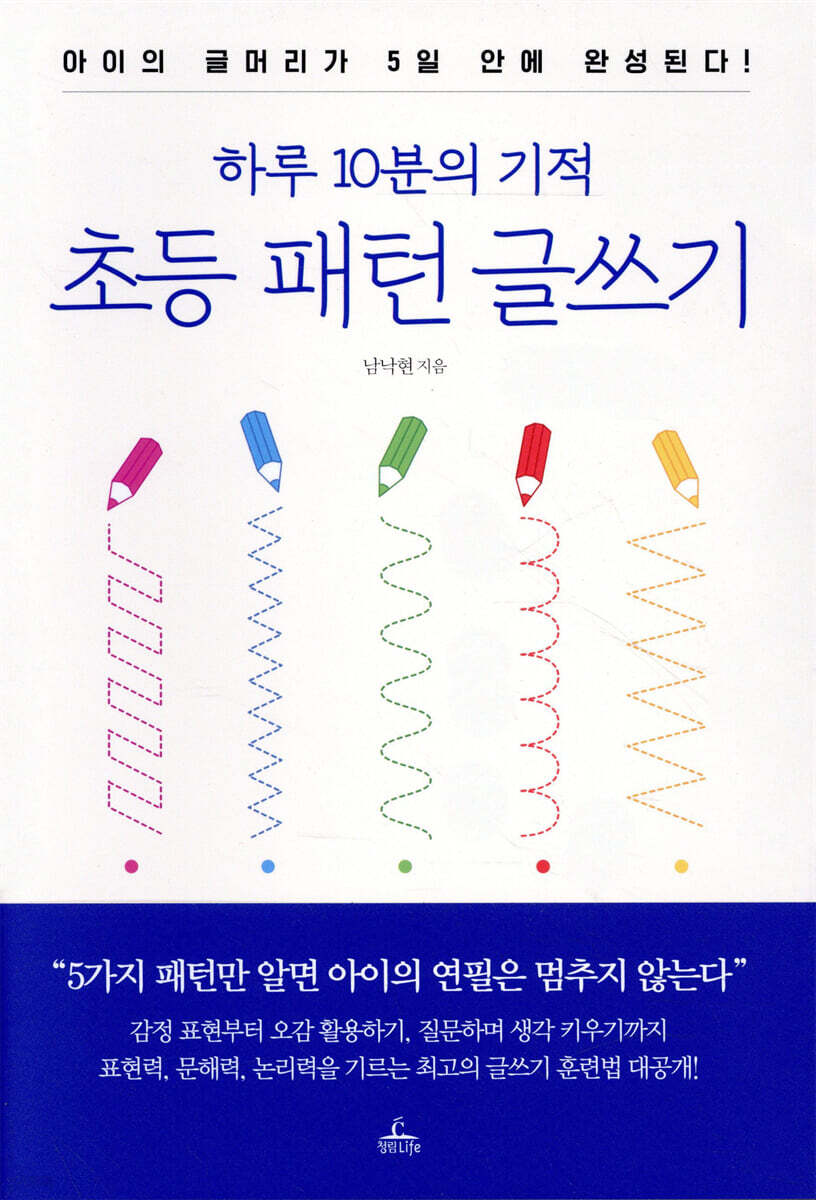
10 Minutes of Miracle Elementary Pattern Writing a Day
 |
Description
Book Introduction
“Writing is the gateway to a child’s thinking.”
The ultimate writing training method to develop critical thinking, expressive, and logical thinking skills revealed!
There is a common parenting method that globally successful people like Bill Gates and Mark Zuckerberg adhere to.
The first thing to do is to limit your child's smartphone use.
Because smartphones don't give you time to think and reduce your concentration.
The author recommends writing as the best way to develop children's thinking, expressive, and logical skills.
The act of moving a pencil stimulates the brain, and writing allows you to accurately identify what you are feeling and what you know at the moment.
However, many children are reluctant to write because they feel pressured to write well.
The author spent a long time thinking about how to remove the burden on children and make writing more playful.
And after teaching my own three children and countless other elementary school students, I realized that the most important thing in elementary writing is 'fun'.
It has to be fun to use it often, and the more you use it, the more your skills will improve.
The author has included in this book the core secrets of elementary writing, learned through real-life experience, that is, the know-how to establish a child's writing habit, along with an appropriate amount of time (10 minutes a day) and an easy way to get started (5 writing patterns).
Ten minutes is a significant time in elementary writing.
The author gave children various time limits, such as 5 minutes, 10 minutes, and 15 minutes, and had them write accordingly.
As a result, I experienced that 5 minutes was too short and 15 minutes was too short for children to concentrate.
Ten minutes is the optimal amount of time for a child to maintain interest and improve their skills.
But when you ask children to write for 10 minutes, they often say, "There's nothing to write."
By using the five writing patterns (observation, five senses, question, emotion, and theme), children will be able to develop a wealth of writing ideas.
We hope that the new solutions presented in this book will help both parents and children enjoy writing time.
The ultimate writing training method to develop critical thinking, expressive, and logical thinking skills revealed!
There is a common parenting method that globally successful people like Bill Gates and Mark Zuckerberg adhere to.
The first thing to do is to limit your child's smartphone use.
Because smartphones don't give you time to think and reduce your concentration.
The author recommends writing as the best way to develop children's thinking, expressive, and logical skills.
The act of moving a pencil stimulates the brain, and writing allows you to accurately identify what you are feeling and what you know at the moment.
However, many children are reluctant to write because they feel pressured to write well.
The author spent a long time thinking about how to remove the burden on children and make writing more playful.
And after teaching my own three children and countless other elementary school students, I realized that the most important thing in elementary writing is 'fun'.
It has to be fun to use it often, and the more you use it, the more your skills will improve.
The author has included in this book the core secrets of elementary writing, learned through real-life experience, that is, the know-how to establish a child's writing habit, along with an appropriate amount of time (10 minutes a day) and an easy way to get started (5 writing patterns).
Ten minutes is a significant time in elementary writing.
The author gave children various time limits, such as 5 minutes, 10 minutes, and 15 minutes, and had them write accordingly.
As a result, I experienced that 5 minutes was too short and 15 minutes was too short for children to concentrate.
Ten minutes is the optimal amount of time for a child to maintain interest and improve their skills.
But when you ask children to write for 10 minutes, they often say, "There's nothing to write."
By using the five writing patterns (observation, five senses, question, emotion, and theme), children will be able to develop a wealth of writing ideas.
We hope that the new solutions presented in this book will help both parents and children enjoy writing time.
- You can preview some of the book's contents.
Preview
index
Prologue_ Why can't children recall their first sentence?
Part 1.
[Basic] Fun Writing that Opens Children's Minds and Hearts
Chapter 1.
Why should we learn to write in elementary school?
The best training method to develop children's abilities: writing.
Writing concretizes a child's thoughts.
A welcome gift that fosters children's creativity
As I edit my writing, I also edit my heart.
Chapter 2.
Six Ways to Break Down Your Child's Writing Barriers
Eliminate factors that make writing difficult
Let's get into the habit of writing frequently, even if it's short.
What children need is praise, not judgment.
Just start writing
When writing a diary, remember three things:
Connect reading to writing
Chapter 3.
10 minutes a day: the perfect time to build a writing habit.
Find the first domino that opens the chapter.
Repetition makes skill
Three slightly unusual rules for 10-minute writing
It becomes fun when used with mom and dad
Writing like a snack at the table
Part 2.
[Practical] Five Writing Patterns to Help Children Easily Find Writing Inspiration
Chapter 4.
Knowing the patterns makes writing easier.
Five Patterns of Writing
[First] Writing an Observation Pattern
[Second] Five Senses Pattern Writing
[Third] Question Pattern Writing
[Fourth] Writing Emotional Patterns
[Fifth] Topic Pattern Writing
Chapter 5.
Observational Pattern Writing: Turning Everyday Life into Writing Material
Anything you see can become material for writing.
The power of observation that underpins imagination
Writing that requires no eraser or evaluation
Warm-up exercises for writing as if speaking
Observation Pattern Writing Intensive Course
[5-Day Observation Pattern Writing]
[Teacher's Writing Guidance Tips!]
Chapter 6.
Five-sense pattern writing that cultivates expressive power by utilizing the senses
Vivid writing that feels like you can hold it in your hand
Transferring all my senses to the tip of a pencil
Bringing abstract ideas to concrete expression
Adding a child's own feeling to the Korean dictionary
Five Senses Pattern Writing Advanced Course
[5-Day Five Senses Pattern Writing]
[Teacher's Writing Guidance Tips!]
Chapter 7.
Question pattern writing that develops thinking skills through asking and answering
If you put 'why' first, the writing will be done.
Imagination and Hide-and-Seek Reverse Questions
In-depth course on question pattern writing
[5-Day Question Pattern Writing Practice]
[Teacher's Writing Guidance Tips!]
Chapter 8.
Writing about emotional patterns that deeply examine the heart
There are countless writings about emotions.
Children who understand their own emotions also have higher empathy.
In-depth course on writing emotional patterns
[5-Day Emotional Pattern Writing]
[Teacher's Writing Guidance Tips!]
Chapter 9.
Writing a topic pattern that expands on a single topic in various ways
Every child who writes is a writer.
Choose a topic that suits your interests
Titles that act as navigation for your writing
Compile several articles into a book
In-depth course on writing topic patterns
[5-Day Theme Pattern Writing]
[Teacher's Writing Guidance Tips!]
Epilogue_ My child has finally started writing.
Part 1.
[Basic] Fun Writing that Opens Children's Minds and Hearts
Chapter 1.
Why should we learn to write in elementary school?
The best training method to develop children's abilities: writing.
Writing concretizes a child's thoughts.
A welcome gift that fosters children's creativity
As I edit my writing, I also edit my heart.
Chapter 2.
Six Ways to Break Down Your Child's Writing Barriers
Eliminate factors that make writing difficult
Let's get into the habit of writing frequently, even if it's short.
What children need is praise, not judgment.
Just start writing
When writing a diary, remember three things:
Connect reading to writing
Chapter 3.
10 minutes a day: the perfect time to build a writing habit.
Find the first domino that opens the chapter.
Repetition makes skill
Three slightly unusual rules for 10-minute writing
It becomes fun when used with mom and dad
Writing like a snack at the table
Part 2.
[Practical] Five Writing Patterns to Help Children Easily Find Writing Inspiration
Chapter 4.
Knowing the patterns makes writing easier.
Five Patterns of Writing
[First] Writing an Observation Pattern
[Second] Five Senses Pattern Writing
[Third] Question Pattern Writing
[Fourth] Writing Emotional Patterns
[Fifth] Topic Pattern Writing
Chapter 5.
Observational Pattern Writing: Turning Everyday Life into Writing Material
Anything you see can become material for writing.
The power of observation that underpins imagination
Writing that requires no eraser or evaluation
Warm-up exercises for writing as if speaking
Observation Pattern Writing Intensive Course
[5-Day Observation Pattern Writing]
[Teacher's Writing Guidance Tips!]
Chapter 6.
Five-sense pattern writing that cultivates expressive power by utilizing the senses
Vivid writing that feels like you can hold it in your hand
Transferring all my senses to the tip of a pencil
Bringing abstract ideas to concrete expression
Adding a child's own feeling to the Korean dictionary
Five Senses Pattern Writing Advanced Course
[5-Day Five Senses Pattern Writing]
[Teacher's Writing Guidance Tips!]
Chapter 7.
Question pattern writing that develops thinking skills through asking and answering
If you put 'why' first, the writing will be done.
Imagination and Hide-and-Seek Reverse Questions
In-depth course on question pattern writing
[5-Day Question Pattern Writing Practice]
[Teacher's Writing Guidance Tips!]
Chapter 8.
Writing about emotional patterns that deeply examine the heart
There are countless writings about emotions.
Children who understand their own emotions also have higher empathy.
In-depth course on writing emotional patterns
[5-Day Emotional Pattern Writing]
[Teacher's Writing Guidance Tips!]
Chapter 9.
Writing a topic pattern that expands on a single topic in various ways
Every child who writes is a writer.
Choose a topic that suits your interests
Titles that act as navigation for your writing
Compile several articles into a book
In-depth course on writing topic patterns
[5-Day Theme Pattern Writing]
[Teacher's Writing Guidance Tips!]
Epilogue_ My child has finally started writing.
Detailed image

Into the book
This book contains the process of children accepting writing as a fun game through five patterns.
I wrote this book with the hope that at least one more child would develop the habit of writing and grow up to be a writer.
Are you saying elementary school writing is difficult? Not at all.
All you have to do is help your child open the bulletin board so he can write on his own.
Then, the child writes down the thoughts that come to mind during break time.
Even if I'm sitting at the table, if something comes to mind, I'll start scribbling it down.
These small experiences will help develop writing habits and serve as great tools for nurturing your child's emotions and imagination.
--- p.7, from "Prologue"
Usually, when a child doesn't write, what parents say is obvious.
All I do is ask, “What happened today?” and encourage writing.
Writing must come from within the child.
Even parents cannot replace their children.
Children's writing should begin with writing down their own thoughts and experiences.
This means that children who enjoy writing and write frequently are more likely to be able to express their experiences and thoughts in a variety of ways.
Now, I want to examine whether our child has the ability to express his or her own thoughts in writing.
--- p.20~21, from “The Best Training Method to Develop Children’s Abilities: Writing”
Post-it note writing is simple and effective for developing a writing habit.
Another advantage is that children can easily carry the post-it notes around in their bags or pockets.
The paper is only about the size of a child's palm, which reduces the burden of writing.
Simply writing down any thoughts that come to mind as if they were notes is effective in developing a writing habit.
--- p.49, from “Let’s get into the habit of writing frequently, even if it’s short”
Reading and writing are different ways of expressing ourselves.
Reading is about acquiring information and knowledge through your eyes, and writing is about putting your thoughts down with your fingertips.
Simply put, reading is an input act, and writing is an output act.
If you write it down, you can clearly see the difference.
Writing, rather than just reading, will definitely give you the ability to express your own subjective thoughts.
--- p.72~73, from “Connect Reading to Writing”
There are three rules to making 10-minute writing easy and effective.
First, think while writing in the short time given.
Second, write as much as possible without worrying about what others think.
Third, don't stop thinking.
Applying three rules to your 10-minute writing routine can help you achieve more effective results.
--- p.89~90, from “Three slightly unique rules for 10-minute writing”
Pattern writing is an approach that was designed with a different perspective from conventional writing.
When I explain to children who are just starting to write why they need to write, most of them just listen with one ear and let it go out the other.
Elementary writing should be easy to follow.
The key is to provide a pattern that allows you to start writing right away.
You need to provide a pattern that can open the bullet points and guide the child to write on his own and achieve results.
I wrote this book with the hope that at least one more child would develop the habit of writing and grow up to be a writer.
Are you saying elementary school writing is difficult? Not at all.
All you have to do is help your child open the bulletin board so he can write on his own.
Then, the child writes down the thoughts that come to mind during break time.
Even if I'm sitting at the table, if something comes to mind, I'll start scribbling it down.
These small experiences will help develop writing habits and serve as great tools for nurturing your child's emotions and imagination.
--- p.7, from "Prologue"
Usually, when a child doesn't write, what parents say is obvious.
All I do is ask, “What happened today?” and encourage writing.
Writing must come from within the child.
Even parents cannot replace their children.
Children's writing should begin with writing down their own thoughts and experiences.
This means that children who enjoy writing and write frequently are more likely to be able to express their experiences and thoughts in a variety of ways.
Now, I want to examine whether our child has the ability to express his or her own thoughts in writing.
--- p.20~21, from “The Best Training Method to Develop Children’s Abilities: Writing”
Post-it note writing is simple and effective for developing a writing habit.
Another advantage is that children can easily carry the post-it notes around in their bags or pockets.
The paper is only about the size of a child's palm, which reduces the burden of writing.
Simply writing down any thoughts that come to mind as if they were notes is effective in developing a writing habit.
--- p.49, from “Let’s get into the habit of writing frequently, even if it’s short”
Reading and writing are different ways of expressing ourselves.
Reading is about acquiring information and knowledge through your eyes, and writing is about putting your thoughts down with your fingertips.
Simply put, reading is an input act, and writing is an output act.
If you write it down, you can clearly see the difference.
Writing, rather than just reading, will definitely give you the ability to express your own subjective thoughts.
--- p.72~73, from “Connect Reading to Writing”
There are three rules to making 10-minute writing easy and effective.
First, think while writing in the short time given.
Second, write as much as possible without worrying about what others think.
Third, don't stop thinking.
Applying three rules to your 10-minute writing routine can help you achieve more effective results.
--- p.89~90, from “Three slightly unique rules for 10-minute writing”
Pattern writing is an approach that was designed with a different perspective from conventional writing.
When I explain to children who are just starting to write why they need to write, most of them just listen with one ear and let it go out the other.
Elementary writing should be easy to follow.
The key is to provide a pattern that allows you to start writing right away.
You need to provide a pattern that can open the bullet points and guide the child to write on his own and achieve results.
--- p.113, from “Five Patterns of Writing”
Publisher's Review
"Know these five patterns and your child's pencil will never stop."
From the first step of writing to running
Master elementary writing in one book!
This book is part 1.
[Basic] ‘Fun writing that opens children’s thoughts and hearts’ and ‘Part 2.
[Practical Edition] It consists of 'Five Writing Patterns That Help Children Easily Find Writing Materials'.
Part 1 (Chapters 1-3) is for children who are taking their first steps in writing, and Part 2 (Chapters 4-9) is for children who have some knowledge about writing but do not know how to write.
You can choose and read according to your child's ability.
Looking at the contents in order, Chapter 1 emphasizes the importance of writing.
The secret weapon that maximizes a child's potential more easily and quickly than any other educational method is writing.
In other words, a child's future abilities depend on his or her writing habits.
Chapter 2 introduces six ways to break down writing barriers.
We will reveal the know-how to help children enjoy writing in everyday situations, such as when writing a diary or reading a book.
Chapter 3 tells us that 10 minutes a day is the optimal amount of time to increase a child's concentration and form a writing habit.
This short period of time is less burdensome for the child and can lead to the habit of writing 'frequently' and 'repeatedly'.
Chapter 4 briefly introduces the author's unique five-pattern writing method, and the following chapters delve into each pattern in depth.
Chapter 5 introduces 'Observation Pattern Writing', which involves writing down what you see, Chapter 6 introduces 'Five Senses Pattern Writing', which involves opening up your senses and expressing what you feel in a new way, Chapter 7 introduces 'Question Pattern Writing', which involves creating and answering unexpected questions, Chapter 8 introduces 'Emotion Pattern Writing', which involves examining in detail emotions that you may have overlooked, and Chapter 9 introduces 'Topic Pattern Writing', which involves creating various writings with one material.
With just 10 minutes a day and 5 different patterns, your child will be filling up the paper with creative ideas.
A child who is bad at writing, the problem lies in 'time' and 'pattern'!
10 Minutes a Day, 5 Writing Patterns to Unlock Your Child's Writing Mind
The author presents a new writing paradigm called '10 minutes a day' and '5 patterns.'
There are three rules to follow when writing for 10 minutes a day.
First, don't worry about what to write, just think while you write.
Second, write as much as possible within the limited time.
Third, don't stop until the 10 minutes are up.
These rules all have one thing in common: they allow children to think freely.
If you pour out your thoughts freely, unexpectedly good ideas and expressions will pour out.
The five patterns stimulate the child's different senses, allowing them to grow evenly.
Observational pattern writing is writing down what you see.
As you observe things around you closely and discover new things, your creativity will grow beyond recognition.
Five senses pattern writing is about putting tastes, sounds, smells, etc. into writing.
Using this pattern will help your child come up with vivid expressions and naturally develop his or her expressive skills.
Question pattern writing is about using your imagination to answer even the most odd questions.
For example, outrageous ideas like "What if there was no hair?", "What if fish lived on land?", and "What if rain rose from the ground to the sky?" break children's stereotypes and stimulate their imagination.
Emotional pattern writing is a type of writing that allows children to look more closely into their own minds.
If a child does not have time to examine his or her own emotions, it is easy for him or her to overuse “I’m not that good” because he or she does not know how he or she is feeling at the moment.
Writing about emotional patterns provides an opportunity to calmly look into your heart and get to know yourself better.
Topic pattern writing is the process of creating multiple titles for one topic to generate a variety of writing materials.
For example, with the topic of 'dreams', you can create various titles such as 'What is my dream?' or 'What are some cool jobs?' and spend time thinking more deeply about the topic.
It provides a foundation for developing children's thinking skills by allowing them to look at a topic from various perspectives.
★Easy writing game to follow with everyday supplies★
★25 writing missions for each day of the week, Monday, Tuesday, Wednesday, Thursday, and Sunday★
This book adds practicality by including writing games and daily writing missions.
Here are some fun activities you can do with your child using easily found items like paper airplanes and Post-it notes.
Writing games help children realize that writing is not difficult.
Writing is a great way to instill the idea that it can be done anywhere, anytime.
Additionally, it includes daily missions so that you can immediately follow the five writing patterns (observation, five senses, question, emotion, and theme), which are the core secrets of this book.
Use the writing prompts provided in [5-Day Writing Pattern] to write every day, and refer to the notes in [Teacher's Writing Guidance Tips!] for any areas where you get stuck.
It will make children look forward to writing time, and it will become a writing teacher that teaches parents an easy and clear method.
From the first step of writing to running
Master elementary writing in one book!
This book is part 1.
[Basic] ‘Fun writing that opens children’s thoughts and hearts’ and ‘Part 2.
[Practical Edition] It consists of 'Five Writing Patterns That Help Children Easily Find Writing Materials'.
Part 1 (Chapters 1-3) is for children who are taking their first steps in writing, and Part 2 (Chapters 4-9) is for children who have some knowledge about writing but do not know how to write.
You can choose and read according to your child's ability.
Looking at the contents in order, Chapter 1 emphasizes the importance of writing.
The secret weapon that maximizes a child's potential more easily and quickly than any other educational method is writing.
In other words, a child's future abilities depend on his or her writing habits.
Chapter 2 introduces six ways to break down writing barriers.
We will reveal the know-how to help children enjoy writing in everyday situations, such as when writing a diary or reading a book.
Chapter 3 tells us that 10 minutes a day is the optimal amount of time to increase a child's concentration and form a writing habit.
This short period of time is less burdensome for the child and can lead to the habit of writing 'frequently' and 'repeatedly'.
Chapter 4 briefly introduces the author's unique five-pattern writing method, and the following chapters delve into each pattern in depth.
Chapter 5 introduces 'Observation Pattern Writing', which involves writing down what you see, Chapter 6 introduces 'Five Senses Pattern Writing', which involves opening up your senses and expressing what you feel in a new way, Chapter 7 introduces 'Question Pattern Writing', which involves creating and answering unexpected questions, Chapter 8 introduces 'Emotion Pattern Writing', which involves examining in detail emotions that you may have overlooked, and Chapter 9 introduces 'Topic Pattern Writing', which involves creating various writings with one material.
With just 10 minutes a day and 5 different patterns, your child will be filling up the paper with creative ideas.
A child who is bad at writing, the problem lies in 'time' and 'pattern'!
10 Minutes a Day, 5 Writing Patterns to Unlock Your Child's Writing Mind
The author presents a new writing paradigm called '10 minutes a day' and '5 patterns.'
There are three rules to follow when writing for 10 minutes a day.
First, don't worry about what to write, just think while you write.
Second, write as much as possible within the limited time.
Third, don't stop until the 10 minutes are up.
These rules all have one thing in common: they allow children to think freely.
If you pour out your thoughts freely, unexpectedly good ideas and expressions will pour out.
The five patterns stimulate the child's different senses, allowing them to grow evenly.
Observational pattern writing is writing down what you see.
As you observe things around you closely and discover new things, your creativity will grow beyond recognition.
Five senses pattern writing is about putting tastes, sounds, smells, etc. into writing.
Using this pattern will help your child come up with vivid expressions and naturally develop his or her expressive skills.
Question pattern writing is about using your imagination to answer even the most odd questions.
For example, outrageous ideas like "What if there was no hair?", "What if fish lived on land?", and "What if rain rose from the ground to the sky?" break children's stereotypes and stimulate their imagination.
Emotional pattern writing is a type of writing that allows children to look more closely into their own minds.
If a child does not have time to examine his or her own emotions, it is easy for him or her to overuse “I’m not that good” because he or she does not know how he or she is feeling at the moment.
Writing about emotional patterns provides an opportunity to calmly look into your heart and get to know yourself better.
Topic pattern writing is the process of creating multiple titles for one topic to generate a variety of writing materials.
For example, with the topic of 'dreams', you can create various titles such as 'What is my dream?' or 'What are some cool jobs?' and spend time thinking more deeply about the topic.
It provides a foundation for developing children's thinking skills by allowing them to look at a topic from various perspectives.
★Easy writing game to follow with everyday supplies★
★25 writing missions for each day of the week, Monday, Tuesday, Wednesday, Thursday, and Sunday★
This book adds practicality by including writing games and daily writing missions.
Here are some fun activities you can do with your child using easily found items like paper airplanes and Post-it notes.
Writing games help children realize that writing is not difficult.
Writing is a great way to instill the idea that it can be done anywhere, anytime.
Additionally, it includes daily missions so that you can immediately follow the five writing patterns (observation, five senses, question, emotion, and theme), which are the core secrets of this book.
Use the writing prompts provided in [5-Day Writing Pattern] to write every day, and refer to the notes in [Teacher's Writing Guidance Tips!] for any areas where you get stuck.
It will make children look forward to writing time, and it will become a writing teacher that teaches parents an easy and clear method.
GOODS SPECIFICS
- Date of issue: September 9, 2020
- Page count, weight, size: 272 pages | 510g | 152*224*15mm
- ISBN13: 9791188700677
- ISBN10: 1188700677
You may also like
카테고리
korean


korean

![ELLE 엘르 스페셜 에디션 A형 : 12월 [2025]](http://librairie.coreenne.fr/cdn/shop/files/b8e27a3de6c9538896439686c6b0e8fb.jpg?v=1766436872&width=3840)


