

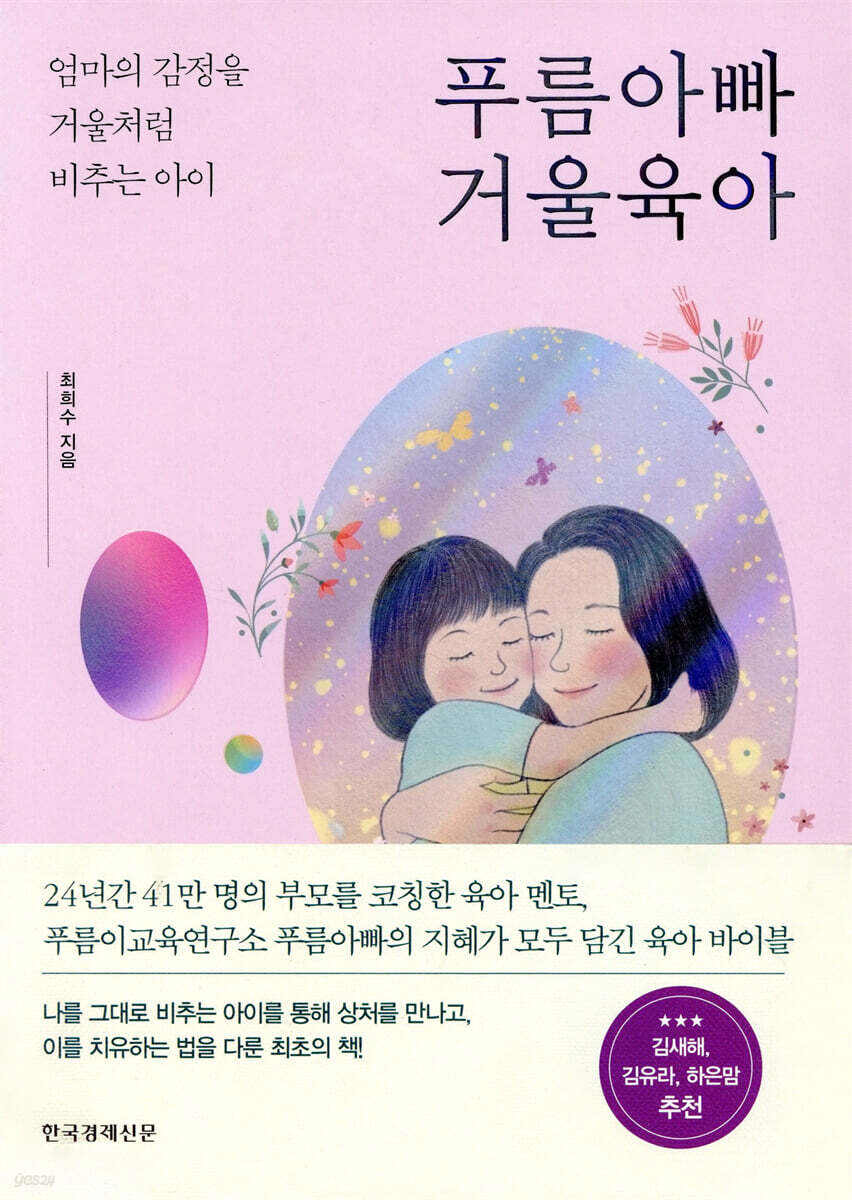
Blue Dad's Mirror Parenting
 |
Description
Book Introduction
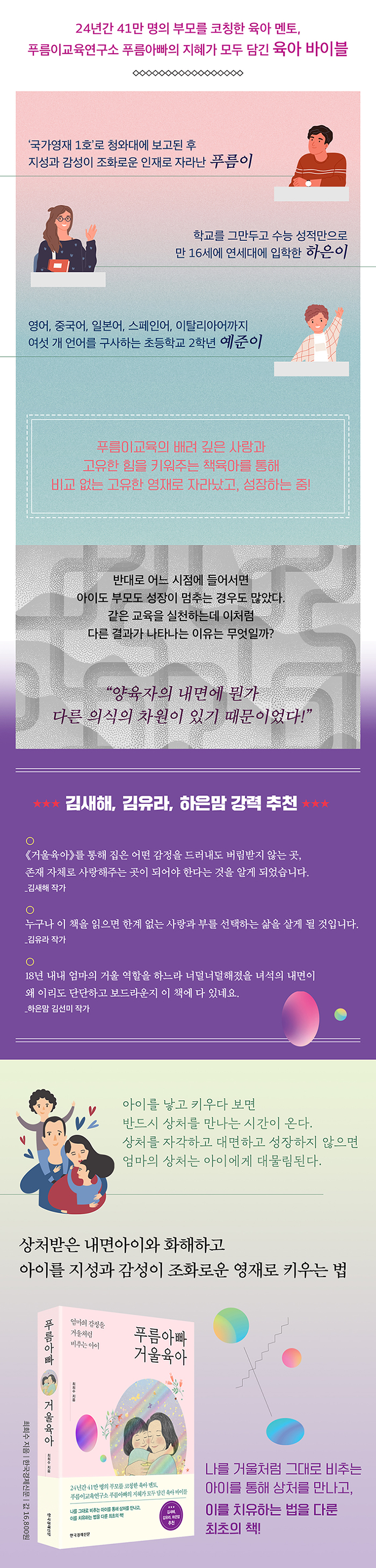
A parenting mentor who has coached 410,000 parents for 24 years. The Parenting Bible, filled with the wisdom of Purum's father from the Purum Education Research Institute. What kind of wounds should I encounter and what kind of emotions should I choose through the child who reflects me like a mirror? Purum, who was reported to the Blue House as the 'National Gifted No. 1' and grew into a talented person with a good balance of intellect and sensibility; Ha-eun, who dropped out of middle school in her first year and entered Yonsei University at the age of 16 solely based on her college entrance exam scores; and Ye-jun, a second-grade elementary school student who speaks six languages: English, Chinese, Japanese, Spanish, and Italian. These children have grown into incomparable, unique talents through Purum Education's caring love and book-based parenting that fosters their unique strengths. Purum's father, Purum Education Research Institute, has raised Purum and Cho-rok as children with a balanced intellect and sensibility. Over the past 24 years, he has given over 5,000 lectures and parenting consultations, meeting hundreds of thousands of people who practice considerate love. Some people practiced the Purum Education method and raised infinitely intelligent and emotionally balanced individuals, but on the other hand, there were many cases where both the child and the parents stopped growing at some point. Author Heesu Choi of Blue Dad was curious as to why such different results were achieved when the same educational practices were implemented. This book analyzes why children get completely different results even when raised with the same educational method, and it contains a journey to find the cause within the caregivers, not the children, and to solve it. The reason for the polar opposite results was that there was a different level of consciousness within the caregiver. When you give birth to a child and raise him, there will inevitably come a time when you will experience pain. Through the child who reflects the mother's emotions like a mirror, the mother must realize the wounded inner child. If a mother does not recognize, confront, and grow from her wounds, her wounds will be passed down to her child. In order for a child to realize that he or she is love itself and grow into a unique being, a mother must grow. Through [Mirror Parenting], children can now grow up in a caring environment of love, and learn how to grow alongside their caregivers. |
- You can preview some of the book's contents.
Preview
index
Recommendation
Prologue_ Healing is a change in perspective.
Chapter 1: Why Raising Children Is So Difficult
· Sadness and anger
A child who reflects his mother's sorrow
A child who reflects his mother's anger
· The point where anger arises
There is a wound at the point of anger
It's hard to welcome and bless a child.
The child is not eating.
The child won't sleep.
I don't get any praise for my child.
The kid looks stupid
When a child whines, it drives me crazy.
I want to hit the child
Chapter 2: Awareness and Confrontation: A Time to Recognize Your Wounds and Meet Your Emotions
· Awareness: The process of recognizing unconscious wounds
To end inner unhappiness
Repressed anger can only be seen as projection.
· Face-to-face: The process of encountering unconscious emotions
Reuniting frozen emotions
Face-to-face scene
How to release anger
It's not your fault
Defense mechanisms
First layer of defense: denial, repression, projection
Second Layer of Defense: Roles
Third Layer of Defense: Personality
Mourn the loss
The First Stage of Grief: Denial
The Second Stage of Grief: Anger
The Third Stage of Grief: Sadness
The Final Stage of Grief: Acceptance
Chapter 3: Growing Up: Getting to Know Myself
Consciousness map
ego
wealth
health
Separate couples
*Recommended books related to consciousness growth
Chapter 4: There are certain laws in a child's development.
From conception to birth: A time to be welcomed
Dear baby, welcome back
If you can't welcome the baby in your belly
If it's a premarital pregnancy
If you were born a daughter in a family that wanted a son
Forgive yourself as you forgive your child.
· From birth to 18 months: The period of attachment formation
A child is a noble and majestic being.
Separation anxiety and attachment
Memories of abandonment
· 18-36 months: First rebellious period
“No, I don’t want to do it”, “It’s mine”, “I’ll do it”
Target homeostasis
shame
*Characteristics of a person who is ashamed of himself
Between brothers and sisters
*Protecting the ownership and boundaries of siblings
· 36-72 months: The lawless stage, when the omnipotent ego dominates
I am the king!
Guilt
Oedipus complex
imagination
Chapter 5: Raising Children Without Limits: Book Parenting
Parenting with books is the most basic of basics.
Familiarization: The stage of becoming familiar with books
Playtime: Playing with books
The Sea Period: The Stages of Immersion in a Book
The Age of Independence: The Stages of Reading Independence
*10 Parenting Books That Awaken Your Child's Great Power
Chapter 6: Raising Children with Considerate Love
Every child is born with great power.
*Characteristics of children growing into infinite human beings
Korean language removal
Study English
Games, YouTube
*How to avoid fighting with your child over games
Love thoughtfully
*10 Things to Remember to Raise Your Child with Considerate Love
Epilogue: Our nature is love itself.
Prologue_ Healing is a change in perspective.
Chapter 1: Why Raising Children Is So Difficult
· Sadness and anger
A child who reflects his mother's sorrow
A child who reflects his mother's anger
· The point where anger arises
There is a wound at the point of anger
It's hard to welcome and bless a child.
The child is not eating.
The child won't sleep.
I don't get any praise for my child.
The kid looks stupid
When a child whines, it drives me crazy.
I want to hit the child
Chapter 2: Awareness and Confrontation: A Time to Recognize Your Wounds and Meet Your Emotions
· Awareness: The process of recognizing unconscious wounds
To end inner unhappiness
Repressed anger can only be seen as projection.
· Face-to-face: The process of encountering unconscious emotions
Reuniting frozen emotions
Face-to-face scene
How to release anger
It's not your fault
Defense mechanisms
First layer of defense: denial, repression, projection
Second Layer of Defense: Roles
Third Layer of Defense: Personality
Mourn the loss
The First Stage of Grief: Denial
The Second Stage of Grief: Anger
The Third Stage of Grief: Sadness
The Final Stage of Grief: Acceptance
Chapter 3: Growing Up: Getting to Know Myself
Consciousness map
ego
wealth
health
Separate couples
*Recommended books related to consciousness growth
Chapter 4: There are certain laws in a child's development.
From conception to birth: A time to be welcomed
Dear baby, welcome back
If you can't welcome the baby in your belly
If it's a premarital pregnancy
If you were born a daughter in a family that wanted a son
Forgive yourself as you forgive your child.
· From birth to 18 months: The period of attachment formation
A child is a noble and majestic being.
Separation anxiety and attachment
Memories of abandonment
· 18-36 months: First rebellious period
“No, I don’t want to do it”, “It’s mine”, “I’ll do it”
Target homeostasis
shame
*Characteristics of a person who is ashamed of himself
Between brothers and sisters
*Protecting the ownership and boundaries of siblings
· 36-72 months: The lawless stage, when the omnipotent ego dominates
I am the king!
Guilt
Oedipus complex
imagination
Chapter 5: Raising Children Without Limits: Book Parenting
Parenting with books is the most basic of basics.
Familiarization: The stage of becoming familiar with books
Playtime: Playing with books
The Sea Period: The Stages of Immersion in a Book
The Age of Independence: The Stages of Reading Independence
*10 Parenting Books That Awaken Your Child's Great Power
Chapter 6: Raising Children with Considerate Love
Every child is born with great power.
*Characteristics of children growing into infinite human beings
Korean language removal
Study English
Games, YouTube
*How to avoid fighting with your child over games
Love thoughtfully
*10 Things to Remember to Raise Your Child with Considerate Love
Epilogue: Our nature is love itself.
Detailed image
Into the book
Among children, there are some who cry especially.
No matter how much I try to soothe him, he won't stop crying.
Children who feel empathy do not cry easily.
Even if I cry, I only cry for a little while, and after crying, there are no emotional residues left behind, so I laugh brightly and run around, to the point where I wonder when I was like that.
But if there is sadness inside the mother, the child will cry until the mother's sadness is completely resolved.
When a child cries, that crying directly touches the sadness that is suppressed in the mother's unconscious.
---From "A Child Reflecting His Mother's Sorrow"
When anger arises, I have to examine how this relates to my childhood.
The point at which anger arises varies from person to person.
There are mothers who cannot bless and welcome their children when they have them.
Some fathers say they get angry when their children don't eat.
Some mothers get angry when their children won't sleep.
Some mothers get into power struggles with their children and explode when they refuse to wash their hair or brush their teeth.
There are fathers who have a hard time when their children don't say hello, and there are also parents who can't stand their children whining and yell at them.
---From "There is a wound at the point of anger"
If you don't like your child whining and clinging, you need to be aware of whether there is a lonely inner child who grew up alone because his mother told him to go away because he was annoyed.
Whining is a child's way of trying to connect and communicate with their mother.
All children have whining expressions.
However, it is difficult for a mother who does not receive empathy from her own mother to empathize with her child.
---From "When a child whines, I go crazy"
When you get married and have children, the child's words and actions will touch on the desires and emotions that have been suppressed in your subconscious.
'She's so pretty, where can I hit her?' Then, I come to my senses.
How miserable and terrifying it was to be beaten in my childhood.
I didn't realize it when I thought being beaten was normal, but as I raised my child, I realized that there was a wounded inner child within me, a desire and emotion that remained unresolved.
The inner child stopped growing right there.
My body is an adult, but inside me, in a dark room, there is a child crying alone.
---From "Repressed anger can only be seen as a projection"
As the encounter continues, all the puzzle pieces fall into place in an instant, explaining why you said and did what you did in the past.
A life-permeating realization comes, and everything becomes understood and clear.
Confrontation is the process of bringing unconscious emotions into consciousness.
Only when we come to consciousness can we make choices based on our will, and only then can healing occur.
If you don't do that, you will be ruled by your subconscious and will act without even knowing why you are doing it.
---From "Meeting Frozen Emotions Again"
The emotional wounds children receive are as painful as being pricked by a thorn.
Adults know that if they get pricked by a thorn, they should remove it even if it stings a little so that it doesn't get worse, but children don't have that understanding.
If a child gets pricked by a thorn, he bandages the area.
Then I don't feel any pain.
This bandage is a defense mechanism.
Every time I get pricked by a thorn, I bandage it.
Although she defends everything well, she ends up becoming a mummy who has difficulty feeling emotions.
---From "Defense Mechanism"
I have had the experience of crying like an animal while facing my wounds and then losing my inner watcher.
I feel at peace because I no longer have to hide myself in shame.
Not hiding means the 'pretend' is gone.
The moment of deep peace I experienced then will be unforgettable for the rest of my life.
When mothers cry, children live.
Don't end a 30-minute cry in 20 minutes.
If you keep thinking about other people while crying, it means you haven't finished crying yet.
---From "The Third Stage of Mourning: Grief"
This means that the level of consciousness that created the environment that hurt us in our childhood is the same as the level of consciousness that creates the present, so we are creating the same environment.
For example, let's say a man and a woman who are very fearful meet and get married.
That home environment is dominated by fear at a level of consciousness of about 100.
Children who grow up in that family have similar friends, and later meet and marry someone with the same level of consciousness.
If we fail to recognize and confront this fear, the same environment will be created for at least five generations.
---From "Ego"
As a first-time mother, you might wonder what a newborn who sleeps and eats can learn, but the child absorbs the direction of life that becomes the foundation of his or her life from the mother.
The child literally absorbs.
I absorb and use what I hear from my mother, and I absorb her attitude towards life.
In fact, a mother doesn't know how she lives unless she observes her own life, but a child can sense what is being suppressed by the mother's unconscious.
---From “Children are noble and majestic beings”
Moms can also get angry, laugh when they are happy, or cry when they are sad.
However, a mother's love must remain constant so that the child can have the image of the mother as an inseparable object and always the same.
This means that the world is not divided into light and darkness, but is one.
To a child, a mother is the world.
Children who become one with their mothers through their mothers' love believe in the world as love.
They look at the world with fear and do not divide it into black and white, good people and bad people.
---From "Target Constancy"
The second reason children don't read is because they are emotionally pressured to read.
When a child is learning something, it is important to let them do it in a friendly environment at a pleasant time, and for the parent to stop before the child expresses the intention to stop.
Parents should create an environment for their children to read books, and give them to their children when they express a desire to read. Parents should not be the first to give in to this.
Parents who raise their children well are not those who control their children, but those who follow them half a step behind and respond.
---From "Playing Time: The Stage of Playing with Books"
Education is about helping children develop this great power they are born with, without damaging it.
If we change our perspective from teaching children to drawing them out rather than forcing them to learn, education becomes natural and easy.
If a child were raised from the moment of conception by parents who, without fear, embraced him or her with caring love, how would that child perceive himself or herself? He or she would believe himself or herself to be noble, majestic, light, and love.
---From "Every child is born with great power"
All parents want to love their children just as they are.
But when I make the choice to love my child as he or she is and try to put it into practice in my daily life, I quickly realize that it is difficult.
Because considerate love brings from the unconscious into consciousness all the opposite pairs that block considerate love.
Considerate love already exists within us because it is our nature and our home.
So, if only the obstacles that prevent us from knowing considerate love were removed, it would reveal itself.
No matter how much I try to soothe him, he won't stop crying.
Children who feel empathy do not cry easily.
Even if I cry, I only cry for a little while, and after crying, there are no emotional residues left behind, so I laugh brightly and run around, to the point where I wonder when I was like that.
But if there is sadness inside the mother, the child will cry until the mother's sadness is completely resolved.
When a child cries, that crying directly touches the sadness that is suppressed in the mother's unconscious.
---From "A Child Reflecting His Mother's Sorrow"
When anger arises, I have to examine how this relates to my childhood.
The point at which anger arises varies from person to person.
There are mothers who cannot bless and welcome their children when they have them.
Some fathers say they get angry when their children don't eat.
Some mothers get angry when their children won't sleep.
Some mothers get into power struggles with their children and explode when they refuse to wash their hair or brush their teeth.
There are fathers who have a hard time when their children don't say hello, and there are also parents who can't stand their children whining and yell at them.
---From "There is a wound at the point of anger"
If you don't like your child whining and clinging, you need to be aware of whether there is a lonely inner child who grew up alone because his mother told him to go away because he was annoyed.
Whining is a child's way of trying to connect and communicate with their mother.
All children have whining expressions.
However, it is difficult for a mother who does not receive empathy from her own mother to empathize with her child.
---From "When a child whines, I go crazy"
When you get married and have children, the child's words and actions will touch on the desires and emotions that have been suppressed in your subconscious.
'She's so pretty, where can I hit her?' Then, I come to my senses.
How miserable and terrifying it was to be beaten in my childhood.
I didn't realize it when I thought being beaten was normal, but as I raised my child, I realized that there was a wounded inner child within me, a desire and emotion that remained unresolved.
The inner child stopped growing right there.
My body is an adult, but inside me, in a dark room, there is a child crying alone.
---From "Repressed anger can only be seen as a projection"
As the encounter continues, all the puzzle pieces fall into place in an instant, explaining why you said and did what you did in the past.
A life-permeating realization comes, and everything becomes understood and clear.
Confrontation is the process of bringing unconscious emotions into consciousness.
Only when we come to consciousness can we make choices based on our will, and only then can healing occur.
If you don't do that, you will be ruled by your subconscious and will act without even knowing why you are doing it.
---From "Meeting Frozen Emotions Again"
The emotional wounds children receive are as painful as being pricked by a thorn.
Adults know that if they get pricked by a thorn, they should remove it even if it stings a little so that it doesn't get worse, but children don't have that understanding.
If a child gets pricked by a thorn, he bandages the area.
Then I don't feel any pain.
This bandage is a defense mechanism.
Every time I get pricked by a thorn, I bandage it.
Although she defends everything well, she ends up becoming a mummy who has difficulty feeling emotions.
---From "Defense Mechanism"
I have had the experience of crying like an animal while facing my wounds and then losing my inner watcher.
I feel at peace because I no longer have to hide myself in shame.
Not hiding means the 'pretend' is gone.
The moment of deep peace I experienced then will be unforgettable for the rest of my life.
When mothers cry, children live.
Don't end a 30-minute cry in 20 minutes.
If you keep thinking about other people while crying, it means you haven't finished crying yet.
---From "The Third Stage of Mourning: Grief"
This means that the level of consciousness that created the environment that hurt us in our childhood is the same as the level of consciousness that creates the present, so we are creating the same environment.
For example, let's say a man and a woman who are very fearful meet and get married.
That home environment is dominated by fear at a level of consciousness of about 100.
Children who grow up in that family have similar friends, and later meet and marry someone with the same level of consciousness.
If we fail to recognize and confront this fear, the same environment will be created for at least five generations.
---From "Ego"
As a first-time mother, you might wonder what a newborn who sleeps and eats can learn, but the child absorbs the direction of life that becomes the foundation of his or her life from the mother.
The child literally absorbs.
I absorb and use what I hear from my mother, and I absorb her attitude towards life.
In fact, a mother doesn't know how she lives unless she observes her own life, but a child can sense what is being suppressed by the mother's unconscious.
---From “Children are noble and majestic beings”
Moms can also get angry, laugh when they are happy, or cry when they are sad.
However, a mother's love must remain constant so that the child can have the image of the mother as an inseparable object and always the same.
This means that the world is not divided into light and darkness, but is one.
To a child, a mother is the world.
Children who become one with their mothers through their mothers' love believe in the world as love.
They look at the world with fear and do not divide it into black and white, good people and bad people.
---From "Target Constancy"
The second reason children don't read is because they are emotionally pressured to read.
When a child is learning something, it is important to let them do it in a friendly environment at a pleasant time, and for the parent to stop before the child expresses the intention to stop.
Parents should create an environment for their children to read books, and give them to their children when they express a desire to read. Parents should not be the first to give in to this.
Parents who raise their children well are not those who control their children, but those who follow them half a step behind and respond.
---From "Playing Time: The Stage of Playing with Books"
Education is about helping children develop this great power they are born with, without damaging it.
If we change our perspective from teaching children to drawing them out rather than forcing them to learn, education becomes natural and easy.
If a child were raised from the moment of conception by parents who, without fear, embraced him or her with caring love, how would that child perceive himself or herself? He or she would believe himself or herself to be noble, majestic, light, and love.
---From "Every child is born with great power"
All parents want to love their children just as they are.
But when I make the choice to love my child as he or she is and try to put it into practice in my daily life, I quickly realize that it is difficult.
Because considerate love brings from the unconscious into consciousness all the opposite pairs that block considerate love.
Considerate love already exists within us because it is our nature and our home.
So, if only the obstacles that prevent us from knowing considerate love were removed, it would reveal itself.
---From "Love Considerately"
Publisher's Review
Why is it so difficult to raise a loving child?
This is because, as you raise a child, there will inevitably come a time when you encounter the wounds within yourself.
How to reconcile with your wounded inner child and raise your child into a gifted individual with a balanced intellect and emotions.
If I grew up trembling in fear at the sight of my parents' blazing anger, I resolve not to inflict that fear on my children.
It is a decision to raise your child differently from your parents.
But I am often surprised to find myself, without realizing it, seeing the same anger in my eyes as my parents.
Why is it so difficult to raise a loving child? Why do we display such raw anger toward our own children while being kind to others? It's because we harbor a wounded inner child within our unconscious.
You may not experience this feeling of sadness until you have a child.
Because we can avoid confrontation through various defense mechanisms.
But once you have a child, you are driven into a dead end that you can no longer avoid.
Among children, there are some who cry especially.
No matter how much I try to soothe him, he won't stop crying.
Children who feel empathy do not cry easily.
Even if I cry, I only cry for a little while, and after crying, there are no emotional residues left behind, so I laugh brightly and run around, to the point where I wonder when I was like that.
But if there is sadness inside the mother, the child will cry until the mother's sadness is completely resolved.
If you find it particularly difficult to tolerate your child's crying, you should reflect on whether the child has touched the wounded inner child within you, causing sadness and anger to arise.
If you become a parent and continue to look back at yourself through the image of your child growing up to resemble you, as if reflected in a mirror, you will eventually be able to meet your true self.
In other words, parenting is both the process of raising a child and the process of finding one's true self.
My child tests me endlessly, and as I answer those tests, I grow and change little by little, and sometimes even face my own shortcomings.
As you become a parent and raise a child, there will inevitably come a time when you realize that there is a wounded inner child within your unconscious through your child's love.
When raising a child, if anger, regret, and various complex and inexplicable feelings and emotions arise, you must realize that this is the beginning of change and the beginning of 'growth' where fear turns into love.
Before I am a ‘mother’, I am ‘myself’.
Instead of beating yourself up for being angry, take care of yourself first.
From the characteristics and parenting methods for each stage of life to raising a child with no limits, to book-based parenting that allows your child's unique strengths to be revealed!
So how do I recognize, confront, and heal my wounded inner child? My child can't make me angry.
I choose anger because my child's words and actions mirror what is already inside me.
It is important to be 'aware' and aware of where I am getting angry.
If there is a baby younger than your own child inside you, it is natural that raising the child will be difficult.
'Confrontation' is the process of bringing these unconscious emotions into consciousness, truly healing the wounds and moving from fear to love.
To end the internal unhappiness that has been passed down through generations, we must go through a period of awareness, confrontation, and growth.
In this process, we must go through a process of mourning the loss by facing and letting go of defense mechanisms such as 'denial', which is believing that something happened but did not happen; 'repression', which is pushing emotions that we cannot acknowledge ourselves because our parents do not acknowledge them into the subconscious; and 'projection', which is projecting what is repressed and separated within us onto others.
If the caregiver has met the wounded inner child and gone through a time of healing, then he or she is now ready to raise his or her beloved child as an infinite human being.
From conception to birth, unconditional welcome is required, and during the period of attachment formation up to 18 months, expressions of love must be expressed with the whole body. From 18 to 36 months, the period of first rebellion is when the baby gradually separates from the mother and goes through the process of becoming his or her own unique self.
Between 36 and 72 months, there is a period of lawlessness where the omnipotent ego dominates. If this period is managed well, a competent ego that is satisfied with challenges and achievements can develop.
[If you find it difficult to read to your child, it would be good to read to your inner child as if you were reading to him.
As an adult, let me read a book to my childhood self.
When I read a book to my child, I also hear the content with my own ears.
Book parenting is the most basic of basics during the child-rearing process from birth to five years of age and even thereafter.
Books can be a medium that helps children unleash their greatest powers.
After going through the familiarization period, the play period, and the sea period of immersion, independent reading becomes possible. At this stage, children discover the joy of reading, gain confidence, and are able to choose high-level specialized books without fear.
As children achieve reading independence, they begin to discover and develop their own talents as they grow on their own.
As you give birth to and raise children, you come to realize that you live two lives: the first is the life you were raised by your parents, and the second is the life you are re-raising while raising your children.
Life as a re-parent is also a process of finding the truth about myself.
Parents who raise their children well know that their children's light must grow to mirror their own shadow.
So parenting helps parents grow.
If you don't grow up, parenting is bound to be difficult.
Purum's father, who has raised gifted children and advocated for book-based parenting for 30 years, has accumulated concrete healing experiences for the wounded inner child through numerous lectures and various cases over the past 10 years.
Now, that experience is contained in 『Blue Dad's Mirror Parenting』, and you can learn how to raise your child with peace and joy by simultaneously intertwining parenting and growth, and how to help your child grow into a gifted individual with his or her own unique light.
This is because, as you raise a child, there will inevitably come a time when you encounter the wounds within yourself.
How to reconcile with your wounded inner child and raise your child into a gifted individual with a balanced intellect and emotions.
If I grew up trembling in fear at the sight of my parents' blazing anger, I resolve not to inflict that fear on my children.
It is a decision to raise your child differently from your parents.
But I am often surprised to find myself, without realizing it, seeing the same anger in my eyes as my parents.
Why is it so difficult to raise a loving child? Why do we display such raw anger toward our own children while being kind to others? It's because we harbor a wounded inner child within our unconscious.
You may not experience this feeling of sadness until you have a child.
Because we can avoid confrontation through various defense mechanisms.
But once you have a child, you are driven into a dead end that you can no longer avoid.
Among children, there are some who cry especially.
No matter how much I try to soothe him, he won't stop crying.
Children who feel empathy do not cry easily.
Even if I cry, I only cry for a little while, and after crying, there are no emotional residues left behind, so I laugh brightly and run around, to the point where I wonder when I was like that.
But if there is sadness inside the mother, the child will cry until the mother's sadness is completely resolved.
If you find it particularly difficult to tolerate your child's crying, you should reflect on whether the child has touched the wounded inner child within you, causing sadness and anger to arise.
If you become a parent and continue to look back at yourself through the image of your child growing up to resemble you, as if reflected in a mirror, you will eventually be able to meet your true self.
In other words, parenting is both the process of raising a child and the process of finding one's true self.
My child tests me endlessly, and as I answer those tests, I grow and change little by little, and sometimes even face my own shortcomings.
As you become a parent and raise a child, there will inevitably come a time when you realize that there is a wounded inner child within your unconscious through your child's love.
When raising a child, if anger, regret, and various complex and inexplicable feelings and emotions arise, you must realize that this is the beginning of change and the beginning of 'growth' where fear turns into love.
Before I am a ‘mother’, I am ‘myself’.
Instead of beating yourself up for being angry, take care of yourself first.
From the characteristics and parenting methods for each stage of life to raising a child with no limits, to book-based parenting that allows your child's unique strengths to be revealed!
So how do I recognize, confront, and heal my wounded inner child? My child can't make me angry.
I choose anger because my child's words and actions mirror what is already inside me.
It is important to be 'aware' and aware of where I am getting angry.
If there is a baby younger than your own child inside you, it is natural that raising the child will be difficult.
'Confrontation' is the process of bringing these unconscious emotions into consciousness, truly healing the wounds and moving from fear to love.
To end the internal unhappiness that has been passed down through generations, we must go through a period of awareness, confrontation, and growth.
In this process, we must go through a process of mourning the loss by facing and letting go of defense mechanisms such as 'denial', which is believing that something happened but did not happen; 'repression', which is pushing emotions that we cannot acknowledge ourselves because our parents do not acknowledge them into the subconscious; and 'projection', which is projecting what is repressed and separated within us onto others.
If the caregiver has met the wounded inner child and gone through a time of healing, then he or she is now ready to raise his or her beloved child as an infinite human being.
From conception to birth, unconditional welcome is required, and during the period of attachment formation up to 18 months, expressions of love must be expressed with the whole body. From 18 to 36 months, the period of first rebellion is when the baby gradually separates from the mother and goes through the process of becoming his or her own unique self.
Between 36 and 72 months, there is a period of lawlessness where the omnipotent ego dominates. If this period is managed well, a competent ego that is satisfied with challenges and achievements can develop.
[If you find it difficult to read to your child, it would be good to read to your inner child as if you were reading to him.
As an adult, let me read a book to my childhood self.
When I read a book to my child, I also hear the content with my own ears.
Book parenting is the most basic of basics during the child-rearing process from birth to five years of age and even thereafter.
Books can be a medium that helps children unleash their greatest powers.
After going through the familiarization period, the play period, and the sea period of immersion, independent reading becomes possible. At this stage, children discover the joy of reading, gain confidence, and are able to choose high-level specialized books without fear.
As children achieve reading independence, they begin to discover and develop their own talents as they grow on their own.
As you give birth to and raise children, you come to realize that you live two lives: the first is the life you were raised by your parents, and the second is the life you are re-raising while raising your children.
Life as a re-parent is also a process of finding the truth about myself.
Parents who raise their children well know that their children's light must grow to mirror their own shadow.
So parenting helps parents grow.
If you don't grow up, parenting is bound to be difficult.
Purum's father, who has raised gifted children and advocated for book-based parenting for 30 years, has accumulated concrete healing experiences for the wounded inner child through numerous lectures and various cases over the past 10 years.
Now, that experience is contained in 『Blue Dad's Mirror Parenting』, and you can learn how to raise your child with peace and joy by simultaneously intertwining parenting and growth, and how to help your child grow into a gifted individual with his or her own unique light.
GOODS SPECIFICS
- Date of issue: June 3, 2020
- Page count, weight, size: 380 pages | 612g | 150*210*24mm
- ISBN13: 9788947545945
- ISBN10: 8947545945
You may also like
카테고리
korean


korean

![ELLE 엘르 스페셜 에디션 A형 : 12월 [2025]](http://librairie.coreenne.fr/cdn/shop/files/b8e27a3de6c9538896439686c6b0e8fb.jpg?v=1766436872&width=3840)


