

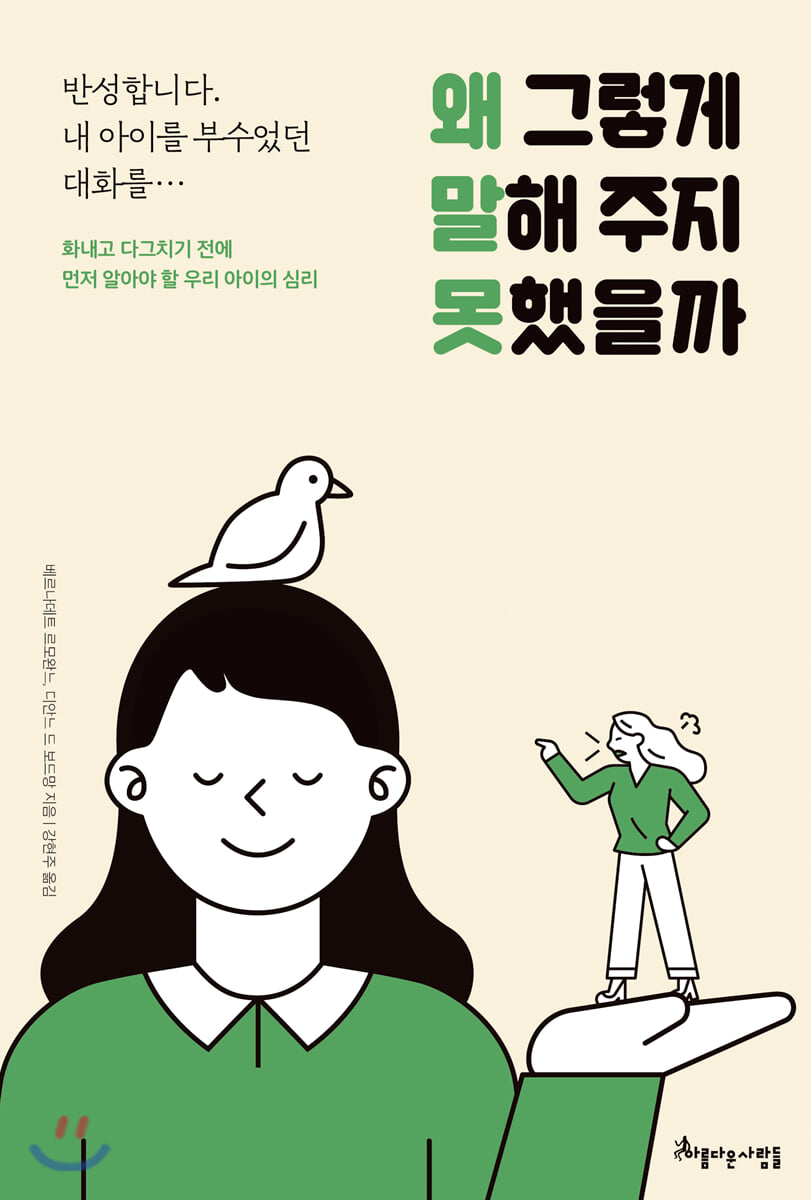
Why couldn't you have told me so?
 |
Description
Book Introduction
Child psychology and parent education expert
A conversation method that reads a child's mind
“Wrongly spoken words wound the soul,” said Plato.
Words have tremendous power, they can empower or suppress abilities.
Depending on whether they are true or false, positive or negative, words can make us happy, give us a sense of security, fill a need, help us grow, give us courage, but they can also make us aggressive, depressed, helpless, or explode with anger.
Providing appropriate, loving advice is a key aspect of raising children, and something parents must learn and master.
The author, a child psychologist, helps children stop the old, wrong conversations that have been destroying them.
We studied and included 'the right way to talk to a child to read their mind' according to the situation and the child's stage of development.
It contains easy-to-follow instructions for any parent on how to listen to their child, speak to them affectionately, and respond, as well as speaking techniques that can help develop their child's self-esteem, social skills, and learning ability.
A conversation method that reads a child's mind
“Wrongly spoken words wound the soul,” said Plato.
Words have tremendous power, they can empower or suppress abilities.
Depending on whether they are true or false, positive or negative, words can make us happy, give us a sense of security, fill a need, help us grow, give us courage, but they can also make us aggressive, depressed, helpless, or explode with anger.
Providing appropriate, loving advice is a key aspect of raising children, and something parents must learn and master.
The author, a child psychologist, helps children stop the old, wrong conversations that have been destroying them.
We studied and included 'the right way to talk to a child to read their mind' according to the situation and the child's stage of development.
It contains easy-to-follow instructions for any parent on how to listen to their child, speak to them affectionately, and respond, as well as speaking techniques that can help develop their child's self-esteem, social skills, and learning ability.
- You can preview some of the book's contents.
Preview
index
Prologue: Reflection.
The conversation that broke my child…
Chapter 1 If I knew how to speak without hurting others
10 Secrets to Raising a Happy Child
3-Step Conversation Method to Improve the Quality of Communication
The essence of conversation is feeling loved
Poisonous Words vs. Powerful Words
If you feel guilty every time you get angry
Consistent speech habits that lead children
First and second, similar yet different discipline techniques
Body language that softens relationships
Chapter 2: Mind-reading conversations that foster self-esteem and social skills
Controlling emotions such as anger and frustration starts with the parents rather than the children.
When you're easily irritated and throwing tantrums, the 3-step rule
Conversation techniques for curious and questioning children
Good words for a child who often complains and sullies
When you're jealous of your siblings, there's a more effective response than scolding them.
Words to stop a child from crying over trivial things
Reassuring a Fearful Child
Words and Actions to Help a Violent Child Find Composure
How to Talk to a Child Who Blames Others
The art of making rules understandable and turning them into habits
Changing the habit of talking back to self-expression
What to do first when you make a big mistake
How to Properly Discipline a Child Who Lies
Techniques for reconciling children when they fight
Raising a child who hates losing without being hated
Warm but firm, never losing control
Completing character education through repetition and habit
Chapter 3: Understanding Your Child's Anxiety Before Scolding
Good things to say when you don't want to sleep alone
Creating sleeping habits is a matter of consistency and determination.
Reassuring words when your child has a nightmare
How to explain when you have a younger sibling
Reassurance when you need to be away from your mom for a while
How to prepare your child for daycare
How to Build Trust with a Child Who Cries and Refuses School
If you need to ask your grandmother or relatives to take care of your child for a long period of time
Good things to say when leaving your child with a babysitter
Child Psychology to Remember When Moving Between Daycare and School
Reading a Child's Anxiety While Preparing for a Move
Things you must explain when your teacher changes
Comforting techniques to reassure a sick child
An eye-level explanation of what you need when you're anxious about a family member's illness
How to explain the death of a family member or close friend
Chapter 4: The Miracle of Warm Words That Change Your Study Attitude
Developing Study Habits for Children Who Hate Homework
Good things to say when your test scores drop
Organizing habits that improve concentration
Economic education starts with autonomous money management.
If you suspect smartphone addiction or internet addiction
How to get students to actively participate in extracurricular activities
How to wake up a child who wakes up late every morning
Correcting the habit of doing something else while preparing for school
The art of encouragement and praise that fosters autonomy
When siblings have different sleeping times
Things to prepare for table manners education
Techniques for Correcting Picky Eating Habits in Children
Get rid of your snacking habit
The meaning of service is not learned from books, but from family life.
Cleanliness education to maintain healthy condition
When and how to start sex education for children
Chapter 5: Cutting Off the Words That Make Your Child's Mind Hell
For shy children, it is a way to express themselves.
For a child who is afraid of failure, confidence
If you are a child who has ever been teased for your physical characteristics,
Encouraging Words to Say When You First Experience Frustration
Self-esteem recovery training to overcome shame and guilt
Understanding the psychology of a child who has been hurt by a friend
What to do first when parents become aware of a situation of ongoing bullying
A new sex education that makes you feel loved
References and footnotes
The conversation that broke my child…
Chapter 1 If I knew how to speak without hurting others
10 Secrets to Raising a Happy Child
3-Step Conversation Method to Improve the Quality of Communication
The essence of conversation is feeling loved
Poisonous Words vs. Powerful Words
If you feel guilty every time you get angry
Consistent speech habits that lead children
First and second, similar yet different discipline techniques
Body language that softens relationships
Chapter 2: Mind-reading conversations that foster self-esteem and social skills
Controlling emotions such as anger and frustration starts with the parents rather than the children.
When you're easily irritated and throwing tantrums, the 3-step rule
Conversation techniques for curious and questioning children
Good words for a child who often complains and sullies
When you're jealous of your siblings, there's a more effective response than scolding them.
Words to stop a child from crying over trivial things
Reassuring a Fearful Child
Words and Actions to Help a Violent Child Find Composure
How to Talk to a Child Who Blames Others
The art of making rules understandable and turning them into habits
Changing the habit of talking back to self-expression
What to do first when you make a big mistake
How to Properly Discipline a Child Who Lies
Techniques for reconciling children when they fight
Raising a child who hates losing without being hated
Warm but firm, never losing control
Completing character education through repetition and habit
Chapter 3: Understanding Your Child's Anxiety Before Scolding
Good things to say when you don't want to sleep alone
Creating sleeping habits is a matter of consistency and determination.
Reassuring words when your child has a nightmare
How to explain when you have a younger sibling
Reassurance when you need to be away from your mom for a while
How to prepare your child for daycare
How to Build Trust with a Child Who Cries and Refuses School
If you need to ask your grandmother or relatives to take care of your child for a long period of time
Good things to say when leaving your child with a babysitter
Child Psychology to Remember When Moving Between Daycare and School
Reading a Child's Anxiety While Preparing for a Move
Things you must explain when your teacher changes
Comforting techniques to reassure a sick child
An eye-level explanation of what you need when you're anxious about a family member's illness
How to explain the death of a family member or close friend
Chapter 4: The Miracle of Warm Words That Change Your Study Attitude
Developing Study Habits for Children Who Hate Homework
Good things to say when your test scores drop
Organizing habits that improve concentration
Economic education starts with autonomous money management.
If you suspect smartphone addiction or internet addiction
How to get students to actively participate in extracurricular activities
How to wake up a child who wakes up late every morning
Correcting the habit of doing something else while preparing for school
The art of encouragement and praise that fosters autonomy
When siblings have different sleeping times
Things to prepare for table manners education
Techniques for Correcting Picky Eating Habits in Children
Get rid of your snacking habit
The meaning of service is not learned from books, but from family life.
Cleanliness education to maintain healthy condition
When and how to start sex education for children
Chapter 5: Cutting Off the Words That Make Your Child's Mind Hell
For shy children, it is a way to express themselves.
For a child who is afraid of failure, confidence
If you are a child who has ever been teased for your physical characteristics,
Encouraging Words to Say When You First Experience Frustration
Self-esteem recovery training to overcome shame and guilt
Understanding the psychology of a child who has been hurt by a friend
What to do first when parents become aware of a situation of ongoing bullying
A new sex education that makes you feel loved
References and footnotes
Detailed image

Into the book
Why does this book focus on parents' appropriate use of words? "Wrongly spoken words wound the soul," said Plato.
For a child to grow well, he or she needs adults who can show him or her the way, give him or her courage, and build trust.
An adult who can show infinite love through sincere words and actions, and warm gaze and attitude.
We are all sensitive to words, whether we are babies, children, or adults.
Words have tremendous power, both empowering and suppressing.
Depending on whether they are true or false, positive or negative, words can make us happy, give us a sense of security, fill our needs, help us grow, and give us courage, but they can also make us aggressive, depressed, helpless, and cause us to explode in anger.
--- From “I reflect on the conversation that broke my child…”
We need to teach children to admit their mistakes after they have done something foolish or lied.
However, parents need to distinguish between the child's existence and the child's behavior.
It's not the child that's bad, it's the child's actions, the child's words.
Then ask your child to repair the relationship he or she has destroyed.
Only by asking for forgiveness can we reconcile and comfort those who have suffered because of our foolish actions, lies, or ill-mannered behavior.
If parents have done something wrong, they should not hesitate to ask their children for forgiveness.
If you feel that you have hurt someone with words you said unintentionally or that you have punished them too harshly.
Asking your child for forgiveness never compromises your authority as a parent.
--- From "If I knew how to speak without hurting others"
Frustration is the feeling we get when we are disappointed, feeling inadequate, dissatisfied, or even unfair.
Frustration often manifests itself in forms such as anger or autism.
The words 'desire' and 'need' are often used interchangeably, so it is important to distinguish between them.
--- From "A Mind-Reading Conversation That Builds Self-Esteem and Sociality"
Psychotherapists say that the majority of difficulties children experience with their children are related to separation anxiety caused by negative experiences.
Why is that? Newborn babies aren't yet completely separated from their mothers.
As the child gradually develops an identity of who he or she is, he or she begins to separate from the mother and gradually distances himself or herself from her.
In this process of distancing, if the separation is too early, too long, or is experienced incorrectly without proper preparation, the child will suffer.
If one bad experience causes a child to perceive every breakup as painful, the moment they break up with someone, they may believe the love is over, feel abandoned, or even feel like they are in serious danger.
For a child to grow well, he or she needs adults who can show him or her the way, give him or her courage, and build trust.
An adult who can show infinite love through sincere words and actions, and warm gaze and attitude.
We are all sensitive to words, whether we are babies, children, or adults.
Words have tremendous power, both empowering and suppressing.
Depending on whether they are true or false, positive or negative, words can make us happy, give us a sense of security, fill our needs, help us grow, and give us courage, but they can also make us aggressive, depressed, helpless, and cause us to explode in anger.
--- From “I reflect on the conversation that broke my child…”
We need to teach children to admit their mistakes after they have done something foolish or lied.
However, parents need to distinguish between the child's existence and the child's behavior.
It's not the child that's bad, it's the child's actions, the child's words.
Then ask your child to repair the relationship he or she has destroyed.
Only by asking for forgiveness can we reconcile and comfort those who have suffered because of our foolish actions, lies, or ill-mannered behavior.
If parents have done something wrong, they should not hesitate to ask their children for forgiveness.
If you feel that you have hurt someone with words you said unintentionally or that you have punished them too harshly.
Asking your child for forgiveness never compromises your authority as a parent.
--- From "If I knew how to speak without hurting others"
Frustration is the feeling we get when we are disappointed, feeling inadequate, dissatisfied, or even unfair.
Frustration often manifests itself in forms such as anger or autism.
The words 'desire' and 'need' are often used interchangeably, so it is important to distinguish between them.
--- From "A Mind-Reading Conversation That Builds Self-Esteem and Sociality"
Psychotherapists say that the majority of difficulties children experience with their children are related to separation anxiety caused by negative experiences.
Why is that? Newborn babies aren't yet completely separated from their mothers.
As the child gradually develops an identity of who he or she is, he or she begins to separate from the mother and gradually distances himself or herself from her.
In this process of distancing, if the separation is too early, too long, or is experienced incorrectly without proper preparation, the child will suffer.
If one bad experience causes a child to perceive every breakup as painful, the moment they break up with someone, they may believe the love is over, feel abandoned, or even feel like they are in serious danger.
--- From "Understanding Your Child's Anxiety Before Scolding"
Publisher's Review
The power of words, rediscovering speaking habits!
I reflect on this.
The conversation that broke my child…
There are no good parents from the beginning.
But anyone can be a good parent.
It's not always easy to stay calm and talk to your child in the midst of a busy daily life.
That's why the author advises that you follow the steps in this book slowly and step by step.
If you want to discover and experience the power of words, it is important to develop good speaking habits.
To help children grow up and clearly express their opinions, act appropriately in each situation, and develop appropriate attitudes, parents must first pay special attention to the words, attitudes, and reactions they give to their children.
This book will be of great help to parents of young children, both linguistically and educationally.
You may have regretted getting angry too easily, saying the wrong thing too quickly, or speaking negatively.
But after encountering this book, you will find yourself astonished, saying, “I can’t believe I kept my composure!” or “I used the right words!”
You will also be proud of the appearance and attitude of your children as they grow up together.
- From the text
Before you get angry and nag
What you need to know about your child's psychology first
As a psychologist and psychotherapist, the author explains in detail how the 'anxiety' that children and adolescents experience in childhood has a significant impact on their growth.
It is truly surprising that if the problem of 'mental anxiety' is not resolved, it can lead to behavioral and learning disabilities.
This book contains very specific conversation techniques on how to apply them in real life, based on the author's experience as a psychotherapist and parent, and the information that parents are most curious about through parent counseling.
Reading the book will naturally give you the confidence to become a good parent.
If you look at the table of contents of the book and start reading from the problem or concern you are most interested in solving at the moment, you will be able to see your child's emotional state and figure out how to best communicate it to them.
Starting today, let's tell our children, "I am loved!" so they can feel it.
I reflect on this.
The conversation that broke my child…
There are no good parents from the beginning.
But anyone can be a good parent.
It's not always easy to stay calm and talk to your child in the midst of a busy daily life.
That's why the author advises that you follow the steps in this book slowly and step by step.
If you want to discover and experience the power of words, it is important to develop good speaking habits.
To help children grow up and clearly express their opinions, act appropriately in each situation, and develop appropriate attitudes, parents must first pay special attention to the words, attitudes, and reactions they give to their children.
This book will be of great help to parents of young children, both linguistically and educationally.
You may have regretted getting angry too easily, saying the wrong thing too quickly, or speaking negatively.
But after encountering this book, you will find yourself astonished, saying, “I can’t believe I kept my composure!” or “I used the right words!”
You will also be proud of the appearance and attitude of your children as they grow up together.
- From the text
Before you get angry and nag
What you need to know about your child's psychology first
As a psychologist and psychotherapist, the author explains in detail how the 'anxiety' that children and adolescents experience in childhood has a significant impact on their growth.
It is truly surprising that if the problem of 'mental anxiety' is not resolved, it can lead to behavioral and learning disabilities.
This book contains very specific conversation techniques on how to apply them in real life, based on the author's experience as a psychotherapist and parent, and the information that parents are most curious about through parent counseling.
Reading the book will naturally give you the confidence to become a good parent.
If you look at the table of contents of the book and start reading from the problem or concern you are most interested in solving at the moment, you will be able to see your child's emotional state and figure out how to best communicate it to them.
Starting today, let's tell our children, "I am loved!" so they can feel it.
GOODS SPECIFICS
- Date of issue: January 15, 2020
- Page count, weight, size: 272 pages | 430g | 142*210*20mm
- ISBN13: 9788965135692
- ISBN10: 8965135699
You may also like
카테고리
korean


korean

![ELLE 엘르 스페셜 에디션 A형 : 12월 [2025]](http://librairie.coreenne.fr/cdn/shop/files/b8e27a3de6c9538896439686c6b0e8fb.jpg?v=1766436872&width=3840)


